
Short Answer
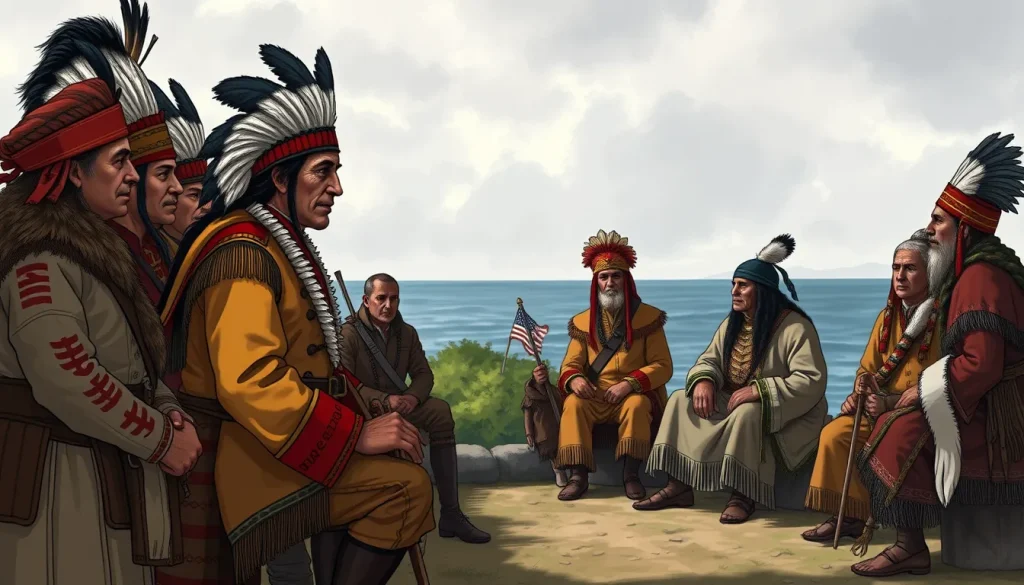
The end of British support for Native Americans after the War of 1812 marks a decisive turning point in North American history. Once indispensable allies in the conflict, Indigenous nations along the Great Lakes and Ohio Valley found themselves abandoned by Great Britain in the decades that followed, allowing the United States to assert uncontested control over vast territories. This reversal, solidified by the Treaty of Ghent in 1814 and Britain’s global strategic recalibration, dismantled the Anglo-Indian alliance and left Native communities vulnerable to removal and displacement.
Historical Context
For generations, Great Britain had cultivated military and economic alliances with Indigenous nations in North America, particularly in the Great Lakes region. These relationships were rooted in the fur trade, mutual defense, and the British desire to create a buffer zone against American westward expansion. The British policy of supporting an Indigenous confederacy as a barrier between the United States and Canada was a recurring theme from the 1760s onward. By the early 1800s, the Shawnee leader Tecumseh and his brother Tenskwatawa had built an intertribal confederation to resist American land cessions, aligning themselves with British interests. In the War of 1812, this alliance proved essential to the defense of Upper Canada, as Indigenous warriors fought alongside British regulars and Canadian militia in critical battles at Detroit, Queenston Heights, and the Thames River. The partnership was, however, never unconditional: Britain’s commitment to Indigenous territorial integrity was largely a matter of imperial self-interest, and it eroded as the war turned against the British.
What Happened
Following the death of Tecumseh at the Battle of the Thames in October 1813, the Indigenous confederacy collapsed, and British reliance on Indian allies became less effective. By late 1814, the British were negotiating at Ghent, and their negotiators initially demanded that the United States recognize Indigenous boundaries and a buffer state, but they soon dropped these demands when the broader peace settlement proved more important. The Treaty of Ghent, signed on December 24, 1814, technically restored pre-war borders and called for the return of lands taken from Indigenous peoples, but it did not guarantee any enforcement mechanism. Britain’s decision to abandon the buffer-state concept was partly a response to American military successes, such as the victories at Lake Erie and the Thames, and partly a reordering of imperial priorities toward the Napoleonic Wars and overseas commerce. After the war, British Indian agents, such as those at Drummond Island, continued to hold councils with Indigenous nations, but these meetings increasingly reflected British withdrawal rather than continued support. By the 1820s, Britain had effectively ended its subsidies and military cooperation with south of the Great Lakes, and many Indigenous communities migrated north to British territory or faced forcible removal by the United States.
Why It Matters
The end of British support had immediate and long-term consequences. In the short term, it shattered the last hope that Indigenous nations could maintain territorial autonomy against American expansion. The United States quickly negotiated treaties that stripped millions of acres from Indigenous tribes, including the Treaty of Fort Jackson in 1814 and the Treaty of Greenville in 1815. In the decades that followed, Andrew Jackson’s policy of Indian removal forcibly relocated eastern tribes to land west of the Mississippi. For Great Britain, the abandonment of Indigenous allies was a strategic recalculation that allowed the empire to focus on other global interests, but it also damaged its reputation as a protector of Indigenous peoples. Historians differ over whether Britain’s abandonment was a deliberate betrayal or an inevitable consequence of the peace settlement, but there is general agreement that it was a devastating blow for Indigenous sovereignty and was central to the larger tragedy of American expansion. The shift in power also influenced the development of Canada, as many Indigenous communities that had fought for the Crown moved north across the border, leaving a lasting legacy in Ontario and the upper Great Lakes.
Definition
The end of British support refers to the cessation of military, diplomatic, and material aid that Great Britain had provided to Indigenous nations in the Great Lakes and Ohio Valley during and before the War of 1812. This aid included arms, supplies, trade goods, and the promise of a buffer state that would protect Indigenous territories from American settlement.
Background
British-Indigenous alliances dated to the colonial era, formalized through treaties such as the Covenant Chain and the Royal Proclamation of 1763, which recognized Indigenous land rights. In the decades before the War of 1812, the British viewed Indigenous confederacies as a necessary counterweight to American expansion. Tecumseh’s confederation, which drew on many nations, was aligned with British interests as a bulwark against the United States. The British supplied arms and provisions, and in return, Indigenous warriors helped defend Upper Canada against American invasions.
How It Worked
The support system operated through British Indian Department officials, fur-traders, and military officers who distributed gifts, weapons, and ammunition to allied communities. In exchange, Indigenous warriors served as scouts, raiders, and frontline fighters. The British also promised to support a permanent Indigenous buffer state, a policy that was never formally announced but was secretly embraced. During the war, this partnership was decisive in early victories, but it was always conditional on British needs. As the war progressed and American forces gained strength, the practical value of the alliance diminished, particularly after Tecumseh’s death and the defeat at the Thames.
Competing Viewpoints
American diplomats and officials after the war claimed that the British continued to incite Indigenous resistance, citing councils at Drummond Island and other posts. British records, however, reveal that these councils were largely despairing and reflected the end of meaningful support. Colin Calloway, in his study of British-Indian relations after 1812, shows that while old connections persisted, the Treaty of Ghent signalled the death knell of the alliance. Some historians argue that Britain’s abandonment was a calculated betrayal of Indigenous allies, while others stress that the treaty’s limitations and Britain’s other obligations made continued support impractical. The debate hinges on whether Britain ever truly intended to uphold the buffer-state idea or used it only as a wartime expedient.
Role in the War of 1812
During the war, British support for Indigenous nations was crucial. Indigenous allies helped capture Fort Detroit and Michilimackinac, participated in the defence of the Niagara Peninsula, and engaged American forces in the Northwest. Tecumseh’s leadership galvanized an intertribal alliance that fought alongside British troops. However, after the Battle of the Thames, the alliance shattered. British military defeats weakened the value of the partnership, and by the negotiations at Ghent, British negotiators were willing to sacrifice Indigenous territorial demands to secure peace.
Consequences and Historical Interpretation
The immediate consequence of the end of British support was the rapid American acquisition of Indigenous lands through coercive treaties. This set the stage for Indian Removal and the eventual destruction of Indigenous sovereignty east of the Mississippi. Historians see this as a turning point that shifted the balance of power overwhelmingly in favour of the United States. For Britain, the decision aligned with its global strategy, but it was a moral failure that left Indigenous allies defenseless. Indigenous communities who had fought for the Crown faced retaliation or were forced to migrate north into British territory (modern Canada), creating new Indigenous communities there. The long-term interpretation is that the War of 1812, despite its ‘status quo ante bellum’ framing, led to a decisive loss for Native Americans and paved the way for transcontinental expansion.
Primary Sources
Relevant primary sources include the Treaty of Ghent itself, which contains provisions about Indigenous lands, and the correspondence of British Indian agents, such as those held at Library and Archives Canada and the British National Archives. American military reports and treaty negotiations, such as those for the Treaty of Fort Jackson, also offer insight. Contemporary accounts from American officers like William Henry Harrison provide the American perspective, while Indigenous voices are recorded in council speeches and diplomatic records, though often filtered through colonial documents. The limitations of these sources include biases and the fact that Indigenous intentions are rarely captured directly.
Further Reading
- Calloway, Colin G., “The End of an Era: British-Indian Relations in the Great Lakes Region after the War of 1812,” Michigan Historical Review, 1986.
- Hall, Anthony J., “Indigenous Title and the War of 1812,” The Canadian Encyclopedia, updated 2022.
- Heidler, David and Jeanne T., “Courting victory: British, Native and American alliances,” National Park Service.
- Braund, Kathryn, “Losing ground: The wages of war in Indian Country,” National Park Service.
- Schilling, Vincent, “Why the War of 1812 Was a Turning Point for Native Americans,” HISTORY, 2022.
References
- Calloway, Colin G., “The End of an Era: British-Indian Relations in the Great Lakes Region after the War of 1812,” Michigan Historical Review, 1986, DOI: 10.2307/20173078.
- Hall, Anthony J., “Indigenous Title and the War of 1812,” The Canadian Encyclopedia, updated 2022, https://www.thecanadianencyclopedia.ca/en/article/aboriginal-title-and-the-war-of-1812.
- Heidler, David and Jeanne T., “Courting victory: British, Native and American alliances,” National Park Service, https://www.nps.gov/articles/courting-victory.htm.
- Braund, Kathryn, “Losing ground: The wages of war in Indian Country,” National Park Service, https://www.nps.gov/articles/losing-ground.htm.
- Schilling, Vincent, “Why the War of 1812 Was a Turning Point for Native Americans,” HISTORY, 2022, https://www.history.com/articles/war-of-1812-native-americans-tecumseh.
FAQ
Why did Britain stop supporting Native Americans after the War of 1812?
Britain withdrew because the war's outcome made continued support impractical, and imperial priorities shifted toward global trade and the Napoleonic aftermath. The United States had won control of the Northwest, and Britain was unwilling to risk another war to protect Indigenous territories.
What was the impact on Indigenous nations?
The end of British support led to rapid loss of land through American treaties, forced migration, and the eventual policy of Indian Removal under President Andrew Jackson. Indigenous communities were left without a powerful ally and faced displacement.
Did the Treaty of Ghent mention Indigenous peoples?
Yes, Article IX of the Treaty of Ghent stated that Indigenous peoples were to be granted the lands they had held before the war and that hostilities against them would cease. However, the treaty had no enforcement mechanism, and Britain did not insist on honoring these terms.


Leave a Reply