
Short Answer
The War of 1812 (1812–1815) placed the United States at war with Great Britain while the Russian Empire, ruled by Tsar Alexander I, was fighting for its survival against Napoleonic France. Russia never entered the Anglo-American war as a belligerent, but it became the first power to offer mediation, received an American peace commission at St. Petersburg, and saw its Baltic trade with the United States disrupted by the British blockade. The episode matters because it produced the first sustained diplomatic contact between Washington and St. Petersburg and helped establish the cordial but limited relationship that historians have called a “distant friendship.”
Historical Context
Russian-American relations before 1812 rested on commerce rather than alliance. From the 1760s onward, Russian hemp, bar iron, sailcloth, and cordage reached North American ports, while American ships carried sugar, coffee, rice, tobacco, and cotton to St. Petersburg and other Baltic ports; American vessels performed the great majority of this carrying trade. Catherine the Great’s Declaration of Armed Neutrality (1780) asserted that neutral ships might trade freely, a principle the United States later made a cornerstone of its foreign policy, and during the American Revolution Catherine refused British requests for military help while declining openly to back the rebels.
Formal diplomacy came later. Russia extended recognition to the United States in 1803; John Quincy Adams presented his credentials as American minister at St. Petersburg in 1809, while Andrey Dashkov represented Russian interests at Washington. Some accounts date the establishment of formal ties to 1807 and others to 1809, a discrepancy that reflects the gradual, trade-driven growth of the relationship rather than a single founding moment.
Two European developments framed the war. Britain’s maritime policy—impressment from neutral vessels, broad search powers, and the Orders in Council of 1807—damaged Russian commerce as well as American, giving St. Petersburg and Washington a shared grievance over neutral rights. Yet Russia’s own position toward Britain was shifting: after the Treaty of Tilsit (1807) Russia was briefly at war with Britain, a conflict ended by the Anglo-Russian agreement at Örebro in July 1812, weeks after the American declaration of war. Russia thus fought Napoleon as Britain’s ally throughout the Anglo-American war, which limited how far it could support American claims against London. Napoleon’s invasion of Russia began in June 1812, and Alexander I wanted British power concentrated in Europe.

What Happened
Congress declared war on Great Britain on June 18, 1812. Some Republican supporters expected that Britain, already entangled with Napoleon, would concede quickly; instead the Madison administration began hunting for a negotiated exit almost at once. As the National Park Service’s account of the peace negotiations puts it, Madison observed that “the sword was scarcely out of the scabbard before the enemy was apprised of the reasonable terms on which it would be resheathed.” Britain’s repeal of the Orders in Council, decided in June 1812 but unknown in Washington for weeks, removed one grievance; London nonetheless refused to renounce impressment.
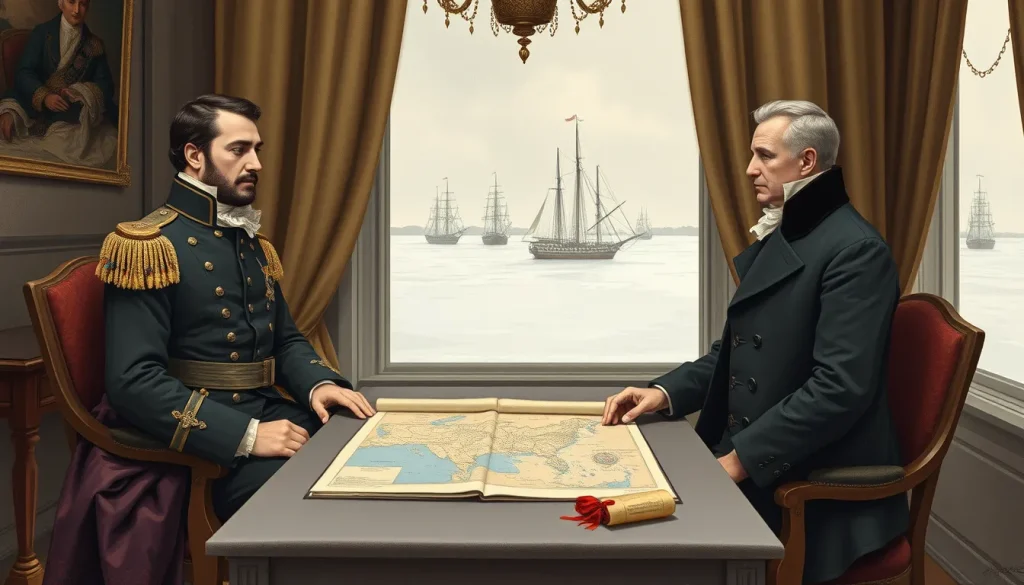
The Russian opening came in the autumn of 1812, when Russian intermediaries signaled a willingness to help end the Anglo-American war. Alexander I had an obvious interest: peace in North America would free British resources for the struggle against Napoleon. A formal offer of mediation followed in 1813, communicated to the Madison administration through Russia’s minister at Washington. Madison accepted and nominated a peace commission that included Albert Gallatin, John Quincy Adams, and James A. Bayard. Adams was already serving at St. Petersburg; Gallatin and Bayard reached the Russian capital in the summer of 1813 and waited there for months while London deliberated.
Britain declined Russian mediation. Its foreign secretary maintained that no British government could survive a renunciation of impressment, and London preferred direct talks with the United States to negotiation through a third party whose interests were bound up with its own war effort. Direct Anglo-American negotiations opened at Ghent in the summer of 1814 and produced the Treaty of Ghent, signed on December 24, 1814. Russia had no seat at the table but welcomed the settlement; the American commissioners at Ghent included men who had first been sent to St. Petersburg.
The war also disrupted the commerce that sustained the relationship. American shipping to Baltic Russia had prospered during the Napoleonic wars, when neutral vessels carried colonial goods into Russian markets; the British blockade and the Anglo-American war closed much of that traffic. In the Pacific, the Russian-American Company’s Alaskan colonies relied on shipping, supplies, and fur sales that frequently involved American merchants, and the wartime sale of John Jacob Astor’s post at Astoria to the British North West Company in 1813 complicated those arrangements.
Why It Matters
In the short term, the war demonstrated both the value and the limits of Russian goodwill. Russia offered diplomatic assistance no other power attempted and never moved toward hostility with Washington, but it would not press Britain against British interests while Britain remained its indispensable ally against Napoleon. For the United States, the Russian offer kept a diplomatic channel open during the discouraging first year of the war.
Over the longer term, the relationship survived the conflict without rupture and resumed its commercial character after 1815: American vessels returned to Baltic ports, a Russo-American convention on the Pacific Northwest followed in 1824, and a commercial treaty in 1832. Historian Paul Behringer has described early U.S.-Russian relations as a “distant friendship”—warm in tone, rooted in trade and shared resentment of British maritime power, but geographically and culturally remote. Historians differ over how much weight to give the war itself: some treat the mediation episode as an early sign of durable alignment, while others, noting that Russia acted from European strategic necessity and that Britain rejected its offer, regard it as a limited and largely symbolic gesture.
Definition
This article treats “U.S.-Russian relations” as the diplomatic, commercial, and informal contacts between the United States and the Russian Empire between roughly 1812 and 1815, together with their prewar foundations and postwar consequences. It does not address twentieth-century Soviet-American relations, which belong to a different period and political context.
Background
The two governments approached the war from opposite directions. The United States wanted an end to impressment and to restrictions on neutral trade; Russia wanted neutral commerce protected in principle and, more urgently, wanted Britain free to fight Napoleon. Both had quarreled with British maritime practice, and both had an interest in the doctrine of free ships, free goods. Their interests converged on the value of peace, not on its terms.
How It Worked
Mediation in this period was an offer, not an obligation: a third power proposed its good offices, and both belligerents had to accept before talks could proceed. Russia’s initiative therefore ran through ordinary diplomatic channels—Russia’s representative in Washington conveyed the proposal, and the American commissioners traveled to St. Petersburg prepared to negotiate. When Britain refused, the mechanism collapsed and the conflict reverted to direct negotiation. Alongside diplomacy, the commercial relationship operated through neutral shipping, consuls, and merchant houses in St. Petersburg and New England, and, in the Pacific, through agreements between the Russian-American Company and American traders.
Competing Viewpoints
Historians disagree on three points. First, was Russian mediation sincere? One view emphasizes Alexander I’s interest in arbitration and maritime law; another stresses that Russia’s motive was to redirect British power toward France. Second, did mediation matter? Some scholars argue that the American commission at St. Petersburg kept peace diplomacy alive and eased the way toward Ghent; others note that Britain’s refusal meant the Russian initiative had little influence on the terms finally reached. Third, did the war bring the two countries closer? Behringer’s “distant friendship” suggests that the affinity was real but thin, resting on trade and shared grievances rather than deep attachment, and that later rivalry over the Pacific and divergent ideologies would strain it.
Role in the War of 1812
Russia was a neutral with a stake in the outcome, not a participant. It did not declare war on the United States, its ships did not fight American or British forces in the Anglo-American conflict, and it signed no treaty with either side. Its role was confined to diplomacy—the mediation offer of 1812–1813 and the reception of the American peace commission—and to the indirect effects of its alliance with Britain and of wartime disruption on Russian-American commerce.
Consequences and Historical Interpretation
The most durable consequence was negative but important: nothing happened. Relations were not severed, no Russian-American hostility developed, and the trading connection revived after 1815. The American practice of seeking European mediation, first tested with Russia, recurred in later diplomacy. Interpretations of the episode have shifted with the times: nineteenth-century American writers often presented Russian mediation as evidence of Russian friendship, while later historians have been more skeptical, stressing Russian self-interest, the shallowness of the relationship, and the fact that the peace was concluded in Belgium rather than St. Petersburg.
Primary Sources
- Russian offer of mediation (1812–1813). Conveyed to the Madison administration through Russia’s minister at Washington, Andrey Dashkov, with supporting correspondence from Alexander I’s government. It shows how St. Petersburg presented its initiative as a service to peace; as diplomatic language, it does not state Russia’s strategic motive openly.
- Madison’s nomination of the peace commission (1813). The president’s message to the Senate naming Gallatin, Adams, and Bayard documents American acceptance of mediation. It records intent rather than results.
- John Quincy Adams’s diary and dispatches from St. Petersburg. Adams, American minister in Russia from 1809, recorded negotiations and impressions in a diary published by the Massachusetts Historical Society. The entries are detailed but reflect a politically engaged and often critical observer.
- Albert Gallatin’s correspondence (1813–1814). Gallatin’s letters describe the commissioners’ long wait in Russia and their frustration when Britain declined. They are personal and partial in perspective.
- British diplomatic correspondence refusing mediation. London’s stated position—that no British ministry could renounce impressment—is summarized in the National Park Service’s account of the peace negotiations and appears in British foreign office papers.
- Contemporary newspapers. American papers such as Niles’ Weekly Register reported the Russian offer and the peace negotiations for a partisan public; their accounts mix information with speculation.
No verified transcript of the Russian mediation offer is reproduced here. Readers should consult U.S. diplomatic correspondence held by the National Archives and Records Administration and the published Adams papers at the Massachusetts Historical Society.
Further Reading
- Ahonen, Kalevi. From Sugar Triangle to Cotton Triangle: Trade and Shipping between America and Baltic Russia, 1783–1860. University of Jyväskylä, 2005.
- Behringer, Paul. “US-Russian Relations before 1917.” Oxford Research Encyclopedia of American History, 2024.
- Hickey, Donald R. The War of 1812: A Forgotten Conflict. University of Illinois Press (multiple editions).
- Kaplan, Fred. John Quincy Adams: American Visionary. New York: Harper, 2014.
- Stagg, J. C. A. Mr. Madison’s War. Princeton University Press.
- Massachusetts Historical Society, Diary of John Quincy Adams (digital edition).
- National Park Service, “Republicans hope to win concessions with minimal bloodshed,” War of 1812 resources.
- U.S. National Archives and Records Administration, diplomatic correspondence of U.S. ministers to Russia.
References
- Wheeler, Michael. “Managing the Transition from Ally to Adversary: Reflections on an Earlier Era of U.S.-Russian Relations.” Report, Lawrence Livermore National Laboratory, 2017. https://doi.org/10.2172/1424602
- National Park Service. “Republicans hope to win concessions with minimal bloodshed.” https://nps.gov/articles/winning-the-peace.htm
- Behringer, Paul. “US-Russian Relations before 1917.” Oxford Research Encyclopedia of American History, 2024. https://doi.org/10.1093/acrefore/9780199329175.013.1101
- Ahonen, Kalevi. From Sugar Triangle to Cotton Triangle: Trade and Shipping between America and Baltic Russia, 1783–1860. University of Jyväskylä, 2005. http://urn.fi/URN:ISBN:951-39-2184-0
- “Russian Empire–United States relations.” Wikipedia. Tertiary overview used only for basic chronology of recognition and diplomatic representation. https://en.wikipedia.org/wiki/Russian_Empire%E2%80%93United_States_relations
FAQ
Did Russia fight in the War of 1812?
No. Russia remained neutral in the Anglo-American war and took no military part in it. It did offer mediation in 1812–1813, an offer the United States accepted and Britain declined, and its ships did not engage American or British forces in that conflict.
Why did Tsar Alexander I offer to mediate between the United States and Britain?
Alexander I wanted the Anglo-American war ended so that British naval and military resources could be concentrated against Napoleon, who had invaded Russia in June 1812. Russia also had a longstanding interest in protecting neutral commerce from British search and seizure, a grievance it shared with the United States.
Did the War of 1812 damage U.S.-Russian relations?
It did not produce a lasting rupture. Diplomatic relations continued, Russia's mediation offer kept a channel open during the first year of the war, and trade resumed after 1815. The main wartime damage was commercial, as the British blockade and the war itself cut American shipping to Baltic Russia.


Leave a Reply