Short Answer
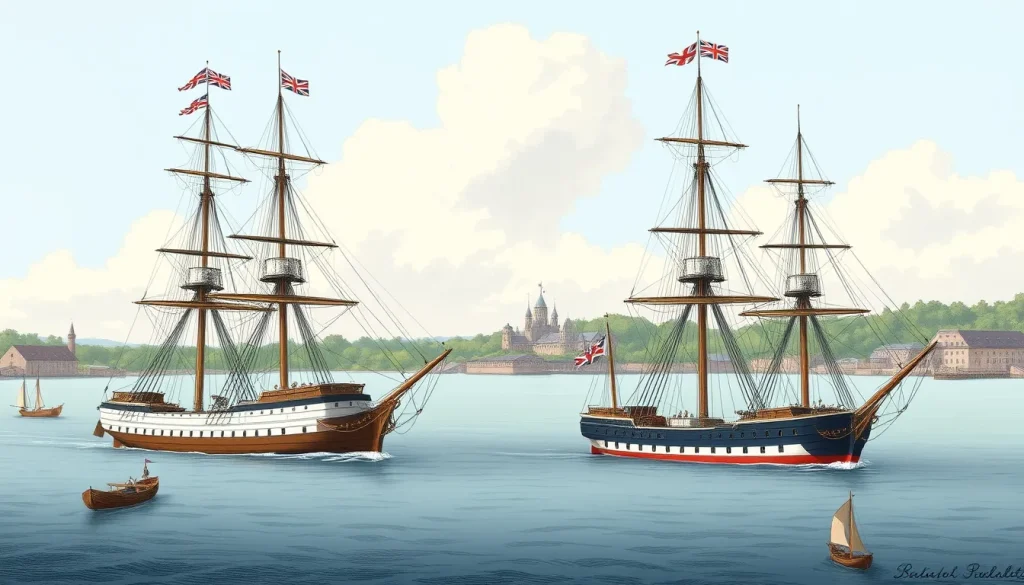
HMS Prince Regent and HMS Princess Charlotte were British frigates built at the Kingston Royal Naval Dockyard in Upper Canada and launched in April 1814 for service on Lake Ontario during the War of 1812. They were among the most powerful British warships on the lake until the completion of HMS St. Lawrence later that year, and they served in Commodore James Lucas Yeo’s squadron during the Anglo-American contest for control of the lake. Their construction, service, and eventual sinking in Kingston Harbour illustrate the scale of the wartime naval arms race on the Great Lakes and the postwar disarmament that followed the Rush-Bagot Agreement.
Historical Context
During the War of 1812, Lake Ontario was a strategic corridor for both the United States and Britain. Control of the lake enabled the movement of troops, supplies, naval stores, and messages between Kingston, York (now Toronto), the Niagara frontier, and the St. Lawrence River. The British base at Kingston, Upper Canada, and the American base at Sackets Harbor, New York, faced each other across the lake. After the United States declared war in June 1812, both sides recognized that naval superiority on Lake Ontario could determine the fate of the province of Upper Canada and the Niagara campaign.
In the winter of 1812-13, British forces took over the Kingston naval base and began expanding the dockyard. Commodore James Lucas Yeo assumed command of the British squadron in May 1813. His strategy depended on maintaining naval superiority in numbers of ships and firepower, which meant an ongoing shipbuilding race with the Americans under Commodore Isaac Chauncey at Sackets Harbor. Master shipbuilders were recruited from Quebec, and hundreds of carpenters and laborers worked at Kingston. Oak and elm beams were purchased locally, while cannon and other equipment were brought across the Atlantic and then carried by packet boat and portage up the St. Lawrence River. The ships were designed with narrower V-shaped hulls to increase speed in fresh water, and their firepower was maximized by fitting as many cannon as possible. The term “superfrigate” is not a formal Royal Navy rating; on Lake Ontario it describes frigates that were unusually large and heavily armed for the lake and that outclassed the sloops and brigs used earlier in the war.
What Happened
Shipbuilding at Kingston accelerated through 1813 and 1814. Between 1813 and 1817, at least ten ships were built in the Kingston dockyards. In April 1814, HMS Prince Regent and HMS Princess Charlotte were launched. Parks Canada states that Princess Charlotte carried 40 guns and Prince Regent carried 58; some naval references list them as 42 and 56 guns, respectively, reflecting different methods of counting long guns and carronades. They joined Yeo’s squadron on Lake Ontario and became central to British operations.
In May 1814, the British squadron supported a raid on Oswego, New York. The operation captured Fort Ontario and a large quantity of military stores. The frigates also took part in transport, escort, and blockade duties. In September 1814, HMS St. Lawrence, a 102-gun ship, was completed and launched at Kingston. It was the largest and most heavily armed warship of its time on fresh water, and its appearance gave the British clear ascendancy on Lake Ontario without having to fight a major fleet action. The American squadron at Sackets Harbor remained largely inactive, and Chauncey declined to risk a general engagement against the reinforced British fleet.
After the Treaty of Ghent ended the war in December 1814, the ships were no longer needed. The Rush-Bagot Agreement of 1817 provided for disarmament on the Great Lakes. Prince Regent and Princess Charlotte were laid up at Kingston and eventually sank in Deadman Bay. In 2014, Parks Canada designated the wrecks of Prince Regent, Princess Charlotte, and St. Lawrence as the War of 1812 Shipwrecks National Historic Site of Canada.
Why It Matters
The two frigates mattered immediately because they helped Britain maintain naval superiority on Lake Ontario. That superiority protected British supply routes, supported land operations, and limited American options on the Niagara frontier and along the St. Lawrence. In the longer term, the ships represent the scale of the Great Lakes arms race. The Kingston shipbuilding program mobilized skills, supplies, and labor from British North America and Britain, and it demonstrated how quickly the Royal Navy could adapt to inland waters. The wrecks are now archaeological resources that attest to that mobilization and to the magnitude of the contest.
Historians disagree about how decisive the Lake Ontario naval race was. Robert Malcomson and others argue that naval control of Lake Ontario was crucial in preventing American invasions and in shaping the military stalemate that influenced the peace. Other scholars emphasize that the war ended before the fleets could decide the issue in a major battle, and that the shipbuilding race was enormously expensive for both sides. The British frigates never fought a large fleet action, but their presence helped deter American naval initiative. Their postwar fate also illustrates the rapid disarmament that followed the Rush-Bagot Agreement, which demilitarized the Great Lakes and became a lasting feature of Canada-United States relations.
Type and Construction
Both vessels were frigates built at the Kingston Royal Naval Dockyard in Upper Canada. They were constructed with narrow, V-shaped hulls intended to improve speed on Lake Ontario, using local oak and elm and fitting as many cannon as possible. Prince Regent was the larger of the two; Princess Charlotte was smaller but still a major warship for the lake. Their construction was part of a rapid mobilization of shipwrights, carpenters, and laborers from Quebec, Upper Canada, and Britain. The term “superfrigate” is informal; in the context of Lake Ontario, it denotes a frigate larger and more heavily armed than the sloops and brigs that had dominated the lake earlier in the war.
Nation
Both ships belonged to the United Kingdom and served the Royal Navy in British North America. Their base was the Kingston naval establishment in Upper Canada, now Kingston, Ontario. They operated alongside vessels of the Provincial Marine and Royal Navy on Lake Ontario.
Armament
Parks Canada states that HMS Princess Charlotte was launched with 40 guns and HMS Prince Regent with 58. Other naval references sometimes list Prince Regent as a 56-gun frigate and Princess Charlotte as a 42-gun frigate. The difference reflects how long guns, carronades, and other ordnance were counted in various returns. Their batteries were designed to maximize firepower within the limits of lake construction and available materials. The arrival of HMS St. Lawrence with 102 guns later in 1814 surpassed both.
Crew
Exact crew complements for Prince Regent and Princess Charlotte are not consistently recorded in the readily available Parks Canada material. As frigates of their size, they would have required several hundred officers, sailors, marines, and artificers. Crews on the Great Lakes were often supplemented by local labor, soldiers, and sailors drawn from the Atlantic squadron. Precise numbers varied with armament, stores, and operational needs.
Commander
On Lake Ontario, the British squadron was commanded by Commodore James Lucas Yeo from May 1813. HMS Prince Regent was commanded in 1814 by Captain Richard O’Conor, and HMS Princess Charlotte by Captain William Howe Mulcaster. Both officers served under Yeo during the 1814 campaign. Command arrangements could change with illness, wounds, and transfers.
Engagements
The two frigates took part in British operations on Lake Ontario in 1814, most notably the raid on Oswego, New York, in May 1814, where the squadron captured Fort Ontario and military stores. They also supported blockade, escort, and transport duties. After HMS St. Lawrence joined the squadron in September 1814, the British held clear naval superiority, but the American squadron under Commodore Isaac Chauncey declined a major fleet action. No large ship-to-ship battle involving Prince Regent and Princess Charlotte occurred before the war ended.
Fate
After the War of 1812, the Rush-Bagot Agreement of 1817 provided for disarmament on the Great Lakes. Prince Regent and Princess Charlotte were no longer needed, were laid up at Kingston, and eventually sank in Deadman Bay. Their wrecks, along with that of HMS St. Lawrence, were designated the War of 1812 Shipwrecks National Historic Site of Canada in 2014. They remain underwater archaeological sites in Kingston Harbour.
Primary Sources
Contemporary evidence for these ships comes from Royal Navy administrative and operational records. Captain’s logs, muster books, and letters from the Lake Ontario squadron document construction, armament, and service. Commodore James Lucas Yeo’s dispatches to the Admiralty report operations such as the Oswego raid. American sources, including Commodore Isaac Chauncey’s correspondence, provide an opposing perspective on British movements and capabilities. Kingston dockyard records and Admiralty papers in The National Archives (UK) and Library and Archives Canada are important. These sources have limitations: official dispatches often emphasize success and omit losses or delays; logs are terse; and accounts from each side may differ on numbers and outcomes. No verified verbatim transcript is reproduced here because the exact wording of relevant documents is not available in the supplied research context.
Further Reading
- Parks Canada, War of 1812 Shipwrecks National Historic Site of Canada, Canadian Register of Historic Places. https://www.pc.gc.ca/apps/DFHD/page_nhs_eng.aspx?id=14212
- Parks Canada, War of 1812 Shipwrecks, Backgrounder, Canada.ca. https://www.canada.ca/en/parks-canada/news/2017/10/war_of_1812_shipwrecks.html
- Robert Malcomson, Lords of the Lake: The Naval War on Lake Ontario, 1812-1814 (Toronto: Robin Brass Studio, 1998).
- William S. Dudley, ed., The Naval War of 1812: A Documentary History, vol. 3 (Washington, DC: Naval Historical Center, 2002).
- Library and Archives Canada, War of 1812 records and Kingston naval dockyard materials.
References
- Parks Canada. War of 1812 Shipwrecks National Historic Site of Canada. Canadian Register of Historic Places. https://www.pc.gc.ca/apps/DFHD/page_nhs_eng.aspx?id=14212
- Parks Canada. War of 1812 Shipwrecks. Backgrounder, Canada.ca, October 10, 2017. https://www.canada.ca/en/parks-canada/news/2017/10/war_of_1812_shipwrecks.html
- Malcomson, Robert. Lords of the Lake: The Naval War on Lake Ontario, 1812-1814. Toronto: Robin Brass Studio, 1998.
- Dudley, William S., ed. The Naval War of 1812: A Documentary History. Vol. 3. Washington, DC: Naval Historical Center, 2002.
FAQ
What were HMS Prince Regent and HMS Princess Charlotte?
They were British frigates built at the Kingston Royal Naval Dockyard in Upper Canada and launched in April 1814 for service on Lake Ontario during the War of 1812.
Did HMS Prince Regent and HMS Princess Charlotte fight in a major battle?
They supported operations such as the May 1814 raid on Oswego, New York, and blockade duties, but no large ship-to-ship fleet action involving them occurred before the war ended.
What happened to HMS Prince Regent and HMS Princess Charlotte after the war?
After the Rush-Bagot Agreement of 1817, they were laid up at Kingston and eventually sank in Deadman Bay. Their wrecks are part of the War of 1812 Shipwrecks National Historic Site of Canada, designated in 2014.


Leave a Reply