
Short Answer
USS Constitution was a 44-gun United States Navy frigate that played a prominent and symbolic role in the War of 1812. Between 1812 and 1815, she conducted commerce-raiding cruises, escaped a British squadron, and defeated the British frigates HMS Guerriere and HMS Java and later HMS Cyane and HMS Levant. Her service did not break the British blockade or decide the war, but it boosted American morale, demonstrated the power of the large American frigate design, and gave the ship the enduring nickname Old Ironsides.
Historical Context
The War of 1812 grew out of maritime and imperial tensions between the United States and Great Britain. American grievances included impressment of sailors from American merchant vessels, British Orders in Council that restricted neutral trade, and British support for Indigenous resistance to American expansion in the Northwest. The United States declared war on June 18, 1812, hoping to pressure Britain by invading Canada and by attacking British shipping.
At sea, the United States faced the Royal Navy, the world’s most powerful fleet. The U.S. Navy had only about sixteen warships in 1812, compared with roughly five hundred British ships in service. American naval strategy therefore emphasized commerce raiding and single-ship actions rather than fleet battle. USS Constitution was one of six frigates authorized by the Naval Act of 1794 and designed by Joshua Humphreys. Launched in Boston in 1797, she was larger, more heavily built, and more powerfully armed than standard British frigates of similar rating. After an overhaul at the Washington Navy Yard, she was ready for sea when war began.
What Happened
In June 1812, Captain Isaac Hull took Constitution to Annapolis to finish fitting out and drill the crew. On July 5, she sailed down the Chesapeake and into the Atlantic to join Commodore John Rodgers’s squadron. On July 17, lookouts sighted ships that Hull first took for Rodgers’s command, but they proved to be a British squadron. In the famous Great Race of July 17-19, Constitution escaped off the New Jersey coast by lightening ship, wetting sails, towing with boats, and kedging in calm air. The escape preserved one of the U.S. Navy’s most valuable frigates.
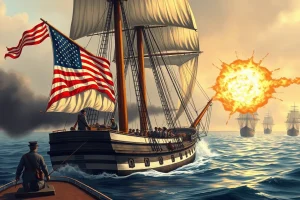
On August 19, 1812, Constitution met HMS Guerriere, a British frigate commanded by Captain James Richard Dacres, south of Halifax. In a close action, Constitution’s heavier guns and sturdier hull gave her the advantage. British round shot reportedly struck and rebounded from Constitution’s side, prompting the nickname Old Ironsides. Guerriere was dismasted and forced to surrender; she was later burned and sunk. American casualties were light compared with British losses, though accounts differ in detail.
On December 29, 1812, under Captain William Bainbridge, Constitution defeated HMS Java off the coast of Brazil near Bahia. Java was also dismasted and captured, then burned. Bainbridge was wounded in the action. The victory reinforced the reputation of American frigates and shocked British naval opinion.
In 1813 and 1814, Constitution cruised against British commerce and was periodically blockaded in port. Under Captain Charles Stewart, she captured the British schooner Pictou in February 1814 and took merchant prizes. On February 20, 1815, Constitution fought HMS Cyane and HMS Levant in the Atlantic. Although the Treaty of Ghent had been signed in December 1814, news of peace had not yet reached the combatants. Stewart engaged both British ships, captured them after a hard fight, and then escaped when a British squadron appeared. The action was one of the war’s last significant naval victories.
Why It Matters
Constitution’s wartime role was more important for morale and naval reputation than for decisive strategy. The United States could not challenge Britain’s blockade or fleet superiority, and Constitution spent part of the war confined to port. Yet her victories gave Americans proof that their young navy could defeat British frigates in single combat. They also validated the Humphreys-designed frigates, which combined heavy timbers, powerful armament, and fast sailing qualities.
For Britain, the losses of Guerriere and Java were embarrassing, though not strategically crippling. British naval authorities continued to control the Atlantic and to blockade much of the American coast. Historians generally agree that Constitution’s successes did not win the war. Some emphasize their psychological and political value; others stress that they were exceptions within a broader story of British naval dominance. In the longer term, Old Ironsides became a symbol of American sea power and national endurance. She was saved from breaking up in the 1830s, restored several times, and remains a commissioned U.S. Navy warship and museum at the Charlestown Navy Yard in Boston.
Type and Construction
USS Constitution is a wooden-hulled, three-masted frigate. She was rated for 44 guns, though her actual armament varied. Her overall length was about 204 feet, her beam about 43 feet 6 inches, and her displacement roughly 2,200 tons. Joshua Humphreys designed her and her sister frigates with thick oak planking, diagonal riders, and copper fastenings to create a hull strong enough to carry heavy guns and absorb punishment. She was built at Edmund Hartt’s shipyard in Boston and launched on October 21, 1797.
Nation
Constitution served the United States. She was one of the six original frigates authorized by Congress in 1794 to protect American commerce and to give the new republic a credible naval force. During the War of 1812, she operated under the authority of the United States Navy and the Secretary of the Navy.
Armament
In the War of 1812, Constitution typically carried about 30 long 24-pounder cannon on her gun deck, 22 32-pounder carronades on her spar deck, and two long 18-pounder chase guns. This gave her a heavy broadside for a frigate. British frigates of similar rate often carried 18-pounder long guns, so Constitution could both hit harder at close range and sustain damage from larger shot. Her exact armament changed over time as guns were replaced or redistributed.
Crew
Constitution’s crew numbered roughly 450 officers and men, and sometimes more than 500 when fully manned. The crew included American sailors, foreign-born seamen, and some free Black sailors, reflecting the diverse maritime labor force of the early United States. Service aboard a frigate involved gunnery, sail handling, ship maintenance, and long periods of cramped and dangerous duty.
Commander
Constitution’s principal War of 1812 commanders were Captain Isaac Hull, who commanded during the escape from the British squadron and the victory over HMS Guerriere; Captain William Bainbridge, who commanded during the defeat of HMS Java; and Captain Charles Stewart, who commanded later cruises and the capture of HMS Cyane and HMS Levant. Their official reports, along with British captains’ accounts, are central sources for the ship’s wartime operations.
Engagements
Constitution’s major wartime actions included the Great Race against a British squadron in July 1812; the defeat of HMS Guerriere on August 19, 1812; the defeat of HMS Java on December 29, 1812; the capture of the schooner Pictou in February 1814; and the defeat and capture of HMS Cyane and HMS Levant on February 20, 1815. She also took numerous merchant prizes during her cruises.
Fate
Constitution survived the War of 1812 and remained in U.S. Navy service. She later served as a flagship, training ship, and receiving ship. Public pressure and naval interest saved her from being broken up in the 1830s, and she underwent major restorations in the nineteenth, twentieth, and twenty-first centuries. She is preserved at the Charlestown Navy Yard in Boston, Massachusetts, as the oldest commissioned warship afloat and as a museum ship.
Primary Sources
Several contemporary sources document Constitution’s role. Captain Isaac Hull’s official report to Secretary of the Navy Paul Hamilton, written after the Guerriere action in August 1812, describes the battle from the American command perspective. Captain James Richard Dacres’s British report offers a different account of the same engagement. Captain William Bainbridge’s report on the Java victory in early 1813 and Captain Charles Stewart’s report on the Cyane and Levant action in 1815 are also important. The ship’s logbooks record weather, position, sail handling, and daily operations. Newspapers such as Niles’ Weekly Register reprinted reports and letters, spreading news of the victories to a broad public.
These sources have limitations. Official reports were written to justify commanders’ decisions, to claim credit, and to shape public opinion. Casualty figures and damage assessments often varied between American and British accounts. Logbooks are factual but terse. Newspapers could be partisan or inaccurate. Historians therefore compare American and British reports, logs, and later correspondence to reconstruct events.
Further Reading
- Cutler, Thomas J. ‘Old Ironsides.’ Naval History Magazine, June 2023.
- Dudley, William S., ed. The Naval War of 1812: A Documentary History. 3 vols. Naval Historical Center, 1985-2002.
- Hickey, Donald R. The War of 1812: A Forgotten Conflict. University of Illinois Press.
- Latimer, Jon. 1812: War with America. Harvard University Press, 2007.
- Toll, Ian W. Six Frigates: The Epic History of the Founding of the U.S. Navy. W. W. Norton, 2006.
- USS Constitution Museum. ‘War of 1812 Overview (1812-1815).’
References
- USS Constitution Museum. ‘War of 1812 Overview (1812-1815).’ https://ussconstitutionmuseum.org/major-events/war-of-1812-overview/.
- Cutler, Thomas J. ‘Old Ironsides.’ Naval History Magazine 37, no. 3 (June 2023). https://www.usni.org/magazines/naval-history-magazine/2023/june/old-ironsides.
- Naval History and Heritage Command. ‘USS Constitution.’ https://www.history.navy.mil/browse-by-topic/ships/traditional-sail/constitution.html.
- Toll, Ian W. Six Frigates: The Epic History of the Founding of the U.S. Navy. New York: W. W. Norton, 2006.
- Hickey, Donald R. The War of 1812: A Forgotten Conflict. Urbana: University of Illinois Press, 1989.
- Dudley, William S., ed. The Naval War of 1812: A Documentary History. 3 vols. Washington, DC: Naval Historical Center, 1985-2002.
FAQ
What role did USS Constitution play in the War of 1812?
She served as a U.S. Navy frigate and commerce raider, escaped a British squadron in July 1812, and won single-ship victories over HMS Guerriere, HMS Java, HMS Cyane, and HMS Levant. Her successes boosted American morale but did not break British naval dominance.
Why was USS Constitution called Old Ironsides?
During the August 19, 1812 battle with HMS Guerriere, British round shot reportedly struck Constitution’s heavy oak hull and fell away. The sight led to the nickname Old Ironsides, which became permanent.
Did USS Constitution’s victories win the War of 1812?
No. Her victories were important for morale and naval reputation, but Britain maintained its blockade and naval superiority. The war ended with the Treaty of Ghent, which restored the status quo ante bellum.

Leave a Reply