Short Answer
African American soldiers, sailors, and laborers played a significant but often overlooked role in the War of 1812 (1812–1815). Both free blacks and enslaved individuals served on the American and British sides, driven by promises of freedom, citizenship, or necessity. Their contributions were vital in battles from Lake Erie to New Orleans, yet their stories have been largely ignored in mainstream histories.
Historical Context
In the early 1800s, the United States and Great Britain were locked in a diplomatic and military struggle over maritime rights, impressment, and territorial expansion. The Chesapeake–Leopard affair of 1807, during which British officers impressed four African American sailors from the USS Chesapeake, highlighted the fragility of black freedom and citizenship. The 1792 federal militia act delegated military service to the states, many of which restricted service to free white men; African Americans were ambiguously excluded or barred altogether. As war approached, the British actively enticed enslaved people to escape and join their forces, promising freedom, while American authorities reluctantly turned to black volunteers to fill military shortages.
What Happened
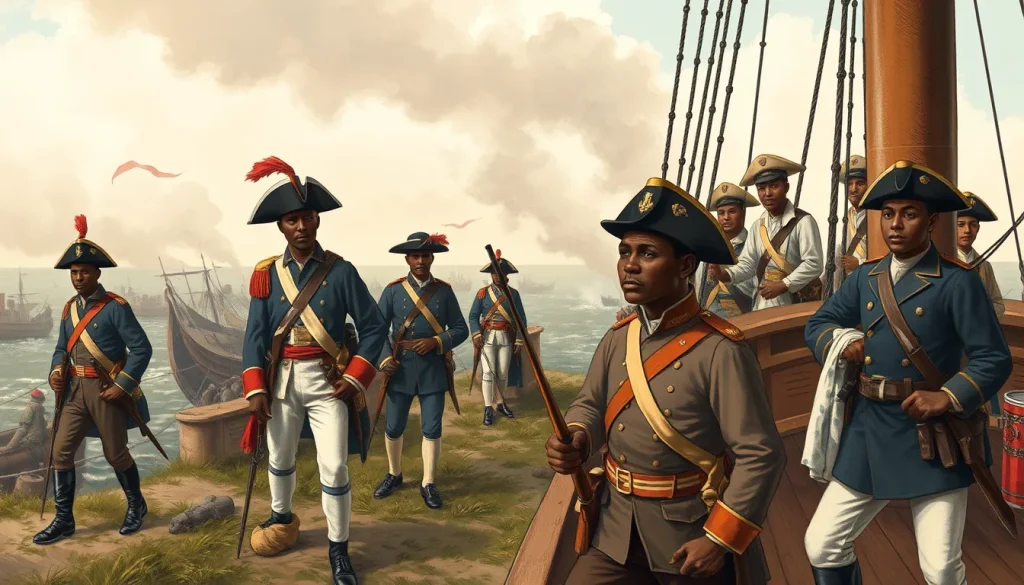
African Americans participated in the War of 1812 in a variety of roles. In the Royal Navy, thousands of black sailors served, often escaping bondage and finding relative liberty at sea. The British also organized the Colonial Marines, a corps of formerly enslaved men recruited in the Chesapeake region who fought alongside Royal Marines in campaigns against Washington, D.C., and Baltimore. On the American side, state militias in Louisiana enlisted free black men; the “Battalion of Free Men of Color” fought valiantly at the Battle of New Orleans in January 1815. Black sailors served on U.S. Navy vessels and privateers, including Charles Ball and George Roberts, who served in Chesapeake Bay operations. Enslaved men also labored as pioneers, constructing fortifications and performing logistical duties. Thousands of enslaved people fled to British lines, seeking freedom; an estimated 4,000–5,000 escaped in the Chesapeake alone.
Why It Matters
The war did not deliver the equality or emancipation that many African Americans hoped for. Black veterans returned to a society that increasingly restricted their rights, and the end of the war saw the reinstatement of racial discrimination. The British resettled many former slaves in Canada, Bermuda, and Trinidad, leaving them free but often economically destitute. The memory of black service faded from public discourse, reinforcing the “forgotten” status of their contributions. Modern historians have demonstrated that African American participation was not incidental but essential to key victories, and their sacrifice highlighted the contradictions of a young republic fighting for freedom while maintaining slavery.
Definition
African American participation in the War of 1812 refers to the various forms of military and logistical service by persons of African descent, both free and enslaved, on both the American and British sides. It encompasses soldiers, sailors, laborers, and civilians who contributed to wartime efforts or sought their own freedom through involvement.
Background
The legal status of African Americans in the early Republic was defined by a patchwork of state laws and the dominance of slavery. The U.S. Army initially barred black enlistment, but naval service was more open. Britain, however, offered slaves freedom if they joined the fight, a policy from the American Revolution that was revived in 1814. The British navy actively encouraged enslaved people to escape, leading to the creation of Colonial Marine units.
How It Worked
On the American side, African Americans served in integrated crews on warships and privateers, and in some state militia units, especially in Louisiana where free blacks were mustered as “Free Men of Color.” Slave contributions often came as forced labor, building fortifications and performing domestic duties. On the British side, escaped slaves were formed into organized military units, issued uniforms and weapons, and drilled with regular troops. They also served as guides, pilots, and laborers. At sea, both navies relied heavily on black sailors, who often faced less discrimination than on land.
Competing Viewpoints
Historians debate the motivations and outcomes of African American participation. Some emphasize American patriotism and the fight for citizenship, while others stress the pragmatic search for freedom. There is also contention over the British promises: were they genuine offers of liberation or merely wartime strategy? The post-war experiences of black veterans suggest that neither side fully honored their sacrifices—American society reimposed racial hierarchies, and British relocation often led to harsh conditions in colonies.
Role in the War of 1812
Black soldiers were instrumental in several major engagements. At the Battle of New Orleans (January 1815), some 300–400 free black militia members helped defend the city; Jordan Noble, a drummer, became a symbol of that service. In the Chesapeake, Colonial Marines participated in the burning of Washington and later the attack on Baltimore. Black sailors served on U.S. frigates, including the USS Constitution, and on British warships on the Great Lakes and the open ocean. Approximately 1,000 African American sailors were captured and held at Dartmoor prison, indicating their widespread naval presence.
Consequences and Historical Interpretation
The war did not bring lasting freedom or equality. For enslaved participants on the American side, promises of emancipation often remained unfulfilled; for those who joined the British, evacuation secured freedom but not prosperity. The hardening of racial lines in the following decades erased black service from popular memory, and it remained a footnote until the late 20th century. Modern scholarship, such as the work of Gene Allen Smith, has restored these stories, showing that black agency shaped the outcome of the war and the post-war order.
Primary Sources
The documentary record is fragmentary, but key sources include the journals and memoirs of participants like Charles Ball, who left an account of his naval service, and the records of the British Royal Marines regarding Colonial Marine enlistments. Official military correspondence, such as letters between British officers and escaped slaves, also illuminate the promise of freedom. The National Park Service has compiled accessible accounts of Ned Simmons, Jordan Noble, and others. One must approach these sources with caution, as they often reflect the biases of the time and the limited legal standing of blacks.
Further Reading
- Fighting for Freedom: African Americans and the War of 1812, a National Park Service series by Gene Allen Smith.
- Accounts of African American service during the War of 1812 (NPS).
- Omar Price, “Away to Freedom: African American Soldiers and the War of 1812” (Ph.D. diss., University of Louisville, 2011).
- Alan Taylor, The Internal Enemy: Slavery and War in Virginia, 1772–1832.
References
- Gene Allen Smith, “Accounts of African American Service during the War of 1812,” National Park Service, https://www.nps.gov/articles/accounts-of-african-american-service-during-the-war-of-1812.htm.
- Gene Allen Smith, “Uncertain Americans: The Slippery Status of African American Soldiers and Civilians,” National Park Service, https://www.nps.gov/articles/uncertain-americans.htm.
- National Park Service, “African Americans in the War of 1812,” Charles Young Buffalo Soldiers National Monument, http://nps.gov/chyo/learn/historyculture/african-americans-in-the-war-of-1812.htm.
- Gene Allen Smith, “Wedged Between Slavery and Freedom: African American Equality Deferred,” National Park Service, http://nps.gov/articles/wedged-between-slavery-and-freedom.htm.
- Omar Price, “Away to Freedom: African American Soldiers and the War of 1812,” Ph.D. diss., University of Louisville, 2011, https://doi.org/10.18297/etd/1153.
FAQ
How many African Americans served in the War of 1812?
Exact numbers are unknown, but historians estimate that at least 1,000 African American sailors were captured and held at Dartmoor prison alone, and several thousand more served on both sides in various capacities, including Colonial Marines and militia units.
Why did many enslaved African Americans side with the British?
The British promised freedom to enslaved people who escaped and joined their forces, a policy that drew thousands to British lines, especially in the Chesapeake Bay region.
What was the long-term impact of African American participation?
Despite their contributions, African Americans did not achieve immediate equality. The post-war period saw a tightening of racial restrictions, and the memory of black service faded until modern historians restored it.
Leave a Reply