
Short Answer
Sir James Lucas Yeo (7 October 1782 – 21 August 1818) was a Royal Navy officer who served as commodore and commander-in-chief of the British forces on the lakes of Canada from March 1813 until the end of the War of 1812. He directed the naval campaign on Lake Ontario against the American squadron under Isaac Chauncey, a contest that proved decisive in preventing American control of the lake and in sustaining the British position in Upper Canada. His leadership, though often criticized as overly cautious by contemporaries and later historians, helped create the strategic standoff that allowed both sides to claim victory only in the broader context of the eventual peace.
Historical Context
Lake Ontario was the central naval frontier of the War of 1812. Control of the lake allowed one side to transport troops and supplies along the line connecting Kingston, Upper Canada, with the Niagara Peninsula and the St. Lawrence River. The British maintained a naval base at Kingston, while the Americans established a major shipyard at Sackets Harbor, New York. The contest on Lake Ontario was a race to build and equip warships, with each side attempting to gain a decisive edge. The British army in Upper Canada depended on this water route for reinforcement and communication, making the lake a vital strategic asset. When Yeo arrived in 1813, the British position was threatened by recent American successes, including the fall of York (Toronto) in April and the ongoing pressure on the Niagara frontier.
What Happened
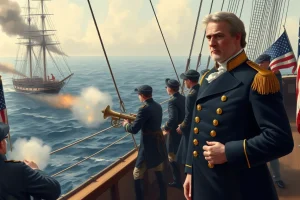
Yeo reached Quebec on 5 May 1813 with 437 officers and men, and immediately moved up the St. Lawrence to Kingston, where he assumed command of a squadron consisting of the Wolfe, Royal George, Prince Regent, Earl of Moira, and several schooners, along with gunboats. The Americans, under Commodore Isaac Chauncey, had only the Madison, Oneida, and a number of converted schooners, but their crews were larger and their long guns had greater range. Yeo’s primary weapon was the 32-pounder carronade, which was effective at close range but inferior to the American long guns at distance. Over the summer, Yeo conducted a series of operations, including an attack on Sackets Harbor on 28–29 May, which failed to destroy the American dockyard due to the caution of Sir George Prevost, the governor-in-chief. For most of the summer, Yeo maintained a loose blockade of Sackets Harbor, but when Chauncey launched the new 28-gun General Pike in July, the two squadrons became engaged in a series of maneuvers and skirmishes. The most notable encounter, often called the Burlington Races, occurred on 28 September 1813, when Yeo broke off contact and retired to Kingston after a running fight. In late 1814, Yeo oversaw the construction of the HMS St. Lawrence, a 112-gun ship of the line built for freshwater service, which gave the British unquestioned control of the lake, though the war ended before any major engagement with this new ship.
Why It Matters
Yeo’s command on Lake Ontario prevented the Americans from gaining control of that lake, thereby securing the vital supply line from Kingston to the Niagara front. His cautious approach, which many contemporaries viewed as timidity, reflected the material shortcomings of his squadron, including under-manning and inferior long-range armament. Historians have debated whether Yeo or his adversary Chauncey deserves more credit for the stalemate, but it is clear that Yeo’s determination to avoid a decisive defeat kept the British fleet in being and allowed the campaign to continue. His strained relationship with Sir George Prevost further complicated operations, as the two men often disagreed on military strategy. Yeo’s eventual command of the HMS St. Lawrence gave Britain naval supremacy on the lake, but the war ended before this strength could be exploited. The Lake Ontario campaign thus ended in a strategic draw, which ultimately contributed to the war’s overall stalemate.
Early Life
James Lucas Yeo was born on 7 October 1782 in Hampshire, England, the elder son of James Yeo, an agent victualler to the Royal Navy at Minorca. After a brief schooling at Bishop’s Waltham near Winchester, he volunteered for the Royal Navy in March 1793 at the age of ten. He rose rapidly, becoming an acting lieutenant by 1797 and a full lieutenant on 20 February 1797. His early career was marked by service in the West Indies and the Adriatic, and he fought yellow fever and malaria, which were recurring ailments that would shadow his life.
Role Before the War
Yeo earned distinction during the Napoleonic Wars. On 4 June 1805, while first lieutenant of the frigate Loire, he led a shore party of fifty men in a daring attack on the Spanish port of Muros. He captured a battery defended by 250 men and twelve cannon, and subsequently took possession of the French privateer Confiance, which he was then appointed to command. The Admiralty confirmed his promotion to commander on 21 June 1805. In 1807 he was promoted to post-captain, and in the winter of 1808–1809 he led an Anglo-Portuguese expedition against Cayenne in French Guiana, compelling the surrender of a garrison of 1,200 with only 400 men and a few heavy guns. This achievement led to his knighthood in the Portuguese Order of St. Benedict of Avis in 1809, the first Protestant to receive that honour, and in 1810 he was knighted by King George III. After recuperating from a severe bout of malaria, he was assigned to the 32-gun Southampton in 1811 and sent to Jamaica.
Role During the War
On 19 March 1813, Yeo was appointed commodore and commander-in-chief on the lakes of Canada, with orders to cooperate fully with Sir George Prevost. He arrived at Quebec in May, after the fall of York, and took command at Kingston. His squadron was undermanned and his ships were of mixed quality, while his counterpart Isaac Chauncey enjoyed better crews and longer-range guns. Yeo was obliged to coordinate with Prevost, who was cautious and often reluctant to risk troops. Their personal antipathy grew throughout the war, hampering effective joint operations. Yeo did succeed in maintaining control of the lake for much of 1813, blockading the Americans at Sackets Harbor, and in 1814 he launched a successful attack on Oswego in May, capturing supplies and fortifications. He also directed the expansion of the fleet, culminating in the construction of the massive St. Lawrence.
Major Actions
Among Yeo’s principal actions were the attack on Sackets Harbor on 28–29 May 1813, a combined operation with Prevost that inflicted damage but failed due to the latter’s hesitation; the blockade of the American fleet in Sackets Harbor throughout June and early July; and the skirmishes with Chauncey during August and September, including the engagement on 10 August 1813. The most famous encounter, the Burlington Races on 28 September 1813, saw Yeo’s squadron flee a pursuing American force after a running fight. In May 1814, Yeo led an amphibious assault on Oswego, capturing the fort and naval stores. Following this, he maintained control of the eastern end of the lake. The launch of the HMS St. Lawrence in the autumn of 1814 established British naval supremacy, but no major fleet action occurred before the war’s end.
Contemporary Accounts
An American officer described the two commanders as “lying alongside of each other, like two dogs, always growling and snapping but never biting,” a vivid summary of the frustrating stalemate. British and American commentators alike often criticized Yeo for excessive caution. Theodore Roosevelt later remarked that “The admirers of Sir James lay the blame on Sir George, and vice versa; but in reality neither seems to have done particularly well.” Yeo himself, in his after-action reports, emphasized his material disadvantages and the difficulty of cooperating with Prevost. Contemporary letters and naval dispatches reflect the tension between the two services.
Later Life
After the peace was announced in February 1815, Yeo returned to England. He traveled through the United States, spending several days at Sackets Harbor as a guest of his former opponent Isaac Chauncey. Arriving in England in May, he delivered a candid report to the Admiralty, asserting that British successes had been due more to American blunders than to British preparedness. He was immediately given command in the West Africa Squadron, patrolling for slave ships. In August 1818 he contracted a fever and died at sea on 21 August. His body was preserved in spirits and transported to England, where he was buried at the Royal Garrison Chapel in Portsmouth on 8 September 1818.
Historical Legacy
Yeo’s historical reputation has been largely shaped by his cautious conduct on Lake Ontario. Scholars have increasingly recognized that his apparent timidity was a rational response to his squadron’s deficiencies, including the lack of long guns and reliable crews. The naval race on the lake, in which Yeo played a central role, is studied as a precursor to modern naval arms competition. In 1937, he was designated a National Historic Person in Canada, and a plaque commemorating him was placed at Kingston. The Royal Military College of Canada named a dining and mess hall after him in 1936. Some historians have suggested that his daring early career served as an inspiration for C.S. Forester’s fictional hero Horatio Hornblower, though no direct evidence supports this claim.
Primary Sources
The primary sources for Yeo’s wartime command include his official dispatches and correspondence with the Admiralty and Sir George Prevost. These documents are housed in the National Archives (UK) in London and in the colonial and naval records at Library and Archives Canada in Ottawa. Yeo’s own report delivered to the Admiralty in May 1815, though not published in full, is frequently cited by historians. The letters and memoirs of American officers, such as those of Isaac Chauncey and his subordinates, provide a contrasting perspective. These sources are essential for reconstructing the decisions and limitations of both commanders, but they should be read with awareness of each author’s biases.
Further Reading
- Renée Lafferty, “Sir James Lucas Yeo,” The Canadian Encyclopedia.
- Dictionary of Canadian Biography, s.v. “YEO, Sir JAMES LUCAS.”
- Parks Canada, “Yeo, Sir James Lucas National Historic Person.”
- American Battlefield Trust, “James Yeo.”
- Robert Malcomson, Lords of the Lake: The Naval War on Lake Ontario, 1812–1814 (Toronto: Robin Brass Studio, 1998).
References
- Renée Lafferty, “Sir James Lucas Yeo,” The Canadian Encyclopedia, last edited December 16, 2013, https://thecanadianencyclopedia.ca/en/article/sir-james-lucas-yeo.
- Dictionary of Canadian Biography, s.v. “YEO, Sir JAMES LUCAS,” http://www.biographi.ca/en/bio/yeo_james_lucas_5E.html.
- Parks Canada, “Yeo, Sir James Lucas National Historic Person,” https://www.pc.gc.ca/apps/DFHD/page_nhs_eng.aspx?id=1216.
- American Battlefield Trust, “James Yeo,” https://www.battlefields.org/learn/biographies/james-yeo.
FAQ
Why was Yeo criticized as overly cautious?
Because he frequently avoided a decisive battle with the American squadron, leading contemporaries and later historians to believe he lacked aggression. However, his squadron was under-manned and equipped with short-range carronades, which made long-range duels unfavorable.
What was the outcome of Yeo's command on Lake Ontario?
Yeo managed to prevent the Americans from gaining control of Lake Ontario, thus protecting the British supply line from Kingston to the Niagara frontier. The campaign ended in a stalemate, with each side retaining its own naval base.
How did Yeo die?
He contracted a fever while serving on the West African coast in 1818 and died at sea on 21 August 1818. His body was preserved in spirits and returned to England for burial.

Leave a Reply