
Short Answer
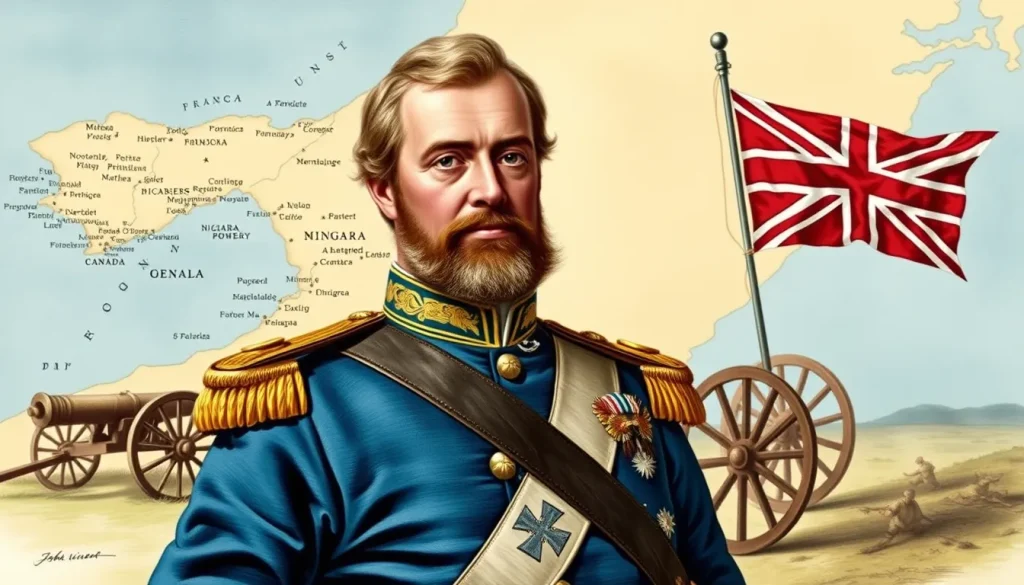
John Vincent (1764–1848) was a career British army officer who commanded the Niagara Peninsula during the American invasion of Upper Canada in 1813. After his forces were overwhelmed at Fort George, he withdrew to Burlington Heights and then authorized a successful night attack at Stoney Creek, which helped reverse American gains. Vincent’s leadership in the spring and summer of 1813 preserved the British position on the Niagara frontier.
Historical Context
In the spring of 1813, the United States launched a renewed effort to conquer the British colonies in Upper Canada. The American army on the Niagara frontier, commanded by Major General Henry Dearborn, assembled at Fort Niagara and prepared to cross the river and seize Fort George, the main British post at the mouth of the Niagara River. The British force defending the peninsula was under strength and included many unreliable militia. The strategic goal for the Americans was to gain control of Lake Ontario and the Niagara corridor, which would cut British communications between Kingston and the west. For the British, holding the Niagara Peninsula was essential to maintain contact with Indigenous allies and the western posts.
What Happened
John Vincent had been promoted to brigadier general in February 1813 and sent to replace the ailing Major General Sir Roger Hale Sheaffe as commander on the Niagara frontier. He established his headquarters at Fort George and attempted to prepare defences with about 1,900 men, many of them dispirited militia. Throughout May, American batteries were built opposite Fort George, and on the evening of 24 May they opened a heavy bombardment, supported by Commodore Isaac Chauncey’s naval squadron. On 27 May, a force of about 5,000 American troops landed at Two Mile Creek, just west of the fort. Vincent’s outnumbered defenders resisted the landing but quickly recognized that they would be outflanked. Vincent ordered the fort evacuated, the guns spiked, and ammunition destroyed, then retreated westward with his regulars. The Americans occupied Fort George and sent about 3,500 infantry and 150 cavalry in pursuit.
Vincent halted at Burlington Heights, at the western end of Lake Ontario, where he received word of his promotion to major-general. The American pursuit, commanded by Brigadier Generals John Chandler and William H. Winder, camped at Stoney Creek on the night of 5 June. Vincent’s deputy, Lieutenant-Colonel John Harvey, recommended a sudden night attack. Vincent agreed, and shortly after midnight on 6 June, Harvey led about 700 regulars in a bayonet charge that threw the American camp into confusion. The battle lasted under an hour, but resulted in the capture of both American generals and several artillery pieces. Vincent himself never reached the fighting, having been thrown from his horse in the dark and lost his way; he was found wandering the next morning. Nevertheless, the American force fell back to Fort George.

For the next several months, Vincent maintained a blockade of Fort George, with outposts that included a position at Beaver Dams. On 24 June, an American detachment of about 500 men attempted to attack the British outpost there, but was ambushed and forced to surrender, eliminating further American moves for the rest of the year. Vincent continued to hold the Niagara frontier until October, when the British defeat at Moraviantown (Thames) threatened his rear, forcing him to abandon his advanced position and fall back on Burlington Heights. He was soon transferred to Kingston, and later to Montreal, before leaving for England in 1814 due to illness.
Why It Matters
The American campaign against Fort George was a serious threat to British control of Upper Canada. Vincent’s decision to retreat and then counterattack turned a near-disaster into a defensive victory. The Battle of Stoney Creek was a critical point in the war on the Niagara frontier, stopping the American advance and forcing the United States to remain confined to Fort George for the remainder of 1813. Historians generally agree that Vincent’s actions showed competent defensive leadership, though his personal performance at Stoney Creek was marred by his absence from the fight. His legacy is that of a capable if not brilliant officer, whose willingness to take a calculated risk saved the British position.
Early Life
John Vincent was born in Ireland in 1764, the youngest son of John Vincent of Mardyke, County Limerick, and Catherine Love. He entered the British army as an ensign in the 66th Foot in July 1781, and transferred to the 49th Foot as a lieutenant in 1783. He rose to captain in 1786 and major in 1795. He saw service in the West Indies, including the capture of Saint-Domingue (Haiti) in 1793, and later took part in the expedition to Holland in 1799 and the Battle of Copenhagen in 1801.
Role Before the War
Vincent’s regiment, the 49th Foot, was sent to Lower Canada in 1802 and then to Upper Canada in 1803. For nine years, Vincent performed garrison duty at York (Toronto), Fort George, and Kingston. He was promoted to brevet lieutenant-colonel in 1800 and was known as a strict trainer and disciplinarian. When war broke out in 1812, Vincent was in command of several companies at Kingston and was credited with helping to organize the defence of that post.
Role During the War
In November 1812, Vincent oversaw the shore batteries that repelled Commodore Chauncey’s attack on Kingston Harbour, for which Governor-General Sir George Prevost commended him. In February 1813, Prevost promoted Vincent to brigadier general and sent him to take command of the Niagara frontier. He replaced Sheaffe and immediately began preparing for an expected American offensive. Vincent organised his forces into three divisions, but he was heavily outnumbered when the Americans landed at Fort George. His decision to abandon the fort and retreat preserved his army and allowed for the later counterattack at Stoney Creek.
Major Actions
Vincent’s most significant actions were: the defence of Kingston Harbour in November 1812; the evacuation of Fort George on 27 May 1813; the authorization and planning of the night attack at Stoney Creek on 6 June 1813, though he did not personally participate; and the subsequent blocking of American forces at Fort George. He also supported the operation that led to the American surrender at Beaver Dams on 24 June 1813.
Contemporary Accounts
In his report after abandoning Fort George, Vincent wrote to Prevost: “I could not consider myself justified in continuing so unequal a contest.” Lieutenant-Colonel Harvey, who led the attack at Stoney Creek, praised Vincent for his “good sense & manly spirit” in approving the plan. However, other contemporaries later offered a less flattering view. Lieutenant James FitzGibbon claimed Vincent was “at all times a feeble man, both in mind and body.” The details of Vincent’s fall from his horse and his absence from the battle became known from later testimony and were omitted from official reports.
Later Life
After leaving Canada in 1814, Vincent held the sinecure appointment of Lieutenant-Governor of Dumbarton Castle. He was promoted to lieutenant-general in 1825 and to full general in 1841 or 1843 (sources differ). He was colonel of the 69th Foot from 1836. Vincent never married and died in London on 21 January 1848, aged 83.
Historical Legacy
Modern historians generally place Vincent among the competent, second-tier British commanders in the War of 1812. He lacked the flair of Isaac Brock, but his resolute defense and strategic counterattack at Stoney Creek were crucial to preserving the British hold on the Niagara Peninsula. Some Canadian historians have argued that Vincent’s victory restored morale among British forces and local militia, and his name remains associated with the Battle of Stoney Creek. He is commemorated in the Vincent neighbourhood of Hamilton, Ontario.
Primary Sources
The most important primary sources for Vincent’s career are the official reports and correspondence he sent to Lieutenant-General Sir George Prevost, many of which are published in the Documentary History of the Campaign upon the Niagara Frontier, edited by Ernest Cruikshank. These documents include Vincent’s report on the evacuation of Fort George and accounts of the Battle of Stoney Creek. Lieutenant-Colonel Harvey’s letters and reports also provide firsthand testimony. One limitation is that official reports often omitted Vincent’s personal mishap on the night of Stoney Creek; that episode appears in court-martial testimonies and memoirs of other officers.
Further Reading
- Elliott, James E. Strange Fatality: The Battle of Stoney Creek, 1813. Toronto: Robin Brass Studio, 2009.
- Bailey, Thomas Melville. Dictionary of Hamilton Biography (Vol I, 1791–1875). W.L. Griffin Ltd., 1981.
- Cruikshank, Ernest. Documentary History of the Campaign upon the Niagara Frontier. 1900s.
- Ridler, Jason. “John Vincent.” The Canadian Encyclopedia, 2011.
References
- “John Vincent.” Dictionary of Canadian Biography. link
- Ridler, Jason. “John Vincent.” The Canadian Encyclopedia. link
- Wikipedia contributors. “John Vincent (British Army officer).” Wikipedia. link
- “John Vincent.” WarHistory.org. link
- Niagara 1812 Legacy Council. “Good sense & manly spirit – John Vincent.” 2014. link
FAQ
Who was John Vincent?
John Vincent was a career British army officer born in Ireland in 1764. He served in the War of 1812 and commanded the Niagara Peninsula, most notably leading a retreat from Fort George and a counterattack at Stoney Creek.
Why did Vincent leave Fort George?
On 27 May 1813, an American force of about 5,000 men landed near Fort George and threatened to outflank him. Vincent determined that his roughly 1,900 men could not hold the position, so he ordered the fort evacuated and withdrew to Burlington Heights.
What is Vincent's historical significance?
Vincent's decision to strike back at Stoney Creek stopped the American invasion of the Niagara Peninsula and helped preserve British control of Upper Canada for the rest of 1813. Historians view him as a capable, reliable, if not brilliant, commander.



Leave a Reply