Short Answer
Henry Eckford (1775–1832) was a Scottish-born American shipbuilder and naval architect who played a decisive role in the United States’ naval efforts on the Great Lakes during the War of 1812. Under his direction, the remote village of Sackets Harbor, New York, became a major naval station where he constructed eight warships, including the frigate Superior and the unfinished ship-of-the-line New Orleans. His speed and skill in building a fresh-water squadron helped the U.S. Navy maintain a strategic presence on Lake Ontario, influencing the course of the war.
Historical Context
At the outbreak of the War of 1812, control of the Great Lakes—and particularly Lake Ontario—was vital for both the United States and Great Britain. The lakes formed a natural frontier and a logistical corridor for supplying military operations in Upper Canada and the northern United States. Each side sought to build or capture naval forces capable of commanding these waters. The Royal Navy already held a global advantage, but on the lakes, the contest was more even, depending heavily on the speed of local shipbuilding. The United States, facing the need to challenge British control of Lake Ontario, turned to civilian shipbuilders with the expertise to construct warships under frontier conditions. Henry Eckford, already a successful New York commercial shipbuilder, was among those recruited to meet this challenge.
What Happened
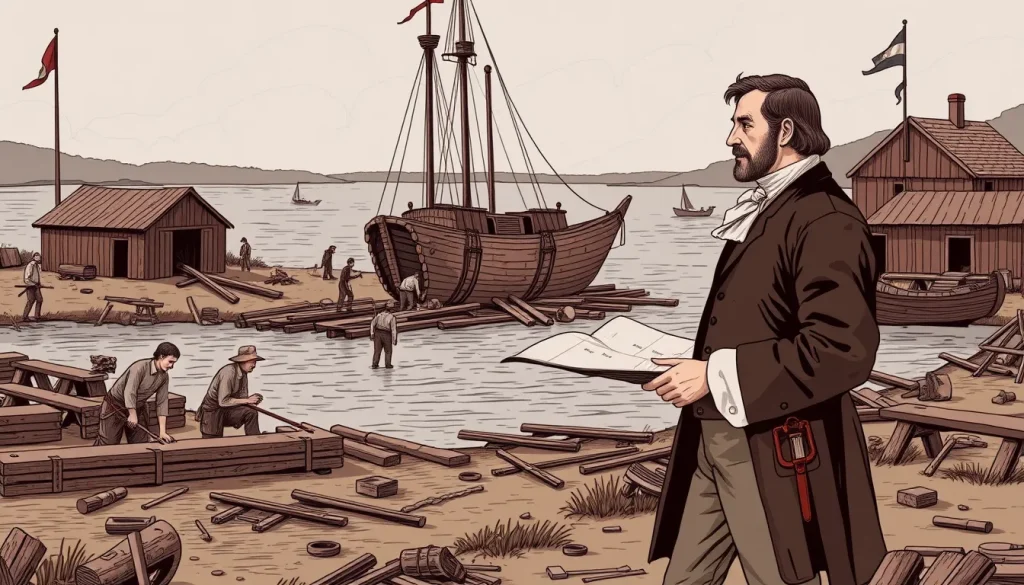
In late 1812, Commodore Isaac Chauncey, commander of American naval forces on Lake Ontario, persuaded Eckford to accompany him to Sackets Harbor. There, Eckford oversaw the construction of new warships from timber felled from nearby forests. His first major project was the corvette Madison, launched in November 1812 after only about six weeks of work. Over the next two years, Eckford directed the building of the schooner Lady of the Lake, the brigs Sylph and General Pike, the frigates Superior and Mohawk, and the brigs Jones and Jefferson. He also supervised the purchase and arming of nine schooners. His most ambitious projects were the large ships-of-the-line Chippewa and New Orleans, intended to counter the British HMS St. Lawrence, but they remained unfinished when the war ended. Eckford’s shipbuilding effort was characterized by remarkable speed; the frigate Superior was launched in just 80 days, and the Mohawk took only five weeks. His operations at Sackets Harbor turned the village into the most active naval station in the United States during the war.
Why It Matters
Eckford’s work had immediate strategic and operational consequences. The American squadron he built allowed Commodore Chauncey to maintain a credible threat on Lake Ontario, preventing British naval dominance and enabling American raids on Canadian shore installations. Though no major fleet action occurred on the lake, the shipbuilding race constrained British movements and supported the American defensive posture. Eckford’s innovative designs and construction techniques later influenced the U.S. Navy’s larger shipbuilding programs, including the construction of six ships-of-the-line at the Brooklyn Navy Yard. His legacy is also tied to the post-war fate of the ships he built: many decayed at Sackets Harbor, while the unfinished New Orleans rested on its stocks until 1883. Historians view Eckford’s contribution as essential to the American naval effort on the Great Lakes, highlighting the importance of industrial and mechanical expertise in the war.

Early Life
Henry Eckford was born on 12 March 1775 in Kilwinning, Scotland, and grew up in nearby Irvine. As a youth, he trained as a shipbuilder, likely in the shipyard at Irvine on the Firth of Clyde. In 1791, at age sixteen, he emigrated to British North America to serve a five-year apprenticeship with his uncle, John Black, a shipwright. After completing his apprenticeship in Quebec and Kingston, Eckford moved to New York City in 1796, where he began working in a boatyard on the East River. He soon established his own shipyard in Brooklyn and developed a reputation for building fast and seaworthy commercial vessels, including ships for John Jacob Astor.
Role Before the War
Before the War of 1812, Eckford built a successful career in New York’s commercial shipbuilding industry. He designed and constructed the brig Fox, noted for its speed, and the ship Beaver for Astor. His first naval contract came in 1806 when his yard built coastal gunboats for the U.S. Navy. In 1808, he assisted Christian Bergh in building the brig Oneida at Oswego, New York, on Lake Ontario. This experience gave him firsthand knowledge of the challenges of lake shipbuilding. By 1812, Eckford had become one of the most respected naval architects in New York and a friend of Commodore Isaac Chauncey.
Role During the War
Eckford’s main wartime contribution was his service at Sackets Harbor from late 1812 to 1815. Appointed by the Navy Department to oversee ship construction there, he transformed the village into a major naval base. He designed and built eight warships, organized a workforce of hundreds of carpenters, and managed the procurement and logistics needed to operate under frontier conditions. Eckford’s construction methods emphasized speed without sacrificing quality; he used locally available timber and developed efficient assembly techniques. His ships formed the core of the American squadron on Lake Ontario, and their presence helped secure American control of the lake during critical phases of the war.
Major Actions
Among Eckford’s most notable achievements were the rapid construction of the corvette Madison (launched November 1812) and the frigate Superior (launched May 1814), which was the largest U.S. Navy warship in service during the war. He also built the brigs Sylph and General Pike, the dispatch schooner Lady of the Lake, and the frigate Mohawk. His supervision of the construction of the ship-of-the-line New Orleans and its sister ship Chippewa represented the high-water mark of American naval ambition on the lakes, though neither was completed before peace was signed. Eckford’s ships participated in several minor engagements and bombardments, but no decisive fleet battle occurred on Lake Ontario. Nevertheless, his building program influenced British strategy by forcing the Royal Navy to match American strength, culminating in the launch of HMS St. Lawrence in late 1814.
Contemporary Accounts
Contemporary accounts emphasize Eckford’s extraordinary productivity. A historical marker at Sackets Harbor notes that under his leadership, craftsmen could launch a major warship in about thirty-five days. Appletons’ Cyclopædia of American Biography, published in 1888, observed that ‘he was employed by the government to construct ships-of-war on the lakes, and filled the contract with expedition and skill.’ Commodore Chauncey, in his official correspondence, repeatedly praised Eckford’s work. These sources, while generally positive, reflect the military’s interest in highlighting successful efforts and may not fully capture the harsh conditions or the strategic limitations of the American shipbuilding program.
Later Life
After the war, Eckford returned to New York City, where he resumed his commercial shipyard and also served as naval constructor at the Brooklyn Navy Yard from 1820. He designed and oversaw construction of six ships-of-the-line for the U.S. Navy, including the Ohio. In 1822, he built the steamer Robert Fulton, which made a historic voyage to New Orleans and Havana. In the late 1820s, Eckford became involved in business ventures, including a plan to establish a professorship of naval architecture at Columbia College, but he suffered financial losses. In 1831, he accepted an offer to build warships for the Ottoman Empire, moving to Constantinople, where he established a navy-yard. He died there on 12 November 1832 and was later reinterred in New York.
Historical Legacy
Eckford’s legacy is primarily tied to his wartime shipbuilding at Sackets Harbor, which helped the United States maintain naval parity on Lake Ontario. His technical innovations, such as the use of live oak and fast construction methods, influenced subsequent American naval architecture. In the decades after the war, his apprentices, including Isaac Webb and John A. Robb, became prominent shipbuilders, spreading his techniques. Eckford’s reputation as a ‘shipbuilding genius’ endures, although some modern historians question whether the massive investment in large warships on the lakes was ultimately necessary, given that no decisive battle occurred. Nonetheless, his work exemplifies the industrial mobilization that underpinned American military efforts in the conflict.
Primary Sources
Primary sources for Eckford’s wartime activities include official correspondence between Commodore Chauncey and Secretary of the Navy William Jones, which mention Eckford’s progress and the ships he built. These documents are preserved in the National Archives and Records Administration in Washington, D.C. A contemporaneous historical marker at Sackets Harbor, erected by the Great Lakes Seaway Trail, summarizes the shipbuilding efforts and includes a timeline of vessels. Additionally, the memoir of John Galt, Eckford’s childhood friend, provides some personal recollections. Each of these sources has limitations: naval letters often focus on operational matters, while the marker is interpretive and composed much later. No comprehensive personal diary or archive by Eckford himself is known to have survived.
Further Reading
- Jampoler, Andrew C.A. “Who Was Henry Eckford?” Naval History Magazine, vol. 21, no. 6 (December 2007). Available online at U.S. Naval Institute.
- “Henry Eckford (shipbuilder).” Wikipedia. Accessed 2025. https://en.wikipedia.org/wiki/Henry_Eckford_(shipbuilder).
- “Sackets Harbor Shipbuilding Historical Marker.” Historical Marker Database. https://www.hmdb.org/m.asp?m=75748.
- Wilson, J.G., and J. Fiske, eds. Appletons’ Cyclopædia of American Biography. New York: D. Appleton and Company, 1888.
References
- “Henry Eckford (shipbuilder).” Wikipedia. https://en.wikipedia.org/wiki/Henry_Eckford_(shipbuilder).
- Jampoler, Andrew C.A. “Who Was Henry Eckford?” Naval History Magazine 21, no. 6 (2007). https://www.usni.org/magazines/naval-history-magazine/2007/december/who-was-henry-eckford.
- “Sackets Harbor Shipbuilding Historical Marker.” Historical Marker Database. https://www.hmdb.org/m.asp?m=75748.
- “Henry Eckford.” Neptune’s Needle. https://neptunesneedle.github.io/people/henryeckford/.
- “Appletons’ Cyclopædia of American Biography/Eckford, Henry.” Wikisource. https://en.wikisource.org/wiki/Appletons%27_Cyclop%C3%A6dia_of_American_Biography/Eckford,_Henry.
FAQ
What warships did Henry Eckford build at Sackets Harbor?
During the War of 1812, Eckford built the corvette Madison, the brigs Sylph and General Pike, the frigate Superior, the frigate Mohawk, the brigs Jones and Jefferson, and the dispatch schooner Lady of the Lake. He also started construction on the large ships-of-line Chippewa and New Orleans, which were unfinished at war's end.
How did Eckford's shipbuilding affect the War of 1812 on Lake Ontario?
Eckford's rapid construction gave the American squadron a credible presence, which deterred British operations and supported American raids. The shipbuilding race shaped the strategic standoff on Lake Ontario, though no major fleet battle occurred.
What was Henry Eckford's later career after the war?
After the war, Eckford served as naval constructor at Brooklyn Navy Yard, built the steamer Robert Fulton, and designed ships for foreign navies, including the Ottoman Empire. He died in Constantinople in 1832 while establishing a navy-yard there.

Leave a Reply