Short Answer
Indigenous warriors were central to both sieges of Fort Meigs, the American stockaded fort on the Maumee River in northwestern Ohio, in 1813. During the first siege (April 28-May 9) and the second siege (July 21-28), warriors from Tecumseh’s confederacy and other Indigenous nations provided the British command with scouts, skirmishers, ambush forces, and much of the numerical strength that made the operations possible. Their participation, and their eventual unwillingness to continue conventional siege operations, helped determine that both British-Indigenous attempts failed and deepened the rupture between Tecumseh and Brigadier General Henry Procter.
Historical Context
The sieges of Fort Meigs belong to the War of 1812 in the Old Northwest, where American, British, Canadian, and Indigenous interests collided along the Detroit River, Lake Erie, and the Maumee River. After Brigadier General William Hull surrendered Detroit in August 1812, the United States lost control of Michigan Territory and much of the northwestern frontier. Major General William Henry Harrison, commanding the Army of the Northwest, built Fort Meigs in early 1813 on the south bank of the Maumee River near the rapids, close to the ruins of British Fort Miami and the site of the 1794 Battle of Fallen Timbers. The fort was intended as a staging point for an American campaign to retake Detroit and invade Upper Canada.
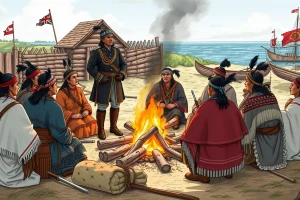
British forces in the region operated from Amherstburg in Upper Canada under Brigadier General Henry Procter. Procter had too few regulars and Canadian militia to conduct large offensive operations without Indigenous allies. Tecumseh’s confederacy, a coalition of Wyandot, Shawnee, Potawatomi, Odawa, Ojibwe, and other nations, had allied with Britain to resist American expansion and to seek restoration of Indigenous lands and sovereignty. For Tecumseh and his followers, the war was not merely a British imperial contest. It was also a continuing struggle for Indigenous survival and political independence in the Great Lakes region.
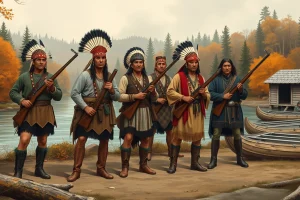
Indigenous warriors fought under their own leaders and according to their own customs. They were not interchangeable with British regulars. Many served for limited periods, returned home for planting or hunting, and expected provisions, gifts, and honors. They were often willing to skirmish, scout, and ambush, but they generally resisted frontal assaults on fortified positions. These military and political realities shaped every stage of the Fort Meigs operations.

What Happened
The first siege began on April 28, 1813. Procter crossed Lake Erie with about 522 British regulars, 462 Canadian militia, and artillery, while Tecumseh and the Wyandot leader Roundhead brought roughly 1,200 Indigenous warriors overland. Procter established batteries on the north side of the Maumee River and tasked Tecumseh with investing the fort. Harrison commanded the garrison, which numbered around 1,200 before reinforcements.
On May 5, a Kentucky relief column under Brigadier General Green Clay approached the fort. Part of the column, led by Lieutenant Colonel William Dudley, crossed the river and attacked the British batteries. The initial assault succeeded, but Dudley’s men pursued the retreating British and Indigenous defenders into the woods, where they were ambushed. The defeat was severe. Many Americans were killed or captured, and in the confused fighting that followed, Indigenous warriors killed a number of prisoners. Tecumseh and British officers intervened to stop the killing, according to several accounts, but the exact number of victims and the responsibility for the massacre remain disputed. The siege was abandoned on May 9.
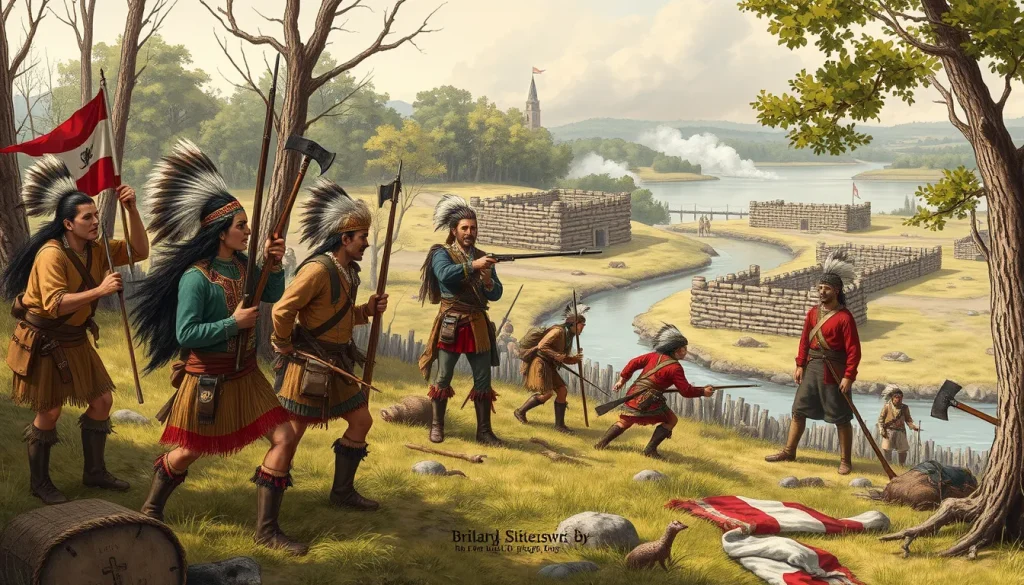
The second siege ran from July 21 to July 28, 1813. Procter returned with only about 400 regulars and militia but a much larger Indigenous force, estimated at around 2,600 warriors. Tecumseh reportedly proposed a ruse: warriors would stage a mock battle in the woods near the fort, imitating an attack on an American relief column. The garrison, if it sallied out to help, would be drawn into an ambush. On July 26 the warriors carried out the simulated fight, complete with musket fire and war cries. But Brigadier General Green Clay, now commanding the fort, remembered the disaster of May 5 and kept his men inside the walls. With no prospect of luring the garrison out, and with too few British regulars to storm the earthworks, the operation collapsed. The warriors began dispersing, and Procter withdrew to Amherstburg on July 28.
Why It Matters
The sieges of Fort Meigs show both the power and the limits of the British-Indigenous alliance. Indigenous warriors supplied the British with reconnaissance, skirmishing, psychological pressure, and the manpower that allowed Procter to threaten a fort he could not otherwise besiege. They were especially effective in mobile fighting, as at Dudley’s defeat on May 5. Yet they were not a substitute for a proper siege train or a large corps of disciplined regulars. Their reluctance to assault prepared earthworks, their need to return home, and their frustration with Procter’s caution repeatedly constrained British strategy.
For the United States, the survival of Fort Meigs preserved a foothold on the Maumee and helped delay British and Indigenous operations against the Ohio frontier. For Britain and Tecumseh’s confederacy, the failures worsened an already strained relationship. Tecumseh had grown contemptuous of Procter’s leadership, and the second siege made cooperation even more difficult. That rupture contributed to the British-Indigenous defeat at the Battle of the Thames on October 5, 1813, where Tecumseh was killed and his confederacy suffered a devastating blow.
Historians disagree about how to weigh Indigenous agency in these campaigns. Some emphasize British operational incompetence and the limits of Indigenous auxiliaries. Others stress that Indigenous leaders pursued their own diplomatic and military goals, entering and leaving campaigns according to their nations’ interests. Older accounts often reduced Indigenous warriors to auxiliaries or focused on Tecumseh alone. Recent scholarship places the confederacy, its sovereignty claims, and the material and political pressures on its warriors closer to the center of the story.
Prelude
The prelude to the Fort Meigs sieges was the American collapse at Detroit and the subsequent struggle for the Maumee Valley. Harrison’s army needed a forward base to recover Michigan Territory, while Procter needed to disrupt American preparations before they could threaten Amherstburg. Indigenous warriors joined the British campaign because an American advance threatened their communities and because the alliance offered a chance to push back settlers and American military power. Fort Meigs therefore became a test of whether the British-Indigenous coalition could destroy an American fortified position.
Forces and Commanders
On the British-Indigenous side, Brigadier General Henry Procter commanded British regulars, Canadian militia, and artillery. Tecumseh was the leading Indigenous war leader, with Roundhead, a Wyandot chief, also prominent. The Indigenous contingent included Wyandot, Shawnee, Potawatomi, Odawa, Ojibwe, and other nations. On the American side, Major General William Henry Harrison exercised overall command, while Brigadier General Green Clay commanded the Kentucky militia and later the Fort Meigs garrison. Lieutenant Colonel William Dudley led the relief detachment destroyed on May 5. Estimates of strength vary: the first siege involved about 1,200 Indigenous warriors and roughly 1,000 British and Canadian troops; the second involved far fewer British regulars but perhaps 2,600 Indigenous warriors.
Battlefield and Map Context
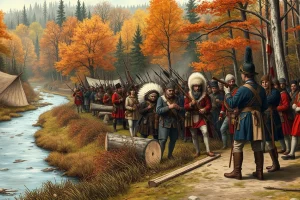
Fort Meigs stood on the southeast bank of the Maumee River, just above the rapids, in present-day Perrysburg, Ohio. The river flowed northeast toward Lake Erie, and the fort controlled an important route between the Ohio settlements and Detroit. Across the river were the ruins of Fort Miami and the battlefield of Fallen Timbers. British batteries were placed on the north side of the river, while Indigenous warriors operated in the woods and along the approaches to the fort. The terrain of river, bluff, forest, and stockade shaped the fighting: it favored ambush and skirmishing but made a direct assault on the fort costly.
Battle Chronology
April 28, 1813: The first siege begins as Procter’s British and Canadian troops and Tecumseh’s Indigenous force invest Fort Meigs. May 5: Dudley’s Kentucky detachment attacks British batteries and is ambushed; heavy American losses follow. May 9: Procter lifts the first siege. July 21: The second siege begins with a larger Indigenous force and fewer British regulars. July 26: Tecumseh’s ruse, a staged battle near the fort, fails to draw out the garrison. July 28: Procter withdraws to Amherstburg.
Casualties and Losses
Casualty figures for the first siege are approximate and vary by source. One common set of estimates lists British losses at 14 killed, 47 wounded, and 41 captured, with 19 Indigenous killed and wounded, for a total of about 121. American losses are much higher: roughly 161 killed, 189 wounded, and 627 captured, a total near 977, largely from Dudley’s defeat and the subsequent killings of prisoners. The second siege produced minimal casualties because the garrison refused to leave the fort and the Indigenous warriors did not assault the walls. These numbers should be treated as estimates, not exact totals.
Result
Both sieges ended in American victories in the sense that Fort Meigs remained in United States hands. The first siege failed after the British could not break the fort and the relief column’s destruction did not compel surrender. The second siege failed when Tecumseh’s ruse miscarried and the Indigenous force dispersed. Procter’s withdrawal left the fort intact and exposed the fragility of the British-Indigenous campaign in the region.
Strategic Consequences
The immediate strategic consequence was the preservation of an American base on the Maumee and the delay of British operations against Ohio and Kentucky. The longer consequence was the deterioration of the Procter-Tecumseh partnership. Tecumseh’s confidence in Procter declined sharply after the second siege, and the British retreat from Amherstburg in September 1813 set the stage for the Battle of the Thames. There, Tecumseh was killed and the Indigenous confederacy lost much of its military cohesion. The Fort Meigs sieges thus belong to the chain of events that ended with American control of the Detroit frontier and the collapse of the British-Indigenous offensive in the northwest.
Primary Accounts
Contemporary accounts of the sieges come from American officers, British commanders, and participants in the Indigenous coalition. Harrison’s letters and reports describe the defense of the fort and the disaster of May 5. Procter’s reports to his superiors explain British operations and often defend his decisions. Kentucky soldiers left letters, diaries, and reminiscences that describe the ambush and the killing of prisoners. Indigenous perspectives are harder to recover from written records; some survive through oral tradition, later interviews, and the speeches attributed to Tecumseh. All of these sources are partial. British and American officers had reputations to protect, while accounts of Indigenous actions were often filtered through hostile or romanticized observers.
Battlefield Today
Fort Meigs is now the Fort Meigs Historic Site in Perrysburg, Ohio, operated by the Ohio History Connection. Reconstructed blockhouses, earthworks, and interpretive exhibits mark the location. The site interprets the War of 1812 in the Great Lakes and the roles of American, British, Canadian, and Indigenous participants, though the fullness of Indigenous perspectives remains a subject of ongoing public history work.
Primary Sources
Researchers can begin with William Henry Harrison’s official correspondence from 1813, including his letters and reports on the defense of Fort Meigs. Henry Procter’s reports to Governor General Sir George Prevost and other British officials provide the British command perspective. Green Clay’s papers and Kentucky militia records illuminate the relief column and the May 5 sortie. British Indian Department records, held in archives such as Library and Archives Canada, document the recruitment, provisioning, and diplomatic management of Indigenous allies, though they are written from a colonial administrative viewpoint. Later published recollections and oral traditions offer Indigenous and soldier perspectives, but they must be used cautiously because memory, translation, and political purpose shape them.
No verbatim transcript of Tecumseh’s words at Fort Meigs is known to survive. Statements attributed to him, including his criticism of Procter, come through later reminiscence or report and should be treated as reported rather than as exact quotation.
Further Reading
- Donald R. Hickey, The War of 1812: A Forgotten Conflict.
- John Sugden, Tecumseh: A Life.
- Sandy Antal, A Wampum Denied: Procter’s War of 1812.
- Robert S. Allen, His Majesty’s Indian Allies: British Indian Policy in the Defence of Canada, 1774-1815.
- Colin G. Calloway, Crown and Calumet: British-Indian Relations, 1783-1815.
- David Curtis Skaggs, William Henry Harrison and the Conquest of the Ohio Country: Frontier Fighting in the War of 1812.
- Fort Meigs Historic Site, Ohio History Connection.
- The War of 1812, Second Siege of Fort Meigs, https://thewarof1812.org/battles/second-siege-of-fort-meigs/.
References
- The War of 1812, Second Siege of Fort Meigs, https://thewarof1812.org/battles/second-siege-of-fort-meigs/.
- Wikipedia, Siege of Fort Meigs, https://en.wikipedia.org/wiki/Siege_of_Fort_Meigs.
- Donald R. Hickey, The War of 1812: A Forgotten Conflict (Urbana: University of Illinois Press, 1989).
- John Sugden, Tecumseh: A Life (New York: Henry Holt, 1997).
- Sandy Antal, A Wampum Denied: Procter’s War of 1812 (Ottawa: Carleton University Press, 1997).
- Robert S. Allen, His Majesty’s Indian Allies: British Indian Policy in the Defence of Canada, 1774-1815 (Toronto: Dundurn Press, 1992).
- Colin G. Calloway, Crown and Calumet: British-Indian Relations, 1783-1815 (Norman: University of Oklahoma Press, 1987).
- David Curtis Skaggs, William Henry Harrison and the Conquest of the Ohio Country: Frontier Fighting in the War of 1812 (Baltimore: Johns Hopkins University Press, 2014).
- Pierre Berton, The Invasion of Canada, 1812-1813 (Toronto: McClelland and Stewart, 1980).
FAQ
How many Indigenous warriors fought at Fort Meigs?
Estimates vary, but about 1,200 Indigenous warriors participated in the first siege in April-May 1813, and roughly 2,600 in the second siege in July 1813. These figures come from British and later historical estimates and are not exact.
Did Indigenous warriors capture Fort Meigs?
No. Both sieges failed to take the fort. In the first siege, the British and Indigenous force could not break the defenses and withdrew after the American relief column was defeated. In the second siege, a ruse failed to draw the garrison out, the warriors dispersed, and Procter withdrew.
Why did Indigenous warriors disperse during the second siege?
Many Indigenous warriors were unwilling to assault prepared earthworks, and the second siege offered no decisive action after the failed ruse. Seasonal obligations, frustration with British leadership, and the costs of a prolonged campaign also encouraged them to return home.
Leave a Reply