Short Answer
The British Indian Department was an imperial agency created in 1755 to manage relations between the British Crown and the First Nations of North America. During the War of 1812, its officers in Upper Canada and the Great Lakes region organized Indigenous alliances that supplied warriors, intelligence, and military support to British and Canadian forces. This article focuses on the department’s role in building and sustaining those alliances, especially between 1812 and 1815, and on how the wartime relationship shaped later British-Indigenous policy in Canada.
Historical Context
Before 1755, British colonies handled Indigenous diplomacy separately, often with conflicting results. The Seven Years’ War prompted London to centralize this work. Sir William Johnson was appointed Superintendent of Indian Affairs for the Northern Department in 1755, and a Southern Department was established soon afterward. The department’s original purpose was to secure Indigenous support against New France and to manage relations with nations whose lands lay between the British colonies and the interior. After the American Revolution, the department’s area of responsibility was limited to Canada, and the northern and southern branches were formally merged. By 1796 the Indian Department in Upper Canada was subordinate to the lieutenant governor of that province, while the department in Lower Canada came under the governor general by 1800.
The department had both civil and military duties. Its daily work included distributing gifts, regulating the fur trade, administering justice in some frontier areas, and employing blacksmiths, teachers, and missionaries. Its military role was to mobilize Indigenous warriors in times of crisis. The Royal Proclamation of 1763 and the Treaty of Fort Stanwix of 1768 reflected British attempts to manage Indigenous land boundaries and preserve alliances, though settlers and colonial governments often ignored these arrangements. By the early nineteenth century, Britain’s hold on the Great Lakes depended heavily on cooperation with First Nations. The department maintained posts and agents at places such as Amherstburg, Fort George, York, St. Joseph, and Michilimackinac, where diplomacy, trade, and military planning intersected. Indigenous nations including the Six Nations, Ojibwe, Odawa, Potawatomi, Shawnee, Delaware, Miami, and Wyandot pursued their own interests as American settlement pressed westward. When the United States declared war on Britain in June 1812, the British Indian Department became a key instrument for turning those interests into military alliance.
What Happened
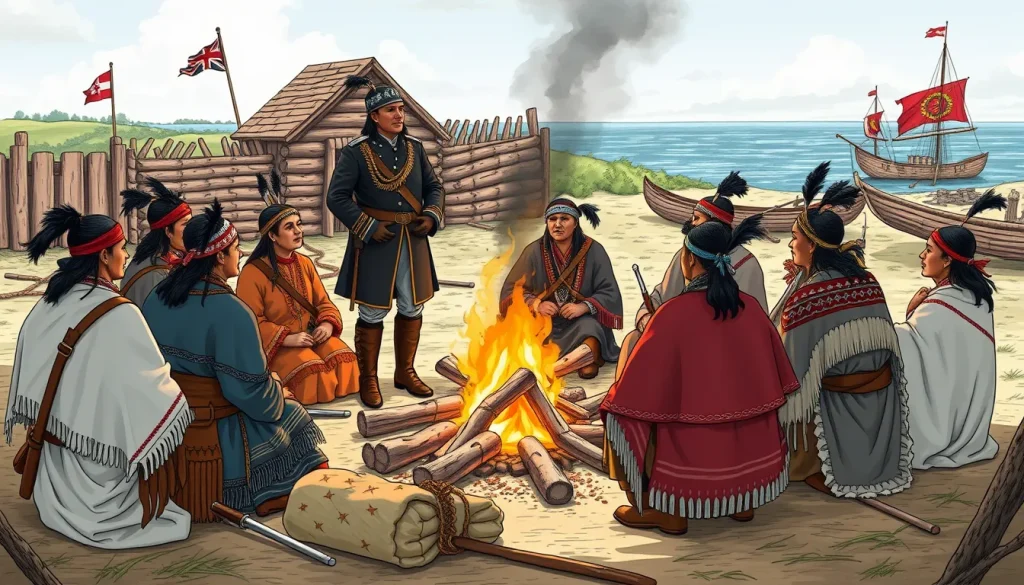
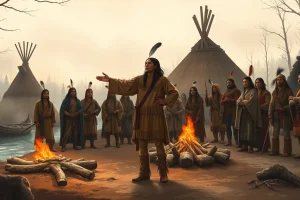
As war approached, Indian Department officers renewed the so-called chain of friendship through councils, presents, and promises of support. Matthew Elliott, superintendent at Amherstburg, worked closely with Shawnee leader Tecumseh and other northwestern nations. William Claus, deputy superintendent general in Upper Canada, managed relations with nations near Niagara and York. John Norton, a Mohawk war chief and department officer, helped mobilize Six Nations warriors. When the United States declared war, the department coordinated with British military commanders to bring Indigenous warriors into the field.
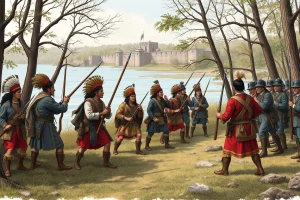
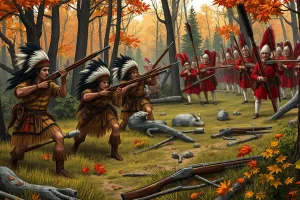
The first year of the war demonstrated the value of these alliances. In July 1812, British and Indigenous forces captured Michilimackinac without a shot, securing the upper Great Lakes. In August 1812, Major General Isaac Brock, with Tecumseh and a large Indigenous contingent, forced the surrender of Detroit. In October 1812, at Queenston Heights, Mohawk and other warriors under John Norton fought alongside British regulars and Canadian militia. These successes depended on the department’s ability to supply arms, ammunition, provisions, and information, and on Indigenous leaders’ decisions to join the British cause. Indigenous nations were not uniform in their allegiances. Some Six Nations communities in the United States fought for the Americans, while others remained neutral or divided.
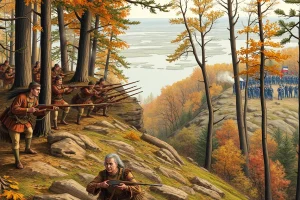
The alliance suffered a major blow in 1813. After the British defeat at the Battle of the Thames on October 5, Tecumseh was killed, and the northwestern confederacy lost much of its cohesion. The department’s network in the Detroit and western region was weakened, and many Indigenous warriors withdrew or sought terms. In 1814, Indigenous allies continued to serve in the Niagara campaign and other operations, but their numbers and influence had declined. The Treaty of Ghent, signed on December 24, 1814, included Article IX, which required the United States to end hostilities with Indigenous nations and restore their possessions and rights as they had existed in 1811. The treaty did not create a lasting Indigenous homeland, and the United States did not fully carry out this provision.
Why It Matters
The British Indian Department’s wartime work had immediate military consequences. Indigenous warriors provided scouting, intelligence, surprise attacks, and knowledge of terrain that British regulars could not easily replace. Their participation helped Britain defend Canada in 1812 and 1813, and their presence shaped American planning and morale. At the same time, the war cost Indigenous nations heavily in lives, land, and political autonomy. In the United States, many allied nations faced removal and land loss after the peace. In Canada, Britain continued to recognize First Nations as allies, but the department increasingly shifted toward managing reserves and encouraging settled agriculture.
Historians interpret the department in different ways. Robert S. Allen argues that British Indian policy between 1774 and 1815 was central to the defence of Canada and that Indigenous allies were essential to British strategy. Nathan Ince describes the Upper Canadian Indian Department as an empire within an empire, whose officers and Indigenous communities shaped imperial relations from the ground up. Colin G. Calloway emphasizes the diplomatic and cultural dimensions of British-Indian relations, while Alan Taylor places the alliance within the broader civil conflict of the War of 1812. A central debate concerns agency. Were Indigenous nations manipulated auxiliaries of British power, or sovereign actors who used Britain to resist American expansion? Most recent scholarship treats the alliance as a negotiation in which both sides pursued their own goals, though with unequal power and resources.
Definition
The British Indian Department was an imperial institution responsible for managing relations between the British Crown and First Nations in North America. In the context of the War of 1812, organizing Indigenous alliances meant recruiting warriors, distributing arms and provisions, holding councils, providing interpreters, and coordinating Indigenous contingents with British military operations. The department did not command Indigenous nations as a modern army would. It acted as a liaison, supply agency, and diplomatic channel, while Indigenous leaders retained authority over their own warriors and decisions.
Background
By 1812, the department had nearly six decades of experience in frontier diplomacy. It had survived the Seven Years’ War, Pontiac’s War, the American Revolution, and the Northwest Indian War. After the Jay Treaty of 1794, Britain agreed to evacuate several western posts, but it continued to cultivate Indigenous alliances from Canada. In Upper Canada, the department operated through superintendencies at Amherstburg, Fort George, York, and St. Joseph. Its officers often had family and kinship ties to Indigenous communities, which gave them access and influence but also made them dependent on local relationships. Many Indigenous nations, meanwhile, saw Britain as a counterweight to American settlement. Tecumseh’s confederacy and other northwestern alliances were not created by the British Indian Department, but the department became a crucial source of supplies and military coordination once war began.
How It Worked
The department’s wartime methods combined diplomacy and logistics. Officers held councils with chiefs and warriors, exchanged wampum belts and speeches, and distributed presents such as clothing, tools, tobacco, and silver ornaments. They also supplied muskets, ammunition, and food. Blacksmiths repaired weapons and tools, while interpreters translated negotiations and orders. Department officers corresponded with the governor general, lieutenant governors, and British commanders, passing along intelligence and requesting supplies. They helped plan campaigns and accompanied Indigenous war parties, but they did not usually direct them in battle. Indigenous leaders chose when and where to fight, and they could withdraw if British support failed or their own interests changed. This system was effective when supplies arrived and trust held, but it was vulnerable to shortages, corruption, personal rivalries, and competition between military and civil authorities.
Competing Viewpoints
Historians disagree about the character of the alliance. One interpretation emphasizes British manipulation: the department used gifts, trade goods, and promises to draw Indigenous nations into a war that served British imperial interests. Another interpretation stresses Indigenous agency: First Nations negotiated with Britain because the alliance served their own goal of resisting American expansion and securing land and sovereignty. A third view focuses on the department itself as a bureaucratic and familial network that often acted independently of London and sometimes protected Indigenous interests against settlers. These perspectives are not mutually exclusive. The evidence shows both dependence and negotiation. The department needed Indigenous warriors, and Indigenous nations needed British supplies and diplomatic support. The Treaty of Ghent is especially contested. Some historians see Article IX as a British attempt to protect allies; others argue Britain abandoned them when peace with the United States became more important. The treaty’s incomplete implementation left many Indigenous nations without the restored rights it promised.
Role in the War of 1812
The department’s role varied by region and year. In the northwest, Matthew Elliott and his colleagues helped coordinate Tecumseh’s warriors with British forces at Amherstburg and Detroit. The capture of Michilimackinac in July 1812 and the surrender of Detroit in August 1812 were early successes that depended on Indigenous participation. On the Niagara frontier, William Claus and John Norton helped bring Six Nations warriors into battles such as Queenston Heights in October 1812. In 1813, after the Battle of the Thames, the northwestern alliance fragmented. In 1814, the department continued to supply and coordinate Indigenous allies in the Niagara campaign and around Michilimackinac and Prairie du Chien. By the end of the war, the department had helped Britain defend Canada, but it had also exposed the limits of imperial support for Indigenous territorial goals. After 1815, the department’s military role declined. It continued to manage Indigenous affairs in Canada, and after 1830 its main work became the administration of Indian reserves.
Consequences and Historical Interpretation
The War of 1812 accelerated changes in British-Indigenous relations. In Canada, the alliance reinforced the idea that First Nations were allies of the Crown, but it also encouraged policies aimed at settling them on reserves and transforming their economies and societies. The department survived until 1860, when imperial control was ceded to the Province of Canada, setting the stage for later federal departments. In the United States, Indigenous nations that had allied with Britain faced land cessions, removal, and diminished sovereignty. Historical memory in Canada often celebrates Tecumseh and Brock as heroic allies, but it sometimes overlooks the department’s bureaucratic role and the diversity of Indigenous loyalties. Recent scholarship, including Allen’s His Majesty’s Indian Allies and Ince’s An Empire within an Empire, shows that the department was neither simply a tool of oppression nor a neutral protector. It was an imperial institution that organized alliances, distributed resources, and mediated power, while Indigenous nations pursued their own strategies within and sometimes against British plans.
Primary Sources
Several contemporary records illuminate the department’s work. The Royal Proclamation of 1763, issued by King George III, established a framework for Indigenous land rights and imperial frontier policy; it reflects British legal thinking but not the full range of Indigenous responses. The Treaty of Fort Stanwix of 1768 recorded a boundary negotiation between British officials and the Six Nations; the document is valuable for diplomacy but incomplete for Indigenous perspectives. The Sir William Johnson Papers, published by the University of the State of New York, contain correspondence from the department’s formative years. Guy Johnson’s correspondence as superintendent during the American Revolution shows how the department mobilized allies in an earlier conflict. The Indian Department records in Library and Archives Canada, especially RG 10, include correspondence, returns, accounts, and council minutes from the War of 1812 era; they are essential but bureaucratic and often written from an official viewpoint. The Journal of Major John Norton, 1816, edited by Carl F. Klinck and James J. Talman, offers a personal account by a Mohawk leader and department officer who fought in the war. Article IX of the Treaty of Ghent records the diplomatic promise to Indigenous allies, but it does not show how the provision was implemented or how Indigenous nations responded. Colonial Office records in CO 42 at The National Archives in the United Kingdom provide additional official correspondence. These sources must be read critically because they rarely preserve Indigenous voices directly and often reflect the assumptions of British officials.
Further Reading
- Robert S. Allen, His Majesty’s Indian Allies: British Indian Policy in the Defence of Canada, 1774–1815 (Toronto: Dundurn Press, 1992).
- Robert S. Allen, The British Indian Department and the Frontier in North America, 1755–1830, Canadian Historic Sites: Occasional Papers in Archaeology and History No. 14 (Parks Canada).
- Nathan Ince, An Empire within an Empire: The Upper Canadian Indian Department, 1796–1845 (PhD diss., McGill University, 2021).
- Colin G. Calloway, Crown and Calumet: British-Indian Relations, 1783–1815 (Norman: University of Oklahoma Press, 1987).
- Carl F. Klinck and James J. Talman, eds., The Journal of Major John Norton, 1816 (Toronto: Champlain Society, 1970).
- Alan Taylor, The Civil War of 1812: American Citizens, British Subjects, Irish Rebels, & Indian Allies (New York: Knopf, 2010).
- Library and Archives Canada, RG 10, Indian Affairs records.
References
- Wikipedia, British Indian Department, https://en.wikipedia.org/wiki/British_Indian_Department.
- Huron Research, The Department & the Society: Government-Missionary Collaboration in British North America, https://www.huronresearch.ca/confrontingcolonialism/the-department-the-society-government-missionary-collaboration-in-british-north-america-as-background-to-the-mohawk-primer-of-daniel-claus/.
- Nathan Ince, An Empire within an Empire: The Upper Canadian Indian Department, 1796–1845, PhD diss., McGill University, 2021, https://mcgill.scholaris.ca/server/api/core/bitstreams/d61b404c-a102-4eec-afc3-dc6fa02a5367/content.
- Robert S. Allen, His Majesty’s Indian Allies: British Indian Policy in the Defence of Canada, 1774–1815 (Toronto: Dundurn Press, 1992).
- Robert S. Allen, The British Indian Department and the Frontier in North America, 1755–1830, Canadian Historic Sites No. 14, Parks Canada, http://www.parkscanadahistory.com/series/chs/14/chs14-1e.htm.
- Colin G. Calloway, Crown and Calumet: British-Indian Relations, 1783–1815 (Norman: University of Oklahoma Press, 1987).
- Alan Taylor, The Civil War of 1812: American Citizens, British Subjects, Irish Rebels, & Indian Allies (New York: Knopf, 2010).
FAQ
What was the British Indian Department?
An imperial agency established in 1755 to manage diplomatic and military relations between the British Crown and First Nations in North America. It distributed gifts, regulated trade, and mobilized Indigenous warriors in wartime. During the War of 1812, it helped organize alliances in Upper Canada and the Great Lakes.
How did the department organize Indigenous alliances during the War of 1812?
Through agents at posts such as Amherstburg and Fort George, it held councils, distributed arms, ammunition, provisions, and gifts, provided interpreters and blacksmiths, and coordinated with British commanders. Indigenous leaders retained authority over their warriors and decided whether and how to fight.
Did Britain betray its Indigenous allies after the war?
The Treaty of Ghent included Article IX, which required the United States to make peace with Indigenous nations and restore rights and possessions as of 1811. The U.S. did not fully implement this, and many Indigenous nations lost land. Britain continued its relationship with First Nations in Canada but increasingly moved toward reserve administration and assimilation. Historians debate how much Britain could or would have done for its allies.
Leave a Reply