Short Answer
The Seven Nations of Canada (Tsiata Nihononhwentsiá:ke) was a confederation of Catholic First Nations communities in the St. Lawrence River valley. During the War of 1812 (1812–1815), warriors and auxiliaries from these communities served with British, Canadian, and other Indigenous forces against the United States. Their participation was most concentrated in Lower Canada and along the St. Lawrence frontier, where it helped check American advances toward Montreal. It also exposed the tension between British reliance on Indigenous allies during the war and British neglect of their interests afterward.
Historical Context
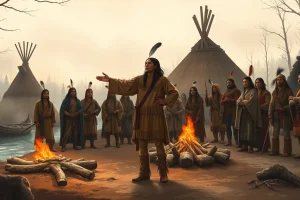
The Seven Nations were not seven distinct nations but seven communities or towns: the Huron-Wendat of Jeune-Lorette (Wendake), the Abenaki of Bécancour (Wôlinak) and Odanak, the Mohawk and Anishinabeg of Kanesatake, the Mohawk of Kahnawake (Caughnawaga), the Mohawk of Akwesasne, and the Oneida, Onondaga, and Cayuga of Oswegatchie. Most were Catholic mission communities shaped by French colonial policy and Jesuit missions, and many retained Mohawk, Abenaki, Algonquin, Huron, or Iroquoian languages and clan systems.
During the Seven Years’ War, the Seven Nations fought alongside New France. After the British conquest, they negotiated the Treaty of Kahnawake in 1760, which recognized their access between Canada and New York for trade. In the American Revolutionary War, they again largely supported Britain. By the early nineteenth century, however, their position was precarious. American settlement pressed on Indigenous lands, and the boundary between British North America and the United States cut through or near several communities. Britain’s Indian Department maintained alliances and distributed presents, but British officials often treated Indigenous allies as auxiliaries rather than sovereign partners.
When the United States declared war on Britain on June 18, 1812, Britain was absorbed by the Napoleonic Wars in Europe. British North America had few regular troops, so Governor-in-Chief Sir George Prevost and the Indian Department depended heavily on First Nations and Métis support. For the Seven Nations, the war offered a chance to defend their communities, reaffirm treaty relationships, and resist American expansion, though not all individuals or communities chose the same course.
What Happened
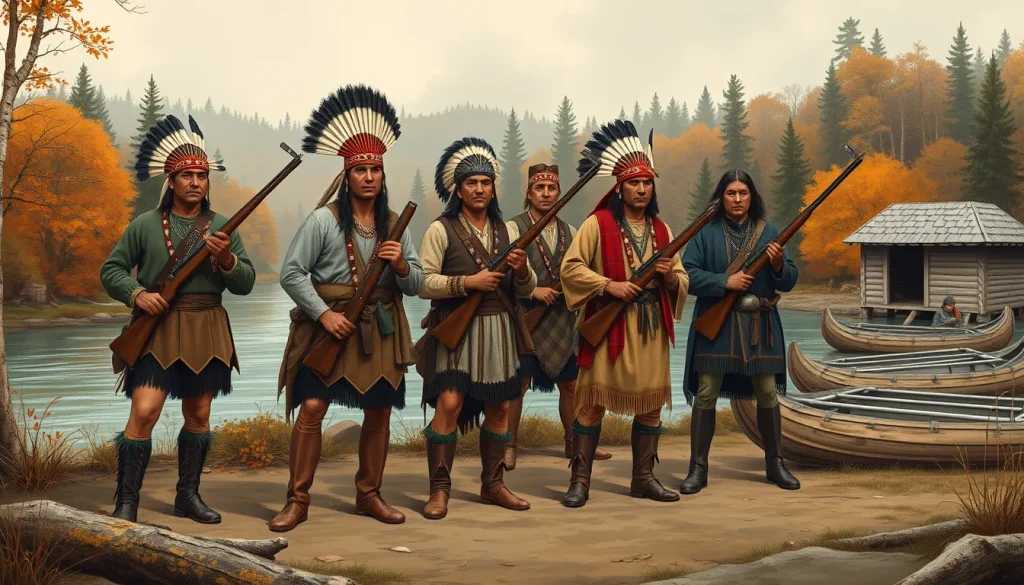
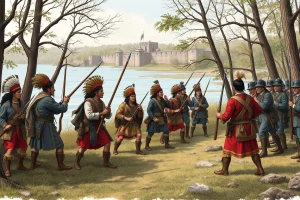
Mobilization began soon after the declaration of war. British Indian Department agents, officers, and interpreters called on First Nations communities in Lower Canada, including those of the Seven Nations. Warriors from communities such as Kahnawake, Akwesasne, Kanesatake, Odanak, Bécancour, and Wendake served in different ways: as scouts, guides, interpreters, boatmen, provisioners, and light infantry. Some were formally enrolled and paid; others served intermittently or through community obligations. Their service was rarely organized as a single Seven Nations regiment. Instead, it reflected the decisions of individual communities, councils, and leaders.
In 1812, the main fighting in the east centered on the Niagara frontier and the St. Lawrence corridor. Warriors from the Seven Nations communities, especially Mohawk from Kahnawake and Akwesasne, were involved in frontier defence and scouting. Some also served in Upper Canada, but the Seven Nations’ most distinctive contribution came in Lower Canada, where their knowledge of the St. Lawrence valley and its river routes was invaluable.
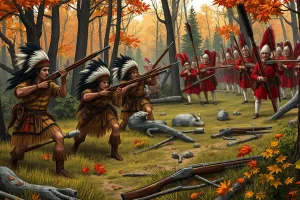
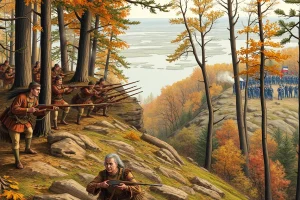
The decisive year was 1813. American forces planned a two-pronged campaign against Montreal: Major General Wade Hampton advanced from Lake Champlain, while Major General James Wilkinson moved down the St. Lawrence. On October 26, 1813, at the Battle of Châteauguay, Lieutenant-Colonel Charles-Michel de Salaberry’s force of Canadian Voltigeurs, militia, and Indigenous warriors stopped Hampton’s much larger army. The Indigenous contingent, including Mohawk and Algonquin from Kanesatake and other Seven Nations communities, operated in the woods and used war cries, flanking fire, and skirmishing to help convince the Americans they faced a larger force. The American retreat ended the southern threat to Montreal.
On November 11, 1813, at Crysler’s Farm near the St. Lawrence, British regulars, Canadian militia, and Indigenous scouts and warriors under Lieutenant-Colonel Joseph Wanton Morrison defeated Wilkinson’s rear guard. Again, First Nations fighters from the St. Lawrence valley contributed reconnaissance and harassment. In the Niagara theatre, Kahnawake Mohawk and Six Nations warriors took part in the Battle of Beaver Dams on June 24, 1813, where an American detachment under Lieutenant-Colonel Charles Boerstler surrendered after being surrounded and ambushed. Although the Seven Nations and the Six Nations were distinct confederacies, their communities were related by kinship and language, and individual Mohawk from Kahnawake served alongside Six Nations fighters.
By 1814, the war’s focus shifted to the Niagara frontier, Lake Champlain, and the Atlantic coast. Seven Nations warriors continued to serve in smaller actions, patrols, and defensive duties in Lower Canada. The Treaty of Ghent, signed December 24, 1814, ended the war without addressing Indigenous territorial guarantees or creating a sovereign Indigenous buffer state. News reached North America in early 1815.
Why It Matters
The Seven Nations’ participation helped protect Montreal and the St. Lawrence corridor in 1813, the most dangerous year for British North America. Their scouting, local knowledge, and skirmishing multiplied the effectiveness of a small British and Canadian force. At Châteauguay and Crysler’s Farm, their presence contributed to American defeats that shaped the war’s outcome in the east.
The war’s aftermath was bitter. Britain had promised to protect its Indigenous allies, but the Treaty of Ghent abandoned any firm guarantee of Indigenous lands or sovereignty. In the following decades, Seven Nations communities faced continuing encroachment, land loss, and pressure to assimilate. Many petitioned the Crown for compensation, reserve land, and recognition of their wartime service. Their wartime role became part of Canadian military memory, but it was often folded into a general narrative of “Indigenous allies” rather than acknowledged as the distinct diplomacy and sacrifice of the Seven Nations.
Historians disagree about how unified the Seven Nations were by 1812. Jean-Pierre Sawaya argues that the confederation remained a meaningful political and diplomatic body. John A. Dickinson and others contend that the evidence for a formal, centralized Seven Nations government is weak and that participation was mainly community-based. Most scholars now emphasize Indigenous agency: the Seven Nations were not simply pawns of British policy. They acted to defend their lands, trade, autonomy, and religious communities, even as they depended on British support.
Definition
The Seven Nations of Canada was a confederation of seven Catholic First Nations communities in the St. Lawrence valley, known in Mohawk as Tsiata Nihononhwentsiá:ke. Its membership included Huron-Wendat, Abenaki, Mohawk, Anishinabeg, Oneida, Onondaga, and Cayuga communities. It was distinct from the Six Nations (Iroquois Confederacy), although the two were closely related through Mohawk and other Iroquoian kinship ties.
Background
The confederation’s roots lay in the French colonial period, when Catholic missions drew Indigenous converts to settlements near Montreal, Trois-Rivières, and Quebec. After the British conquest of New France, the Seven Nations negotiated the Treaty of Kahnawake in 1760 and later allied with Britain during the American Revolution. By 1812, they were connected to Britain through the Indian Department, trade, and military alliances, but they also had their own grievances over land and sovereignty.
How It Worked
Seven Nations participation operated through British Indian Department agents, military officers, interpreters, and community leaders. Warriors were recruited from individual towns rather than through a single standing army. They served as scouts, guides, boatmen, and skirmishers, often fighting in wooded terrain where their marksmanship and mobility were effective. Some received pay, clothing, and provisions; others served through kinship and community obligation. The British valued them for intelligence, local knowledge, and the psychological effect of Indigenous warfare on American troops.
Competing Viewpoints
One debate concerns unity: did the Seven Nations act as a confederation in 1812, or did its communities make separate decisions? Sawaya emphasizes confederacy continuity; Dickinson argues the federation was looser and less documented. Another debate concerns motivation: were the Seven Nations driven mainly by British pressure and presents, or by their own diplomatic and territorial goals? Most recent scholarship stresses Indigenous initiative and the desire to resist American expansion. A third issue is scale: British records often undercount or omit Indigenous service, especially that of women, boatmen, and provisioners, so the full extent of participation is uncertain.
Role in the War of 1812
The Seven Nations’ most important military contribution came in Lower Canada and the St. Lawrence valley. At Châteauguay in October 1813, Indigenous warriors from the Seven Nations communities helped stop Hampton’s advance on Montreal. At Crysler’s Farm in November 1813, they served as scouts and skirmishers in Morrison’s victory over Wilkinson. In the Niagara region, Mohawk from Kahnawake fought at Beaver Dams and in other frontier actions. Throughout the war, Seven Nations people also supported British and Canadian forces as boatmen, guides, interpreters, and suppliers, roles that were essential but less visible in battle accounts.
Consequences and Historical Interpretation
The immediate consequence was military: Seven Nations participation helped save Montreal and maintain British control of the St. Lawrence. The longer consequence was political and social. The Treaty of Ghent did not secure Indigenous rights, and Britain’s postwar policy increasingly prioritized settler interests. Seven Nations communities continued to assert treaty rights and land claims, and their wartime service became a memory used both to claim recognition and to criticize British and Canadian neglect. Historians now treat their participation as evidence of Indigenous diplomacy and military agency, not merely as an auxiliary to British power.
Primary Sources
Contemporary evidence for Seven Nations participation is scattered across British military and Indian Department records. The most important are held in Library and Archives Canada, particularly RG 8 (British Military and Civil Records) and RG 10 (Indian Affairs). These include correspondence, muster rolls, pay lists, petitions, and agents’ reports. They show who was recruited, where they served, and what they were paid, but they are incomplete and reflect British administrative priorities. Indigenous voices appear mainly through interpreters, petitions, and oral traditions rather than in full transcripts.
Sir George Prevost’s correspondence and the papers of British Indian Department officers provide operational detail on Lower Canada and the St. Lawrence campaigns. For the Niagara theatre, John Norton’s journal offers a detailed Indigenous perspective on 1813, though Norton was a Six Nations war chief rather than a Seven Nations leader; it must be used carefully when discussing Seven Nations communities. Postwar petitions and memorials from Kahnawake, Akwesasne, and Kanesatake document grievances over land, compensation, and recognition. The Government of Canada’s commemorative exhibit “Indigenous Contributions to the War of 1812” reproduces images and summaries but is an official public-history source, not a neutral archive.
Further Reading
- Allen, Robert S. His Majesty’s Indian Allies: British Indian Policy in the Defence of Canada, 1774–1815. Toronto: Dundurn Press, 1992.
- Benn, Carl. The Iroquois in the War of 1812. Toronto: University of Toronto Press, 1998.
- Sawaya, Jean-Pierre. La Fédération des Sept Feux de la vallée du Saint-Laurent, XVIIe–XIXe siècle. Sillery: Septentrion, 1998.
- Government of Canada. “Exhibit: Indigenous Contributions to the War of 1812.” Crown-Indigenous Relations and Northern Affairs Canada.
- Library and Archives Canada. Indian Affairs records (RG 10) and British Military and Civil Records (RG 8).
References
- Government of Canada. “Exhibit: Indigenous Contributions to the War of 1812.” Crown-Indigenous Relations and Northern Affairs Canada. https://www.rcaanc-cirnac.gc.ca/eng/1348771334472/1607906032957.
- Wikipedia. “Seven Nations of Canada.” https://en.wikipedia.org/wiki/Seven_nations_of_canada.
- Allen, Robert S. His Majesty’s Indian Allies: British Indian Policy in the Defence of Canada, 1774–1815. Toronto: Dundurn Press, 1992.
- Benn, Carl. The Iroquois in the War of 1812. Toronto: University of Toronto Press, 1998.
- Sawaya, Jean-Pierre. La Fédération des Sept Feux de la vallée du Saint-Laurent, XVIIe–XIXe siècle. Sillery: Septentrion, 1998.
FAQ
Did the Seven Nations of Canada fight as a single unified army in the War of 1812?
No. Participation was organized mainly at the community level, through individual towns, councils, and leaders working with British Indian Department agents. The Seven Nations did not field one centralized regiment.
Which battles did the Seven Nations of Canada take part in?
Warriors from Seven Nations communities were most active in Lower Canada and the St. Lawrence valley, including the Battle of Châteauguay in October 1813 and the Battle of Crysler's Farm in November 1813. Mohawk from Kahnawake also fought at Beaver Dams and in other Niagara frontier actions.
Why did the Seven Nations of Canada side with Britain?
They acted from a mix of treaty obligations, long-standing alliances, trade connections, and a desire to defend their lands and autonomy against American expansion. British presents, provisions, and military support also mattered, but Indigenous communities made their own decisions.
What happened to the Seven Nations after the War of 1812?
The Treaty of Ghent did not secure Indigenous land or sovereignty guarantees. In the postwar years, Seven Nations communities faced continued settler encroachment and land loss, and many petitioned the Crown for compensation and recognition of their wartime service.
Leave a Reply