Short Answer
The War of 1812 (1812–1815) saw Indigenous peoples play crucial military roles on both sides, yet official battle reports portrayed them in widely divergent ways. American commanders and newspapers often characterized Indigenous allies as “savages” and emphasized atrocities, while British reports tended to acknowledge their skill, scouting abilities, and indispensable contribution to victory. These portrayals were not neutral descriptions but served propaganda purposes, influencing public opinion, recruitment, and the treatment of Indigenous nations during and after the conflict.
Historical Context
Indigenous peoples in the Great Lakes and Ohio Valley had long experienced pressure from American expansion. After the Revolution, many nations, especially those who had allied with Britain, moved into Canada. During the War of 1812, the British actively courted Indigenous alliances, most notably through Tecumseh’s confederacy, while some nations, such as the Seneca and Tuscarora from western New York, fought alongside the United States. Battle reports—official dispatches from generals and naval commanders, published in newspapers and read by politicians and the public—became the primary vehicle through which these allies were presented to each side’s home audience. The reports reflected and reinforced existing stereotypes and political needs.
What Happened
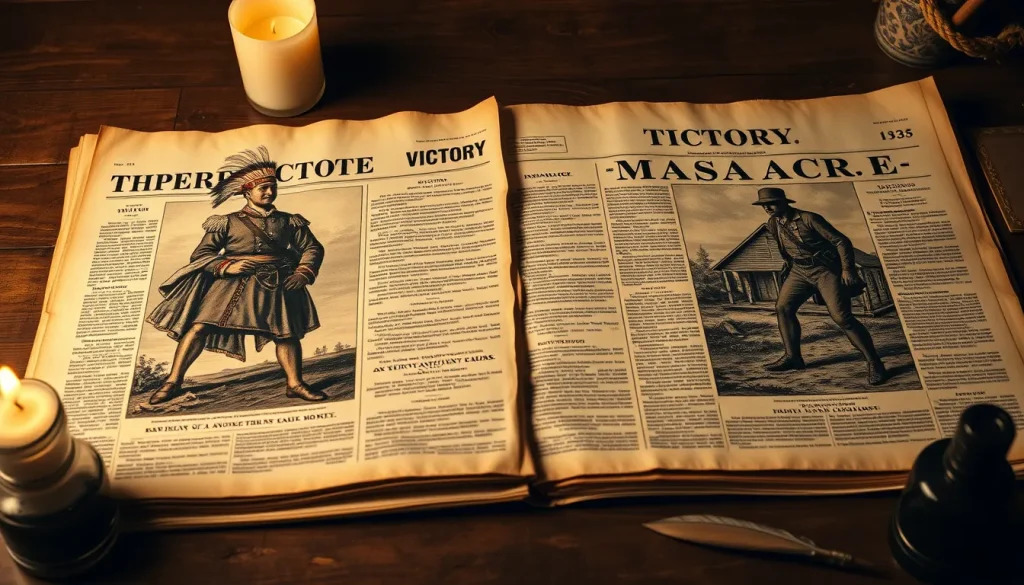
Key battles such as the capture of Fort Detroit (August 1812), the Battle of Frenchtown (January 1813), the defense of Fort Meigs (May 1813), the Battle of Chippawa (July 1814), and the Battle of Lundy’s Lane (July 1814) all saw Indigenous involvement on one or both sides. British reports, such as those from Isaac Brock and Henry Procter, often credited Indigenous warriors with vital scouting, skirmishing, and psychological intimidation. American reports, from William Henry Harrison and others, frequently described Indigenous fighters as “merciless savages” and used their participation to galvanize public anger. Newspaper editors amplified these characterizations, sometimes exaggerating incidents like the River Raisin massacre for propagandistic effect.
Why It Matters
The contrasting portrayals affected military decisions: the American government hesitated to employ Indigenous allies for fear of moral condemnation, while the British exploited the fear of “Indian massacres” to induce surrenders. Post-war, these stereotypes contributed to U.S. policies of Indian removal and the denial of Indigenous sovereignty. For historians, analyzing these portrayals reveals how race, fear, and propaganda intersected in wartime discourse.
Definition
Battle reports are official accounts of military operations, usually written by commanding officers, that were subsequently published in newspapers, read aloud in legislatures, and circulated among the public. “Portrayal” refers to the language, imagery, and emphasis used to describe Indigenous participants—whether as noble allies, indispensable auxiliaries, or barbaric threats.
Background
By 1812, the image of Indigenous warriors in American and British minds had been shaped by centuries of colonial warfare, often depicting them as either “noble savages” or “bloodthirsty savages.” During the War of 1812, both sides had practical reasons to shape these images. Britain needed Indigenous allies to defend Canada and relied on their effectiveness, while the United States, still traumatized by frontier warfare, used reports of Indigenous “atrocities” to justify the war and mobilize volunteers.
How It Worked
Official reports were typically sent from the field to the War Department or Admiralty, then published in national and local newspapers. General orders and proclamations also contained language about Indigenous allies. For instance, British reports from the capture of Detroit praised the “Indian warriors” for their “exertions,” while American reports of the same event lamented the “shocking massacre” following the surrender. Newspapers like Niles’ Weekly Register reprinted these dispatches, and editorial commentary added further color. American reports often employed the term “savages” and recounted scalping and mutilation, whereas British reports used terms like “brave” and “useful” but also sometimes implied that Indigenous warriors were difficult to control.
Competing Viewpoints
Historians have noted that British reports, while appreciative, often treated Indigenous allies as tools rather than equals, and sometimes expressed embarrassment about their methods. American reports were more likely to dehumanize the enemy by calling for “extermination.” Meanwhile, Indigenous perspectives themselves are rarely recorded in these official documents. Some American officers, such as Colonel Peter B. Porter, recognized the value of allied Seneca warriors and lobbied for their use, but the general tone remained negative.
Role in the War of 1812
These portrayals directly impacted military events. The British used the fear of Indigenous attacks to induce American surrenders—most notably at Detroit and Frenchtown. American reports of such “massacres” as the River Raisin became rallying cries (“Remember the Raisin!”) and intensified the war effort. Conversely, the American public’s revulsion at using Indigenous allies limited their deployment, though some nations fought for the U.S. and were often written out of official accounts or marginalized.
Consequences and Historical Interpretation
The wartime portrayals cemented long-lasting stereotypes. Post-war, U.S. policies of Indian removal were justified by presenting Indigenous peoples as obstacles to civilization. British reports, while more positive, still contributed to a paternalistic view that Indigenous people needed British protection. Scholars now recognize that battle reports were not objective but served domestic and diplomatic goals. They also obscure the actual complexity of Indigenous motivations and contributions.
Primary Sources
Important primary sources include: British General Isaac Brock’s dispatches to the governor-general of Canada (1812) praising his Indigenous allies; American General William Henry Harrison’s reports on the River Raisin and Fort Meigs (1812-1813); the official report of the Battle of Chippawa (1814) by Major General Jacob Brown, which mentions the role of Seneca allies. Newspapers such as Niles’ Weekly Register in Baltimore and The Times in London reprinted and editorialized these reports. Each source must be read with attention to its author’s rank, nationality, and intended audience.
Further Reading
- Donald R. Hickey, The War of 1812: A Forgotten Conflict (University of Illinois Press, 1989).
- Peter Stark, Tecumseh’s Vision (Henry Holt, 2013).
- Carl Benn, The Iroquois in the War of 1812 (University of Toronto Press, 1998).
- Robert S. Allen, His Majesty’s Indian Allies: British Indian Policy in the Defence of Canada, 1774-1815 (Dundurn, 1992).
- The War of 1812 Digital Archive, online at war1812.org.
References
- Betke, Tyla C. “Competing Ideas of Empire: British Perceptions of Their Six Nations Allies in the Seven Years’ War.” USURJ 3, no. 2 (2017). https://doi.org/10.32396/usurj.v3i2.246.
- Makos, Isaac. “Roles of Native Americans during the Revolution.” American Battlefield Trust, April 2021. https://www.battlefields.org/learn/articles/roles-native-americans-during-revolution.
- Winfield, Mason. “Guerrillas in a Thrilla: The Battle of Chippawa, Part 2.” Buffalo Rising, August 2014. Republished at https://buffaloah.com/a/h/war1812/mw/mw5/mw5.html.
- Parmenter, Jon. “After the Mourning Wars: The Iroquois as Allies in Colonial North American Campaigns, 1676-1760.” Paper presented at the Omohundro Institute, 2007.
- Palma, Eileen Mary. “An ‘artful Misrepresentation’ of affairs: Alleged British atrocities in American colonial newspapers during the War of Independence.” PhD diss., University of Leeds, 2024.
FAQ
Why did American battle reports depict Indigenous allies as savages?
American reports often employed the 'savage' stereotype to justify the war, rally public anger, and mask military setbacks. They emphasized atrocities such as the River Raisin massacre to portray the enemy as beyond the bounds of civilized warfare.
How did British reports differ from American reports?
British reports tended to praise Indigenous allies for their courage and effectiveness, but also sometimes expressed reservations about their methods. They used the fear of Indigenous attacks to induce surrenders, but did not rely as heavily on dehumanizing language.
What were the consequences of these portrayals?
These portrayals shaped public opinion, influenced military decisions, and contributed to post-war U.S. policies of Indian removal. They also reinforced paternalistic British views that justified continued control over Indigenous lands.
Leave a Reply