
Short Answer
The USS Lawrence was a United States Navy brig launched at Erie, Pennsylvania, on 24 May 1813, and served as Commodore Oliver Hazard Perry’s flagship during the Battle of Lake Erie on 10 September 1813. Though heavily damaged and forced to strike her flag, that act did not concede the day; Perry shifted his command to the sister ship USS Niagara and won an American victory that secured Lake Erie. The ship’s name honored Captain James Lawrence, whose last words became a naval battle cry and adorned Perry’s personal battle flag.
Historical Context
During the opening months of the War of 1812, control of the Great Lakes was a vital strategic concern for both the United States and Great Britain. British forces held Detroit and had established naval supremacy on Lake Erie, which threatened American supply routes and exposed the Northwest frontier. To counter this, Secretary of the Navy William Jones ordered the construction of a fresh-water squadron at Presque Isle (now Erie, Pennsylvania) under the supervision of shipbuilders Adam and Noah Brown. In March 1813, Oliver Hazard Perry arrived to oversee the fitting-out of the brigs, though he had previously been on sea-going service. The keels of Lawrence and her sister Niagara were laid in early 1813, amid limited resources, a remote location, and the constant threat of British attack.
What Happened
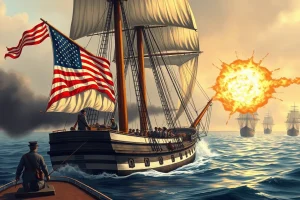
Lawrence was launched on 24 May 1813 and commissioned in August. She was named in honor of Captain James Lawrence, who had been fatally wounded on 1 June 1813 during the frigate action between USS Chesapeake and HMS Shannon. On 10 September 1813, Perry’s squadron, comprising Lawrence, Niagara, and seven gunboats, encountered the British squadron commanded by Commander Robert Heriot Barclay near South Bass Island. Perry formed his line with Lawrence in the lead, flying his blue battle flag emblazoned with “DONT GIVE UP THE SHIP.”
During the engagement, the British concentrated their fire on Lawrence, killing and wounding many of her crew. Despite heavy losses, Perry’s ship delivered effective carronade fire at close range. The Niagara under Commander Jesse D. Elliott initially stayed outside the battle, leaving Lawrence exposed. After two hours, Lawrence had been so badly crippled that she could no longer maneuver or resist effectively. Perry then took her small boat to the undamaged Niagara, boarded her, and sailed through the British line, forcing the surrender of Barclay’s entire squadron. Later that day, Perry returned to the shattered Lawrence to receive the British officers’ formal surrender.
Why It Matters
The American victory at Lake Erie gave the United States undisputed control of the lake, enabling Major General William Henry Harrison’s army to be transported to the Canadian shore and leading to the decisive Battle of the Thames on 5 October 1813. It restored American morale after a year of defeats and removed the British naval threat to the Northwest. For the USS Lawrence specifically, her sacrifice and Perry’s bold transfer became legendary. The ship herself was not preserved as a national monument until much later, but her battle record formed part of the larger story of American naval triumph. Historians have debated Jesse Elliott’s conduct and Perry’s tactical decisions, but the outcome is universally credited as one of the most important American victories of the war.
Type and Construction
Lawrence was of the Niagara class, a two-masted brig (or ‘snow’) constructed quickly for fresh-water service. She displaced 493 tons, measured 109 feet 9 inches (33.5 m) in length, 32 feet (9.8 m) in beam, and drew only 4 feet 8 inches (1.4 m). Her light draft was suited to the shallow waters of Lake Erie and Presque Isle Bay. She was built of pine and oak, with an emphasis on speed and heavy armament rather than long-range endurance.
Nation
United States of America (United States Navy).
Armament
Her main battery consisted of two long 12-pounder guns and eighteen short 32-pounder carronades. The carronades were close-range guns used to devastating effect at Lake Erie, but their short barrels limited accuracy at longer distances.
Crew
The ship’s complement was approximately 134 officers and men. Many of Perry’s crew were volunteers from Newport, Rhode Island, where Perry had previously commanded gunboats, but by September 1813 the crews were supplemented with soldiers and sailors drawn from other stations. High casualties at Lake Erie were reported, though exact numbers for Lawrence alone are uncertain.
Commander
Oliver Hazard Perry, then a Master Commandant, commanded the American squadron and used Lawrence as his flagship until he transferred to Niagara when Lawrence became unmanageable.
Engagements
The ship’s principal action was the Battle of Lake Erie (10 September 1813). Earlier in August 1813, Lawrence participated in operations to prevent British supplies from reaching Upper Canada, but she had no separate combat action before the battle.
Fate
After the War of 1812, Lawrence was placed in reserve. She was sunk in Misery Bay, Presque Isle, Pennsylvania, in 1815 to protect her hull from decay. The hulk was sold in 1825 but remained submerged for decades. In 1875 the remains were raised and transported to Philadelphia for the United States Centennial Exhibition of 1876. The ship’s sections were displayed to show her plan, but the exhibit was destroyed by fire in December 1876.
Primary Sources
Oliver Hazard Perry’s official report to Major General William Henry Harrison, dated 10 September 1813, is the central American account; it announced the capture of the British squadron and contains the sentence famously quoted as ‘We have met the enemy and they are ours.’ The British perspective is provided by Commander Barclay’s report to Vice-Admiral Sir James Yeo, written after the battle, which details losses and the condition of his squadron. The muster rolls of Lawrence are preserved in the National Archives. The court-martial testimony of Commander Jesse D. Elliott, who faced charges regarding his conduct in the battle, is also an important primary source, though it must be consulted carefully because of its defensive tone.
Further Reading
- Skaggs, David C., and William H. B. Turner (eds.), The Battle of Lake Erie and Its Aftermath: A Reassessment (Kent State University Press, 1991).
- Frew, David, Perry’s Lake Erie Fleet: After the Glory (Arcadia Publishing, 2012).
- Skaggs, David C., Oliver Hazard Perry: Honor, Courage, and Patriotism in the Early U.S. Navy (Naval Institute Press, 2006).
- Cruikshank, E. A. (ed.), The Documentary History of the Campaign upon the Niagara Frontier (1899–1908).
References
- “USS Lawrence (1813),” Wikipedia, accessed 2025, https://en.wikipedia.org/wiki/USS_Lawrence_(1813).
- Bancroft, George, “Oliver Hazard Perry and the Battle of Lake Erie,” Rhode Island Historical Series, vol. 1 (1912), https://digitalcommons.providence.edu/ri_history/2.
- Frew, David, Perry’s Lake Erie Fleet: After the Glory (Arcadia Publishing, 2012), ISBN 978-1609496104.
- Skaggs and Turner, eds., The Battle of Lake Erie and Its Aftermath (Kent State University Press, 1991).
FAQ
Why was the USS Lawrence named after James Lawrence?
She was named for Captain James Lawrence, a United States Navy officer fatally wounded in June 1813 aboard USS Chesapeake. His last words became a celebrated motto.
What happened to the USS Lawrence after the Battle of Lake Erie?
After the war she was sunk in Misery Bay in 1815, later raised for the 1876 Centennial Exhibition, and finally destroyed by fire in December 1876.
How successful was the USS Lawrence during the Battle of Lake Erie?
Lawrence became heavily damaged and was forced to strike her flag, but the British never took possession; Perry shifted to Niagara and won the battle, making Lawrence a symbol of sacrifice.

Leave a Reply