
Short Answer
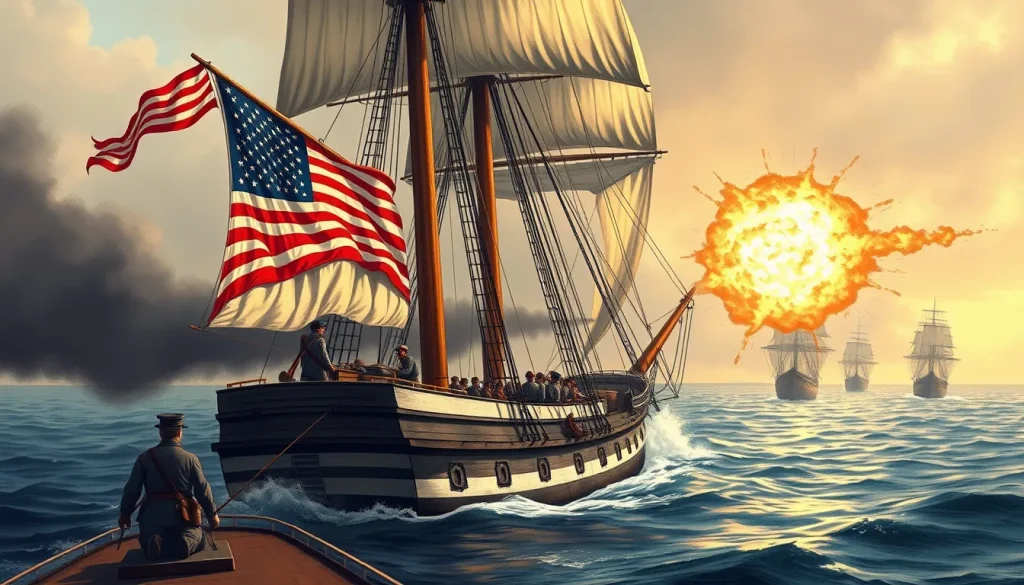
USS Niagara, a 20-gun snow-brig of the United States Navy, served as the relief flagship of Master Commandant Oliver Hazard Perry during the Battle of Lake Erie on 10 September 1813. After Perry transferred his flag from the shattered brig Lawrence, Niagara passed through the enemy line and compelled the surrender of the British squadron. This victory gave the United States uncontested control of Lake Erie, severed British supply lines, and set the stage for the Battle of the Thames.
Historical Context
During the War of 1812, both the United States and Great Britain recognized that control of the Great Lakes was essential for supplying military forces and Indigenous allies in the northwest. The British held posts at Detroit and Amherstburg, supplied via Lake Erie, while the Americans sought to cut that supply route. In early 1813, a shipbuilding race began: the Americans constructed vessels at Presque Isle (present-day Erie, Pennsylvania) under the direction of Noah Brown, while the British built at Amherstburg. The American squadron, including Niagara and her sister ship Lawrence, was launched in the spring and summer of 1813. British commander Robert Heriot Barclay, who had lost an arm at Trafalgar, commanded a smaller but long-gun-armed force. The strategic importance of Lake Erie meant that the two fleets were destined to clash.
What Happened
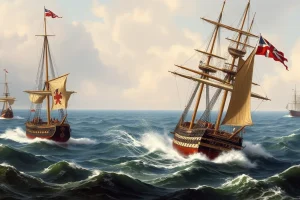
At dawn on 10 September 1813, Perry’s squadron—nine vessels—sighted Barclay’s six vessels near Put-in-Bay. The Americans held a superiority in short-range carronades, while the British had more long guns. For over two hours, Perry maneuvered to close the range, but the British long guns inflicted heavy damage on his flagship Lawrence. By early afternoon, Lawrence was crippled, with most of her crew killed or wounded. Perry then transferred his flag to Niagara, which had been held in reserve under Captain Jesse Elliott. Taking command, Perry ordered Niagara to break through the British line. With her 32-pounder carronades firing raking broadsides at close range, Niagara severely damaged the British flagship Detroit and Queen Charlotte. Within an hour, all six British vessels struck their colours. Perry’s dispatch to General William Henry Harrison—”We have met the enemy and they are ours”—encapsulated the victory.
Why It Matters
The Battle of Lake Erie was one of the most decisive naval actions of the War of 1812. Niagara‘s role was pivotal: had Perry been unable to transfer his flag and break the line, the battle might have been lost. The American victory forced the British to abandon Detroit and Amherstburg, leading directly to the Battle of the Thames on 5 October 1813, where the American army defeated the retreating British and their Indigenous allies, including Tecumseh, who was killed. Control of Lake Erie also allowed the United States to secure the northwest frontier and boosted national morale. Historically, the battle and Niagara‘s part in it have been celebrated as examples of personal courage and tactical initiative. However, historians have debated the actions of Captain Elliott, who held Niagara back early in the battle, and the extent to which Perry’s decision to transfer was the deciding factor. The battle’s legacy is reflected in the preservation of Niagara as a museum ship and the Perry’s Victory and International Peace Memorial at Put-in-Bay.
Type and Construction
Niagara was a snow-brig, a two-masted vessel with square rigging on both masts and a trysail mast abaft the mainmast. She measured approximately 110 feet 8 inches between perpendiculars, with a beam of 32 feet and a depth of hold of 9 feet. Her tonnage was recorded as 492 60/95 tons burthen. Constructed at Presque Isle, Erie, Pennsylvania, from 1812 to 1813, she was built under the supervision of shipwright Noah Brown. The hull was made of black oak, with timbers joined by wooden treenails due to a shortage of iron. Niagara was launched on 13 June 1813, one of two brigs ordered for the Lake Erie fleet.
Nation
United States of America. She was part of the United States Navy, built for service on the Great Lakes.
Armament
Niagara carried 20 guns: 18 × 32-pounder carronades and 2 × 12-pounder long guns. The carronades were short-range but devastating at close quarters, while the long guns provided longer-range fire. Her crew complement was officially 155 officers and enlisted men.
Crew
The crew of Niagara at the Battle of Lake Erie consisted of a mix of regular sailors, landsmen, and volunteers. Perry had drawn from the Army of the Northwest and militia to fill out his crews. Captain Jesse Elliott commanded Niagara during the battle, with a crew that performed effectively once the vessel was brought into action.
Commander
At the Battle of Lake Erie, Niagara was commanded by Master Commandant Jesse Elliott. However, after Oliver Hazard Perry transferred his flag from Lawrence to Niagara around 2:30 p.m., Perry assumed direct command. Elliott volunteered to bring the schooners into closer action, leaving Perry in charge of the brig. Prior to the battle, Niagara was under Elliott’s command during the fleet’s construction and early operations.
Engagements
Niagara participated in the Battle of Lake Erie on 10 September 1813, her only major engagement. After the battle, she served on Lake Erie and later in the war, but saw no further combat. She was part of Perry’s squadron that enforced American control of the lake.
Fate
After the War of 1812, Niagara was laid up and subsequently sunk for preservation in 1820 at Presque Isle. In 1913, she was raised and rebuilt for the centennial of the battle. Additional restorations took place in the 1930s and 1963. A major restoration in 1988 replaced much of the original material, leading some to consider her a replica. Today, the U.S. Brig Niagara is a museum ship docked at the Erie Maritime Museum in Erie, Pennsylvania, and is the official state ship of Pennsylvania. She also travels the Great Lakes as a sailing school vessel.
Primary Sources
Official reports from the Battle of Lake Erie provide the most direct contemporary accounts. Master Commandant Oliver Hazard Perry’s dispatch to Secretary of the Navy William Jones, dated 13 September 1813, describes the action and specifically mentions Niagara and Elliott’s role. Perry wrote that after his transfer, “the Niagara being very little injured, I determined to pass through the enemy’s line.” Captain Jesse Elliott also submitted a report, and both were published in the Navy Department records. Another useful source is the diary of Samuel Hambleton, a purser in Perry’s squadron, which records the making of Perry’s “Don’t Give Up the Ship” flag and details of the battle. These sources are available in the American State Papers and at the National Archives.
Further Reading
- Hickey, Donald R. The War of 1812: A Forgotten Conflict. University of Illinois Press, 1989.
- Lambert, Andrew. The Challenge: Britain Against America in the Naval War of 1812. Faber and Faber, 2012.
- Altoff, Gerard T. Amongst My Best Men: African-Americans and the War of 1812. The Perry Group, 1996.
- National Park Service. “The Battle of Lake Erie.” Perry’s Victory & International Peace Memorial. https://www.nps.gov/pevi/learn/historyculture/battle_erie_detail.htm
- United States Navy. “USS Niagara (1813).” Naval History and Heritage Command. https://www.history.navy.mil/
References
- National Park Service. “The Battle of Lake Erie.” Perry’s Victory & International Peace Memorial. Accessed 2023. https://www.nps.gov/pevi/learn/historyculture/battle_erie_detail.htm.
- Perry, Oliver Hazard. “Official Report to Secretary of the Navy William Jones,” 13 September 1813. In American State Papers, Naval Affairs, vol. 1. Also available at https://www.ibiblio.org/pha/USN/1813/18131231LakeErie.html.
- Wikipedia. “USS Niagara (1813).” Accessed 2023. https://en.wikipedia.org/wiki/USS_Niagara_(1813).
- Hickey, Donald R. The War of 1812: A Forgotten Conflict. University of Illinois Press, 1989.
FAQ
Why is USS Niagara important at the Battle of Lake Erie?
Because after Perry's original flagship Lawrence was disabled, Niagara, under Perry's direct command, broke through the British line and delivered the decisive broadsides that forced the British squadron to surrender.
What happened to USS Niagara after the war?
She was sunk for preservation in 1820, raised in 1913, and underwent multiple restorations. She is now a museum ship in Erie, Pennsylvania.
Who commanded USS Niagara during the battle?
Master Commandant Jesse Elliott commanded her early in the battle. After Perry came aboard, Perry took command and Elliott volunteered to handle the schooners.


Leave a Reply