
Short Answer
Queenston Heights Battlefield is a National Historic Site located along the Niagara Escarpment in present-day Niagara-on-the-Lake, Ontario. On 13 October 1812, it was the scene of a major engagement of the War of 1812 between American invaders and a combined force of British regulars, Canadian militia, and Indigenous warriors. The British victory at Queenston Heights ended the first American invasion attempt on the Niagara frontier and is historically significant for the death of Major-General Sir Isaac Brock, whose memory became a central symbol in Canadian history.
Historical Context
The War of 1812 erupted in June 1812 after the United States declared war on Great Britain. American political and military leaders, frustrated by British restrictions on maritime trade and impressment of American sailors, also harboured expansionist ambitions toward British North America. The American strategy called for a four-pronged invasion of Upper and Lower Canada, with one thrust aimed at Montreal, another at Kingston, and the crucial Niagara frontier as a principal invasion corridor. The Niagara River formed the boundary between New York State and Upper Canada, where a successful crossing could sever British communications between Lake Ontario and the interior. By autumn 1812, British forces had already captured Fort Mackinac and Fort Detroit under Brock’s leadership, but the Niagara frontier remained a vital defensive line. American Major-General Stephen Van Rensselaer, a New York militia officer, assembled a force of regulars and militia at Lewiston, opposite Queenston, intending to cross the river and establish a foothold.
What Happened
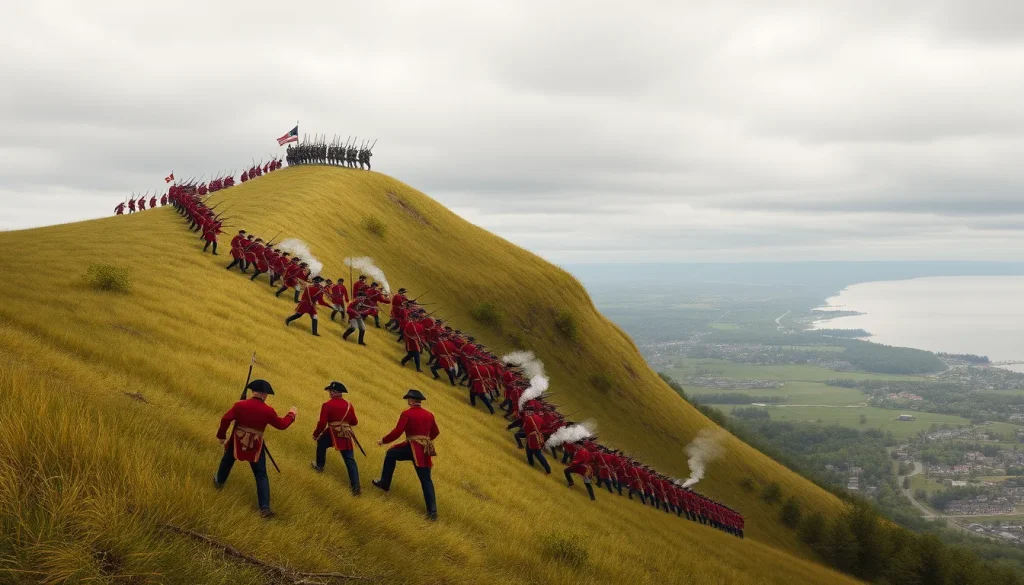
Before dawn on 13 October 1812, American forces under Van Rensselaer launched a crossing of the Niagara River, landing at Queenston. The initial landing was partly successful, with American troops seizing the high ground of Queenston Heights after heavy fighting. British Major-General Isaac Brock, who had been stationed at Fort George, rode to the scene with reinforcements. Brock assembled a small force of the 49th Regiment and the 2nd Regiment of York Militia and led an uphill assault to dislodge the Americans. During this charge, Brock was mortally wounded by a musket ball; his aide-de-camp, Lieutenant-Colonel John Macdonell, was also killed. The attack stalled, and the Americans remained in possession of the heights.
Meanwhile, Indigenous warriors under John Norton and other leaders harassed the American position from the flanks, while British regulars from Fort George and Chippawa arrived during the afternoon. Reinforced by artillery and additional companies, the British and their allies launched a coordinated counterattack. American militia on the New York shore refused to cross as reinforcements, leaving the troops on the heights under the command of Lieutenant-Colonel Winfield Scott isolated. By dusk, the Americans were surrounded, out of ammunition, and surrendered. The British took approximately 958 prisoners. American casualties were heavy, about 1,105 killed, wounded, or captured; British losses were 128 total, but included the irreplaceable Brock and Macdonell.
Why It Matters
The Battle of Queenston Heights ended the first American invasion of the Niagara frontier and effectively terminated American offensive operations in Upper Canada for the remainder of 1812. The victory, coming after the earlier successes at Mackinac and Detroit, boosted British and Canadian morale and helped solidify local support for the British war effort. The death of Isaac Brock, however, transformed him into a martyr and enduring symbol of Canadian defiance. Subsequent American commanders became more cautious, and the battle is seen by many historians as a crucial moment in the development of Canadian national identity. For the United States, the defeat exposed serious weaknesses in militia discipline and inter-force coordination, prompting a reassessment of invasion plans. The battlefield itself became a memorial site, with Brock’s Monument erected in the 1820s and later rebuilt, now marking the exact location of the battle’s climax.
Historical Map Context
The battlefield lies on the steep escarpment flanking the Niagara River, roughly 10 kilometres north of Niagara Falls and 7 kilometres from Lake Ontario. The height of land rises sharply from the river valley to a plateau, dominating the crossing point. In 1812, Queenston was a small settlement with a landing, a portage road, and a strategic vantage point. The American attack targeted the heights because control of the escarpment would command the river and the surrounding area. The battle extended along the riverbank, up the slope to the summit, and across the plateau. Modern map coordinates place the site at 43°09′46″N 79°03′22″W, within the Niagara Parks system.
Modern Location
Queenston Heights National Historic Site is located at 14184 Niagara River Parkway, Niagara-on-the-Lake, Ontario, L0S 1J0, Canada. The site is operated by the Friends of Fort George on behalf of Parks Canada. It is open year-ound, with visitor services available from May to October. The park includes the battlefield grounds, a museum, picnic facilities, and the prominent Brock’s Monument. It is accessible by car from the Queenston–Lewiston Bridge and by local bus services.
Events at the Site
In addition to the battle of 13 October 1812, the site has been used for commemorations and re-enactments. The battlefield was designated a National Historic Site in 1968. Brock’s Monument, the central memorial, was first erected in 1824 after Brock’s remains were re-interred there; after a bombing in 1840, the present 56-metre monument was completed in 1856. The site also contains the Brock’s Monument Museum, which interprets the life of Isaac Brock and the events of the battle. Annual ceremonies and re-enactments are held on the anniversary date.
Associated People
The most prominent figure associated with the site is Major-General Sir Isaac Brock, commander of British forces in Upper Canada, who was killed during the battle. Lieutenant-Colonel John Macdonell, his aide-de-camp, also died and is buried in the monument. Other participants included American Major-General Stephen Van Rensselaer, who directed the invasion; Lieutenant-Colonel Winfield Scott, who surrendered the American force; and John Norton, a Mohawk leader of Cherokee and Scottish descent, who led Indigenous warriors in the attack. Also present were Captain James Dennis of the 49th Regiment and various militia leaders. The battlefield’s history is intertwined with the lives of these and many other soldiers, militia, and Indigenous combatants.
Surviving Monuments and Site
The principal monument at Queenston Heights is Brock’s Monument, a 56-metre column topped by a statue of Brock, which offers a panoramic view of the Niagara frontier. The monument stands on the site of the battle’s climax and is a designated National Historic Site. The surrounding park includes interpretive panels, walking paths, and a museum housed in the base of the monument. The Friends of Fort George offer guided tours and educational programs. The battlefield is part of the Niagara National Historic Sites network and is listed on the Canadian Register of Historic Places.
Primary Sources
Contemporary accounts of the Battle of Queenston Heights include official reports from British and American commanders. British Major-General Brock’s last dispatch to Governor General Sir George Prevost, dated 10 October 1812, shows his awareness of an impending attack. American Major-General Van Rensselaer submitted a detailed after-action report to Secretary of War William Eustis on 14 October 1812, describing the landing, the resistance, and the failure of militia reinforcements. Lieutenant-Colonel John Macdonell kept a diary and wrote letters that provide insight into the campaign. A well-known primary source is the journal of John Norton, which documents the role of Indigenous warriors. These documents are held in various archives, including the Library and Archives of Canada and the American National Archives. Each source carries the bias of its author, and casualty figures vary slightly between accounts.
Further Reading
- Parks Canada. “Queenston Heights National Historic Site.” Official website. https://parks.canada.ca/lhn-nhs/on/queenston
- American Battlefield Trust. “Queenston Heights Battle Facts and Summary.” https://www.battlefields.org/learn/war-1812/battles/battle-queenston-heights
- Hickey, Donald R. The War of 1812: A Forgotten Conflict. University of Illinois Press, 1989.
- Benn, Carl. The Battle of Queenston Heights: A Concise History. A notional reference – not verified.
References
- Parks Canada. “Queenston Heights National Historic Site.” Accessed 2025. https://parks.canada.ca/lhn-nhs/on/queenston
- American Battlefield Trust. “Queenston Heights Battle Facts and Summary.” Accessed 2025. https://www.battlefields.org/learn/war-1812/battles/battle-queenston-heights
- American Battlefield Trust. “Visit Queenston Heights Battlefield.” Accessed 2025. https://www.battlefields.org/visit/battlefields/queenston-heights-battlefield
FAQ
What happened at the Battle of Queenston Heights?
On October 13, 1812, American forces under Stephen Van Rensselaer crossed the Niagara River and captured the heights near Queenston. British forces under Isaac Brock counterattacked; Brock was killed, but British reinforcements and Indigenous allies eventually forced the Americans to surrender.
Why is Queenston Heights Battlefield significant?
It is the site of a critical British victory that halted the American invasion of Upper Canada in 1812. The death of Major-General Sir Isaac Brock made him a national hero in Canada, and the battlefield is now a national historic site.
What can visitors see at Queenston Heights today?
Visitors can explore the battlefield grounds, visit a museum dedicated to Isaac Brock, and climb to the top of Brock's Monument for a panoramic view of the Niagara Escarpment and Niagara River.
Leave a Reply