
Short Answer
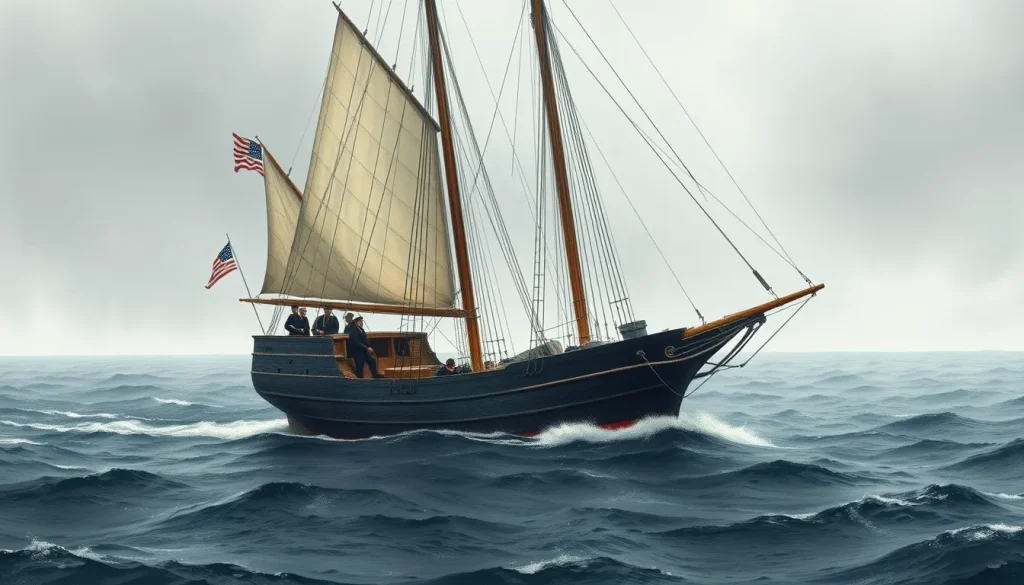
USS Wasp, a 22-gun sloop-of-war of the United States Navy commanded by Master Commandant Johnston Blakeley, sailed from Portsmouth, New Hampshire, on 1 May 1814 on a commerce-raiding cruise into the English Channel and the eastern Atlantic. She captured or destroyed a long list of British vessels, defeated two Royal Navy sloops in single-ship actions, and then disappeared. The last confirmed contact with the ship came on 9 October 1814, and no authentic report of her fate ever reached the United States. Because contemporaries and later writers often called her “Blakeley’s sloop,” her loss became one of the most discussed naval mysteries of the War of 1812 and removed from the war one of the most effective American cruisers of the conflict.
Note on scope: This article concerns the Wasp of 1814, the vessel commanded by Johnston Blakeley. It is not the earlier sloop-of-war Wasp commissioned in 1807 and captured by the British in 1812, nor any later ship of the same name.
Historical Context
By 1813 the British blockade of the American coast had sharply narrowed the options of the United States Navy. On 1 June 1813 HMS Shannon captured the frigate Chesapeake off Massachusetts, and Royal Navy squadrons blockading New London, Connecticut, and Norfolk, Virginia, effectively penned up other American frigates for the remainder of the war. Secretary of the Navy William Jones, who took office in January 1813, concluded that large, expensive, easily blockaded frigates and ships-of-the-line could contribute little. He shifted emphasis toward fast sloops-of-war and privateers that could slip to sea and attack British merchant shipping.
Jones’s commerce-raiding strategy had two purposes: to divert Royal Navy strength from the blockade toward the defense of trade routes, and to impose losses heavy enough that British mercantile interests would press their government over the maritime policies that had helped bring on the war. The strategy also competed with the ambitions of young American officers who wanted ship-to-ship victories over Royal Navy cruisers. The sloops built under the naval construction program of 1812–1813 — among them Frolic, Peacock, and Wasp — were designed for exactly the raiding role Jones had in mind. Added to these pressures was a continuing manpower shortage, since the freshwater squadrons on Lakes Ontario, Erie, and Champlain and the seacoast squadrons all competed for the same limited pool of trained seamen.
What Happened
The Wasp was built at Newburyport, Massachusetts, and Blakeley was ordered to her on 21 August 1813, relinquishing command of the brig Enterprise — which sixteen days later, under Lieutenant William Burrows, captured HMS Boxer. Blakeley’s correspondence in late 1813 and early 1814 shows a commander frustrated by delays, including a dispute with Commodore William Bainbridge at the Charlestown Navy Yard over “salting” the ship’s timbers. She finally sailed from Portsmouth on the evening of 1 May 1814.
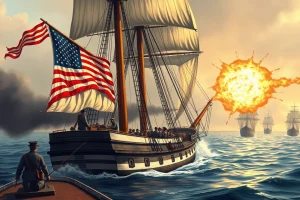
Blakeley took the Wasp across the Atlantic and into the approaches to the British Isles, where she ran down a succession of merchant vessels. On 28 June 1814, in the English Channel, she fought and captured the 18-gun sloop HMS Reindeer. The action was fought at close range, and Reindeer’s commander, Captain William Manners, was killed; more than half the British crew became casualties before the ship was carried. It was, for the Wasp, a costly but decisive victory.
On 1 September 1814 the Wasp forced the 18-gun HMS Avon to surrender, but Blakeley could not take possession of his prize: the British ships HMS Castilian (18 guns) and HMS Tartarus (20 guns) came up and rescued the survivors while the Avon sank. On 21 September 1814, in latitude 33°12′ north and longitude 14°56′ west, the Wasp took the 8-gun dispatch brig HMS Atalanta. Blakeley sent Midshipman Geisinger and a prize crew aboard with orders to take her into an American port. The Atalanta reached Savannah on 4 November 1814, carrying the last direct word from the Wasp and her captain. According to the modern study by Stephen W. H. Duffy, the cruise accounted for thirteen prizes in all.
The final trace of the ship comes from a neutral merchant vessel. The Swedish brig Adonis, sailing from Rio de Janeiro toward Falmouth, recorded in her log that on 9 October 1814, at about 18°35′ north and 30°10′ west, she was chased and boarded by a sloop-of-war. Two American officers who had been exchanged as prisoners — Acting Lieutenant Stephen Decatur McKnight and Master’s Mate James Lyman of the frigate Essex — went aboard the stranger and did not return. The Adonis‘s log identifies the vessel as the Wasp. After that date, nothing certain was heard of the ship, her captain, or her crew.
Why It Matters
The cruise mattered at the time because it demonstrated that the United States Navy could still strike at British trade and shipping despite the blockade, and it gave the government a success to publicize in a year otherwise dominated by British offensives and by the burning of Washington in August 1814. Congress voted Blakeley its thanks and a gold medal, and he was posthumously advanced to the rank of captain. North Carolina, where he had grown up, resolved on 27 December 1816 that his only daughter be educated at state expense.
The disappearance mattered differently. Because no wreck was ever located and no reliable report of the ship’s end reached America, contemporaries generated competing explanations: that the Wasp foundered in a heavy gale or squall; that her magazine exploded; that she went ashore on the African coast and her crew were taken prisoner; or that she had fought and sunk a British frigate in a stormy night action. The last claim, connected with a damaged frigate reported at Cádiz, cannot be traced to a reliable source, and later writers have treated it skeptically. Historians generally consider foundering in weather the most probable explanation, while acknowledging that a magazine accident cannot be excluded and that the evidence is insufficient to prove either. The absence of Blakeley’s personal papers — the modern literature notes that none survive — limits what can be recovered about his final weeks and about the temper of his crew.
More broadly, the case illustrates a historiographical pattern: events at sea after 1813 have received comparatively little attention in general accounts of the war, so a ship that was among the most destructive American cruisers of the conflict is also among the least remembered.
Type and Construction
The 1814 Wasp was a sloop-of-war of 509 tons burthen, designed under the direction of naval constructor William Doughty and built at Newburyport, Massachusetts, by the firm of William Cross and Orlando B. Merrill. She was a flush-decked vessel with a shallow, wide forward hull and a fine, narrow after body — lines influenced by the fast Baltimore clippers — and with a small raised forecastle in place of the high quarterdeck usual in sloops of the period. She was one of a group of similar sloops that included Frolic and Peacock, and her design proved durable enough that later American sailing sloops were modeled closely upon it. Published figures place her building cost at approximately $77,460.
Nation
The Wasp was a United States Navy vessel, built and commissioned during the War of 1812 and manned from the American naval establishment. Her operations were directed by the Navy Department in Washington, and her prizes were sent to American ports for adjudication.
Armament
She was rated at 22 guns, and is customarily described as carrying twenty 32-pounder carronades with two long guns, generally 12-pounders, mounted as chase pieces. The carronade armament gave a small ship heavy short-range hitting power, which helps explain her success in the close actions against Reindeer and Avon.
Crew
Her complement was approximately 170 officers, seamen, and Marines, though precise muster returns for the final cruise do not survive. The crew included detachments sent away as prize crews — most notably the party under Midshipman Geisinger placed aboard the Atalanta — and two American officers taken aboard from the Swedish brig Adonis in October 1814. The fate of the entire company, apart from those detached or exchanged, remains unknown.
Commander
Johnston Blakeley was born in October 1781 near Seaforde, County Down, Ireland, and was brought to the United States as a child in 1783; he grew up in Wilmington, North Carolina, and attended the University of North Carolina before entering the Navy as a midshipman in 1800. He served during the Quasi-War with France in the frigate President under Thomas Truxtun, and in the Mediterranean under John Rodgers during the early campaigns against Tripoli. In 1813 he commanded the brig Enterprise on the New England station before being ordered to the Wasp. He married Jane Hoope in December 1813.
Engagements
During the cruise of 1814 the Wasp captured numerous merchant vessels and fought three notable actions: against HMS Reindeer on 28 June 1814, which she captured; against HMS Avon on 1 September 1814, which she forced to surrender before being driven off by HMS Castilian and HMS Tartarus; and against the dispatch brig HMS Atalanta on 21 September 1814, which was sent to Savannah as a prize.
Fate
The Wasp disappeared sometime after 9 October 1814. No wreck has been found, no survivors are known, and no authenticated account of her loss exists. The most widely accepted explanation is that she foundered in a gale or squall in the Atlantic; an accidental magazine explosion has also been proposed; and the more colorful stories of capture, shipwreck on the African coast, or a victorious but fatal night action with a British frigate rest on no reliable evidence. She was not formally struck from the Navy list on the basis of any recovered record, but simply never returned.
Primary Sources
The surviving documentary record is substantial but one-sided. Commodore Isaac Hull, commanding the navy yard at Portsmouth, reported to Secretary of the Navy William Jones on 2 May 1814 that the Wasp had “sailed last evening” with a fair wind and a good prospect of escaping the blockade. Blakeley’s own letters, such as his letter to a friend of 20 January 1814 lamenting that he had left the Enterprise shortly before her action with HMS Boxer, and his 11 October 1813 letter to Commodore Bainbridge about salting the Wasp‘s timbers, survive chiefly in quotation within later published articles. Navy Department correspondence runs only one way, since Blakeley’s replies were lost with him.
The single most important document for the ship’s final weeks is the log of the Swedish brig Adonis, which recorded the boarding of 9 October 1814, the removal of McKnight and Lyman from her, and the departure of the sloop-of-war. It survives as a merchant vessel’s record made at sea and later produced for the purpose of establishing the whereabouts of two exchanged officers, so it reflects what the Adonis‘s master observed — including a boarding officer who wore what appeared to be an English doctor’s uniform and a vessel that hoisted English colors. That detail is consistent with the use of disguise by the Wasp, but the log is a foreign merchant captain’s account, not an American naval record, and it tells nothing directly about the ship’s condition or intentions. Reports of British naval officers, such as Captain Thomas Hillyar of HMS Phoebe, help establish the movements of the exchanged officers but do not describe the Wasp‘s end. Contemporary newspapers reprinted the cruise’s successes and, later, the rumors about the ship’s fate; those items are evidence of public speculation rather than of the event itself. No verified transcript of any final letter or deathbed report exists, and none should be assumed.
Further Reading
- Duffy, Stephen W. H. Captain Blakeley and the Wasp: The Cruise of 1814. Annapolis: Naval Institute Press, 2001.
- Hanks, Carlos C. “How Ended the Gallant ‘Wasp’?” United States Naval Institute Proceedings 58, no. 12 (December 1932).
- Perry, James M. “U.S. Sloop of War Wasp.” United States Naval Institute Proceedings 87, no. 2 (February 1961).
- Skaggs, David Curtis. “The Cruise of the Wasp.” Naval History 28, no. 6 (December 2014).
- Dudley, William S., ed. The Naval War of 1812: A Documentary History. 3 vols. Washington, D.C.: Naval Historical Center, 1985–2002.
- Roosevelt, Theodore. The Naval War of 1812. New York: G. P. Putnam’s Sons, 1882.
- Mahan, Alfred Thayer. Sea Power in Its Relations to the War of 1812. 2 vols. Boston: Little, Brown, 1905.
- Naval History and Heritage Command, Dictionary of American Naval Fighting Ships, entries for Wasp (1814) and Blakeley.
- Custom House Maritime Museum, Newburyport, Massachusetts (regional collections relating to Newburyport shipbuilding).
References
- Skaggs, David Curtis. “The Cruise of the Wasp.” Naval History 28, no. 6 (December 2014). https://www.usni.org/magazines/naval-history-magazine/2014/december/cruise-wasp
- Perry, James M. “U.S. Sloop of War Wasp.” United States Naval Institute Proceedings 87, no. 2 (February 1961). https://www.usni.org/magazines/proceedings/1961/february/us-sloop-war-wasp
- Hanks, Carlos C. “How Ended the Gallant ‘Wasp’?” United States Naval Institute Proceedings 58, no. 12 (December 1932). https://www.usni.org/magazines/proceedings/1932/december/how-ended-gallant-wasp
- Duffy, Stephen W. H. Captain Blakeley and the Wasp: The Cruise of 1814. Annapolis: Naval Institute Press, 2001. Review by Jeff Seiken, Journal of the Early Republic (2002). https://doi.org/10.2307/3124871
- Wikipedia contributors. “Johnston Blakeley.” Wikipedia (tertiary reference, used with caution for biographical dates and posthumous honors). https://en.wikipedia.org/wiki/Johnston_Blakeley
- Dudley, William S., ed. The Naval War of 1812: A Documentary History. 3 vols. Washington, D.C.: Naval Historical Center, 1985–2002.
FAQ
What happened to USS Wasp after October 1814?
Nothing certain is known. The last confirmed contact was on 9 October 1814, when the Swedish brig Adonis recorded being boarded by a sloop-of-war identified as the Wasp. No wreck, survivor account, or authenticated report of her loss has ever been found. Historians consider foundering in a gale the most probable explanation, with an accidental magazine explosion as a secondary possibility.
Who was Johnston Blakeley?
Blakeley (October 1781 – after October 1814) was an Irish-born United States Navy officer raised in Wilmington, North Carolina. He served in the Quasi-War and the Mediterranean campaigns, commanded the brig Enterprise in 1813, and commanded the sloop-of-war Wasp on her 1814 cruise. He received the thanks of Congress, a gold medal, and posthumous promotion to captain.
Did the Wasp fight a British frigate before disappearing?
No credible evidence supports that claim. A story circulated that a damaged British frigate had reported an action with a heavy American corvette that vanished in a storm, but it cannot be traced to a reliable source. The documented actions of the 1814 cruise were against the sloops Reindeer and Avon and the dispatch brig Atalanta.
How many prizes did the Wasp take in 1814?
The modern study by Stephen W. H. Duffy credits the cruise with thirteen prizes, including two Royal Navy sloops and the dispatch brig Atalanta. Merchant captures were sent to American ports, most notably the Atalanta, which reached Savannah on 4 November 1814.


Leave a Reply