
Short Answer
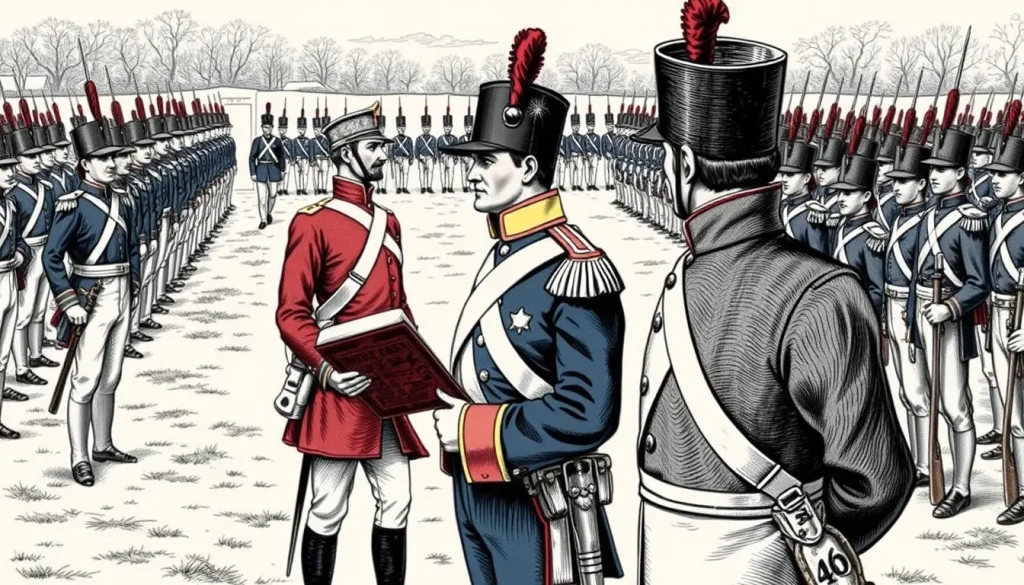
After the War of 1812, the United States Army moved to eliminate the tactical confusion that had hampered its operations by adopting a single uniform system of infantry drill. The first such standardized regulations were the Rules and Regulations for the Field Exercise and Manoeuvres of Infantry, compiled by a board of officers headed by Major General Winfield Scott and authorized by a congressional resolve in December 1814. Published in 1815, this manual replaced the outdated Steuben’s Blue Book and the incomplete Smyth’s Tactics of 1812, and set the pattern for American infantry training for decades.
Historical Context
During the Revolutionary War, Baron von Steuben’s Regulations for the Order and Discipline of the Troops of the United States (the “Blue Book”) had become the official drill manual of the Continental Army and, after 1789, of the regular U.S. Army. By the first decade of the nineteenth century, however, the Blue Book was widely considered antiquated, especially after the Chesapeake crisis of 1807 heightened fears of war with Britain. Several officers and writers, such as Maximilian Godefroy, Irenée Amelot De La Croix, and William Duane, urged the army to adopt the modern French infantry system, embodied in the French Réglement of 1791. In response, Secretary of War William Eustis ordered the publication of Alexander Smyth’s Regulations for the Field Exercise, Manoeuvres, and Conduct of the Infantry of the United States in March 1812. Smyth’s manual was a direct translation of the French regulations, but it was never fully implemented; militias used various systems, and regular regiments often drilled by their own interpretation. This lack of a common tactical language contributed to battlefield missteps during the War of 1812, such as the confusion at the Battle of Chrysler’s Farm and the failed assault on Fort Erie. The army entered the war with no single, enforceable drill system, a problem that military leaders recognized even as hostilities were ending.
What Happened
In December 1814, as peace negotiators convened in Ghent, Congress passed a resolve authorizing the War Department to compile a new set of infantry regulations. Secretary of War James Monroe appointed a board of officers, with Major General Winfield Scott as president, to oversee the work. The board, which included experienced line officers such as Colonel William J. Worth, chose to adapt the French Réglement of 1791, then considered the most advanced tactical system in Europe. They produced a manual titled Rules and Regulations for the Field Exercise and Manoeuvres of Infantry, Compiled and Adapted to the Organization of the Army of the United States, which was published by order of the War Department in 1815. The manual contained detailed instructions on the soldier’s drill, company and battalion evolutions, and the employment of infantry in line and column. It was arranged in a clear, practical format with explanatory plates, and it explicitly superseded all previous systems. Congress’s resolve gave the manual official status, making it the first truly standardized drill regulation for the U.S. Army after the War of 1812.
Why It Matters
The 1815 regulations ended a period of diverse, often contradictory drill methods that had undermined the army’s cohesion on the battlefield. By adopting a single, modern French-based system, the army improved its ability to train recruits, coordinate units, and operate in formed bodies. The manual also established a precedent for using boards of officers to revise tactical doctrine—a method the army has used many times since. Moreover, the 1815 manual directly influenced later regulations, including the 1821 edition and the 1835 Infantry Tactics that remained in service into the Mexican–American War. Historians generally agree that the adoption of a uniform drill system was a crucial reform in the post-war professionalization of the U.S. Army.
Definition
The first standardized drill regulations after the War of 1812 were the Rules and Regulations for the Field Exercise and Manoeuvres of Infantry of 1815, authorized by a congressional resolve of December 1814 and compiled by a board of officers led by Winfield Scott. This manual provided a single, enforceable set of infantry tactics for all regular and militia units, replacing both the 1779 Steuben regulations and the 1812 Smyth manual. It was based on the French Réglement concernant l’exercice et les manoeuvres de l’infanterie of 1791, with modifications to suit American organization and conditions.
Background
The move toward standardization began before the war, as American officers studied the French system through translations and abridgments. William Duane’s American Military Library (1809) included a translation of the French manual, and Colonel De Lacroix published a corrected edition in Boston in 1810. Alexander Smyth’s 1812 manual was itself an adaptation of the French regulations, but it was issued hastily and lacked the official imprimatur of a fully vetted system. The board of 1814–1815 built on these earlier efforts, incorporating the best elements of the French system while adjusting them to the American army’s smaller battalions and its reliance on well-drilled regulars.
How It Worked
The 1815 manual was divided into three parts. The first covered the soldier’s drill: position, facings, steps, the manual of arms, loading and firing, and marching. The second addressed company drill, including formations, column movements, and deploying into line. The third covered battalion drill, with evolutions for changing front, forming columns, and delivering fire. The manual emphasized precise timing and the use of commands, with detailed instructions for officers and non-commissioned officers. It introduced the two-rank line as the primary firing formation and used column movements for rapid maneuver—both hallmarks of the French system. The manual also included administrative details, such as the duties of officers and the care of arms, following Steuben’s earlier pattern but updated to the new tactics.
Competing Viewpoints
At the time, there was debate over whether to adopt the French system wholesale or to retain more of the Prussian-influenced Steuben methods. Some officers, like Godefroy, argued for a complete overhaul and a larger regular army; others, like Duane, defended the militia but acknowledged the need for a modern tactical manual. The French system eventually won out because it was regarded as the most effective in European practice, and because many of the army’s senior officers, especially Winfield Scott, had studied it during the war. Some critics later contended that the 1815 manual was too complex for American militia, but its adoption for the regular army proved enduring.
Role in the War of 1812
Although the 1815 regulations were authorized after the war ended in February 1815, they were a direct response to problems encountered during the conflict. The War of 1812 exposed the dangers of heterogeneous drill: troops from different units could not execute combined maneuvers, and the lack of a common tactical doctrine hindered the command and control of brigades and divisions. The board’s work was also shaped by the wartime experiences of officers like Scott, who had trained his brigade in a uniform system during the Niagara campaign of 1814. The regulations thus institutionalized the tactical practices that Scott had introduced in the field, ensuring that the lessons of the war were not lost.
Consequences and Historical Interpretation
The 1815 regulations remained in effect, with minor revisions, until the 1820s and were the foundation for later standard infantry tactics. They helped professionalize the officer corps by requiring a shared body of knowledge, and they influenced the organization of military academies and training camps. Historians credit the adoption of these regulations with improving the army’s proficiency in the decades between the War of 1812 and the Mexican–American War. Modern scholars, such as Donald E. Graves, have noted that the process of adopting the French system was gradual and fraught with controversy, but the 1815 manual finally provided the U.S. Army with a single, coherent drill that ended the post-revolutionary tactical fragmentation.
Primary Sources
The primary sources for the 1815 regulations include the congressional resolve of December 1814 and the manual itself. The Rules and Regulations for the Field Exercise and Manoeuvres of Infantry was first printed in 1815 in Philadelphia by the War Department. A later edition, published in Concord, New Hampshire, in 1817, is available digitally from the Internet Archive (archive.org/details/rulesregulat00unit). The 1812 Smyth manual is also a key source, as it represents the immediate predecessor and contains the earlier attempt at French-style regulations. Steuben’s Regulations (1779) provides the baseline for the pre-war era. The Graves article “From Steuben to Scott” (1988/2016) offers a detailed scholarly account of the adoption process. These sources are limited by their administrative origins; they do not record the experiences of enlisted men or the actual effectiveness of the drill in combat, but they do document the official intention and content.
Further Reading
- Graves, Donald E. “From Steuben to Scott: The Adoption of French Infantry Tactics by the United States Army, 1807–1816.” War of 1812 Magazine, 2016. Available at napoleon-series.org.
- Toomey, Noxon. The History of the Infantry Drill Regulations of the United States Army. St. Louis, 1917. Available at archive.org.
- United States War Department. Rules and Regulations for the Field Exercise and Manoeuvres of Infantry. 1815; reprint Concord, N.H., 1817. Internet Archive.
- Kapp, Friedrich. Leben des amerikanischen Generals Friedrich Wilhelm von Steuben. Philadelphia, 1858.
References
- Toomey, Noxon. The History of the Infantry Drill Regulations of the United States Army. St. Louis, 1917. https://archive.org/stream/historyofinfantr00toomrich/historyofinfantr00toomrich_djvu.txt
- Graves, Donald E. “From Steuben to Scott: The Adoption of French Infantry Tactics by the United States Army, 1807–1816.” War of 1812 Magazine, 2016. https://www.napoleon-series.org/military-info/Warof1812/2016/Issue26/STEUBEN.pdf
- United States War Department. Rules and Regulations for the Field Exercise and Manoeuvres of Infantry. 1815; reprint Concord, N.H., 1817. https://archive.org/details/rulesregulat00unit
- Smyth, Alexander. Regulations for the Field Exercise, Manoeuvres, and Conduct of the Infantry of the United States. Philadelphia, 1812. http://www.kelloggscompany1812.org/Docs/Smyth_s_Manual_with_plates.pdf
- HathiTrust Catalog record for “Regulations for the Field Exercise, Manœuvres, and Conduct of the Infantry of the United States.” https://catalog.hathitrust.org/Record/011716368
FAQ
What were the first standardized drill regulations after the War of 1812?
They were the Rules and Regulations for the Field Exercise and Manoeuvres of Infantry of 1815, compiled by a board under Winfield Scott and based on the French system of 1791.
Why were new drill regulations needed after the War of 1812?
The pre-war manual, Steuben's Blue Book, was outdated, and Smyth's 1812 translation was incomplete. The army fought with multiple tactical systems, causing confusion and inefficiency. The 1815 regulations established a uniform system.
How did the 1815 regulations affect the U.S. Army?
They provided a single, standard drill for all infantry units, improved training and combat effectiveness, and set a precedent for using boards of officers to revise doctrine.



Leave a Reply