
Short Answer
Letters from captivity—the correspondence, diaries, and later memoirs written by American prisoners of war—are among the most immediate bodies of evidence for the human experience of the War of 1812. Between 1812 and 1815, thousands of American sailors, privateersmen, regular soldiers, and militiamen were captured by British forces and held at places such as Dartmoor Prison in Devon, the prison on Melville Island at Halifax, and designated parole towns in Britain and British North America. This article treats “letters from captivity” as a documentary genre within the War of 1812; the extensive prisoner correspondence of later conflicts lies outside its scope.
Historical Context
The United States declared war on Great Britain in June 1812 after years of dispute over maritime rights, including the impressment of American seamen. The conflict immediately produced captives on both sides. American privateers and the small United States Navy took British merchant vessels, while the Royal Navy’s blockade and British amphibious operations captured American merchantmen, privateer crews, naval crews, and, from 1813 onward, growing numbers of soldiers and militia on the northern and Chesapeake frontiers.
Neither belligerent began the war with a well-developed system for handling large numbers of enemy prisoners. Britain, after two decades of war with France, possessed an established infrastructure: the Transport Board supervised prisoners of war, and depots such as Dartmoor in Devon, Stapleton near Bristol, and the prison on Melville Island in Halifax, Nova Scotia, already existed or could be adapted. The United States had no comparable permanent apparatus until 1813, when the office of Commissary General of Prisoners was created. Custom rather than treaty governed most practice: officers were usually paroled, enlisted men were confined, and exchanges were negotiated case by case. Disputes over who counted as a British subject—linked to the impressment controversy—complicated every exchange.
What Happened
Captivity in the War of 1812 followed several distinct routes. Naval and privateer crews taken at sea were commonly sent to Halifax, Bermuda, or Britain. Prisoners taken on the northern frontier were held at Quebec, Montreal, Kingston, and other posts in British North America. Many commissioned officers, on both sides, were released on parole into designated towns and agreed not to serve until formally exchanged. Enlisted men and sailors were confined in depots, barracks, and, in Britain, in prison ships and land depots.
From April 1813, American prisoners began arriving at Dartmoor, a depot built during the Napoleonic Wars at Princetown on the high moor of Devon. The American population there grew into the thousands—commonly estimated at roughly five to six thousand at its peak in 1814–1815—making it the largest single American prisoner community of the war. Conditions varied with crowding, weather, and the quality of provisions; contemporaries on both sides complained of shortages, and disease and accidents killed prisoners during their confinement. The prison at Melville Island, Halifax, drew similar complaints of cold, overcrowding, and sickness, and American dead from that depot were buried nearby, including on the site known today as Deadman’s Island.
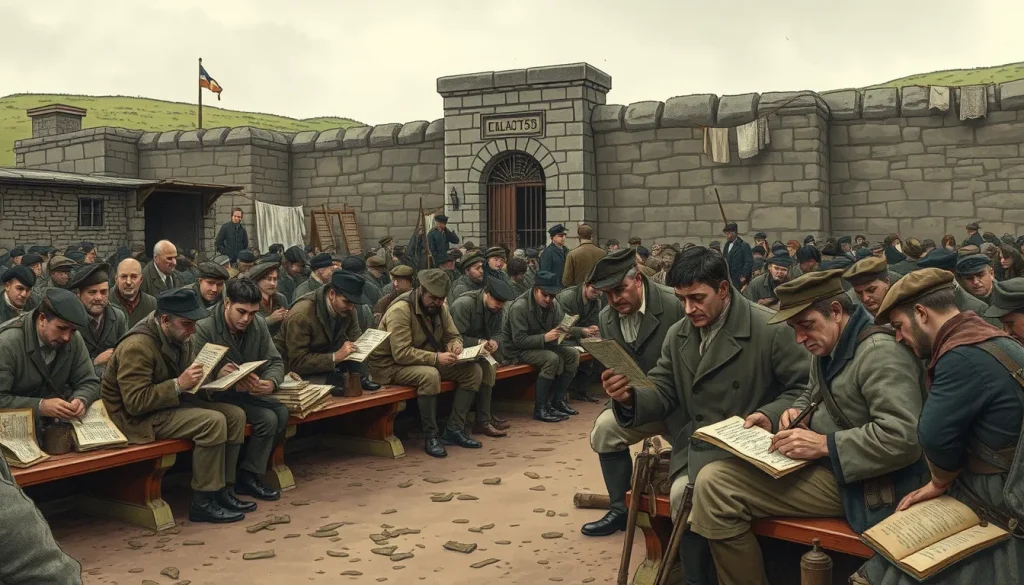
Correspondence was central to the captivity experience. Prisoners wrote to wives, parents, and business partners; they petitioned the American Commissary General of Prisoners and, through him, the British authorities; and they asked for money, clothing, tobacco, and news. Because letters had to pass through official channels—British agents and the Transport Board on one side, the Commissary General of Prisoners on the other—most correspondence was opened, inspected, and sometimes delayed or refused. A letter might take months, arrive after the death of its writer, or never arrive at all.
Exchange negotiations conducted through the agents John Mason, the American Commissary General of Prisoners from 1813, and Thomas Barclay, the British agent for prisoners in the United States, produced periodic agreements and cartel sailings but never a durable system. Disputes over the status of naturalized Americans, the treatment of prisoners in each other’s hands, and the numbers held repeatedly interrupted exchanges. The Treaty of Ghent, signed on 24 December 1814, ended hostilities and provided for the release of prisoners, but repatriation was slow. On 6 April 1815, at Dartmoor, a confrontation over rations and the prisoners’ confinement inside the depot ended when soldiers of the garrison fired into the yard; most accounts report seven prisoners killed and roughly thirty wounded, though figures vary. Survivors were released and returned to the United States over the following months.
Why It Matters
Prisoner correspondence mattered at the time as much as it does to historians. Letters carried information between separated families, supplied newspapers with material, and were used by officials to press claims about treatment and exchange. Published extracts in American papers—and lists of prisoners printed in successive issues—shaped public opinion about the war and about British conduct.
In the longer term, captivity narratives became part of American memory of the conflict, and the Dartmoor deaths were commemorated for generations afterward. Historians such as Donald R. Hickey have cautioned that treatment depended heavily on local circumstances: parole was frequently tolerable, while the largest depots were genuinely dangerous. Scholars disagree about how far suffering resulted from deliberate neglect rather than from overcrowding, distance, and administrative confusion, and they note that American authorities received their own complaints from British prisoners held in the United States. The letters remain essential to social history. They document the experience of ordinary sailors, including African American seamen; some Black captives were carried to the Caribbean rather than to Britain, and American commentators alleged that such prisoners risked being sold into slavery, though the surviving evidence for those outcomes is uneven.
Definition
“Letters from captivity,” as used here, means written communications composed by prisoners of war while confined or on parole, together with closely related contemporaneous records: diaries and journals kept in prison, petitions and memorials addressed to governments, and the prisoner lists that often carried personal messages. These should be distinguished from memoirs and reminiscences published after the war, which were composed in hindsight and often with an eye to readers and political argument. Both kinds of text are primary sources for captivity, but they are not equally reliable about specific events.
Background
The documentary environment shaped what prisoners could write. Paper, ink, pens, and postage cost money, and many captives were destitute; prisoners depended on remittances from home or on the charity of fellow prisoners. Regulations limited the length and frequency of letters, required them to be unsealed for inspection, and routed them through official agents. Britain’s Transport Board and its agents kept registers and correspondence; in the United States, the Commissary General of Prisoners maintained letter books documenting both American captives abroad and British captives at home. Newspapers acted as a parallel channel, printing extracts, notices, and prisoner lists that families scanned for names.
How It Worked
In practice, a letter from an American prisoner held in Britain usually passed through several hands. The prisoner wrote it, submitted it for inspection, and it was forwarded through the depot agent and the Transport Board before going by packet or merchant ship. In the United States it might reach the Commissary General of Prisoners, be forwarded to a family, or be excerpted in a newspaper. Letters from Halifax and Quebec traveled a shorter but still uncertain route. Paroled officers had more freedom to correspond, and their letters more often discuss quarters, allowances, and the terms of parole than the deprivations of a depot.
Much of the surviving correspondence is practical rather than dramatic: requests for money and clothing, confirmation that a man was alive, instructions about debts and property, and questions about children. Some letters describe illness and the deaths of messmates or the quality of food; some contain complaints intended to be read by officials as well as relatives, since writers knew their words might be inspected. Prisoners also wrote to one another’s families, reporting on men who could not write themselves. Postwar memoirs, by contrast, were composed at leisure and shaped into full narratives of capture, confinement, and release. Several such accounts—including the Dartmoor narrative published by the former prisoner Charles Andrews in 1815 and the anonymous A Journal of a Young Man of Massachusetts of 1816—became the best-known American captivity texts of the war.
Competing Viewpoints
Historians read these documents differently. One debate concerns reliability: because prisoners knew their letters were inspected and could be published, some scholars treat them as partly strategic documents written to persuade officials and relatives rather than as neutral records. Another debate concerns representativeness: the letters that survive are those that were permitted, preserved, and often printed, which overrepresents literate prisoners with family resources and underrepresents the illiterate and the unconnected. A third debate concerns the interpretation of suffering, with some accounts emphasizing deliberate British neglect and others stressing the structural pressures of war—overcrowding, epidemic disease, and slow communications—that affected prisoners on both sides. The evidence does not resolve these questions uniformly, because conditions differed sharply between Dartmoor, Melville Island, parole towns, and the smaller frontier depots.
Role in the War of 1812
Prisoner letters and the reports built from them influenced policy. Complaints forwarded by the Commissary General of Prisoners furnished the American government with material for protests, and British agents used correspondence and inspection reports in the same way. Exchange negotiations turned partly on claims about numbers and treatment, which both sides illustrated with documents. Newspapers printed extracts from prisoners’ letters alongside lists of names, keeping the issue before the public, and surviving records show that prisoners themselves tried to influence their fate by writing to agents, officers, and even enemy authorities.
Consequences and Historical Interpretation
The immediate consequence of the correspondence was practical: families learned of deaths and survival, officials obtained evidence, and prisoners sometimes obtained relief. Its longer consequence was memorial. Dartmoor’s dead and the prisoners buried at Halifax were commemorated in the nineteenth and twentieth centuries, and captivity narratives helped fix an image of the war in which Americans endured British imprisonment. Modern scholarship is more cautious. Historians of the war treat the letters as valuable but partial evidence, useful for understanding ordinary people and the machinery of prisoner administration, while insisting that claims about systematic brutality be tested against British records of the same institutions and against the treatment of British prisoners in American hands.
Primary Sources
Prisoner-of-war correspondence in the Admiralty and Transport Board records held at The National Archives (Kew) documents American captives in Britain, including those at Dartmoor. These papers were created by British officials for administrative purposes; they are strong on numbers, transfers, and complaints, but prisoners’ own letters survive unevenly and were filtered by inspection. Paraphrase only should be assumed for their contents unless a document is quoted directly from the original.
Records of the Office of the Commissary General of Prisoners, held by the United States National Archives, include letter books and returns concerning both Americans held abroad and British prisoners held in the United States. They are indispensable for the mechanics of exchange and relief, though they reflect an official perspective and are incomplete.
Charles Andrews, The Prisoners’ Memoirs, or Dartmoor Prison (New York, 1815), is a former prisoner’s published narrative of captivity in England. It contributes detail about daily life and the 1815 shooting at the depot, but it is retrospective, partisan, and written for an American readership.
A Journal of a Young Man of Massachusetts (Boston, 1816), usually attributed to the physician Benjamin Waterhouse, presents an account of captivity in England in journal form. Its literary reworking of events means it should be used with care as a literal record.
Newspapers of the period, including lists of prisoners and extracts from letters printed in American papers such as Niles’ Weekly Register, are a further source. They preserve material that has otherwise been lost, but selection, editing, and political framing shape what appears in print.
Further Reading
- Donald R. Hickey, The War of 1812: A Forgotten Conflict (University of Illinois Press).
- Donald R. Hickey, Don’t Give Up the Ship! Myths of the War of 1812 (University of Illinois Press, 2006).
- David S. Heidler and Jeanne T. Heidler, eds., Encyclopedia of the War of 1812 (Naval Institute Press, 1997).
- William S. Dudley, ed., The Naval War of 1812: A Documentary History, 3 vols. (Naval Historical Center, 1985–2002).
- Alan Taylor, The Civil War of 1812: American Citizens, British Subjects, Irish Rebels, and Indian Allies (Alfred A. Knopf, 2010).
- The National Archives (UK), Kew: Admiralty and Transport Board prisoner-of-war records.
- Dartmoor Prison Museum, Princetown, Devon; Deadman’s Island commemoration, Halifax, Nova Scotia.
References
- Donald R. Hickey, The War of 1812: A Forgotten Conflict (Urbana: University of Illinois Press).
- David S. Heidler and Jeanne T. Heidler, eds., Encyclopedia of the War of 1812 (Annapolis: Naval Institute Press, 1997).
- Alan Taylor, The Civil War of 1812: American Citizens, British Subjects, Irish Rebels, and Indian Allies (New York: Alfred A. Knopf, 2010).
- William S. Dudley, ed., The Naval War of 1812: A Documentary History, 3 vols. (Washington, DC: Naval Historical Center, 1985–2002).
- The National Archives (UK), Admiralty and Transport Board prisoner-of-war records, Kew.
- National Archives and Records Administration (United States), records of the Office of the Commissary General of Prisoners, Washington, DC.
FAQ
What did American prisoners of war write about in the War of 1812?
Most surviving letters are practical: requests for money, clothing, and news, confirmation that a man was alive, instructions about debts and family matters, and reports of illness or the deaths of fellow prisoners. Some letters describe rations, quarters, and treatment, and a few were written with the knowledge that officials as well as relatives might read them.
Were letters from American POWs inspected or censored?
Yes. Letters generally had to be submitted unsealed for inspection and were forwarded through official channels, such as British depot agents and the Transport Board on one side and the American Commissary General of Prisoners on the other. Inspection, delays, and refusals were common, and many letters never reached their destinations.
How many Americans were held prisoner during the War of 1812?
Estimates vary considerably depending on whether captured merchant seamen, privateersmen, and prisoners quickly paroled or exchanged are counted. Historians commonly describe the total as several thousand, with the American population at Dartmoor alone estimated at roughly five to six thousand at its peak in 1814–1815.

Leave a Reply