
Short Answer
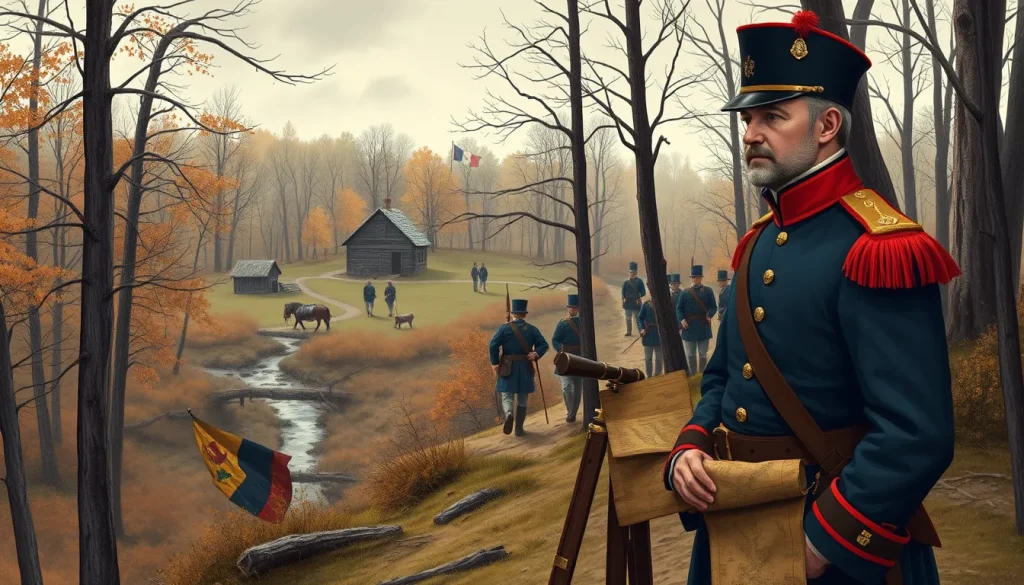
Lieutenant Colonel Christopher Myers was a British Army officer and deputy quartermaster-general who commanded the British and Canadian detachment at the Battle of Cook’s Mills on 19 October 1814, near Lyon’s Creek in Upper Canada. The action was the last engagement between United States and British armies in the Niagara Peninsula during the War of 1812 and formed part of the 1814 Niagara campaign. Myers is chiefly significant for his field command in that skirmish and for his after-action report to Lieutenant General Sir Gordon Drummond, which remains a key British account of the engagement. This article concerns that officer and his role at Cook’s Mills; it does not concern unrelated later persons of the same name.
Historical Context
By autumn 1814, the Niagara campaign had become a war of logistics, attrition, and fortified positions. After the British lifted the Siege of Fort Erie on 21 September 1814, Lieutenant General Sir Gordon Drummond withdrew his forces to a defensive position at Fort Chippawa on the north bank of Chippawa Creek. An American division under Major General George Izard marched overland from Plattsburgh, New York, to reinforce the American army at Fort Erie under Major General Jacob Brown. Because Izard was the senior major general, he took command of the combined force. Brown favored an immediate attack on Drummond, but Izard declined to assault a strong defensive line. Brown then left with his division for Sacketts Harbor, New York, where a British attack was feared.
Izard eventually moved north to Chippawa Creek. The creek was unfordable, and the bridge had been destroyed. On 16 October, American and British artillery exchanged fire without decisive effect. With the main armies deadlocked, both sides turned to raids and detachments. The British depended heavily on local mills and grain for flour, and the Americans sought to deprive them of that supply. Cook’s Mills, a mill site on Lyon’s Creek in Crowland Township, became a target because it was a British source of flour. Myers, as deputy quartermaster-general, was responsible for staff work involving movement, reconnaissance, and coordination, and he was given command of the British response.
What Happened
On the morning of 19 October 1814, Myers advanced from Misener’s House on Lyon’s Creek to reconnoiter the American force at Cook’s Mills, about three miles away. According to his report to Drummond, he directed Lieutenant Colonel Battersby with the Glengarry Regiment of Light Infantry to move in front of the flanks. Lieutenant Colonel the Marquess of Tweeddale followed in support with the 100th Regiment, the flank companies of the 104th and 82nd Regiments, a six-pounder gun, and a Congreve rocket detachment. Major Proctor moved in reserve with the remainder of the 82nd Regiment. Myers estimated the whole British force at about 750 men. Some later summaries list the 6th Regiment among the British units; Myers’s own report names the 100th, 104th, and 82nd, and this article follows his contemporary account for the British order of battle.
The American detachment, under Brigadier General Daniel Bissell, was larger. Later summaries describe a brigade of about 1,200 men, including the 5th, 14th, 15th, and 16th U.S. Infantry, with riflemen and U.S. Dragoons. Myers found the American advance posted on the right bank of a ravine that ran toward Lyon’s Creek, a short distance from the mills. Part of the Glengarry Light Infantry turned around a small wood covering the American front and crossed the head of the ravine, while the remainder passed through the wood. The movement drove back the American light troops.
Some Americans crossed Lyon’s Creek to harass the British left. Myers, whose primary purpose was reconnaissance, found that a forward movement was impracticable because of thick woods. He retired the Glengarry Light Infantry and fell back a short distance, hoping to draw the Americans onto open ground and, if circumstances allowed, bring on a more general action. The Americans advanced only to the edge of the wood, where they showed two columns on the British left and one on the right. A heavy fire of small arms followed, which the British returned sparingly because of the distance. Myers reported that the six-pounder and rockets caused severe losses in the American column on his left.
Myers estimated the American force at not less than 1,500 to 2,000 men and noted that it had no cannon. Unable to draw the Americans out of the woods, he retired his troops to the cantonments around Misener’s House, keeping his advance close to the enemy. The Americans remained in possession of Cook’s Mills and destroyed all the grain found in the mill. Later summaries state that about a dozen American soldiers were killed and buried in shallow pits near the Yokom farmhouse, and that the American force withdrew to its camp at Black Creek the next day. British casualties were reported as one dead and thirty-five wounded, including Captain McMillan of the Glengarry Regiment. Myers forwarded a return of casualties to Drummond with his report.
The result is usually described as an American tactical victory because the U.S. force retained the field and destroyed the mill grain. Myers’s report presents the action as a reconnaissance that ended with an orderly withdrawal when the enemy could not be drawn from cover. Both characterizations reflect the limited and inconclusive nature of the engagement: it lasted less than an hour and did not alter the main strategic stalemate on the Niagara frontier.
Why It Matters
The immediate effect of Cook’s Mills was modest but real. The British lost a source of flour, while the Americans demonstrated that they could send a strong detachment into the countryside and withdraw. The action did not persuade Drummond to leave his defensive position, nor did it give Izard a decisive advantage. Izard soon learned that British ships dominated Lake Ontario, raising the risk that an American advance could be cut off by a landing in its rear. He withdrew to Fort Erie. The British loss of about 200 bushels of wheat at Cook’s Mills was partly offset when several American provision boats crossed the Niagara without knowing of Izard’s retreat and were captured by the British. Izard later destroyed Fort Erie and returned to the United States side of the river. Drummond moved to the remains of the fort but chose not to rebuild it, and major fighting along the Niagara Frontier came to an end.
For historians, Cook’s Mills illustrates the character of the 1814 Niagara campaign: small detachments, supply raids, reconnaissance, and cautious commanders operating in wooded terrain. It also shows the importance of staff officers such as Myers, whose duties went beyond administration and could include leading field forces. His report is valuable because it records British force composition, terrain, and command decisions in detail. At the same time, historians must read it critically. It was written by the commander to his superior, it estimates enemy strength without precise intelligence, and it acknowledges that enemy losses could not be ascertained. The battle site was designated a National Historic Site of Canada in 1921. A federal cairn was erected in 1923, and a new plaque replaced the original on the cairn in 1977. Bicentennial commemorations in 2014 included a visitors’ plaza and interpretive markers. Myers himself is remembered mainly through his connection to this engagement and through the survival of his report in documentary editions.
Early Life
Reliable details of Christopher Myers’s early life, birth date, birthplace, family, and education are not securely documented in the sources consulted for this article. He appears in the record primarily through his British Army rank and his staff appointment as deputy quartermaster-general in Upper Canada during the War of 1812. Because the available evidence centers on his service in 1814, this section cannot responsibly supply personal details that the sources do not establish.
Role Before the War
Myers’s prewar career is similarly unclear in the consulted sources. He was a British Army officer before the War of 1812, but the specific regiments, postings, and dates of his earlier service are not established here. By 1814 he held the staff position of deputy quartermaster-general in Upper Canada. That appointment placed him within the British Army’s logistical and operational staff system, which handled movement, quartering, reconnaissance, and coordination between units and commanders.
Role During the War
During the War of 1812, Myers served as a deputy quartermaster-general on the Niagara frontier. In that role he was involved in the staff work that supported British and Canadian operations in Upper Canada. His most clearly documented field command came at Cook’s Mills in October 1814. His report shows him coordinating Glengarry Light Infantry, regular British regiments, the Royal Artillery, and staff officers. It also shows him exercising independent judgment about reconnaissance, withdrawal, and the risk of a general action. The report names Major Sparrow, assistant adjutant-general, and Captain Powell, deputy assistant quartermaster-general, as officers who assisted him, and it praises Lieutenant Carter of the Royal Artillery for directing the six-pounder and rockets.
Major Actions
The principal documented action associated with Myers is the Battle of Cook’s Mills on 19 October 1814. He commanded the British and Canadian detachment sent to reconnoiter the American force and to contest its movement against the mill. His force engaged the American advance, attempted to draw the larger American force into the open, and then withdrew in good order when the Americans would not leave the woods. Myers’s report claims that the British artillery and rockets inflicted severe losses on one American column, but it also states that the enemy’s total loss could not be determined. The action is often described as an American victory because the U.S. force remained on the field and destroyed the grain. No other major independent command by Myers is documented in the sources used for this article.
Contemporary Accounts
The central contemporary account is Myers’s own report to Lieutenant General Sir Gordon Drummond, dated 19 October 1814 at Misener’s House on Lyon’s Creek. It describes the British order of battle, the terrain around Cook’s Mills, the American position, the course of the skirmish, and the British withdrawal. It also praises the Glengarry Light Infantry, the Marquess of Tweeddale, Major Proctor, Lieutenant Carter, Major Sparrow, Captain Powell, and Major Glegg. The report is an official military document, not a neutral narrative. It was written to justify the commander’s decisions to his superior, it estimates American strength without exact knowledge, and it does not provide an American perspective. The casualty return that Myers forwarded with the report is not reproduced in the excerpted source used here, though later summaries give British losses as one killed and thirty-five wounded. American accounts and reports would be necessary for a fuller comparison of claims.
Later Life
Myers’s later life and death are not documented in the sources consulted for this article. The available material establishes his rank, his staff appointment, and his command at Cook’s Mills, but it does not provide reliable information about his postwar career, residence, family, or burial. Any full biography would need to draw on British Army records, Canadian archives, and genealogical sources beyond those used here.
Historical Legacy
Myers’s historical legacy rests chiefly on the Battle of Cook’s Mills and on the survival of his after-action report. The engagement was minor in terms of territory and casualties, but it marked the last clash between U.S. and British armies in the Niagara Peninsula and helped shape the final phase of the 1814 campaign. The battlefield became a National Historic Site of Canada in 1921 and remains a commemorated place within modern Welland, Ontario. Historians use Myers’s report to understand British command, logistics, and tactics on the Niagara frontier. His rank is sometimes rendered as colonel in later summaries, while the contemporary report styles him lieutenant colonel and deputy quartermaster-general. The battle itself is generally interpreted as a limited American tactical success with little strategic effect, and Myers’s role is usually presented as that of a staff officer who commanded a detachment in a difficult, wooded action.
Primary Sources
The most relevant primary source for Myers at Cook’s Mills is his report to Lieutenant General Sir Gordon Drummond, dated 19 October 1814 at Misener’s House on Lyon’s Creek. It was written by Myers as the British commander on the spot and is preserved in Ernest Cruikshank’s documentary edition, The Documentary History of the Campaign upon the Niagara Frontier. The report contributes detailed information about British force composition, the terrain, the American position, the course of the skirmish, and Myers’s reasons for withdrawing. Its limitations are significant: it is an official self-report to a superior, it estimates American strength rather than measuring it, it cannot state American losses with confidence, and it reflects only the British command perspective.
A casualty return is mentioned in the report, but the excerpted source does not include its full contents. Later summaries provide figures of one British soldier killed and thirty-five wounded, and about a dozen American dead buried near the Yokom farmhouse. These figures should be treated as reported totals rather than fully verified counts. American after-action reports, orderly books, and memoirs would be needed to balance Myers’s account, but they are not summarized in the source material used for this article.
Further Reading
- Cruikshank, Ernest, ed. The Documentary History of the Campaign upon the Niagara Frontier, 1814. Includes Myers’s report to Drummond.
- Heidler, David S., and Jeanne T. Heidler, eds. Encyclopedia of the War of 1812. Annapolis: Naval Institute Press.
- Parks Canada. Battle of Cook’s Mills National Historic Site of Canada. Directory of Federal Heritage Designations.
- Canadian Register of Historic Places. Battle of Cook’s Mills.
- Welland Historical Museum and local heritage resources on the Battle of Cook’s Mills and Crowland Township.
References
- Lieut.-Colonel Christopher Myers to Lieut.-General Sir Gordon Drummond, 19 October 1814, Misener’s House, Lyon’s Creek, in Ernest Cruikshank, ed., The Documentary History of the Campaign upon the Niagara Frontier. Wikisource transcription: Report of Lieutenant-Colonel Christopher Myers re. The Battle of Cook’s Mills.
- Battle of Cook’s Mills. Wikipedia. https://en.wikipedia.org/wiki/Battle_of_Cook%27s_Mills.
- Parks Canada. Battle of Cook’s Mills National Historic Site of Canada. Directory of Federal Heritage Designations.
- Heidler, David S., and Jeanne T. Heidler, eds. Encyclopedia of the War of 1812. Annapolis: Naval Institute Press.
FAQ
Who was Lieutenant Colonel Christopher Myers?
He was a British Army officer and deputy quartermaster-general who commanded the British and Canadian detachment at the Battle of Cook's Mills on 19 October 1814.
What happened at Cook's Mills under Myers?
Myers led about 750 troops against a larger American detachment under Brigadier General Daniel Bissell. After a short skirmish in wooded terrain, Myers withdrew when the Americans could not be drawn into the open, and the Americans destroyed the mill grain.
Did Myers win the Battle of Cook's Mills?
The action is usually described as an American tactical victory because the U.S. force retained the field and destroyed the grain. Myers's report presents it as a reconnaissance that ended with an orderly British withdrawal.
What primary source documents Myers at Cook's Mills?
His report to Lieutenant General Sir Gordon Drummond, dated 19 October 1814 at Misener's House on Lyon's Creek, is the central British primary source. It is preserved in Ernest Cruikshank's Documentary History of the Campaign upon the Niagara Frontier.


Leave a Reply