Short Answer
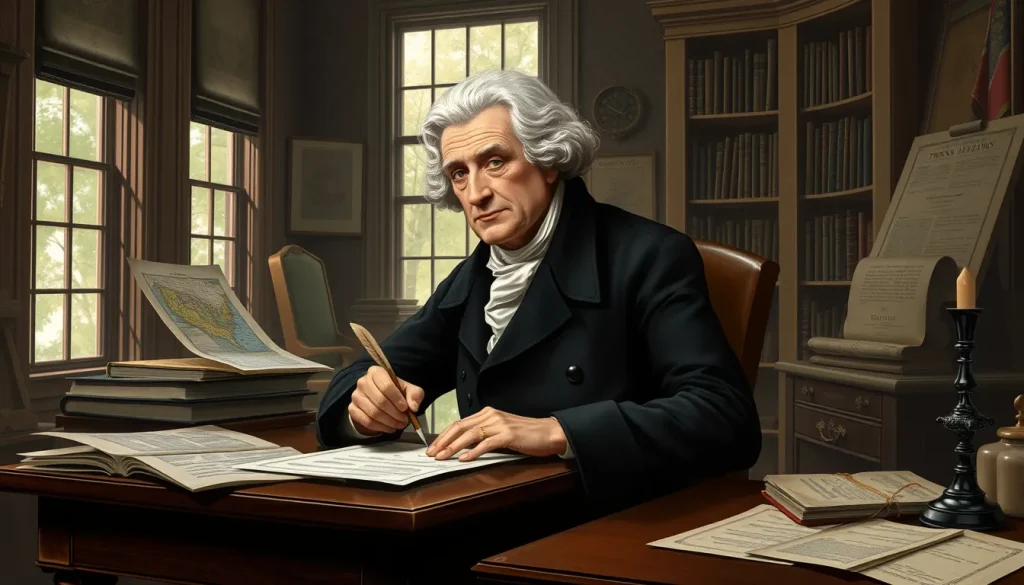
Thomas Jefferson’s letters about the War of 1812 form an important body of primary sources for understanding American political thought and the conflict’s early expectations and disappointments. Written from his retirement at Monticello between 1812 and 1815, these letters to friends, former colleagues, and foreign correspondents articulate Jefferson’s views on the causes of the war, his strategic preferences, and his evolving assessments of British attacks and American resilience. They also reveal how a former president attempted to shape public opinion and advise his successor while the war unfolded.
Historical Context
The War of 1812 (1812–1815) was fought between the United States and the United Kingdom, with significant involvement of Indigenous peoples and Canadian colonists. The immediate causes included British impressment of American sailors, the enforcement of Orders in Council that restricted neutral trade, and British support for Indigenous resistance on the American frontier. Jefferson, who had served as President from 1801 to 1809, had pursued a policy of economic coercion through the Embargo Act of 1807 and the Non-Intercourse Act, which failed to change British policy. When his close friend and political ally James Madison declared war in June 1812, Jefferson was out of office but remained an influential Republican elder statesman. His correspondence during the war reflects his long-standing hostility toward British maritime supremacy and his confidence in American ability to conquer British North America.
What Happened
Jefferson’s letters about the war are numerous, but several stand out for their detail and historical significance. In a letter to the Polish general Thaddeus Kosciusko on June 28, 1812, ten days after the American declaration of war, Jefferson celebrated the decision and predicted that “our present enemy will have the sea to herself, while we shall be equally predominant at land, and shall strip her of all her possessions on this continent.” He advised against meeting the British on the ocean and instead favored a land war against Canada, supplemented by American privateers to harass British commerce. He even floated the idea of retaliating against British naval attacks by “hired incendiaries” in London, a proposal born of frustration rather than policy.
Earlier, on April 25, 1812, Jefferson had written to his old friend James Maury, the American consul in Liverpool, expressing his belief that war was inevitable because of impressment and the exclusion of American vessels from the ocean. He saw the conflict as a final reckoning with British pretensions to maritime dominion.
Jefferson also corresponded with President Madison on strategic and political matters. In a letter of May 30, 1812, he dismissed the idea of a “triangular war” against both Britain and France as a “solecism,” arguing that the United States should fight one enemy at a time and avoid alienating potential European allies.
After the British burned Washington in August 1814, Jefferson wrote to Thomas Cooper on September 14, 1814, offering a rationale for retaliatory arson. He pointed out that the British had destroyed public buildings and suggested that the United States could, if it chose, burn St. James’s Palace and St. Paul’s Cathedral using “their own incendiaries,” though he ultimately hesitated to endorse such tactics as inconsistent with “civilized warfare.”
Jefferson’s wartime letters also returned repeatedly to the theme of American economic self-sufficiency. He saw the war as an opportunity to develop domestic manufacturing, which he believed would lessen American dependence on Britain. In his letter to Kosciusko, he described the household machinery he had installed at Monticello to spin wool and cotton, concluding that “nothing is more certain than that, come peace when it will, we shall never again go to England for a shilling where we have gone for a dollar’s worth.”
Why It Matters
These letters matter for several reasons. First, they document the mindset of a leading Republican figure during a pivotal national crisis. Jefferson’s predictions—that Canada would be easily conquered, that privateers would cripple British trade, and that the war would be short—proved overly optimistic. His later letters, such as the one to Cooper, reveal his outrage at the burning of Washington and his willingness to consider exceptional measures that challenged contemporary norms of warfare.</n
Second, the letters illustrate the partisan and ideological debates of the time. Jefferson’s scathing remarks about “Anglomen,” his dismissal of Federalist calls for a triangular war, and his belief that Britain intended to separate New England from the Union all show how the war became entangled with domestic political struggles.
Historians have used Jefferson’s correspondence to gauge public morale and to understand the influence of former presidents on national policy. They also reveal the limits of Jefferson’s perspective: he was far from the front, relied on secondhand news, and could be vindictive in his rhetoric. Nonetheless, the letters are an essential window into the political culture of the early republic and the intellectual foundations of American nationalism.
Document
The subject of this article is the body of letters written by Thomas Jefferson during the period of the War of 1812. These letters survive in multiple archives and are collected in the Papers of Thomas Jefferson, published by Princeton University Press, and in digital form at the National Archives’ Founders Online. Representative examples include letters to Thaddeus Kosciusko (June 28, 1812), James Maury (April 25, 1812), James Madison (May 30, 1812), and Thomas Cooper (September 14, 1814).
Date
Letters directly related to the War of 1812 range from April 1812, before the declaration, to late 1815, as the Treaty of Ghent was being ratified and its aftermath discussed. The most substantial letters date from the first year of the war and the period after the British attack on Washington.
Author
Thomas Jefferson (1743–1826) was the third President of the United States (1801–1809). During the war he was a private citizen living at Monticello, but he remained an active correspondent and influential figure among Democratic-Republicans. His letters reflect his educational background, his experience as a diplomat and president, and his deep ideological commitments to agrarianism, limited government, and American expansion.
Historical Context
Jefferson wrote these letters while the United States was engaged in an often unsuccessful military effort against the British Empire. Key events that shaped his commentary include the American defeats at Detroit and Queenston Heights in 1812, the British naval blockade, the burning of Washington in August 1814, and the battles of Plattsburgh and Baltimore in September 1814. The wider context includes the Napoleonic Wars in Europe, which allowed the United States to trade with both belligerents until British and French restrictions made it difficult, and the internal debate over whether the country should fight both Britain and France simultaneously.
Transcript
A representative excerpt from Jefferson’s letter to Thaddeus Kosciusko, June 28, 1812, reads as follows:
“Our present enemy will have the sea to herself, while we shall be equally predominant at land, and shall strip her of all her possessions on this continent. She may burn New York, indeed, by her ships and congreve rockets, in which case we must burn the city of London by hired incendiaries, of which her starving manufacturers will furnish abundance.”
From the letter to Thomas Cooper, September 14, 1814:
“The English have burnt our Capitol and president’s house by means of their force. We can burn their St. James’s and St. Paul’s, by means of our money, offered to their own incendiaries, of whom there are thousands in London who would do it rather than starve.”
These excerpts capture Jefferson’s rhetorical intensity and his willingness to consider unconventional retaliation, though he later softened his stance in the same letter.
Modernized Transcript
A modernized transcription of the above passages, with archaic spellings retained but punctuation updated, would clarify Jefferson’s meaning. For instance, the phrase “congreve rockets” refers to the British incendiary weapon named after Sir William Congreve. In modern English, the passage might read:
“Our present enemy will have the sea to herself, while we will be equally predominant on land, and we will strip her of all her possessions on this continent. She may burn New York with her ships and Congreve rockets; if so, we must burn the city of London by hiring arsonists, of whom her starving workers will provide plenty.”
However, since the original letters are in a form of English that is generally accessible to modern readers, the scholarly transcriptions available at Founders Online are sufficient for research purposes.
What the Document Tells Us
Jefferson’s letters reveal his confidence in American victory, his strategic preference for a land war against Canada, and his conviction that American privateers would devastate British commerce. They also show his deep distrust of British motives and his belief that the war would foster American manufacturing independence. His letters to Madison demonstrate his desire to avoid a multi-front war and his fear that Federalists would exploit the conflict to undermine the Republican administration. The letters are especially valuable for documenting how a leading revolutionary generation figure articulated the war’s ideological stakes—liberty, sovereignty, and national honor.
Limitations and Bias of the Source
Jefferson’s letters are strongly partisan and reflect his personal animus toward Britain. He often overstated American strengths and underestimated British capabilities, as subsequent events proved. His proposals for burning London were rhetorical exercises rather than considered policy, and he did not always distinguish between private opinions and advice he actually expected to be followed. Furthermore, Jefferson was not present in Washington or on battlefields; his information came from newspapers and correspondence, and his views are thus secondhand. Nevertheless, the letters are honest expressions of his beliefs and are invaluable for understanding the politics of the war era.
Citation
The letters discussed are available in the following repositories:
- Thomas Jefferson to Thaddeus Kosciusko, June 28, 1812, Founders Online, National Archives, https://founders.archives.gov/documents/Jefferson/03-04-02-0551
- Thomas Jefferson to James Maury, April 25, 1812, Founders Online, National Archives, https://founders.archives.gov/documents/Jefferson/03-04-02-0551
- Thomas Jefferson to James Madison, May 30, 1812, Founders Online, National Archives, via American Battlefield Trust, https://www.battlefields.org/learn/primary-sources/1812-jefferson-madison-may-30
- Thomas Jefferson to Thomas Cooper, September 14, 1814, Founders Online, National Archives, https://founders.archives.gov/documents/Jefferson/03-07-02-0471
The standard printed edition is The Papers of Thomas Jefferson (Princeton University Press), with the retirement series covering this period.
Primary Sources
The most relevant contemporary documents are Jefferson’s own letters. Beyond those already cited, his correspondence with James Madison and other administration figures provides insight into policy discussions. Another important source is Jefferson’s letter to John B. Colvin of September 20, 1810, in which he articulated his doctrine of executive necessity in times of emergency, a principle he later invoked in wartime debates. Letters to his daughter Martha Jefferson Randolph and to his European correspondents such as Alexander von Humboldt and Madame de Staël further illuminate his wartime views. All these documents are accessible through Founders Online and the published Papers. The main limitations of these sources are their inherent partisanship and Jefferson’s distance from the battlefront.
Further Reading
- Donald Hickey, The War of 1812: A Forgotten Conflict (University of Illinois Press, 1989).
- Merrill D. Peterson, Thomas Jefferson and the New Nation (Oxford University Press, 1970).
- J.C.A. Stagg, Mr. Madison’s War: Politics, Diplomacy, and Warfare in the Early American Republic, 1783–1830 (Princeton University Press, 1983).
- Alan Taylor, The Civil War of 1812: American Citizens, British Subjects, Irish Rebels, & Indian Allies (Alfred A. Knopf, 2010).
- Founders Online, National Archives, https://founders.archives.gov
- American Battlefield Trust, “Primary Sources: War of 1812,” https://www.battlefields.org/learn/primary-sources
References
- Thomas Jefferson to Thaddeus Kosciusko, June 28, 1812, Let.rug.nl, The Letters of Thomas Jefferson, https://www.let.rug.nl/usa/presidents/thomas-jefferson/letters-of-thomas-jefferson/jefl215.php
- Thomas Jefferson to James Maury, April 25, 1812, Founders Online, https://founders.archives.gov/documents/Jefferson/03-04-02-0551
- Thomas Jefferson to James Madison, May 30, 1812, American Battlefield Trust, https://www.battlefields.org/learn/primary-sources/1812-jefferson-madison-may-30
- Thomas Jefferson to Thomas Cooper, September 14, 1814, Founders Online, https://founders.archives.gov/documents/Jefferson/03-07-02-0471
- Stephen F. Knott, “Thomas Jefferson to Thomas Cooper, September 14, 1814,” Teaching American History, https://teachingamericanhistory.org/document/thomas-jefferson-to-thomas-cooper/
- Gilder Lehrman Institute, “Jefferson on British aggression, 1815,” https://www.gilderlehrman.org/history-resources/spotlight-primary-source/jefferson-british-aggression-1815
- Donald R. Hickey, The War of 1812: A Forgotten Conflict (Urbana: University of Illinois Press, 1989).
- J.C.A. Stagg, Mr. Madison’s War (Princeton: Princeton University Press, 1983).
FAQ
Why did Thomas Jefferson support the War of 1812?
Jefferson saw the war as a necessary response to British impressment of American sailors, the enforcement of Orders in Council, and British support for Indigenous resistance. He believed the United States could easily conquer Canada and that the war would end British maritime pretensions.
Did Jefferson actually advocate burning London?
In letters to Kosciusko and Cooper, he floated the idea of employing hired incendiaries to burn London as retaliation for British attacks, but he treated it as a rhetorical possibility rather than a serious policy recommendation, and he later acknowledged it conflicted with civilized warfare.
How do historians use Jefferson's letters about the war?
Historians use these letters to understand Republican ideology, the strategic miscalculations of American leaders, and the domestic political controversies of the war. They also illuminate Jefferson's views on manufacturing, national honor, and executive powers.
Leave a Reply