
Short Answer
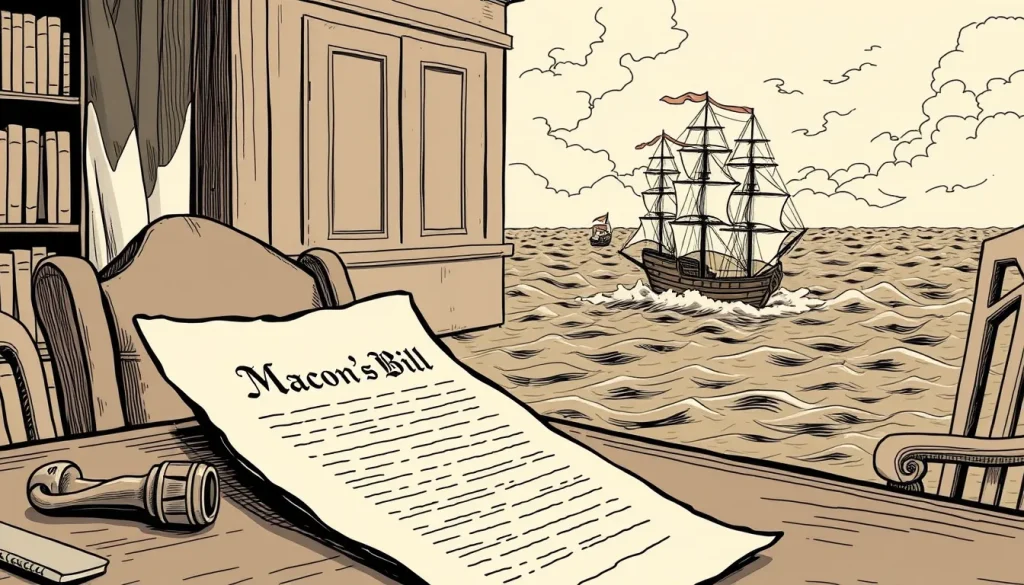
Macon’s Bill No. 2, enacted May 1, 1810, was a U.S. statute designed to use economic leverage to force Britain and France to respect American neutral trading rights during the Napoleonic Wars. It replaced the Non-Intercourse Act, reopened trade with both belligerents, and included a conditional revival of non-intercourse against any nation that refused to revoke its restrictions. The bill’s manipulation by Napoleon and its ultimate failure to avert conflict made it a significant step toward the War of 1812.
Historical Context
From 1803, Britain and France were locked in the Napoleonic Wars, and both nations sought to restrict neutral commerce to weaken the other. U.S. merchants, eager to profit from wartime trade, faced seizure of ships and cargo by both royal navies and French privateers. The United States, a weak neutral power, attempted to defend its rights first through diplomatic protest, then through economic pressure. The Non-Importation Act (1806), the Embargo Act (1807), and the Non-Intercourse Act (1809) all tried to deny American markets to the belligerents, but they damaged American agriculture, shipping, and commerce far more than they influenced European policies. By 1810, the Republican administrations of Thomas Jefferson and James Madison were politically embarrassed by the failure of these measures, and Congress searched for a new approach.
What Happened
In April 1810, Nathaniel Macon, chairman of the House Foreign Relations Committee and a North Carolina Jeffersonian, reported a bill (Macon’s Bill No. 1) that would have excluded British and French warships and restricted trade. That measure was defeated by a coalition of Federalists and Republican dissidents. A second, more liberal bill was then introduced, which Macon himself disliked but which Congress passed on May 1, 1810. The law, formally titled “An Act concerning the commercial intercourse between the United States and Great Britain and France, and their dependencies, and for other purposes,” was signed by President James Madison on May 1, 1810.
The statute did three main things. First, it repealed the Non-Intercourse Act and allowed American ships and merchants to trade with Britain, France, and their colonies. Second, it forbade British and French armed vessels from entering U.S. waters except in distress or on official business. Third, it contained a conditional threat: if either Britain or France should, before March 3, 1811, “so revoke or modify her edicts as that they shall cease to violate the neutral commerce of the United States,” the President was to declare that fact by proclamation. If the other nation then failed to revoke or modify its own edicts within three months, the non-intercourse sections of the earlier 1809 act would automatically be revived against that nation.
The decisive episode came in August 1810, when French Foreign Minister Duc de Cadore sent a letter to U.S. Minister to France John Armstrong. Cadore declared that France would revoke the Berlin and Milan Decrees (which had authorized seizure of neutral ships trading with Britain) effective November 1, 1810, provided the United States would “cause” Britain to revoke the Orders in Council. President Madison, despite having no guarantee, accepted this as a genuine concession. On November 2, 1810, Madison proclaimed that France had complied and that unless Britain revoked its Orders in Council within three months, the U.S. would re-impose non-intercourse against Britain. Britain refused, and in early 1811 the legal restrictions against British trade went into effect. However, Napoleon’s revocation was a deception: France continued to seize American ships and cargo, and the Rambouillet Decree of March 1810 (ordering seizure of all American shipping in French ports) was still in force. Madison, nonetheless, treated France as the complying power, largely because Britain’s Orders in Council were more destructive to American commerce. The result was a serious deterioration of Anglo-American relations and growing war sentiment in the United States.
Why It Matters
Macon’s Bill No. 2 mattered because it represented the final and most desperate experiment with commercial coercion as an alternative to war. By handing the President discretion to impose an embargo on one belligerent at a time, it created a diplomatic trap that Madison fell into. The bill’s mechanism—supposedly to reward the nation that complied with neutral rights in theory—allowed Napoleon to gain diplomatic advantage by promising compliance while continuing to seize American ships. In accepting the Cadore Letter, Madison placed the burden of proof on Britain, which refused to revoke the Orders in Council, thus making Britain appear unyielding and helping build the case for war. Historians argue that Macon’s Bill No. 2 not only failed to protect American commerce but actively worsened relations with Britain, moving the United States closer to the War of 1812. It also revealed the weakness of the U.S. executive and the divisions within the Republican party over foreign policy.
Definition
Macon’s Bill No. 2 was a United States federal law passed on May 1, 1810, that restored trade with Britain and France and provided for a conditional renewal of non-intercourse with either nation if the other revoked its trade restrictions. It is often described as the last major economic coercion measure preceding the War of 1812.
Background
The law was the fourth in a series of measures after the Non-Importation Act (1806), the Embargo Act (1807), and the Non-Intercourse Act (1809). The Embargo Act had been a catastrophic failure, causing widespread unemployment and smuggling along the U.S.-Canadian border. The Non-Intercourse Act, which banned trade with Britain and France, proved equally ineffective. By 1810, the Republican Congress sought to shift strategy from blanket restriction to selective, tactical trade denial based on European behavior. Nathaniel Macon, though initially favoring stricter controls, was chairman of the committee that produced the final bill. He neither wrote nor approved of the final version, which was largely shaped by other Republicans and Federalists who advocated open trade.
How It Worked
The law operated as follows: it removed all prior restrictions on trade with Britain and France, allowing American merchants to legally trade with both. At the same time, it interdicted British and French armed vessels from American waters except under specified conditions. The crucial provision was in Section 4. If either Britain or France revoked or modified its decrees so that they no longer violated neutral commerce before March 3, 1811, the President would declare that fact by proclamation. If the other belligerent then failed to follow suit within three months, the non-intercourse sections of the 1809 act would automatically be revived against that nation, effectively embargoing all trade with it and its dependencies. The President had no discretion to choose which nation to reward; the law stipulated that the nation that first complied would be rewarded, and the other punished.
Competing Viewpoints
Contemporaries disagreed about the wisdom of the bill. Some Federalists supported it as a welcome relaxation of trade restrictions, while others warned that it would lead to French manipulation. Many Republicans, including Thomas Jefferson and James Madison, considered it a damaging surrender of executive authority and a “submissive and degrading” policy. Modern historians also differ in their assessments. Some, like J. C. A. Stagg, emphasize that Madison was trapped by the law’s rigid deadlines and by Napoleon’s deception. Others argue that Madison should have seen through the Cadore Letter and that his decision to accept it was a serious miscalculation that accelerated war. The bill is often criticized as a poorly drafted measure that had no real enforcement mechanism and gave the President no flexibility to deal with false French promises.
Role in the War of 1812
Macon’s Bill No. 2 played a significant role in the path to the War of 1812. By accepting the Cadore Letter as genuine, Madison placed Britain in the position of the “non-complying” power, allowing the United States to renew non-intercourse against Britain while maintaining trade with France. This action convinced many Americans that Britain was the primary obstacle to peace and that war was necessary to protect national honor and neutral rights. It also enraged Britain, which viewed Madison as being duped by Napoleon. When Britain finally revoked the Orders in Council in June 1812, the United States had already declared war on June 18, 1812, showing that economic coercion had failed to prevent or delay the conflict.
Consequences and Historical Interpretation
The immediate consequence of Macon’s Bill No. 2 was a temporary reopening of American trade, followed by a new embargo against Britain. But the long-term consequence was diplomatic isolation. The United States was left with no effective policy to protect its commerce, and the war hawks in Congress gained strength. Historians see the bill as a decisive marker of the failure of Republican economic diplomacy. It contributed to the erosion of transatlantic trust and made the U.S. appear to European powers as a weak, divided nation. It is also interpreted as an early example of the challenges of using economic sanctions for foreign-policy goals, a lesson that remains relevant.
Primary Sources
- An Act concerning the commercial intercourse between the United States and Great Britain and France, and their dependencies, and for other purposes (May 1, 1810). This is the statute itself. It is the foundational primary source, showing the exact wording of the law. The full text is available in the U.S. Statutes at Large, 2 Stat. 605. It is essential for understanding the precise conditions and mechanisms of the bill.
- Letter of the Duke of Cadore to John Armstrong (August 5, 1810). This French diplomatic note purported to revoke the Berlin and Milan Decrees. It is the document that Madison relied upon to proclaim French compliance. Its deceptive nature is now recognized.
- Proclamation of President James Madison (November 3, 1810). Madison’s formal proclamation that France had complied and that Britain would be subject to non-intercourse if it did not follow suit. This shows how the executive interpreted the law.
- U.S. Congress debates (1810). The Annals of Congress or contemporary newspapers record the congressional debates over the bill. They are useful for understanding contemporary arguments for and against the measure.
- Rambouillet Decree (March 23, 1810). A French decree ordering the seizure of American ships in French ports. It was published before the Cadore Letter but was kept secret from American policymakers at the time, adding to the deception.
Further Reading
- Holmberg, Tom. “United States. Macon’s Bill, Number 2. 1 May 1810.” The Napoleon Series. Link
- Hatzenbuehler, Ronald L., and Robert L. Ivie. Congress Declares War: Rhetoric, Leadership, and Partisanship in the Early Republic. Kent State University Press, 1983.
- Merrill, Dennis, and Thomas Paterson. Major Problems in American Foreign Relations: To 1920. Cengage, 2009.
- Wills, Garry. James Madison: The American Presidents Series: The 4th President, 1809-1817. Times Books, 2002.
- Gilpatrick, Delbert Harold. Jeffersonian Democracy in North Carolina, 1789-1816. Columbia University Press, 1931.
References
- “Macon’s Bill Number 2.” Miller Center, University of Virginia. https://millercenter.org/node/63276
- “Macon’s Bill Number 2.” Wikipedia. https://en.wikipedia.org/wiki/Macon%27s_Bill_Number_2
- Holmberg, Tom. “United States. Macon’s Bill, Number 2. 1 May 1810.” The Napoleon Series. https://www.napoleon-series.org/research/government/us/c_macon.html
- Pruden, Caroline. “Macon’s Bill Number Two.” NCpedia (Encyclopedia of North Carolina, edited by William S. Powell). https://www.ncpedia.org/macons-bill-number-two
- Callaway, Patrick. “Macon’s Bill Number 2.” Bandy Heritage Center, University of Maine. PDF
FAQ
What was the purpose of Macon's Bill No. 2?
It was an attempt to force Britain and France to respect American neutral trading rights by reopening trade and offering a conditional embargo against whichever nation refused to revoke its restrictions.
How did Napoleon exploit Macon's Bill No. 2?
Napoleon sent the Cadore Letter, promising to revoke the Berlin and Milan Decrees, but he had no intention of doing so. President Madison accepted the promise and imposed an embargo against Britain, which worsened Anglo-American relations.
Why did many contemporaries oppose the bill?
Many Federalists and Republicans, including President Madison himself, viewed the bill as weak and surrender of executive flexibility. They feared it would let France manipulate the United States, and it violated the principles of economic coercion they favored.
Did Macon's Bill No. 2 contribute to the War of 1812?
Yes. It led to the British revocation of the Orders in Council in June 1812, but by then the U.S. had already declared war. The bill's failure to protect American commerce and its diplomatic consequences are considered among the causes of the war.



Leave a Reply