

Short Answer
The Direct Taxes of 1813 were a series of federal laws passed by the Thirteenth Congress to raise revenue for the War of 1812. The most significant was a direct tax of $3 million apportioned among the states and assessed on land, improvements, dwelling-houses, and slaves, enacted on July 30, 1813. These taxes marked the first use of direct federal taxation since the 1790s, and they generated considerable political controversy and practical collection challenges, shaping public attitudes toward internal taxation for decades.
Historical Context
When the United States declared war on Great Britain in June 1812, the federal government relied overwhelmingly on customs duties, which typically supplied about 90 percent of federal revenues. The British naval blockade, combined with disruptions to trade, caused customs receipts to plummet. Additionally, the charter of the First Bank of the United States had been allowed to expire in 1811, reducing the government’s borrowing capacity. The existing internal taxes—including excises on spirits, carriages, and sugar—had been repealed in 1802 under President Jefferson, leaving the Treasury with no ready internal revenue machinery. With military expenses mounting and foreign loans difficult to secure, Congress had to revive the power of direct taxation.
What Happened
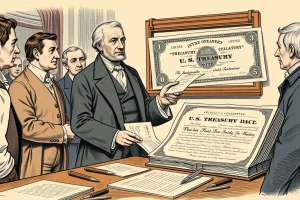
In July and August 1813, Congress enacted a comprehensive package of internal taxes. On July 22, 1813, it passed an act establishing collection districts and administrative machinery for assessing and collecting direct taxes and internal duties. Two days later, on July 24, Congress imposed duties on refined sugar, carriages, distilled spirits, and auction sales. On July 30, 1813, the legislature approved the central measure: a direct tax of $3 million, apportioned among the states according to population, with specific quotas assigned to each. The tax was applied to “the value of all lands, lots of ground with their improvements, dwelling-houses, and slaves.” The act listed each state’s exact payment: for example, New York owed $430,141.62, Pennsylvania $365,479.16, and Virginia $369,018.44. It also provided for assessments by counties and districts, which were laid out in detail in the companion act of July 22.
To implement the tax, President James Madison and Treasury Secretary Albert Gallatin reinstated the Office of the Commissioner of the Revenue and appointed principal assessors and collectors for each collection district. These officials were tasked with valuing taxable property and collecting payments, with a deadline for assessment set for early 1814. Collection proceeded slowly, however, owing to local resistance, the sheer size of the task, and the demands of wartime. Many property owners simply did not pay, and newspapers began printing lists of delinquent taxpayers and notices of property sales for unpaid taxes, which continued into 1816 and even later in some states.

Why It Matters
The Direct Taxes of 1813 represent a turning point in American fiscal history. They provided critical revenue for a war effort that the government otherwise struggled to finance, and they tested the constitutional power of direct taxation for the first time since the 1790s. The taxes also generated a rich documentary record—assessment lists, collector reports, and newspaper notices—that later became invaluable to genealogists and historians. Politically, the taxes became a focal point of opposition, especially in Federalist New England, where some communities denounced them as unconstitutional and disruptive. The eventual repeal of all internal taxes in December 1817 reflected the public’s wariness of standing internal revenues. Historians view the episode as evidence of the limited fiscal capacity of the early Republic and the political sensitivity of direct taxation, themes that recurred in American politics up to the adoption of the income tax.
Definition
The Direct Taxes of 1813 were a group of federal revenue statutes that imposed taxes directly on property and certain goods within the United Sates. The term “direct tax” in this context specifically meant a tax apportioned among the states according to population, as required by the Constitution for direct taxes. The law of July 30, 1813, laid a tax of three million dollars on the assessed value of lands, improvements, dwelling-houses, and slaves, with each state required to collect its assigned quota.
Background
Before 1813, the federal government had experimented with direct taxes during the 1790s, including a 1798 tax on real property and slaves. That tax had been controversial and was repealed with all other internal taxes in 1802. The War of 1812 created an urgent need for revenue. With customs revenues falling due to the blockade and with loans limited, Congress turned again to direct taxation. The Democratic-Republican majority, which had historically opposed such taxes, was forced to accept them, though they insisted on apportionment by population and on limiting the tax to property deemed tangible and assessable.
How It Worked
The tax operated through federal collection districts, which were mapped onto counties or groups of counties. Under the July 22 act, each state was divided into districts, each with a principal assessor and a collector. Assessors were to survey all real property—land, buildings, and improvements—and also to count slaves, who were taxed at a fixed rate per person. The value of property was estimated, and a rate was set to raise each state’s quota. For example, in New York tax rates ranged from about fifteen to eighteen cents per hundred dollars of assessed valuation, depending on the district. Property owners were required to report their holdings, and assessors could also personally inspect properties. Payments were due in installments, typically beginning in 1814, with penalties and interest for non-payment. The act also authorized the sale of property for prolonged non-payment, a measure frequently advertised in local newspapers.
Competing Viewpoints
Supporters of the direct tax argued that it was a necessary and constitutional measure to finance the defense of the nation. They pointed to the broad base of the tax—land and slaves—as a fair way to distribute the burden. Opponents, particularly Federalists in New England, contended that direct taxes were an invasion of state sovereignty, that they placed an unjust burden on landowners, and that the assessment machinery was intrusive. Some also argued that the tax was a step toward a permanent standing internal revenue system, which they believed threatened liberty. In practice, many towns and individuals resisted payment, leading to legal disputes and local protests. A notable example is the refusal of some New England communities to cooperate with assessors, though the federal government eventually collected most of the money.
Role in the War of 1812
The direct taxes supplied essential funds during a period when the Treasury faced severe strain. Although customs duties and loans provided the bulk of war financing, the $3 million direct tax, together with other internal duties, helped cover military expenditures and government operations. The tax also signaled to creditors and foreign nations that the United States was committed to raising revenue domestically, which aided in securing loans. The revenue from these taxes enabled the War Department to pay for supplies, equipment, and personnel, contributing to the overall war effort. Moreover, the need for uniform assessment and collection led to the creation of administrative structures that influenced later federal tax systems.
Consequences and Historical Interpretation
The immediate consequences of the 1813 direct taxes were mixed. They succeeded in raising revenue, but the collection process was slow and often contested, and the taxes were widely unpopular. In the longer term, the experience reinforced American aversion to internal taxes, and Congress repealed all internal duties by an act of December 23, 1817, which took effect at the end of that year. The direct tax of 1813 left a lasting legacy through its records, which today are used for genealogical and historical research. Historians generally interpret the episode as a crucial test of federal taxation powers and a demonstration of the practical limits of early American governance. It is often compared to the later imposition of direct taxes during the Civil War and the eventual creation of the income tax. The controversy also contributed to the growing sectional tensions between Federalist New England and the rest of the country during the war.
Primary Sources
The most direct primary sources for the Direct Taxes of 1813 are the statutes themselves, published in the United States Statutes at Large, Volume 3. Key laws include “An Act to lay and collect a direct tax within the United States” (July 30, 1813) and “An Act for the assessment and collection of certain direct taxes and internal duties” (July 22, 1813). These documents specify the apportionment and administrative framework. Additional primary evidence comes from the assessment lists and collection records preserved at the National Archives and state archives, such as the “Lists of Taxes Payable – New York State Collection Districts, 1814-1815” held by the New York State Library. These lists, prepared by assessors, contain the names of property owners, valuations, and amounts owed. Contemporary newspapers also printed taxpayer lists and notices of delinquent property sales, as exemplified by the Raleigh Register in North Carolina. These sources must be read with awareness of their administrative purpose and of potential biases, such as underreporting by residents or errors by overburdened assessors.
Further Reading
- Donald R. Hickey, The War of 1812: A Forgotten Conflict (Urbana: University of Illinois Press, 1989).
- Thomas L. Hungerford, “U.S. Federal Government Revenues: 1790 to the Present,” Congressional Research Service Report RL33665 (2006).
- Diane L. Richard, “Using Federal Direct Tax Records,” Archives.com (2013).
- United States Statutes at Large, Vol. 3 (Boston: Charles C. Little and James Brown, 1846).
- “United States Office of the Commissioner of the Revenue Lists of Taxes Payable – New York State Collection Districts, 1814-1815,” New York State Library, Manuscripts and Special Collections, SC10872.
References
- United States Congress, “An Act to lay and collect a direct tax within the United States,” July 30, 1813, Statutes at Large, 3 Stat. 53. Available at Wikisource.
- United States Congress, “An Act for the assessment and collection of certain direct taxes and internal duties,” July 22, 1813, Statutes at Large, 3 Stat. 22. Available at Wikisource.
- “United States Office of the Commissioner of the Revenue Lists of Taxes Payable – New York State Collection Districts, 1814-1815,” New York State Library, SC10872. http://www.nysl.nysed.gov/msscfa/sc10872.
- Diane L. Richard, “Using Federal Direct Tax Records,” Archives.com, Apr 11, 2013. https://www.archives.com/experts/richard-l-diane/using-federal-direct-tax-records.html.
- Thomas L. Hungerford, “U.S. Federal Government Revenues: 1790 to the Present,” CRS Report RL33665, September 25, 2006. https://www.congressionalresearch.com/RL33665/document.php.
FAQ
Why was the direct tax of 1813 passed?
It was passed to raise revenue for the War of 1812, as customs duties had fallen sharply due to the British blockade and the government lacked a central bank to facilitate borrowing.
What exactly was taxed by the direct tax of 1813?
The tax applied to the assessed value of all lands, lots of ground with improvements, dwelling-houses, and slaves. It did not tax other forms of property such as personal belongings or income.
How did Americans react to the direct tax?
Reactions were mixed but often negative. Many opposed the federal government's power to tax property, especially in New England, and collection faced resistance, evasion, and delays. Eventually, the tax was collected, but it fueled sectional resentment.




Leave a Reply