
Short Answer
Commodore Oliver Hazard Perry and the Battle of Lake Erie are inseparable in the history of the War of 1812. On 10 September 1813, Perry’s United States squadron defeated a British Royal Navy squadron under Commander Robert Heriot Barclay on western Lake Erie near Put-in-Bay, Ohio. The victory secured American control of the lake, forced the British to abandon Detroit, and contributed to the defeat of Tecumseh’s Indigenous confederacy at the Battle of the Thames.
Historical Context
At the outbreak of the War of 1812, Britain controlled the Great Lakes, with the Provincial Marine and Royal Navy operating on Lake Erie. Control of the lake allowed the British to supply Fort Malden and Detroit, and to move troops and Indigenous allies. The United States had few naval forces on Lake Erie, and an early attempt to invade Canada ended in the surrender of Detroit in August 1812. Recognizing the strategic importance of the lake, the U.S. Navy established a shipyard at Presque Isle (modern Erie, Pennsylvania) and appointed Master Commandant Oliver Hazard Perry to command the lake forces in early 1813. Perry oversaw the construction of two 20-gun brigs, Lawrence and Niagara, and assembled a squadron of smaller vessels. Meanwhile, the British under Commander Robert Heriot Barclay faced supply shortages and an incomplete squadron. The Americans also had to contend with a sandbar at Presque Isle that prevented larger ships from leaving the harbor until August 1813.
What Happened
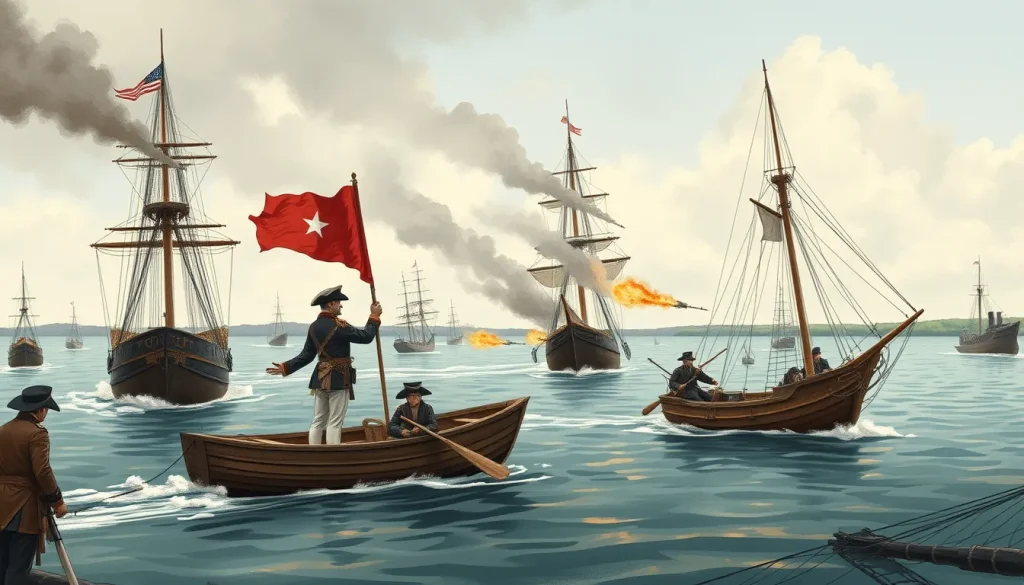
On the morning of 10 September 1813, lookouts at Put-in-Bay sighted the British squadron. Perry’s nine vessels sailed out to engage Barclay’s six ships. The wind initially favored the British, but shifted to the southeast, giving the Americans the weather gauge. Perry formed his line with the Lawrence in the van, followed by the Niagara and smaller gunboats. At about 11:45 a.m., the British flagship Detroit opened fire at long range. Perry pressed forward in the Lawrence, supported by the schooners Scorpion and Ariel, but the Lawrence suffered devastating damage from the combined fire of the Detroit, Queen Charlotte, and other British vessels. With the Lawrence disabled and most of its crew killed or wounded, Perry transferred his flag in a rowboat to the Niagara, which had remained largely out of the action. Taking command of the Niagara, Perry sailed it through the British line, raking the enemy ships. The smaller American vessels joined the attack, and by 2:30 p.m. the British squadron had surrendered. Perry sent a famous dispatch to Major General William Henry Harrison: “We have met the enemy and they are ours.”
Why It Matters
The immediate effect of the battle was American control of Lake Erie. This severed British supply lines to Detroit and Fort Malden, forcing the British to abandon Detroit and retreat up the Thames River. The subsequent American pursuit led to the Battle of the Thames on 5 October 1813, where Tecumseh was killed and his Indigenous confederacy collapsed. In the longer term, the victory secured the northwestern frontier for the United States, boosted American morale, and made Perry a national hero. Historians also note that the battle demonstrated the importance of naval power on the Great Lakes and the logistical challenges of building and supplying fleets in a wilderness. The battle’s outcome has been attributed to American superiority in close-range firepower, British shortages of men and supplies, and Perry’s aggressive leadership. The controversy between Perry and Jesse Elliott, captain of the Niagara, over Elliott’s conduct during the battle became a lasting dispute.
Prelude
In early 1813, Perry arrived at Presque Isle to find a small and incomplete squadron. He worked with shipwrights, including Noah Brown, to construct the brigs Lawrence and Niagara and to convert purchased vessels into gunboats. The British, aware of the growing American threat, blockaded Presque Isle in May and June 1813, but were forced to withdraw in July due to supply shortages and the need to support British operations elsewhere. Perry managed to get his ships over the sandbar at Presque Isle in early August and moved his squadron to Put-in-Bay, a sheltered anchorage in the Bass Islands. Barclay, meanwhile, was desperate for supplies and reinforcements from the British fleet on Lake Ontario, but was largely ignored. He sailed from Amherstburg in early September to seek a decisive engagement before his provisions ran out.
Forces and Commanders
The American squadron consisted of nine vessels: the brigs Lawrence (flagship, 20 guns) and Niagara (20 guns), the brig Caledonia (3 guns), the schooners Scorpion, Ariel, Somers, Porcupine, and Tigress, and the sloop Trippe. In total, they mounted 54 guns. Perry commanded the fleet, with Master Commandant Jesse Elliott as second-in-command aboard the Niagara. The crews were a mix of regular sailors, militia, and volunteers from the Army of the Northwest. The British squadron under Commander Robert Heriot Barclay comprised six vessels: the ships Detroit (19 guns) and Queen Charlotte (17 guns), the brig General Hunter (10 guns), the schooners Lady Prevost (13 guns) and Chippewa (1 gun), and the sloop Little Belt (3 guns), totaling 63 guns. Barclay’s crews were filled with regulars from the Royal Newfoundland Regiment and the 41st Regiment of Foot, as well as Provincial Marine sailors.
Battlefield and Map Context
The battle took place on the western end of Lake Erie, near Put-in-Bay in the Bass Islands, Ohio. The site is approximately 41°39′44″N, 82°49′30″W, between the modern U.S. state of Ohio and the Canadian province of Ontario. The British squadron had sailed from Amherstburg (modern Amherstburg, Ontario), while the American base was at Presque Isle (Erie, Pennsylvania) and later Put-in-Bay. The battle was fought in open water, with the two fleets maneuvering in light and shifting winds.
Battle Chronology
At dawn on 10 September, American lookouts spotted the British squadron northwest of Put-in-Bay. Perry’s squadron weighed anchor and sailed out around 7 a.m. For over two hours, Perry tried to gain the weather gauge, and around 10 a.m. the wind shifted to the southeast, giving the Americans the advantage. The British formed a line of battle heading west. The Americans formed a parallel line. At 11:45 a.m., the Detroit fired the first shot at extreme range. Perry’s Lawrence and the two lead schooners engaged the British van. By noon, the Lawrence was heavily damaged, and Perry decided to transfer his flag to the Niagara. He departed in a rowboat under fire, arriving on the Niagara around 12:30 p.m. Elliott, who had kept the Niagara out of effective range, then took command of the Lawrence’s remaining boats. Perry sailed the Niagara into the British line, firing broadsides into the Detroit and Queen Charlotte. The smaller American gunboats also closed in. By 2:30 p.m., the British ships had struck their colors. Barclay, wounded, surrendered his sword aboard the Niagara.
Casualties and Losses
American casualties were 27 killed and 96 wounded. British casualties were 41 killed, 94 wounded, and 306 captured. The Lawrence suffered the highest American losses, with over 80 percent of its crew killed or wounded. The British ships were all captured, though several were badly damaged. The Detroit and Queen Charlotte were taken into American service but saw little further action. The battle was one of the bloodiest naval engagements of the War of 1812 in terms of proportion of crew casualties.
Result
The result was a decisive American victory. Perry’s squadron captured the entire British squadron, giving the United States control of Lake Erie. Perry sent a dispatch to General Harrison: “We have met the enemy and they are ours; two ships, two brigs, one schooner and one sloop.” The victory was celebrated throughout the United States, and Perry received a Congressional Gold Medal and the Thanks of Congress. In Britain and Canada, the defeat was a serious blow, leading to a court martial that honourably acquitted Barclay and blamed the loss on insufficient resources.
Strategic Consequences
American control of Lake Erie severed British supply lines to the western frontier. The British abandoned Detroit and Fort Malden and retreated up the Thames River. Harrison’s army pursued and defeated the British and their Indigenous allies at the Battle of the Thames on 5 October 1813. Tecumseh was killed, and his confederacy disintegrated. The victory also allowed the Americans to launch operations on Lake Huron in 1814, though they failed to recapture Fort Michilimackinac. The battle secured the northwestern United States from British invasion and helped restore American confidence after a series of defeats. It also underscored the importance of naval supremacy on the Great Lakes, a lesson that influenced later campaigns on Lake Ontario and Lake Champlain.
Primary Accounts
Perry’s dispatch to Harrison is the most famous contemporary document, written on 10 September 1813. The original is held in the National Archives. Samuel Hambleton, Perry’s purser, kept a diary that describes the raising of the “Don’t Give Up the Ship” flag and the battle’s progress. British accounts include Commander Barclay’s official report and the proceedings of his court martial, which provide insight into British shortages and tactics. These accounts are valuable but reflect the perspectives of the authors; Perry’s dispatch is concise and celebratory, while Hambleton’s diary is personal and anecdotal. The court martial testimony is filtered through legal and professional concerns.
Battlefield Today
The battle site is marked by the Perry’s Victory and International Peace Memorial at Put-in-Bay, Ohio, operated by the National Park Service. The memorial includes a 352-foot column and a visitor center with exhibits on the battle. The reconstructed USS Niagara, a sister ship to Perry’s flagship, is berthed at Erie, Pennsylvania, and serves as a museum ship. The original Lawrence was sunk and later recovered; some timbers are displayed at the Naval Academy Museum. Annual commemorations at Put-in-Bay and Erie recall the battle. The site’s international peace aspect reflects the later reconciliation between the United States, Britain, and Canada.
Primary Sources
Key contemporary documents include:
- Oliver Hazard Perry to William Henry Harrison, 10 September 1813, reporting the victory and the famous phrase “We have met the enemy and they are ours.” The original is in the National Archives and published in various documentary editions.
- Samuel Hambleton’s diary, which describes the sewing and raising of the “Don’t Give Up the Ship” flag and provides a firsthand account of the battle.
- Commander Robert Heriot Barclay’s official report and the record of his court martial (held in Halifax, Nova Scotia, in 1814), which detail the British perspective and the lack of resources.
- Contemporary newspaper accounts, such as the Niles’ Weekly Register, which reprinted Perry’s dispatch and other reports.
These sources are limited by their authors’ perspectives and the fog of war. Perry’s dispatch omits the controversy over Elliott’s conduct; Hambleton’s diary is personal and may reflect later recollections; Barclay’s court martial is a legal proceeding with its own agenda.
Further Reading
- David Curtis Skaggs and Gerard T. Altoff, A Signal Victory: The Lake Erie Campaign, 1812–1813 (1997). The standard scholarly study of the campaign.
- Gerard T. Altoff, Amongst My Best Men: African-Americans and the War of 1812 (1996), which covers the role of Black sailors at Lake Erie.
- Barry M. Gough, “Battle of Lake Erie (Battle of Put-in-Bay),” The Canadian Encyclopedia, provides a Canadian perspective.
- National Park Service, “The Battle of Lake Erie,” Perry’s Victory and International Peace Memorial, offers a detailed online history.
- American Battlefield Trust, “Lake Erie Battle Facts and Summary,” for maps and concise overview.
References
- National Park Service, “The Battle of Lake Erie,” Perry’s Victory & International Peace Memorial, https://www.nps.gov/pevi/learn/historyculture/battle_erie_detail.htm.
- American Battlefield Trust, “Lake Erie Battle Facts and Summary,” https://www.battlefields.org/learn/war-1812/battles/battle-lake-erie.
- Barry M. Gough, “Battle of Lake Erie (Battle of Put-in-Bay),” The Canadian Encyclopedia, https://thecanadianencyclopedia.ca/en/article/battle-of-lake-erie-battle-of-put-in-bay.
- Wikipedia, “Battle of Lake Erie,” https://en.wikipedia.org/wiki/The_Battle_of_Lake_Erie. (Used for general chronology and figures.)
- Wikipedia, “Oliver Hazard Perry,” https://en.wikipedia.org/wiki/Commodore_Oliver_Hazard_Perry. (Used for biographical details.)
FAQ
Why was the Battle of Lake Erie important?
The battle gave the United States control of Lake Erie, severing British supply lines to Detroit and forcing the British to abandon the city. It led directly to the Battle of the Thames and the death of Tecumseh, securing the northwestern frontier for the United States.
What was the significance of Perry’s “Don’t Give Up the Ship” flag?
The flag honored Perry’s friend Captain James Lawrence, who was mortally wounded aboard USS Chesapeake in June 1813 and reportedly said, “Don’t give up the ship.” Perry flew the flag during the battle as a rallying symbol, and it became an enduring motto of the U.S. Navy.
What were the casualties at the Battle of Lake Erie?
American losses were 27 killed and 96 wounded. British losses were 41 killed, 94 wounded, and 306 captured. The USS Lawrence suffered the highest American casualties, with most of its crew killed or wounded.


Leave a Reply