
Short Answer
The British attack on Baltimore in September 1814 was a calculated military operation designed to strike a decisive blow against the United States by seizing one of its most important commercial and naval centers. Baltimore’s deep harbor, its shipbuilding industry, and its role as the homeport for numerous privateers made it a high-value target in the War of 1812. The successful defense of the city not only repelled the British but also inspired Francis Scott Key to write the poem that became “The Star-Spangled Banner,” cementing the battle’s place in American memory.
Historical Context
By 1814, the War of 1812 had dragged on for two years with neither side able to achieve a decisive advantage. The British, having defeated Napoleon in Europe and freed up troops and ships, intensified their efforts against the United States. They launched a campaign in the Chesapeake Bay, aiming to disrupt American trade, destroy military resources, and force the U.S. government to accept British peace terms. After burning Washington, D.C., in August 1814, the British turned their attention to Baltimore, then the third-largest city in the country with a population of over 47,000.
Baltimore thrived on trade in tobacco, grain, and other goods, and its shipyards built some of the fastest vessels of the era—the famous Baltimore clippers. The city also became the center of American privateering, with more than 120 privately armed ships receiving letters-of-marque to prey on British merchants. These privateers captured hundreds of British vessels, causing significant economic damage. For the British, Baltimore represented both a strategic and an economic threat, and its capture would deliver a severe blow to American morale and finances.
What Happened
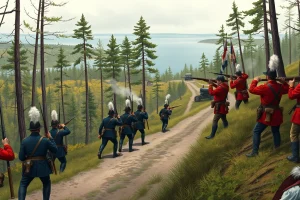
After the British forced the retreat of American forces at the Battle of Bladensburg and subsequently burned the federal buildings in Washington, they marched toward Baltimore in early September 1814. On September 12, about 4,500 British troops under Major General Robert Ross landed on the North Point peninsula, east of the city. They were met by roughly 3,000 Maryland militia under Brigadier General John Stricker, who fought a delaying action at the Battle of North Point. The British drove the Americans back but suffered heavy casualties, including the death of General Ross.

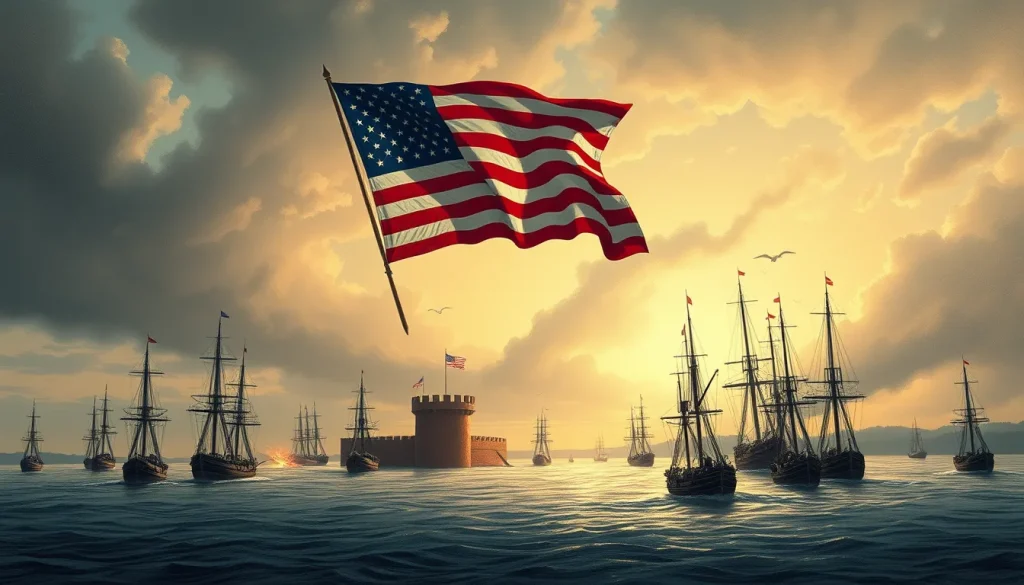
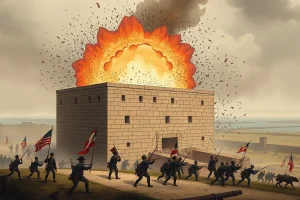
Meanwhile, British naval forces attempted to reduce Fort McHenry, which guarded the entrance to Baltimore’s harbor. Beginning on the morning of September 13, bomb vessels and ships fired rockets and explosive shells at the fort for twenty-five hours. The American garrison, commanded by Major George Armistead, withstood the bombardment, and when dawn broke on September 14, the large American flag still flew over the fort. The failure to capture Fort McHenry, combined with the strong earthworks that had been erected on Hampstead Hill facing the city, convinced the British to withdraw. The attack on Baltimore had failed.
Why It Matters
The defense of Baltimore was a significant American victory in a war that had seen many setbacks. It came at a time when American morale was low after the burning of Washington and boosted confidence in the ability of regulars and militia to resist British power. The battle also had lasting cultural impact: Francis Scott Key, a Maryland lawyer who was present during the bombardment on a truce ship, wrote the four stanzas of “The Star-Spangled Banner” after witnessing the flag still flying. The defense marked the end of the British Chesapeake campaign, and the war ended later that year with the Treaty of Ghent, which restored prewar boundaries.
Definition
When historians ask why the British targeted Baltimore in 1814, they refer to the strategic decision to attack a major American city and seaport as part of Britain’s broader military strategy in the Chesapeake and along the Atlantic coast. Baltimore was not just a symbolic prize; it was a functional hub of trade and naval activity, and its capture would have dealt a serious blow to the United States’ ability to continue the war.
Background
By 1814, the British had shifted their focus from the Canadian frontier to the American seaboard. With the defeat of Napoleon, they could redeploy experienced troops and warships. The Chesapeake Bay was a vulnerable region, and the British launched a series of raids to disrupt American commerce and pin down American resources. After the burning of Washington, Baltimore was the next logical target due to its size, economic importance, and the presence of privateers that had inflicted heavy losses on British shipping.
How It Worked
The British plan involved a combined land and sea attack. The army, under Robert Ross, would land east of the city on the North Point peninsula and march overland, while the Royal Navy forced its way past Fort McHenry to bring ships within range of the city. They intended to destroy the shipyards at Fells Point, capture or burn naval stores, and break the will of the American public. The success of the plan depended on quickly overwhelming the defenders before they could consolidate their positions. However, the Americans, led by Major General Samuel Smith, had spent months preparing fortifications, including earthworks across the eastern approaches and strengthened artillery at Fort McHenry. The defense was strong enough to halt the British advance and withstand the naval bombardment.
Competing Viewpoints
Contemporaries held differing views about British motives. Some Americans saw the attack simply as retaliation for American privateering and for the humiliating defeat of British arms. British officers and politicians emphasized the need to suppress privateering and to restore the prestige of the Royal Navy. Military historians debate whether Baltimore was a primary objective or part of a larger strategy to force a peace treaty by striking at the American heartland. Some argue that the British hoped to capture the city and use it as a bargaining chip in negotiations, while others maintain that the raid was primarily punitive. The fierce resistance at Baltimore, however, showed the limits of British power and contributed to the decision to end the war on both sides.
Role in the War of 1812
The British target of Baltimore in 1814 was a central episode in the Chesapeake campaign, which sought to bring the war to the American population and government. Although the British had successfully taken Washington, their defeat at Baltimore halted their momentum and allowed the Americans to negotiate from a stronger position at Ghent. The heavy losses and failure of the attack undermined British public enthusiasm for continuing the war, while American confidence rose. The defense of Baltimore therefore not only preserved a major city but also shaped the final stages of the conflict.
Consequences and Historical Interpretation
In the short term, the failed attack on Baltimore marked the end of major British operations in the Chesapeake. The British withdrew their fleet and troops, and no further large-scale expeditions were mounted against the American coast. The victory boosted American pride, and the flag that flew over Fort McHenry became a national symbol. Later historians have interpreted the battle as evidence of the effectiveness of American militia and fixed fortifications against a professional British Army and Navy. They also point to the strategic miscalculation by the British in underestimating the city’s defenses. The event is commemorated at Fort McHenry National Monument and Historic Shrine, and the Battle Monument in Baltimore stands as the first public war memorial in the United States.
Primary Sources
Major George Armistead’s report to Secretary of War James Monroe, written after the bombardment, provides a detailed account of the defense of Fort McHenry. It was published in Niles’ Weekly Register in October 1814. John Stuart Skinner, a prisoner-exchange agent who accompanied Francis Scott Key, left an account of the bombardment and Key’s composition of the anthem. The diaries and letters of British officers, though less common, offer insight into their expectations and subsequent disappointment. The Salem Gazette printed eyewitness accounts of the fighting from American participants. These sources are valuable but reflect each author’s perspective and limitations, such as the need to justify actions or appeal to public sentiment.
Further Reading
- George, Christopher T. Terror on the Chesapeake: The War of 1812 on the Bay. White Mane Books, 2000.
- Marine, William M. The British Invasion of Maryland, 1812-1815. Lippincott, 1913.
- Risjord, Norman K. Baltimore and the War of 1812. Maryland Historical Society, 2002.
- Stevenson, Walter. The Battle of North Point and the Defense of Baltimore. Maryland Historical Society, 2014.
- Star-Spangled Banner National Historic Trail, National Park Service.
References
- American Battlefield Trust. “10 Facts: Baltimore in the War of 1812.” battlefields.org, 2024.
- National Park Service. “Baltimore and North Point.” Star-Spangled Banner National Historic Trail.
- National Park Service. “Battle for Baltimore City.” Star-Spangled Banner National Historic Trail.
- Army Historical Foundation. “Battles That Saved America: North Point and Baltimore 1814.” armyhistory.org.
- Smithsonian National Museum of American History. “Baltimore in the Balance.” amhistory.si.edu.
FAQ
Why was Baltimore considered strategically important in 1814?
Baltimore was the third-largest U.S. city, a major seaport, and a leading shipbuilding center. It also housed many privateers that damaged British commerce, making it a prime target to cripple the American war economy.
How did the British plan to capture Baltimore?
The British planned a combined land and sea attack. Troops would land east of the city and march overland, while the navy would force its way past Fort McHenry to bombard the city and land additional forces. Both prongs failed due to strong American defenses.
What was the outcome of the attack on Baltimore?
The attack failed. The British suffered heavy casualties at North Point, the bombardment of Fort McHenry proved ineffective, and the strong earthworks convinced the British to withdraw. This victory boosted American morale and inspired the national anthem.
Leave a Reply