
Short Answer
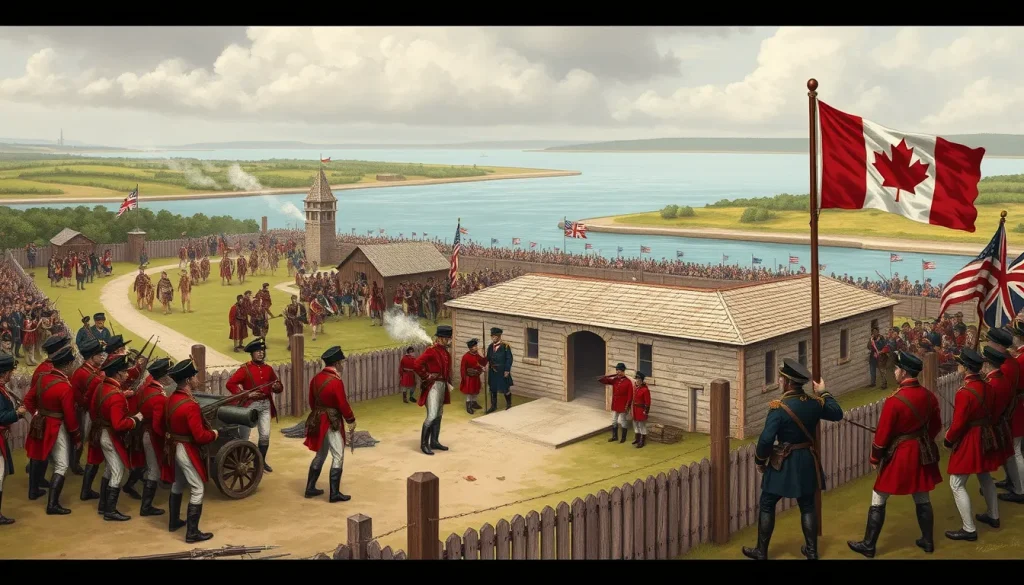
The Fall of Detroit refers to the surrender of Fort Detroit and the United States Army of the Northwest to British and Indigenous forces on August 16, 1812, during the War of 1812. Brigadier General William Hull capitulated to Major General Isaac Brock and the Shawnee leader Tecumseh, delivering Detroit and the Michigan Territory into British hands. The event was the first major American disaster of the war and directly reshaped the military and political balance in the Old Northwest, the region often called the Northwest Territory. This article uses Northwest Territory in that broad sense, because by 1812 the formal federal Northwest Territory had already been divided into Ohio, Indiana Territory, Illinois Territory, and Michigan Territory.
Historical Context
The United States declared war on Britain on June 18, 1812. The conflict grew from maritime disputes, including impressment and trade restrictions, but the war in the interior also involved long-running conflicts over land and Indigenous sovereignty. American settlers pressed into the Old Northwest, while Britain maintained posts and alliances with Indigenous nations. Tecumseh and his brother Tenskwatawa had built a confederacy to resist U.S. expansion, and British officials in Upper Canada saw that confederacy as a crucial buffer.
Detroit sat on the Detroit River opposite Sandwich in Upper Canada and near the British post at Fort Amherstburg, later Fort Malden. Control of Detroit and the upper Great Lakes meant control of supply routes, fur trade, and the ability to move troops and Indigenous allies. The Michigan Territory was a small American population center, but its position made it a launching point for an invasion of Upper Canada. President James Madison’s administration sent Hull’s Northwestern Army to occupy Detroit and threaten Canada.
British resources in Upper Canada were thin because Britain was fighting Napoleon in Europe. Major General Isaac Brock, commanding in Upper Canada, therefore depended on speed, deception, militia, and Tecumseh’s warriors. American leaders, by contrast, expected Canada to be vulnerable and assumed that Canadian settlers would welcome or at least not resist an American invasion. Those assumptions shaped Hull’s campaign and contributed to its failure.

What Happened
Hull marched north from Ohio in June 1812 and reached Detroit in early July. On July 12 he crossed the Detroit River into Upper Canada, the first American invasion of the war, and issued a proclamation to the inhabitants. He did not press an immediate attack on Fort Amherstburg, and his supply line back to Ohio remained exposed. On July 17, British and Indigenous forces captured Fort Mackinac, alarming American officials and Indigenous communities across the region.
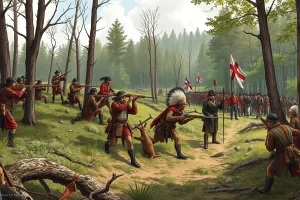
In early August Hull withdrew to Detroit. American supply columns were attacked near Brownstown on August 5, and a larger American force fought an inconclusive action at Maguaga, also called Monguagon, on August 9. Brock moved quickly from Niagara to Amherstburg, gathering regulars, Canadian militia, and Tecumseh’s warriors. On August 15 Brock demanded Detroit’s surrender, warning that he could not guarantee restraint of his Indigenous allies if fighting began. Hull refused at first, but British artillery began firing on the fort. Early on August 16, Brock crossed the river with his combined force. Faced with enemy guns, Indigenous warriors in the woods, cut supply lines, and a frightened civilian population, Hull surrendered Fort Detroit and his army.
Why It Matters
The surrender was a strategic catastrophe for the United States. It gave Britain and Tecumseh’s confederacy control of Detroit, Michigan Territory, and much of the upper Great Lakes. It exposed the Ohio, Indiana, and Illinois frontiers to raids and sieges. It also encouraged Indigenous nations that had been uncertain about alliance with Britain, while damaging American credibility among those who had favored the United States. The fall of Detroit was followed by the attack on Fort Dearborn on August 15, 1812, and the siege of Fort Wayne in September.
Historians disagree about how much blame belongs to Hull personally. Some emphasize his indecision, fear of Indigenous warfare, and failure to attack Fort Amherstburg when he had the chance. Others stress structural problems: inadequate regular troops, unreliable militia, poor logistics, confusing orders, and the difficulty of offensive operations across a vast frontier. Most agree that Brock and Tecumseh exploited American weaknesses with skill and that the defeat had effects far beyond Detroit. The United States eventually recovered Detroit in 1813, but only after campaigns at River Raisin, Fort Meigs, and Lake Erie. The death of Tecumseh at the Thames in October 1813 shattered the Indigenous confederacy, and the Treaty of Ghent returned territory without restoring Indigenous sovereignty.
Prelude
The prelude to the surrender was a contest of speed and supply. Hull had enough men to threaten Upper Canada, but he believed he lacked the artillery and transport to reduce Fort Amherstburg. When Fort Mackinac fell and his supply line was cut, he lost the initiative. Brock, reinforced by Tecumseh, understood that Detroit could be taken by psychological pressure as much as by firepower. The arrival of British regulars, militia, and Indigenous warriors around Detroit made the American position appear far weaker than its numbers suggested.
Forces and Commanders
The American force under Brigadier General William Hull numbered roughly 2,000 to 2,500 regulars, militia, and volunteers, though estimates vary. Hull’s subordinates included regular officers and Ohio and Michigan militia commanders, but the army suffered from divided authority and uncertain supplies. The British and Indigenous force was smaller in regular troops but effective in combination. Major General Isaac Brock commanded British regulars, including detachments of the 41st Foot, Canadian militia, and artillery. Tecumseh led a large body of Indigenous warriors from several nations, including Shawnee, Ojibwe, Potawatomi, Wyandot, and others. Colonel Henry Procter was a senior British officer on the Detroit frontier and later commanded at River Raisin and Fort Meigs.
Battlefield and Map Context
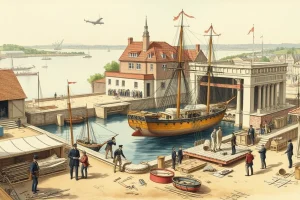
Detroit in 1812 was a fortified town on the north bank of the Detroit River, across from Sandwich in Upper Canada. The river connected Lake St. Clair to Lake Erie. Fort Amherstburg, later rebuilt as Fort Malden, lay to the south on the Canadian side near Lake Erie. The American supply route ran south from Detroit toward the River Raisin and Ohio, making it vulnerable to ambush. Brock positioned artillery on the Canadian shore and crossed the river with his force. In modern terms, the action occurred at Detroit, Michigan, opposite Windsor, Ontario, with Fort Malden National Historic Site at Amherstburg, Ontario. Fort Detroit itself no longer exists.
Battle Chronology
- June 18, 1812: The United States declares war on Britain.
- July 5, 1812: Hull’s army reaches Detroit.
- July 12, 1812: Hull crosses into Upper Canada at Sandwich.
- July 17, 1812: British and Indigenous forces capture Fort Mackinac.
- August 5, 1812: American supply force is ambushed at Brownstown.
- August 9, 1812: Americans fight at Maguaga or Monguagon.
- August 13, 1812: Brock arrives at Amherstburg with reinforcements.
- August 15, 1812: Brock demands Detroit’s surrender; Fort Dearborn is attacked.
- August 16, 1812: Brock crosses the Detroit River; Hull surrenders Fort Detroit and his army.
Casualties and Losses
The fighting before the surrender produced only modest casualties compared with the capitulation itself. The decisive loss was the entire American garrison and its equipment. Hull surrendered roughly 2,000 to 2,500 troops, along with artillery, small arms, and military stores. British and Indigenous casualties during the immediate operation were small. The broader human cost included the prisoners taken at Detroit, the dead and captured at Fort Dearborn, and the civilian and Indigenous communities drawn deeper into the war.
Result
The immediate result was a British and Indigenous victory. Detroit and Michigan Territory passed into British control, and American authority in the upper Great Lakes collapsed. Hull was later court-martialed, found guilty, and sentenced to death, though President Madison remitted the sentence because of his service in the American Revolution. The British held Detroit until September 1813, when Major General William Henry Harrison reoccupied it after Commodore Oliver Hazard Perry’s victory at the Battle of Lake Erie. The surrender therefore marked the low point of American fortunes in the Northwest, not the final outcome.
Strategic Consequences
In the Old Northwest, the fall of Detroit opened the frontier to British and Indigenous operations. Fort Dearborn was destroyed, Fort Wayne was besieged, and American settlements in Ohio, Indiana, and Illinois feared attack. The defeat also damaged American relations with Indigenous nations, many of which chose or were pushed toward Britain and Tecumseh. It forced the United States to rebuild its northwestern army, improve supply lines, and rely more on regular troops and naval power. The campaigns of 1813, including River Raisin, Fort Meigs, Lake Erie, and the Thames, were direct responses to the crisis created at Detroit.
For Britain and Canada, Detroit was a defensive and psychological victory. For Tecumseh’s confederacy, it was a moment of hope that British-Indigenous cooperation could halt American expansion. That hope faded after Lake Erie and the Thames. The Treaty of Ghent in 1814 restored the territorial status quo between Britain and the United States, but it did not restore Indigenous sovereignty or the confederacy’s power. In historical memory, Detroit became a symbol of American unpreparedness, Brock became a Canadian hero, and Tecumseh became a central figure in both Indigenous and military history.
Primary Accounts
Several kinds of contemporary accounts survive. William Hull’s official correspondence and his 1824 Memoirs of the Campaign of the North Western Army present his defense and must be read as self-justifying. Isaac Brock’s dispatches to Governor General Sir George Prevost, printed in nineteenth-century editions of his life and correspondence, give the British command perspective and emphasize Brock’s use of psychological pressure. American court-martial testimony from 1814 records conflicting memories of Hull’s decisions. Indigenous perspectives are harder to recover in written form because Tecumseh and most warriors left no memoirs; their roles appear in British and American documents, in later oral traditions, and in the records of Indigenous nations. All these sources are shaped by loyalty, blame, and the desire to justify wartime choices.
Battlefield Today
Fort Detroit no longer survives. Its site lies in downtown Detroit, Michigan, where historical markers and local institutions interpret the early American and British period. Across the river, Fort Malden National Historic Site in Amherstburg, Ontario, preserves the British post associated with the Detroit frontier. River Raisin National Battlefield Park in Monroe, Michigan, commemorates a later campaign that followed from the fall of Detroit. The international border between Detroit and Windsor now crosses the same river that Brock’s force crossed in August 1812.
Primary Sources
William Hull, Memoirs of the Campaign of the North Western Army of the United States, A.D. 1812 (1824), is a participant’s defense and should be compared with official records. Isaac Brock’s letters and dispatches, especially those of August 1812, are available in published editions of his correspondence and provide the British view. The Articles of Capitulation for Detroit, dated August 16, 1812, are cited in documentary collections and set out the surrender terms. American and Canadian newspaper reports from 1812 show how contemporaries interpreted the defeat, often with strong partisan bias. Court-martial records and officer correspondence add detail but reflect personal and political agendas.
Further Reading
- Donald R. Hickey, The War of 1812: A Forgotten Conflict.
- Alan Taylor, The Civil War of 1812: American Citizens, British Subjects, Irish Rebels, and Indian Allies.
- Pierre Berton, The Invasion of Canada, 1812-1813.
- John Sugden, Tecumseh: A Life.
- American Battlefield Trust, The Detroit Frontier in the War of 1812.
- Fort Malden National Historic Site, Parks Canada.
- River Raisin National Battlefield Park, National Park Service.
References
- American Battlefield Trust, The Detroit Frontier in the War of 1812, https://www.battlefields.org/learn/articles/detroit-frontier-war-1812
- The War of 1812, The Northwest Campaign, https://thewarof1812.org/campaigns/the-northwest-campaign/
- Donald R. Hickey, The War of 1812: A Forgotten Conflict, University of Illinois Press.
- Alan Taylor, The Civil War of 1812, Alfred A. Knopf, 2010.
- Pierre Berton, The Invasion of Canada, 1812-1813, McClelland and Stewart, 1980.
- William Hull, Memoirs of the Campaign of the North Western Army of the United States, A.D. 1812, Boston, 1824.
- Ferdinand Brock Tupper, ed., The Life and Correspondence of Major-General Sir Isaac Brock, K.B., London, 1845.
FAQ
What was the Fall of Detroit?
The Fall of Detroit was the surrender of Fort Detroit and Brigadier General William Hull's American army to British and Indigenous forces under Major General Isaac Brock and Tecumseh on August 16, 1812.
Why did William Hull surrender Detroit?
Hull faced British artillery, Tecumseh's warriors, cut supply lines, and a frightened civilian population. He also feared that resistance would lead to uncontrolled Indigenous warfare. Historians debate how much his decisions reflected personal failure and how much they reflected the weaknesses of the American militia and supply system.
How did the fall of Detroit affect the Northwest Territory?
It gave Britain and Tecumseh's confederacy control of Michigan Territory and the upper Great Lakes, encouraged Indigenous alliances against the United States, and exposed the Ohio, Indiana, and Illinois frontiers to raids and sieges. The United States only recovered Detroit in 1813 after the Battle of Lake Erie and the Battle of the Thames.
Did the United States retake Detroit?
Yes. Major General William Henry Harrison reoccupied Detroit on September 29, 1813, after Commodore Oliver Hazard Perry's victory at the Battle of Lake Erie. Harrison then pursued the British and Indigenous forces to the Thames River in Upper Canada.
Leave a Reply