Short Answer
The Battle of Lake Erie, also known as the Battle of Put-in-Bay, was fought on 10 September 1813 near Put-in-Bay, Ohio, on Lake Erie. A United States Navy squadron commanded by Master Commandant Oliver Hazard Perry defeated a British Royal Navy squadron under Commander Robert Heriot Barclay. The engagement secured American control of Lake Erie for the remainder of the War of 1812, severed British supply lines to the western posts, and enabled the United States to recover Detroit and advance into Upper Canada. Its strategic consequences extended beyond the lake, contributing to the collapse of Tecumseh’s Indigenous confederation at the Battle of the Thames.
Historical Context
The War of 1812 grew out of maritime disputes, trade restrictions, and frontier tensions, but in the Great Lakes region it became a contest for control of waterborne supply routes. When the United States declared war in June 1812, the British held a small naval force on Lake Erie through the Provincial Marine, including the sloop-of-war Queen Charlotte, the brig General Hunter, and the schooner Lady Prevost. These vessels, supported by the Royal Navy, allowed Britain to move troops and supplies to Fort Malden at Amherstburg in Upper Canada (present-day Ontario) and to support Indigenous allies under Tecumseh.
The United States lost Detroit in August 1812 when Brigadier General William Hull surrendered to Major-General Isaac Brock. That defeat exposed the American Northwest and demonstrated that without control of Lake Erie, American armies could not be supplied or reinforced reliably. The U.S. Navy established a shipyard at Presque Isle (modern Erie, Pennsylvania), where shipwrights built a squadron under Perry’s command. Perry arrived in March 1813 and worked to assemble crews, guns, and supplies despite shortages and a sandbar that blocked the harbor entrance. By late summer 1813, the American fleet was ready, and Perry moved it to Put-in-Bay to challenge British control.
What Happened
On the morning of 10 September 1813, lookouts spotted the British squadron northwest of Put-in-Bay. Perry’s nine vessels sailed out to engage Barclay’s six ships. The wind initially favored the British, but it shifted to the southeast around 10 a.m., putting the Americans upwind. Perry closed to within carronade range, where his short-range guns could inflict heavy damage. The battle began around 11:45 a.m. with British long guns firing first.
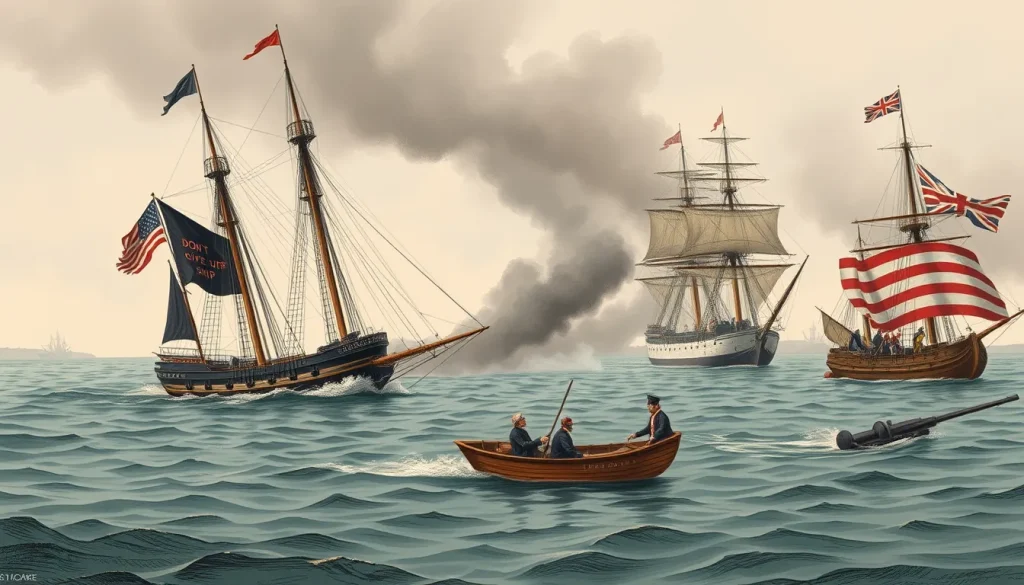
Perry’s flagship, the brig Lawrence, engaged Barclay’s flagship Detroit at close range and was battered almost to a wreck. With the Lawrence disabled and many of its crew killed or wounded, Perry transferred his flag by rowboat to the brig Niagara. Taking command of the Niagara, he broke through the British line and raked the British ships. By about 3 p.m., the British squadron had surrendered. Perry sent a brief dispatch to Major General William Henry Harrison: "We have met the enemy and they are ours."
Why It Matters
The immediate effect was American control of Lake Erie. That control cut the British supply route from Port Dover to Fort Malden and forced the British to abandon their positions on the western end of the lake. Harrison’s army then recaptured Detroit and pursued the British and their Indigenous allies into Upper Canada, winning the Battle of the Thames on 5 October 1813. Tecumseh was killed in that battle, and his confederation, already strained, fragmented. Historians generally agree that Lake Erie was strategically decisive in the Northwest, even though it did not end the wider war. Britain retained naval superiority on Lake Ontario and continued its Atlantic blockade. Later interpretations differ on how much Perry’s personal leadership or the fleet’s construction and logistics contributed most to the victory, but the strategic link between the naval battle and the subsequent land campaign is well established.
Prelude
After the loss of Detroit, American leaders recognized that Lake Erie had to be contested. Secretary of the Navy William Jones ordered two brig-rigged corvettes built at Presque Isle, and shipwright Noah Brown supervised their construction. Perry arrived in March 1813, obtained seamen from Commodore Isaac Chauncey on Lake Ontario, and gathered soldiers and militia to fill out his crews. British Commander Robert Heriot Barclay, meanwhile, faced his own shortages. His squadron needed supplies and reinforcements that had to travel from the Atlantic and Lake Ontario, and the British position at Fort Malden depended on shipments across Lake Erie. When Perry’s fleet appeared at Put-in-Bay in late summer, Barclay could either fight or see the British western posts starve. He chose to fight.
Forces and Commanders
The American squadron consisted of nine vessels: the brigs Lawrence, Niagara, and Caledonia; the schooners Scorpion, Ariel, Somers, Porcupine, and Tigress; and the sloop Trippe. They carried 54 guns. Perry commanded the fleet, with Master Commandant Jesse Elliott commanding the Niagara. The British had six vessels: the Detroit, Queen Charlotte, General Hunter, Lady Prevost, Chippewa, and Little Belt, carrying 63 guns. Barclay commanded the British squadron. Both sides were short of trained seamen and filled out their crews with landsmen, soldiers, and militia. Perry drew on Kentucky and Ohio militia and volunteers from Harrison’s army; Barclay used men from the Royal Newfoundland Regiment of Fencible Infantry and the 41st Regiment of Foot. Indigenous allies were not a major part of the ship crews, but the British alliance with Tecumseh’s confederation shaped the campaign’s strategic stakes.
Battlefield and Map Context
The battle took place in the western basin of Lake Erie near Put-in-Bay, Ohio, in the area of the Bass Islands. The commonly cited location is approximately 41°39′44″N 82°49′30″W, between modern South Bass Island and the Ontario shoreline. On a modern map, the battlefield lies near Put-in-Bay, Ohio, with Amherstburg, Ontario, and Detroit, Michigan, to the west and northwest. The lake narrows between the American and Canadian shores, making control of the water route strategically vital for both Detroit and Fort Malden.
Battle Chronology
The battle unfolded over several hours. At dawn, American lookouts sighted the British squadron. Perry sailed from Put-in-Bay around 7 a.m. and spent more than two hours maneuvering for the wind. Around 10 a.m., the wind shifted to the southeast, giving the Americans the weather gauge. At about 11:45 a.m., the Detroit fired the first shot. For the next hour, the Lawrence took severe punishment from several British ships while the Niagara and other American vessels engaged less closely. Around 2:30 p.m., Perry left the disabled Lawrence in a rowboat and transferred his flag to the Niagara. He then sailed the Niagara into the British line, delivering raking fire. By approximately 3 p.m., the British ships had struck their colors. Barclay, wounded, was taken prisoner.
Casualties and Losses
American casualties were 27 killed and 96 wounded. British losses were approximately 41 killed, 94 wounded, and 306 captured. These figures, based on commonly cited returns, vary slightly among accounts. The Lawrence suffered the heaviest American losses, while the Detroit and Queen Charlotte were heavily damaged. The United States captured all six British vessels. The human cost was significant for a single afternoon and reflected the close-range nature of the fighting.
Result
The result was an American victory and the capture of the British squadron. Perry’s dispatch to Harrison, "We have met the enemy and they are ours," became one of the most quoted messages of the war. The victory made Perry a national hero and secured his reputation. Elliott’s conduct during the battle became controversial; Perry and some officers believed the Niagara had not supported the Lawrence promptly enough, while Elliott defended his actions. The dispute persisted for years and divided opinion among naval officers and historians. No court-martial convicted Elliott, but the controversy remains a subject of historical debate.
Strategic Consequences
Strategically, the victory gave the United States control of Lake Erie for the rest of the war. British forces abandoned Fort Malden and retreated up the Thames River. Harrison’s army recovered Detroit and won the Battle of the Thames on 5 October 1813, where Tecumseh was killed and his confederation broke apart. The battle thus weakened the British-Indigenous alliance in the Northwest and secured the American frontier. It also improved American morale and strengthened the U.S. position in later negotiations, though it did not end the war or change British control of Lake Ontario and the Atlantic. Historians such as David Curtis Skaggs treat Lake Erie as a decisive campaign that made the American recovery of the Northwest possible, while others emphasize that the wider war remained unresolved until 1814–1815.
Primary Accounts
Several contemporary accounts survive. Perry’s official report to Secretary of the Navy William Jones, dated 10 September 1813, describes the battle and claims victory. Barclay’s report to his superiors offers the British perspective and explains the loss of his squadron. Samuel Hambleton’s diary records Perry’s use of the flag bearing Captain James Lawrence’s dying words, "Dont Give Up the Ship," and the ceremony of hoisting it. Elliott’s correspondence presents his defense of the Niagara’s role. These accounts are valuable but limited: Perry and Elliott had a personal dispute, Barclay was writing after a defeat, and all were shaped by professional reputation and national loyalty.
Battlefield Today
The battle site remains in Lake Erie and is not marked by a single land battlefield park. The primary memorial is the Perry’s Victory and International Peace Memorial at Put-in-Bay, Ohio, administered by the National Park Service. The memorial includes a 352-foot column, a visitor center, and exhibits on the battle and the peace between the United States, Britain, and Canada. On the Canadian side, Fort Malden National Historic Site in Amherstburg, Ontario, interprets the British and Indigenous context of the campaign. The lake itself, the Bass Islands, and nearby historic sites allow visitors to trace the geography that made control of Lake Erie so important.
Primary Sources
Key primary sources include Perry’s dispatch to William Jones (10 September 1813), Barclay’s official report, Samuel Hambleton’s diary, and the correspondence of Jesse Elliott. Perry’s dispatch is the most frequently quoted American document, but it was written in the immediate aftermath of victory and reflects his perspective. Hambleton’s diary provides a participant’s account of the flag ceremony but is a personal record. Barclay’s report explains British supply problems and the decision to engage. Elliott’s letters are essential for understanding the controversy over the Niagara, but they are self-defensive. When exact wording is quoted, it is drawn from these documents or from reliable published transcriptions; where a verified transcript is unavailable, readers should consult the National Archives, the Naval History and Heritage Command, or the published documentary editions listed below.
Further Reading
- Skaggs, David Curtis. A Signal Victory: The Lake Erie Campaign, 1812–1813. Annapolis: Naval Institute Press, 1997.
- Hickey, Donald R. The War of 1812: A Forgotten Conflict. Urbana: University of Illinois Press, 1989.
- Dudley, William S., ed. The Naval War of 1812: A Documentary History. Vol. 2. Washington, DC: Naval Historical Center, 1992.
- Perry’s Victory and International Peace Memorial, National Park Service. "The Battle of Lake Erie." https://www.nps.gov/pevi/learn/historyculture/battle%5Ferie%5Fdetail.htm
- Ohio History Connection. "Battle of Lake Erie."
References
- National Park Service. "The Battle of Lake Erie." Perry’s Victory and International Peace Memorial. https://www.nps.gov/pevi/learn/historyculture/battle%5Ferie%5Fdetail.htm
- Wikipedia. "Battle of Lake Erie." https://en.wikipedia.org/wiki/Battle_of_Lake_Erie
- Skaggs, David Curtis. A Signal Victory: The Lake Erie Campaign, 1812–1813. Annapolis: Naval Institute Press, 1997.
- Hickey, Donald R. The War of 1812: A Forgotten Conflict. Urbana: University of Illinois Press, 1989.
- Dudley, William S., ed. The Naval War of 1812: A Documentary History. Vol. 2. Washington, DC: Naval Historical Center, 1992.
FAQ
Why was the Battle of Lake Erie important?
It gave the United States control of Lake Erie, which severed British supply lines to Fort Malden and the western posts. That control allowed the Americans to recapture Detroit and win the Battle of the Thames, weakening Tecumseh's confederation.
Who commanded the American and British forces at Lake Erie?
Master Commandant Oliver Hazard Perry commanded the United States squadron, with Master Commandant Jesse Elliott commanding the brig Niagara. Commander Robert Heriot Barclay commanded the British squadron.
What happened to Oliver Hazard Perry after the battle?
Perry became a national hero and was promoted. He continued naval service, but his later career was affected by disputes, including the controversy with Jesse Elliott over the Niagara's role in the battle.



Leave a Reply