Short Answer
The impact of food shortages on the American campaign of the War of 1812 was a critical logistical failure that hampered U.S. military operations from 1812 to 1815. American forces, tasked with invading British North America (modern Canada), repeatedly suffered from insufficient, poor-quality, and untimely food supplies. These shortages contributed to failed offensives, low morale, disease, and the eventual abandonment of key positions, shaping the course of the war along the U.S.-Canadian border and the Great Lakes.
Historical Context
When the United States declared war on Great Britain on June 18, 1812, it possessed a small regular army of about 12,000 men and relied heavily on state militias. The primary American war aim was the conquest of Canada, but the vast distances, undeveloped infrastructure, and harsh climate of the northern frontier posed immense logistical challenges. The U.S. supply system was antiquated, based on a mix of military agents and private contractors, and was unprepared for sustained operations. In March 1812, Congress created the Quartermaster Department and the Office of the Commissary General of Purchases to improve supply, but these reforms were untested and underfunded. British and Canadian forces, while also facing supply difficulties, operated closer to their bases along the St. Lawrence River and had the advantage of established supply lines and naval control of the Great Lakes in the early part of the war. Indigenous allies on both sides also played significant roles, often relying on their own networks for food and supplies.
What Happened
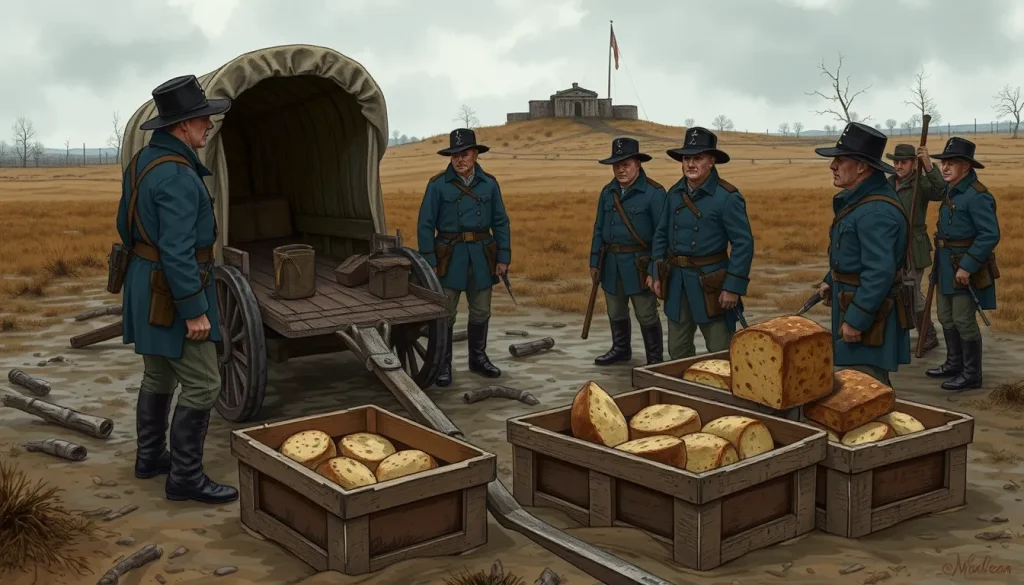
Food shortages plagued American campaigns throughout the war. In 1812, Brigadier General William Hull’s army invaded Canada from Detroit but soon found itself cut off from supplies. Lack of provisions, combined with fear of British and Indigenous attacks, led to Hull’s surrender of Detroit in August 1812 without a fight. Similarly, the Niagara campaign under Major General Stephen Van Rensselaer suffered from supply failures; militia units refused to cross the Niagara River into Canada, citing both legal concerns and the absence of adequate food and forage. In 1813, American forces on Lake Ontario and the St. Lawrence River struggled to maintain supply lines. The campaign against Montreal was abandoned partly due to logistical breakdowns. Soldiers often received spoiled meat, moldy flour, and half-rations, leading to malnutrition and disease. In 1814, despite some improvements under Quartermaster General Thomas Sidney Jesup, shortages persisted during the Niagara campaign and the siege of Fort Erie. Throughout the war, the U.S. Army’s dependence on unreliable contractors, poor roads, and scarce transport wagons meant that food often failed to reach the front lines in time.
Why It Matters
The immediate effects of food shortages were severe: failed invasions, loss of territory, high rates of disease and desertion, and low morale. The inability to sustain armies in the field directly contributed to the American failure to achieve its principal war aim—the conquest of Canada. In the longer term, the logistical crisis exposed the need for military reform. After the war, the U.S. Army established permanent supply departments, implemented stricter accountability measures, and professionalized the Quartermaster Corps. Historians generally agree that logistics was the most intractable problem for the American war effort, though some emphasize that leadership failures, militia limitations, and British resistance were equally important. The study of food shortages in 1812 has become a key case study in military logistics and the challenges of sustaining armies in remote theaters.
Definition
In the context of the War of 1812, food shortages refer to the insufficient quantity, poor quality, or untimely distribution of food to American military forces. This included a lack of fresh meat, vegetables, and flour, and an over-reliance on salted provisions that often spoiled. Food shortages were a component of broader supply failures that also encompassed clothing, ammunition, and forage for animals.
Background
Before the war, the U.S. Army’s supply system relied on a network of military agents and private contractors. In March 1812, Congress created the Quartermaster Department and the Office of the Commissary General of Purchases to centralize procurement and distribution. However, these new institutions lacked experienced personnel, clear regulations, and adequate funding. The system was further strained by the decision to rely on state militias, which often expected the federal government to provide for them but were themselves poorly supplied. The geography of the northern frontier—dense forests, few roads, and vast distances—made transportation slow and costly.
How It Worked
The supply chain began with the Commissary General of Purchases, who contracted with private suppliers for rations (typically comprising meat, flour, and a small amount of salt or vinegar). These provisions were then transported by wagon, boat, or ship to depots and forwarded to regiments. The Quartermaster Department handled transportation, but it suffered from a shortage of wagons, horses, and skilled teamsters. Contractors frequently failed to deliver on time or delivered substandard goods. Corruption and profiteering were widespread. Once at the front, food was distributed by regimental quartermasters, but poor storage led to spoilage. Soldiers often had to forage or purchase food from locals, which was unreliable in hostile territory.
Competing Viewpoints
Historians debate the causes of food shortages. Some, like Jean-Pierre Beugoms, argue that the systemic breakdown of the supply system was the primary culprit, citing the lack of professional logistics expertise and the reliance on corrupt contractors. Others emphasize geographic and environmental factors, such as the difficulty of moving supplies overland in winter or through muddy terrain. Christopher Dishman highlights the interdependence of land and naval operations, showing that control of the Great Lakes was essential for supply, and American failures there exacerbated shortages. Some scholars point to poor leadership and the refusal of militia to serve outside their states as key factors. There is also debate over whether food shortages were decisive or merely one of several factors that led to American defeat. Most agree that logistics played a critical role, but the relative weight of food versus other supplies remains contested.
Role in the War of 1812
Food shortages directly influenced several key campaigns. In August 1812, Hull’s surrender at Detroit was precipitated by his army’s lack of provisions and the failure of supply columns to reach him. The Niagara campaign of 1812 collapsed when militia refused to cross into Canada, citing insufficient food and forage. In 1813, the American advance on Montreal was halted partly due to supply failures, and the campaign on the St. Lawrence River was plagued by hunger. During the 1814 Niagara campaign, American forces under Major General Jacob Brown initially succeeded but were soon crippled by supply shortages, leading to the siege of Fort Erie and eventual withdrawal. On the Great Lakes, naval squadrons also depended on food supplies for their crews; shortages affected shipbuilding and operations. Throughout the war, the American army was never able to fully solve the food supply problem, limiting its ability to conduct sustained offensives.
Consequences and Historical Interpretation
The immediate consequence of food shortages was the failure of American arms to achieve decisive victory in Canada. The war ended with the Treaty of Ghent in 1814, which restored the status quo ante bellum, but the logistical lessons were not lost. In the postwar period, the U.S. Army underwent significant reforms: the Quartermaster Corps was professionalized under Thomas Sidney Jesup, new regulations were enacted, and the army developed a more reliable supply system. Historians interpret these reforms as a direct response to wartime failures. The study of food shortages in the War of 1812 has also contributed to broader understanding of military logistics, highlighting how supply lines can determine the outcome of campaigns. While often overshadowed by battles and naval engagements, the logistical struggle remains a vital part of the war’s history.
Primary Sources
Contemporary documents that illuminate food shortages include the official correspondence of American generals and government officials. For example, the letters of Major General William Hull during the Detroit campaign repeatedly request provisions and describe the dire state of his army. The papers of Major General Henry Dearborn and other commanders contain similar complaints. The records of the Commissary General of Purchases, Callender Irvine, and the Quartermaster Department, held in the National Archives, document the challenges of procurement and transportation. Soldiers’ diaries and reminiscences, such as those of participants in the Niagara campaigns, often mention hunger and poor rations. Newspapers of the period, like the National Intelligencer, occasionally reported on supply issues. These sources are valuable but must be used critically: commanders often exaggerated shortages to excuse failures, and contractors had incentives to downplay problems. Official reports may omit corruption or inefficiency.
Further Reading
- Beugoms, Jean-Pierre. ‘The Logistics of the United States Army, 1812–1821.’ PhD diss., Temple University, 2018.
- Dishman, Christopher D. ‘Warfare and Logistics along the US-Canadian Border during the War of 1812.’ University Press of Kansas, 2021.
- Nobbs, Gary H. Jr. ‘Failure on All Fronts: The United States Army in the First Year of the War of 1812.’ Master’s thesis, SUNY Buffalo State, 2021.
- U.S. Army Center of Military History. ‘American Military History, Chapter 6: The War of 1812.’ Washington, D.C.: Government Printing Office, 1989.
- Hickey, Donald R. ‘The War of 1812: A Forgotten Conflict.’ Urbana: University of Illinois Press, 1989.
- Stagg, J.C.A. ‘Mr. Madison’s War: Politics, Diplomacy, and Warfare in the Early American Republic, 1783–1830.’ Princeton: Princeton University Press, 1983.
References
- Beugoms, Jean-Pierre. ‘The Logistics of the United States Army, 1812–1821.’ PhD diss., Temple University, 2018. https://scholarshare.temple.edu/items/25b7d58c-0ad6-4c72-8cf5-2d767e3c723c
- Nobbs, Gary H. Jr. ‘Failure on All Fronts: The United States Army in the First Year of the War of 1812.’ Master’s thesis, SUNY Buffalo State, 2021. https://digitalcommons.buffalostate.edu/history_theses/50
- Dishman, Christopher D. ‘Warfare and Logistics along the US-Canadian Border during the War of 1812.’ University Press of Kansas, 2021. https://kansaspress.ku.edu/9780700632701/
- U.S. Army Center of Military History. ‘American Military History, Chapter 6: The War of 1812.’ https://webdoc.sub.gwdg.de/ebook/p/2004/CMH/American%20Military%20History/www.army.mil/cmh-pg/books/AMH/AMH-06.htm
FAQ
How did food shortages affect the American campaign in 1812?
Food shortages led to failed invasions, such as William Hull's surrender at Detroit, and caused militia to refuse crossing into Canada. They resulted in low morale, disease, and the inability to sustain offensives.
What caused food shortages in the U.S. Army during the War of 1812?
Causes included an inefficient supply system, reliance on unreliable contractors, poor transportation networks, geographic challenges, and corruption. The Quartermaster and Commissary departments were newly created and underfunded.
Did food shortages lead to reforms after the War of 1812?
Yes. The logistical failures prompted postwar reforms, including the professionalization of the Quartermaster Corps under Thomas Sidney Jesup, new regulations, and a more reliable supply system.

Leave a Reply