
Short Answer
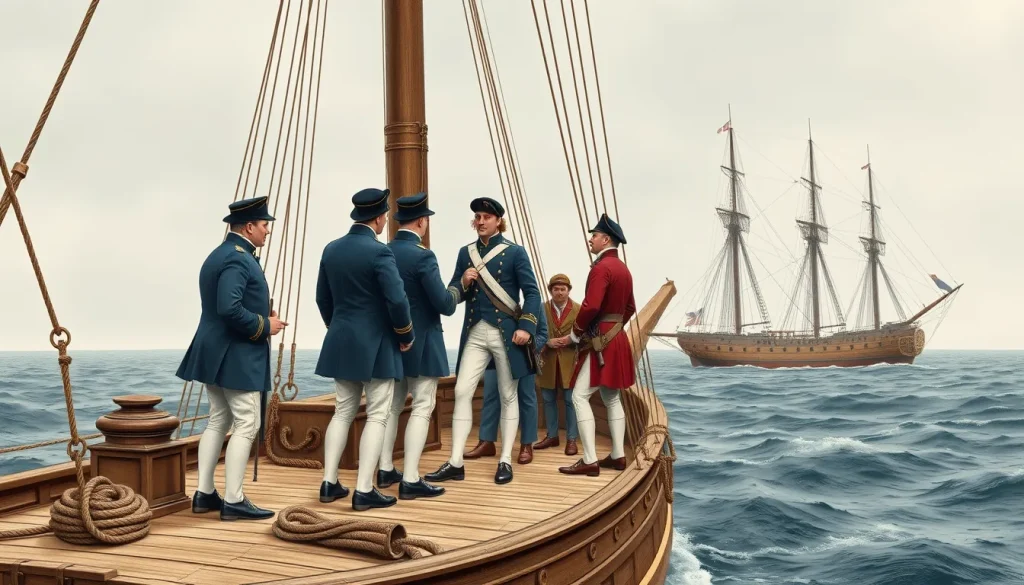
Impressment of American sailors was the forcible removal of seamen from United States merchant vessels into service in the Royal Navy, carried out principally during Britain’s wars with Revolutionary and Napoleonic France between 1793 and 1815. It became the most bitterly contested Anglo-American dispute of the prewar years and was named by President James Madison and by Congress among the leading causes of the War of 1812. Americans treated impressment as a violation of national sovereignty and of the rights of neutral commerce; British officials defended it as a lawful and indispensable means of manning the fleet that guarded the British Isles and enforced the blockade of France. The war ended without a settlement of the question: impressment is not mentioned in the Treaty of Ghent and lapsed only when the Napoleonic Wars ended.
Historical Context
The practice grew out of the maritime emergency created by the French Revolutionary and Napoleonic Wars. Britain’s fleet expanded from roughly 36,000 seamen in 1793 to about 114,000 by 1812, according to figures cited by the U.S. National Park Service, while conditions aboard British warships—harsh discipline, disease, shipwreck, and combat—kept voluntary enlistment well below demand; the National Park Service notes that as many as 100,000 Royal Navy personnel died during that twenty-year period. Press gangs operated in British ports, and the Royal Navy also took men at sea from merchant shipping, including the ships of neutral nations.
The United States was the largest neutral carrier of the era. American vessels carried their own cargoes and re-exported goods from French and British Caribbean colonies to Europe, a trade Britain challenged under the revived Rule of 1756 and the 1805 Essex decision. Britain’s Orders in Council of November 1807 and France’s Berlin Decree of 1806 and Milan Decree of 1807 placed rival restrictions on neutral trade, and American countermeasures—the Non-Importation Act of 1806, the Embargo Act of December 1807, the Non-Intercourse Act of 1809, and Macon’s Bill No. 2 of 1810—failed to secure either belligerent’s respect for neutral rights. Impressment was therefore bound up with a wider dispute over trade, blockade, and the standing of the United States in international law.
Underlying the dispute was a disagreement about nationality itself. British law held that allegiance was permanent: a British subject could not shed it by emigrating or by being naturalized abroad. The United States maintained that expatriation was a natural right and that a naturalized citizen was fully American. On the deck of a stopped merchant ship, the disagreement became a practical question—whether a man who spoke with an English accent, carried an American protection certificate, and had sailed from an American port was a deserter to be seized or a citizen to be released.
What Happened
Impressment of men from American vessels increased in step with British manpower needs. American consuls issued protection certificates to seamen as evidence of citizenship, and merchant captains carried crew lists, but British boarding officers accepted such documents only as persuasive, not decisive, evidence. Because many sailors were British-born, because protections could be forged or sold, and because the Royal Navy regarded the recovery of deserters as essential, seizures continued through the 1790s and 1800s without a formal Anglo-American agreement. The Monroe–Pinkney Treaty of 1806, negotiated in London, contained no concession on impressment; Madison declined to submit it to the Senate.
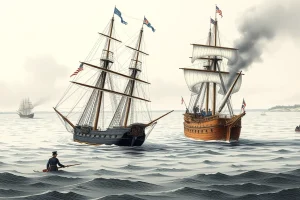
The Chesapeake–Leopard affair of 22 June 1807 brought the issue to a crisis. The British frigate HMS Leopard, commanded by Captain Salusbury Pryce Humphreys, stopped the United States frigate USS Chesapeake under Commodore James Barron off Cape Henry near Norfolk, Virginia, and demanded the surrender of alleged deserters. When Barron refused, Leopard opened fire; Chesapeake, unprepared for action, struck after three men were killed and eighteen wounded. A boarding party removed four men, three of them American-born and the fourth, Jenkin Ratford, a British deserter who was later hanged at Halifax. The three Americans were eventually returned in 1812. Vice-Admiral George Cranfield Berkeley, the Halifax station commander, had issued a proclamation in June 1807 authorizing such searches; the British government disavowed the proclamation and recalled him but did not renounce impressment itself.
The American response was economic and diplomatic rather than military. The Embargo Act of December 1807 closed American trade with the belligerents; the Erskine Agreement of April 1809, under which Britain promised to withdraw the Orders in Council, was repudiated by London; and negotiations in 1811–1812 produced no binding limits on impressment. Tension on the seas continued, including the exchange of fire between USS President and HMS Little Belt in May 1811. On 1 June 1812 Madison sent his war message to Congress, arguing that British conduct presented "a series of acts hostile to the United States as an independent and neutral nation" and complaining that thousands of American citizens had been "torn from their country and from everything dear to them." Congress declared war on 18 June 1812 by votes of 79 to 49 in the House and 19 to 13 in the Senate. Britain suspended the Orders in Council on 23 June 1812, but news of the decision reached Washington too late to prevent the conflict.
Impressment did not end with the declaration of war. The Royal Navy continued to take men from American vessels, and the British government continued to claim seamen of British birth among captives. The Treaty of Ghent, signed on 24 December 1814, made no mention of impressment; the American commissioners did not press the point, and the British refused to concede the principle. What ended the practice was the end of the Napoleonic Wars and the rapid demobilization of the Royal Navy, which removed the demand for men.
Why It Matters
Impressment mattered to contemporaries in a way that its scale alone may not explain. The number of men involved was comparatively small next to the total size of the American merchant marine, yet the practice combined several grievances at once: the physical seizure of American citizens, the humiliation of American ships submitting to search, the loss of crews and voyages, and the assertion of a British legal claim that appeared to deny the United States’ status as an independent nation. The phrase "free trade and sailors’ rights," used by American Republicans in the war years, tied the impressment grievance to neutral commerce and to national honor.
Larger consequences followed. The unresolved dispute contributed to the deterioration of Anglo-American relations, to the embargo policy that damaged the American economy, and ultimately to the decision for war. In the longer term, the issue faded because the conditions that produced it disappeared: after 1815 Britain had no wartime fleet to man. Historians have continued to debate whether impressment was the decisive cause of the war or one grievance among several, and the differing estimates of how many Americans were taken reflect that uncertainty.
Definition
Impressment, in the naval sense discussed here, is the compulsory recruitment of men into naval service without their consent. Two forms should be distinguished. The first was shore-based pressing, carried out by press gangs in British ports under the authority of British statutes, which fell on British subjects and on foreign seamen found in British harbors. The second was impressment at sea, in which Royal Navy officers stopped merchant vessels—including those flying the American flag—and removed seamen they identified as British subjects or deserters. American complaints focused overwhelmingly on the second form, because it involved the search and seizure of crews aboard vessels of a neutral state on the high seas.
Background
Great Britain had impressed seamen since the seventeenth century, and the practice was regulated by statute and administered by the Admiralty rather than being simply lawless. Its scale varied with the size of the fleet: it was limited in peacetime and expanded sharply in wartime. Because the Royal Navy offered low wages, dangerous service, and severe discipline, while the merchant marine and the American merchant service offered better pay and conditions, desertion from warships was common, and recovery of deserters was a persistent concern of British captains. The American merchant marine grew rapidly after 1783, and its demand for experienced seamen drew men from Britain and Ireland as well as from the United States, which made the question of who was genuinely American difficult to resolve in practice.
How It Worked
When a Royal Navy warship stopped an American merchant vessel, a boarding party inspected the crew and questioned individuals, using accents, appearance, tattoos, and seafaring knowledge as informal tests. Officers compared the crew against the ship’s papers and against the protection certificates issued by American consuls and notaries, which named the bearer and asserted American citizenship. British officers were under instructions to look for deserters from the Royal Navy, but they decided individual cases at sea with little oversight. Men taken were transferred to a warship’s crew and thereafter subject to naval discipline; correspondence between American consuls, shipowners, and the State Department traces efforts to secure their release through appeals to the Admiralty or the Foreign Office. Because documentation was often incomplete and because British and American definitions of nationality conflicted, the process produced persistent accusations that free American seamen were being seized alongside genuine deserters. It should be noted that the United States Navy also impressed men into its service, including British sailors, as the National Park Service observes; the American objection was directed at the exercise of the practice by a foreign power against American vessels and claimed citizens, not at compulsion at sea as such.
Competing Viewpoints
The American position, stated repeatedly by Madison, by American diplomats, and by congressional committees, was that impressment violated the sovereignty of the flag, the rights of neutral commerce, and the personal liberty of American citizens, and that no search of an American vessel’s crew could be lawful without American consent. The British position was that allegiance was indelible, that naturalization in the United States did not release a British subject from service, that the right to search for deserters was a necessity of national survival, and that the Royal Navy could not police its own fleet without it. British statesmen frequently added that many men claimed as Americans were in fact British deserters, and that protection certificates were sometimes fraudulently obtained or purchased.
Both positions had weaknesses that contemporaries recognized. Americans could not always demonstrate that impressed men were citizens, and the citizenship of naturalized seamen was precisely the point in dispute. Britain found it difficult to explain why the ships of a friendly neutral should be searched without limit, and British ministers repeatedly acknowledged that seizures of genuine Americans damaged relations while insisting that the right itself could not be surrendered. Historians have added further qualifications, noting that impressment declined somewhat in the period immediately before the war and that some British officials expected a negotiated settlement.
Role in the War of 1812
Impressment was the grievance most often invoked in public argument for war. Madison’s message of 1 June 1812 presented it as one of the administration’s central charges against Britain, alongside the Orders in Council and British influence among Indigenous nations on the northwestern frontier, and the report of the House Committee on Foreign Relations on 3 June 1812 placed it prominently among the grounds for hostilities. The slogan "free trade and sailors’ rights" expressed a Republican interpretation of the conflict that combined commerce with personal liberty.
Yet the politics of the issue were not simple. The sailors most exposed to impressment came from the maritime states of New England, which largely opposed the war, while support for war was strongest in the South and West, where the Indian frontier and territorial questions loomed large. Impressment also remained an active grievance during the fighting rather than a settled cause of it, and the failure of the Treaty of Ghent to address it left the legal question unresolved. The result is a paradox often noted in the scholarship: the issue that most effectively justified the war was the one the peace settlement ignored.
Consequences and Historical Interpretation
The immediate consequence of the war for impressment was minimal. The practice ceased because the Napoleonic Wars ended and the Royal Navy shrank, not because Britain conceded the principle or because the United States obtained a guarantee. The Treaty of Ghent was silent on the subject, and no later nineteenth-century agreement formally renounced impressment, although it was not revived. The broader legacy was a lasting American commitment to freedom of the seas and to the protection of sailors, an idea that reappeared in later disputes over neutral rights.
Historians differ over how much weight impressment should carry as a cause of the war. Reginald Horsman and Bradford Perkins, writing in the mid-twentieth century, treated maritime grievances—impressment, the Orders in Council, and the blockade—as central to the Anglo-American rupture. Other scholars have emphasized western expansionism, the politics of the Republican party, or Madison’s expectation that Britain would retreat once confronted; Roger H. Brown, for example, argued that the Orders in Council and domestic political pressures bore more directly on the timing of the declaration than impressment did. More recent work, including Paul A. Gilje’s study of the slogan "free trade and sailors’ rights," argues that impressment mattered both as a legal grievance and as a powerful political language that mobilized Americans, even where its practical consequences were uneven. Denver Brunsman’s work on British naval impressment places the practice in a wider Atlantic context, treating it as a system of labor recruitment that was contested at home as well as abroad. The estimates of how many Americans were taken—about 6,000 according to one widely used figure predating the declaration of war, about 10,000 during the Napoleonic Wars according to the National Park Service—vary because definitions of "American" and records of individual cases are both incomplete.
Primary Sources
- James Madison, Message to Congress, 1 June 1812. The president’s public case for war, printed in American State Papers: Foreign Relations and in congressional records. It is the single most cited American statement of the impressment grievance, but it is an advocacy document that groups several complaints together and does not distinguish carefully among them.
- Report of the House Committee on Foreign Relations, 3 June 1812. A legislative statement of grievances that accompanied the march toward a declaration. Useful for showing how Congress framed the issue, but it reflects the majority party’s position rather than a neutral survey.
- Correspondence and records of the Chesapeake–Leopard affair, 1807. Commodore Barron’s report, the American court of inquiry, and the British admiralty correspondence from Halifax document the most famous single impressment incident. Each side’s accounts are shaped by national interest.
- British Orders in Council and Admiralty instructions. These show the legal and administrative framework within which impressment operated. They are official instruments rather than reflections on the practice’s human cost.
- Protection certificates, consul reports, and seamen’s petitions to Congress. Records of individual cases, including the affidavits and memorials of impressed men and their families, are preserved in American diplomatic and legislative files. They are invaluable but fragmentary, and many impressed sailors left no documentation at all.
- Contemporary newspapers. Republican and Federalist papers reported seizures, published lists of men taken, and debated the issue in partisan terms; Niles’ Weekly Register is among the most frequently consulted compilations. Newspaper evidence reflects editorial perspective and uneven reporting.
Further Reading
- Reginald Horsman, The Causes of the War of 1812 (University of Pennsylvania Press, 1962).
- Bradford Perkins, Prologue to War: England and the United States, 1805–1812 (University of California Press, 1961).
- Donald R. Hickey, The War of 1812: A Forgotten Conflict (University of Illinois Press, revised edition, 2012).
- Paul A. Gilje, Free Trade and Sailors’ Rights in the War of 1812 (Cambridge University Press, 2013).
- Denver Brunsman, The Evil Necessity: British Naval Impressment in the Eighteenth-Century Atlantic World (University of Virginia Press, 2013).
- Nicholas Rogers, The Press Gang: Naval Impressment and Its Opponents in Georgian Britain (Continuum, 2007).
- J. C. A. Stagg, Mr. Madison’s War: Politics, Diplomacy, and Warfare in the Early American Republic, 1783–1830 (Princeton University Press, 1983).
- U.S. National Park Service, "Impressment and the War of 1812," nps.gov.
- Archival and site resources: Library of Congress, National Archives and Records Administration, The National Archives (UK), and the National Maritime Museum, Greenwich.
References
- U.S. National Park Service, "Impressment and the War of 1812," https://nps.gov/articles/impressment.htm.
- Smithsonian American Art Museum, "Causes of the War of 1812," teaching resource PDF, https://americanexperience.si.edu/wp-content/uploads/2014/10/Causes-of-the-War-of-1812_.pdf.
- Reginald Horsman, The Causes of the War of 1812 (University of Pennsylvania Press, 1962).
- Bradford Perkins, Prologue to War: England and the United States, 1805–1812 (University of California Press, 1961).
- Donald R. Hickey, The War of 1812: A Forgotten Conflict (University of Illinois Press, revised edition, 2012).
- Paul A. Gilje, Free Trade and Sailors’ Rights in the War of 1812 (Cambridge University Press, 2013).
- Denver Brunsman, The Evil Necessity: British Naval Impressment in the Eighteenth-Century Atlantic World (University of Virginia Press, 2013).
FAQ
Was impressment the main cause of the War of 1812?
It was one of the principal causes named by President Madison and by Congress, and it was the grievance most often invoked in public argument for war. Historians disagree about its relative weight, with some emphasizing maritime grievances such as impressment and the Orders in Council and others stressing the northwestern frontier, territorial expansion, or Republican party politics.
How many American sailors were impressed?
Estimates vary widely because records are incomplete and the definition of an American sailor was itself disputed. A commonly cited figure for the years before the declaration of war is about 6,000; the U.S. National Park Service gives about 10,000 Americans impressed during the Napoleonic Wars.
Did the War of 1812 end impressment?
No formal settlement was reached. Impressment is not mentioned in the Treaty of Ghent of 24 December 1814, and the American commissioners did not press the issue to a conclusion. The practice ceased because the Napoleonic Wars ended and the Royal Navy demobilized, removing the need for large numbers of seamen.
Did the United States ever impress sailors itself?
Yes. The U.S. National Park Service notes that American naval officers also impressed men, including British sailors, into service. The American objection was directed chiefly at a foreign power searching American vessels and seizing men claimed as American citizens.
Leave a Reply