
Short Answer
During the War of 1812, thousands of enslaved African Americans, especially in the Chesapeake Bay region, the Lower South, and the Gulf Coast, sought freedom by escaping to British military forces. The British Royal Navy and Army welcomed many of them as laborers, guides, sailors, soldiers, and settlers, and by 1814 Britain formalized this policy through Vice Admiral Sir Alexander Cochrane’s proclamation. After the war, most of these freedom seekers were evacuated to Bermuda, Nova Scotia, Trinidad, or other British territories, while their former enslavers demanded their return or compensation under the Treaty of Ghent. The episode is significant because it was one of the largest emancipations in North America before the Civil War and because it forced the United States and Britain into a diplomatic dispute over slavery, property, and freedom.
Historical Context
The War of 1812 grew out of maritime disputes, trade restrictions, and frontier tensions between the United States and Great Britain, but its military campaigns in the Chesapeake and along the southern coast directly affected enslaved people. Maryland and Virginia held large enslaved populations; the 1810 census counted 103,036 enslaved people in Maryland and 292,627 in Virginia, according to figures cited by historian Frank A. Cassell. The Chesapeake’s waterways gave the Royal Navy access to plantations, towns, and the national capital, and British officers recognized that enslaved people possessed knowledge of creeks, roads, and local geography that could be militarily useful.
British policy was not initially designed to abolish American slavery. In 1813, commanders such as Admiral John Borlase Warren and Colonel Sir Thomas Sydney Beckwith were ordered not to incite slave uprisings, but they could offer protection and transportation to enslaved people who assisted British operations. The British also drew on earlier precedents, including Lord Dunmore’s 1775 proclamation during the American Revolution and the evacuation of Black Loyalists after 1783. By 1814, as Britain expanded its Chesapeake campaign, the offer became broader and more systematic.
What Happened
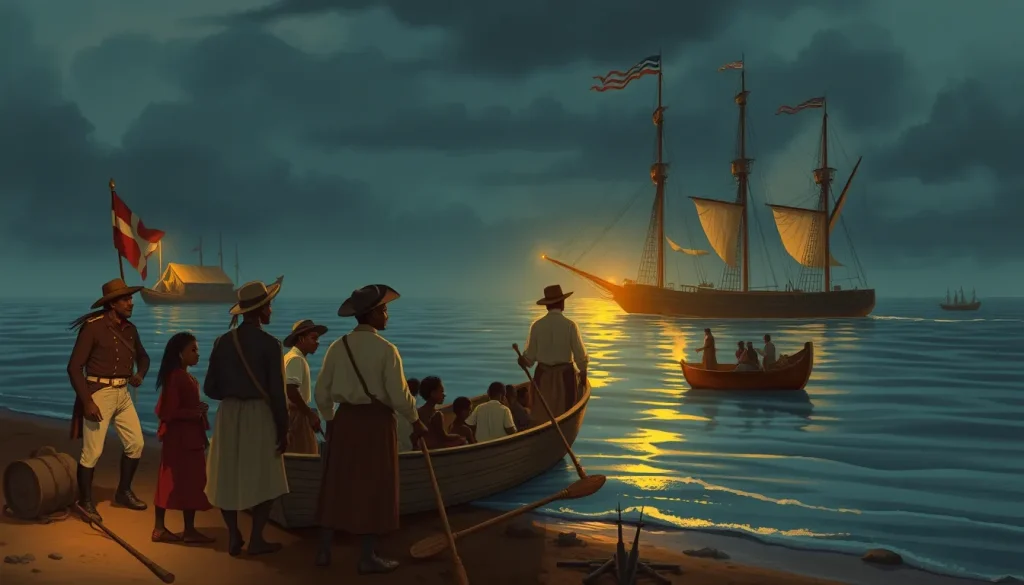
From the spring of 1813, enslaved African Americans in the Chesapeake began escaping to British ships, often rowing out at night. A Washington newspaper, the National Intelligencer, reported on May 1, 1813, that enslaved people had deserted to British landing parties on Kent Island. These early escapes were small and risky, but they signaled that many enslaved people would seize the opportunity created by the war.
On April 2, 1814, Vice Admiral Sir Alexander Cochrane issued a proclamation stating that persons who were residents of the United States and were received on board British ships could emigrate with their families to British North America or the Caribbean as free settlers, or enter British sea or land forces. The wording did not explicitly say “enslaved,” but the intended audience was clear. The proclamation accelerated escapes throughout the Chesapeake. British forces established a receiving station on Tangier Island, where freedom seekers were sheltered and organized.
About 200 formerly enslaved men from the Chesapeake are often identified as joining the British Corps of Colonial Marines. They trained on Tangier Island, were issued arms, and fought alongside British troops in the 1814 campaigns, including the march on Washington, D.C., and the Battle of North Point near Baltimore. Broader estimates of Black men who served in British colonial marine units range from 550 to 700. Colonial Marines also served as guides, messengers, and spies, using their knowledge of local waterways and plantations. Meanwhile, many wives, children, and other relatives remained under British protection on Tangier Island until the war ended.
In the Lower South, similar escapes occurred. On Cumberland Island, off the Georgia coast, British forces gathered hundreds of freedom seekers in 1814 and early 1815. When American commissioners arrived on March 6, 1815, to demand the return of enslaved people under the Treaty of Ghent, Rear Admiral George Cockburn refused. One day earlier, on March 5, nearly 500 men, women, children, and Colonial Marines had already left Cumberland Island aboard the British warship Regulus. They reached Bermuda on April 29, 1815. Some continued to Trinidad, while others sailed to Halifax, Nova Scotia. Among them were families such as that of Peter Sewell, a 25-year-old man who escaped from Calvert County, Maryland, in July 1814; he was reunited with his wife and children in Bermuda after they left Tangier Island aboard HMS Orlando in March 1815.
The Treaty of Ghent, signed December 24, 1814, required the restoration of captured territory and property, including “slaves or other private property.” American officials interpreted this to mean that enslaved people who had escaped to the British should be returned or compensated. British officials argued for a narrower reading: a freedom seeker could be re-enslaved only if still residing at the place from which they had escaped, a condition rarely met after mass evacuations. Cockburn rejected American demands at Cumberland Island, and U.S. enslavers submitted claims for compensation. According to the National Park Service, the resulting diplomatic dispute was not fully resolved until 1828.
Why It Matters
The escapes mattered immediately because they deprived American enslavers of property, disrupted plantation labor, and gave the British military valuable local knowledge. They also intensified white American fears of insurrection and foreign incitement. For enslaved people, the choice to flee was an act of self-emancipation, but it carried enormous risks: capture could mean sale, punishment, or death, and separation from family was common.
In the longer term, the British evacuations created new Black communities in the Atlantic world. In Nova Scotia, many refugees settled in or near Halifax, and one community became known as Africville. In Trinidad, descendants of the Colonial Marines and other refugees call themselves “Merikins.” In Bermuda, the refugees were a temporary but significant presence. The episode also shaped international law and diplomacy, because it forced Britain and the United States to argue over whether enslaved people were property or persons capable of choosing freedom.
Historians disagree about how to characterize British motives. Some emphasize military expediency: Britain used freedom as a weapon to weaken the United States and gain labor and soldiers. Others note that British antislavery sentiment and the example of earlier Black Loyalist resettlement gave the policy a genuine, if limited, emancipatory dimension. Most agree that enslaved people themselves were not passive recipients of British policy; they forced the issue by escaping, guiding, fighting, and demanding freedom.
Definition
This subject concerns the wartime process by which enslaved African Americans left U.S. enslavers and sought protection, employment, military service, or resettlement with British forces during the War of 1812. It includes the British policies that received them, the roles they played, and the postwar evacuations and disputes over their return.
Background
Britain had abolished the slave trade in 1807 but still permitted slavery in many colonies. During the War of 1812, British commanders in North America were authorized to use enslaved people’s knowledge and labor while avoiding direct encouragement of rebellion. Cochrane’s 1814 proclamation expanded this practice by offering U.S. residents received on British ships the status of free settlers or the option of military service. The policy was both strategic and humanitarian in its language, but it was applied unevenly and always subordinate to military needs.
How It Worked
Freedom seekers typically reached British forces by boat, sometimes at night, from plantations, towns, and islands along the Chesapeake, the Potomac, the Georgia coast, and the Gulf Coast. British ships and shore parties accepted them, sometimes sending them to bases such as Tangier Island or Cumberland Island. Men who chose military service could join the Colonial Marines or Royal Navy; women, children, and older people were usually classified as settlers or dependents. The British provided shelter, rations, and transportation, but conditions were crowded and uncertain. At the end of the war, British authorities evacuated most of those under their protection rather than return them to U.S. enslavers.
Competing Viewpoints
American enslavers and officials viewed the escapes as theft and insisted that the Treaty of Ghent required Britain to return or pay for enslaved people. British officials rejected that interpretation, arguing that people who had voluntarily come under British protection were not ordinary property and that the treaty did not require them to be surrendered. Historians also debate numbers and outcomes. Some estimates suggest about 4,000 African Americans gained freedom with the British; others focus on the more than 3,000 who escaped from the Chesapeake or the figure of 3,608 total escapes. Records are incomplete, especially for women and children, so precise totals remain uncertain.
Role in the War of 1812
Formerly enslaved African Americans contributed to British operations as guides, pilots, spies, laborers, and soldiers. Their knowledge of local waterways and roads helped British raids in the Chesapeake, including operations against Washington and Baltimore. The Colonial Marines fought in several engagements and impressed British officers with their discipline. Their presence also tied down American militia and heightened American fears, while giving the British a military advantage and a propaganda tool. For the United States, the escapes exposed the vulnerability of slavery in a war fought partly over freedom and national sovereignty.
Consequences and Historical Interpretation
After 1815, most freedom seekers were resettled in Nova Scotia, New Brunswick, Trinidad, Bermuda, or other British colonies. Some received land; others struggled with poverty, discrimination, and harsh climates. American enslavers filed compensation claims, and the resulting mixed-claims commission and diplomatic negotiations continued for years. The National Park Service states that the dispute was not fully resolved until 1828. In historical memory, the story has become central to understanding Black agency in the War of 1812. Modern scholarship emphasizes that enslaved people made calculated choices, used British power for their own ends, and helped create diaspora communities that still preserve their history.
Primary Sources
Several contemporary records illuminate these events. Cochrane’s proclamation of April 2, 1814, is the key British policy document. It offered U.S. residents received on board British ships the choice of “entering into His Majesty’s Sea or Land Forces, or of being sent as FREE settlers to the British Possessions in North America or the West Indies.” The proclamation’s language was broad and did not explicitly mention enslaved people, a limitation that made its implementation dependent on British officers.
The Treaty of Ghent, signed December 24, 1814, is essential for the postwar dispute. Article I required the restoration of territory and property, including “slaves or other private property,” but did not define how the provision applied to people who had fled to the British. American compensation claims, such as the claim of Walter Edelin concerning Nace and Henry Colbert, show enslavers’ efforts to recover enslaved people and document the escapes from their perspective. British officers’ letters, including George Cockburn’s correspondence with Cochrane, reveal both military appreciation for the Colonial Marines and the strategic value Britain placed on them. The Halifax List and related Nova Scotia records provide names and details of some refugees, but they are incomplete and often omit family relationships. All these sources are shaped by the perspectives of officials, enslavers, and military men; the voices of freedom seekers themselves appear less often and usually through hostile or administrative records.
Further Reading
- National Park Service, “Black Freedom Seeking During the War of 1812: From the Chesapeake, Cumberland Island, and Beyond Part 2.”
- National Park Service, “Colonial Marines,” Star-Spangled Banner National Historic Trail.
- Frank A. Cassell, “Slaves of the Chesapeake Bay Area and the War of 1812,” The Journal of Negro History 57, no. 2 (1972): 144-155.
- Donald R. Hickey, The War of 1812: A Forgotten Conflict (University of Illinois Press).
- Alan Taylor, The Civil War of 1812: American Citizens, British Subjects, Irish Rebels, and Indian Allies (Knopf, 2010).
- Maryland State Archives, “Legacies of Slavery in Maryland” database and related compensation records.
- Nova Scotia Archives, African Nova Scotian resources and the Halifax List.
References
- National Park Service, “Black Freedom Seeking During the War of 1812: From the Chesapeake, Cumberland Island, and Beyond Part 2,” https://www.nps.gov/articles/000/black-freedom-seeking-during-the-war-of-1812-from-the-chesapeake-cumberland-island-and-beyond.htm.
- National Park Service, “Colonial Marines,” Star-Spangled Banner National Historic Trail, https://www.nps.gov/stsp/learn/historyculture/colonial-marines.htm.
- Frank A. Cassell, “Slaves of the Chesapeake Bay Area and the War of 1812,” The Journal of Negro History 57, no. 2 (April 1972): 144-155, https://msa.maryland.gov/megafile/msa/speccol/sc5300/sc5339/000261/000000/000003/restricted/2717218.pdf.
- National Park Service, “African Americans and the War of 1812,” Fort Washington Park, https://nps.gov/fowa/learn/historyculture/african-americans-and-the-war-of-1812.htm.
- National Park Service, “Equality in the National Capital Area During the Revolution and War of 1812,” https://nps.gov/articles/000/equality-in-the-national-capital-area-during-the-revolution-and-war-of-1812.htm.
- Treaty of Ghent, Article I, December 24, 1814, Avalon Project, Yale Law School, https://avalon.law.yale.edu/19th_century/ghent.asp.
FAQ
Did the British promise freedom to enslaved people during the War of 1812?
British policy evolved. Early orders allowed protection for those who assisted British forces. Cochrane's April 2, 1814 proclamation offered U.S. residents received on British ships the choice to serve or become free settlers. It did not explicitly say enslaved, but it was understood that way and drew thousands.
How many enslaved African Americans escaped to the British?
Estimates vary because records are incomplete. National Park Service accounts cite about 4,000 overall, over 3,000 from the Chesapeake, and a figure of 3,608 total. Many women and children were included.
What happened after the war?
Most were evacuated before or after the Treaty of Ghent to Bermuda, Nova Scotia, Trinidad, or other British colonies. U.S. enslavers sought return or compensation; Britain largely refused, and the dispute continued until 1828.
Leave a Reply