Short Answer
British naval strategy in the War of 1812 treated Lake Ontario as the decisive theatre on the northern lakes and Lake Erie as a secondary one. Because ships, seamen, ordnance, and shipwrights were concentrated at Kingston, the Royal Navy’s Lake Erie squadron at Amherstburg, commanded by Captain Robert Heriot Barclay, never matched the American squadron that Master Commandant Oliver Hazard Perry assembled at Presque Isle, the harbour of modern Erie, Pennsylvania. The result was Perry’s victory of 10 September 1813, which gave the United States control of Lake Erie and forced the British to abandon Detroit and the Amherstburg frontier. The episode matters because it shows how a defensible strategic priority on one lake contributed to a decisive defeat on another.
Historical Context
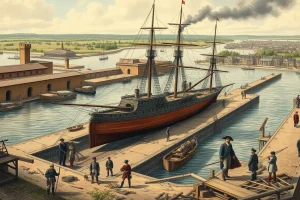
Lake Ontario was the central link in the British line of communications from Montreal to the upper Great Lakes. Kingston, at the eastern end of the lake and near the head of the St. Lawrence River, was the principal British naval station and shipyard in Upper Canada; Sackets Harbor, New York, was its American counterpart and the main base for the United States squadron under Commodore Isaac Chauncey. Together the two harbours controlled the water route that carried troops, provisions, and naval stores westward.
Lake Erie was the water connection between the Niagara frontier and the Detroit frontier, and therefore the supply route to Britain’s Indigenous allies and to the western army based at Amherstburg and Fort Malden. As historian Carl Benn has shown, British planners had long understood that Lake Erie was easier for an enemy to cut than Lake Ontario: it was shallow, close to the American shore at several points, and at the far end of the British communications chain. Lieutenant-Governor John Graves Simcoe’s defensive schemes of the 1790s had accordingly placed the navy’s centre of gravity at Kingston and treated the western lakes as dependent.
Three further circumstances shaped what happened in 1813. Britain was absorbed by the war against Napoleonic France, and the Admiralty treated the lakes as a minor theatre, sending relatively few trained seamen. Civil and military authority in Canada rested with Governor-in-Chief Sir George Prevost, who influenced where men and stores were sent, while Commodore James Lucas Yeo, arriving at Kingston in May 1813, commanded the Royal Navy on both Ontario and Erie. Barclay’s squadron was therefore not an independent command but a subordinate one competing for the same scarce resources as the fleet at Kingston.
What Happened
In 1812 the Provincial Marine, not the Royal Navy, held the lakes. British vessels based at Amherstburg supported the capture of Detroit in August 1812, and in October 1812 a United States cutting-out party under Lieutenant Jesse Elliott seized the brig Caledonia and burned the brig Detroit at Fort Erie, an early sign of how thinly the British western squadron was defended.
That winter the Americans moved their Lake Erie base from Black Rock to Presque Isle and began building. Master Commandant Oliver Hazard Perry took command of the squadron in February 1813, and by summer he had two brigs, Lawrence and Niagara, with a supporting group of schooners and sloops. The British answered at Amherstburg with a new brig, also named Detroit, but their yard was small, its supplies had to come from Kingston over a long interior route, and above all it lacked seamen.
Captain Robert Heriot Barclay reached Amherstburg in June 1813 and pressed Yeo and Prevost repeatedly for seamen, guns, cordage, and provisions. He received some naval officers, a party of seamen, and a few guns, but never enough. His crews were completed with soldiers of the 41st Foot and other detachments, Provincial Marine men, and Canadian boatmen, while the Americans drew on volunteers and drafts from the army. Barclay’s squadron blockaded Presque Isle in the summer of 1813 but had to withdraw for water, provisions, and repairs; while it was away, Perry’s ships crossed the bar at Presque Isle in the first days of August and reached open water.
By September, Barclay faced a choice. Brigadier-General Henry Procter’s army and the Indigenous confederacy depended on supplies carried by water, and the fleet could not supply them unless it could leave Amherstburg. Barclay sailed on 9 September, engaged Perry’s squadron off Put-in-Bay in the western basin of Lake Erie on 10 September 1813, and lost his entire squadron. Perry’s flagship Lawrence was battered into surrender, but he carried his flag to Niagara and broke the British line. The captured vessels were the Detroit, Queen Charlotte, Lady Prevost, Hunter, Little Belt, and Chippeway. American casualties are usually given as about 27 killed and 96 wounded; British losses, roughly 41 killed and 94 wounded, vary slightly between accounts.
Why It Matters
The immediate effect was the collapse of the British position in the west. With Lake Erie in American hands, Amherstburg and Detroit could not be supplied; Procter evacuated them in late September 1813 and retreated up the Thames River, where Major General William Henry Harrison’s army defeated him on 5 October 1813 and the Shawnee leader Tecumseh was killed. The United States recovered Michigan Territory, and the British lost the confidence of many Indigenous nations that had relied on them for protection and supply.
The longer-term consequences were more ambiguous. Lake Ontario remained contested between Chauncey and Yeo throughout the war; neither commander won a decisive action, and the large construction programs on both sides produced stalemate rather than victory. Yeo’s 112-gun ship of the line St. Lawrence, launched at Kingston in 1814, gave the British a late superiority on Ontario, but the Treaty of Ghent ended the war before it could be exploited, and the Rush–Bagot agreement of 1817 demilitarised the lakes. Historical memory has kept Perry’s victory prominent while remembering the British side mainly through the shortages Barclay described.
Definition
In this article, “British naval strategy on Lake Ontario” refers to the Royal Navy’s decision, made between 1812 and 1814, to make Kingston the centre of its lake establishment and to keep the strongest ships, the largest concentration of trained seamen, and the best access to ordnance and stores on Lake Ontario. “Vulnerable” is used here in the narrow military sense: the British squadron on Lake Erie lacked the men, guns, and supplies needed to prevent the Americans from building a superior force, getting it onto the lake, and defeating it in battle. The article treats the question as one of resourcing and command priority rather than as a claim that Britain deliberately chose to lose Lake Erie.
Background
The two lakes were administered as one responsibility. When the Royal Navy took over from the Provincial Marine in 1813, Yeo received a broad commission to command on the lakes; Barclay’s authority on Erie derived from Yeo’s, and he could not draw independently on imperial resources. Kingston possessed a dockyard, access to Montreal and to naval stores shipped up the St. Lawrence, and a substantial civilian shipbuilding community. Amherstburg lay at the western end of a chain that ran by water from Kingston to York, overland to Long Point, and then by water again — a route that American operations on the Niagara peninsula endangered in 1813.
Manpower was the binding constraint. Trained seamen were scarce in North America, and the Admiralty’s priority was the blockade of the American coast. A seaman sent to Amherstburg could not serve at Kingston, and guns sent west could not arm Yeo’s ships or the batteries defending the dockyard.
How It Worked
In practice, the strategy operated as a queue for scarce resources in which Lake Ontario came first. When Barclay requested men and ordnance, Yeo and Prevost had to weigh a western offensive against the risk to Kingston, to the St. Lawrence convoys that fed Upper Canada and Quebec, and to the army on the Niagara frontier. Yeo forwarded some seamen and guns to Amherstburg in 1813 but kept the bulk of both for his own squadron; Prevost, whose primary responsibility was the defence of the St. Lawrence corridor, gave his support to the Ontario fleet. The Americans faced similar pressures, but Perry could build at Presque Isle from local timber, with iron brought overland from Pittsburgh, and man his ships from volunteers as well as army drafts. The consequence was that the British and American construction programs on Lake Ontario consumed resources roughly in balance, while on Lake Erie the American program outran the British.
Competing Viewpoints
Historians generally agree on the factual sequence, but they differ on how to judge the priority given to Ontario.
One position, closest to the reasoning of Prevost and Yeo, holds that the concentration was sound. Lake Ontario was the hinge of the St. Lawrence–Great Lakes system; losing it would have exposed Kingston, threatened Montreal, and isolated Upper Canada. On that reading, Lake Erie was the more expendable of the two theatres, and Barclay’s defeat was the price of defending the more valuable one.
A second position, common among contemporaries and in nineteenth- and twentieth-century accounts, treats the outcome as a failure of leadership. Critics argued that Prevost and Yeo starved the western squadron while the enormous investment on Ontario produced only an indecisive duel with Chauncey, and that the Admiralty should have sent more seamen to North America. Barclay himself was criticised, and defended himself, over his decision to fight on 10 September rather than remain in port.
A third, more recent position emphasises structural limits rather than individual character. Charles E. Brodine Jr. has argued in the case of Chauncey that the failure to win a decisive result on Lake Ontario owed more to the circumstances of the command — divided responsibilities, unreliable subordinates, and a determined opponent — than to personal caution. The same reasoning has been applied to the British side: a navy that could not man two squadrons simultaneously was likely to lose one of them, whatever its stated priorities.
The counterfactual remains open. A reinforced Barclay might have delayed Perry’s control of the lake, but the American squadron was built and launched beyond British reach after the failure to destroy it in 1813, and Procter’s army would still have faced supply difficulties inland.
Role in the War of 1812
The Ontario-first strategy shaped the campaign year of 1813. Yeo’s attack on Sackets Harbor on 29 May 1813, the amphibious operations on the Niagara frontier, and the running contest of shipbuilding and blockade on Lake Ontario all reflected the belief that the war in the centre would be decided there. In the west, the same priority left the smaller British squadron dependent on whatever could be spared.
Erie’s loss did not decide the war. The British retained their position on Lake Ontario, and the campaigns of 1814 in the Niagara peninsula, on Lake Champlain, and along the Atlantic coast were fought on other terms. What the loss of Lake Erie did was end the British ability to move troops and supplies by water in the west and to sustain the Indigenous alliance in the Old Northwest — an outcome achieved by a squadron that was, in effect, the second priority of a secondary theatre.
Consequences and Historical Interpretation
Most historians accept that the resourcing imbalance on Lake Erie followed directly from the priority given to Lake Ontario. They disagree about whether that priority was correct, about how much blame attaches to Prevost, Yeo, or Barclay, and about how far Britain’s global commitments made any other allocation possible.
Nineteenth-century accounts on both sides tended to frame the battle as a contest of individual commanders. Twentieth-century administrative and documentary studies shifted attention to shipbuilding, logistics, and the politics of supply, and later work has stressed how tightly the two lakes were connected: decisions at Kingston were felt at Amherstburg within weeks. The unresolved question is whether the British could have held Lake Erie without risking Lake Ontario — a question no source answers directly, and one that continues to shape how the campaign is taught.
Primary Sources
Barclay’s despatches to Yeo and Prevost, written between June and September 1813, are the central British documents. They itemise what he asked for and what he received, and they underpin most accounts of the squadron’s shortages. They are also self-exculpatory: Barclay was writing to explain and justify his conduct, and his requests were framed partly to establish a record for later scrutiny.
Perry’s report to Major General William Henry Harrison, dated 10 September 1813, is the best-known American document of the action. The celebrated sentence — “We have met the enemy and they are ours” — appears in slightly different forms in different printings, and the report as a whole is a victorious commander’s account written on the day of battle.
Yeo’s letters to the Admiralty and to Prevost, together with the Admiralty’s instructions to Yeo, show how the lakes command was defined and how resources were allocated. Chauncey’s correspondence provides the American counterpart and reveals how closely the two fleets watched each other. Shipyard returns, ordnance requests, and muster records for the lake squadrons supply the quantitative evidence on which arguments about manpower rest. Many of these documents are printed in the documentary editions listed below; originals are held in British Admiralty records and in Canadian and United States archival collections.
Further Reading
- Brodine, Charles E., Jr. “The Cautious Commodore?” Naval History 27, no. 5 (September 2013).
- Skaggs, David Curtis. “More Important Than Perry’s Victory.” Naval History 27, no. 5 (September 2013).
- Skaggs, David Curtis. A Signal Victory: The Lake Erie Campaign, 1812–1813. Annapolis: Naval Institute Press, 1997.
- Malcomson, Robert. Lords of the Lake: The Naval War on Lake Ontario, 1812–1814. Annapolis: Naval Institute Press, 1998.
- Malcomson, Robert. Warships of the Great Lakes, 1754–1834. London: Chatham, 2001.
- Benn, Carl. “Toronto Harbour and the Defence of the Great Lakes Region, 1783–1870.” The Northern Mariner 4, no. 1 (1994): 1–15.
- Dudley, William S., ed. The Naval War of 1812: A Documentary History, vol. 2. Washington, DC: Naval Historical Center, 1992.
- Wood, William, ed. Select British Documents of the Canadian War of 1812. Toronto: Champlain Society, 1920–1928.
- Altoff, Gerard T. Deep Water Sailors, Shallow Water Soldiers: Manning the United States Navy on Lake Erie in the War of 1812 (1993).
References
- Skaggs, David Curtis. “More Important Than Perry’s Victory.” Naval History 27, no. 5 (September 2013). https://www.usni.org/magazines/naval-history-magazine/2013/september/more-important-perrys-victory
- Brodine, Charles E., Jr. “The Cautious Commodore?” Naval History 27, no. 5 (September 2013). https://www.usni.org/magazines/naval-history-magazine/2013/september/cautious-commodore
- Benn, Carl. “Toronto Harbour and the Defence of the Great Lakes Region, 1783–1870.” The Northern Mariner 4, no. 1 (1994): 1–15. https://cnrs-scrn.org/northern_mariner/vol04/nm_4_1_1-15.pdf
- Swedin, Eric G. “War of 1812: Battle of Lake Erie — Oliver Perry Prevails.” HistoryNet. https://historynet.com/war-of-1812-battle-of-lake-erie-oliver-perry-prevails/
- Stewart, Alexander K., and Ross W. Klepetko. “Military Geology of the Battle of Sackett’s Harbour (28 May 1813), Lake Ontario, NY.” New York State Geological Association Field Trip A-2, 2014. https://nysga-online.org/wp-content/uploads/2019/06/NYSGA-2014-A2-Military-Geology-of-the-Battle-of-Sackett%E2%80%99s-Harbour-28-May-1813-Lake-Ontario-Ny.pdf
- Skaggs, David Curtis. A Signal Victory: The Lake Erie Campaign, 1812–1813. Annapolis: Naval Institute Press, 1997.
- Malcomson, Robert. Lords of the Lake: The Naval War on Lake Ontario, 1812–1814. Annapolis: Naval Institute Press, 1998.
FAQ
Why did Britain give Lake Ontario priority over Lake Erie?
Lake Ontario carried the St. Lawrence–Great Lakes line of communications that supplied and connected Upper Canada, Montreal, and Quebec, and Kingston was the naval headquarters and dockyard. Lake Erie was a longer, more exposed supply route to the Detroit frontier and Britain's Indigenous allies, so British planners treated it as the more expendable theatre.
What specific shortages weakened Barclay's Lake Erie squadron?
Barclay's repeated requests to Yeo and Prevost for trained seamen, ordnance, cordage, and provisions were only partly met. His crews were filled out with soldiers of the 41st Foot and other detachments, Provincial Marine men, and Canadian boatmen, and his ships were armed and supplied more thinly than Perry's American squadron.
Did the loss of Lake Erie decide the War of 1812?
No. It ended British waterborne supply and control in the west, forced the evacuation of Amherstburg and Detroit, and contributed to the American victory at the Thames on 5 October 1813, but the war continued elsewhere and ended with the Treaty of Ghent in December 1814.
Was the British concentration on Lake Ontario a strategic mistake?
Historians disagree. Some see it as sound triage that protected the decisive St. Lawrence corridor; others argue that Prevost, Yeo, and the Admiralty starved the western squadron for an Ontario fleet that never won a decisive victory. A third view stresses that Britain simply could not man and supply two lake squadrons at once.



Leave a Reply