
Short Answer
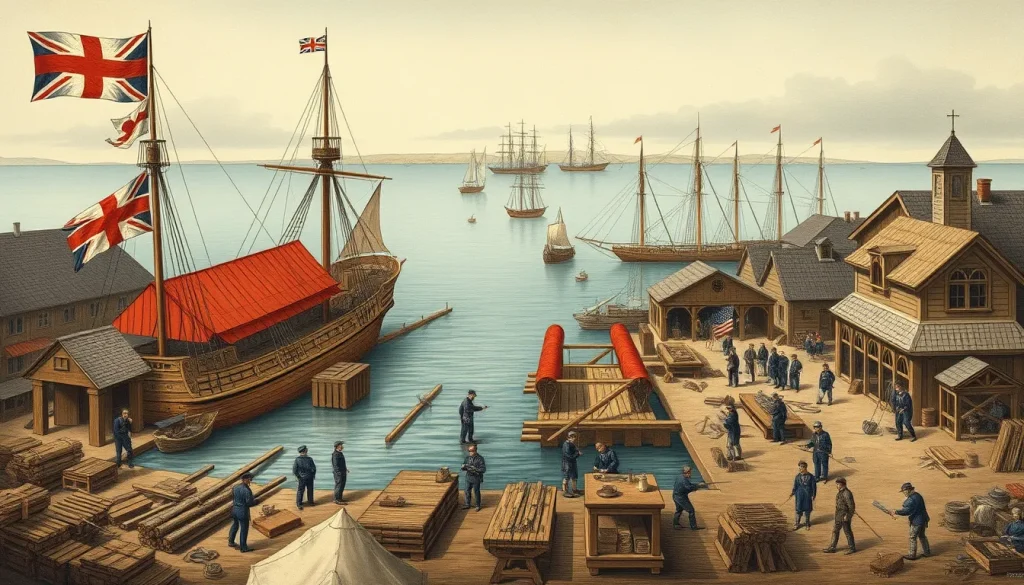
Kingston, in Upper Canada, and Sackets Harbor, in northern New York, were the two principal naval bases on Lake Ontario during the War of 1812. From 1812 to 1814 they served as shipyards, supply depots, and squadron headquarters for Britain and the United States. Their competition shaped control of the lake and the St. Lawrence supply corridor, produced the Battle of Sackets Harbor on May 29, 1813, and culminated in an expensive naval arms race that included HMS St. Lawrence, the largest warship built on the Great Lakes.
Historical Context
Lake Ontario was strategically central because it connected the St. Lawrence River, Montreal, Kingston, York, the Niagara frontier, and American ports such as Sackets Harbor. Control of the lake allowed one side to move troops, guns, food, and naval stores while threatening the other side’s supply lines. Kingston sat at the lake’s eastern outlet into the St. Lawrence, close to Montreal and York, making it a natural British base. Sackets Harbor, on Black River Bay in Jefferson County, New York, became the main American naval station on the lake and a forward base for operations against Upper Canada.
At the outbreak of war, neither side had a powerful freshwater fleet. Britain had a small Royal Navy establishment at Kingston; the United States concentrated naval and military forces at Sackets Harbor. Both sides depended on local timber, Canadian and American shipwrights, and guns and stores hauled overland or by water from Montreal, New York, and other centres. Because the lake froze in winter, much construction occurred in shipyards during the cold months, with launching and campaigning following in the sailing season. British authorities also relied on Canadian militia, regulars, and Indigenous allies, while American forces included regulars, state militia, volunteers, and Native American allies at different moments. The result was not simply a duel between two navies but a contest between two logistical systems.
What Happened
Before Commodore Sir James Lucas Yeo took command of the British Lake Ontario squadron in May 1813, Kingston’s yard had already produced or gathered a mixed force. Vessels associated with the station included General Wolfe, Royal George, Earl of Moira, Prince Regent, Simcoe, Seneca, Growler, and Confiance, carrying between 3 and 32 guns. At Sackets Harbor, Commodore Isaac Chauncey commanded the American squadron, which included vessels such as Madison, Oneida, and General Pike. In early 1813, American naval and military strength at Sackets Harbor was considerable. A proposed attack on Kingston was considered, but exaggerated estimates of British regulars there encouraged caution. Instead, American forces attacked York on April 27, 1813.
That decision exposed Sackets Harbor. With American troops drawn toward the Niagara frontier, a British force under Governor General Sir George Prevost, supported by naval vessels, crossed the lake and attacked on May 29, 1813. British troops landed near Horse Island and on the adjacent mainland. New York militia under Brigadier General Jacob Brown met them, then withdrew; U.S. regulars and volunteers contested the advance. After roughly three hours of fighting, the British withdrew to their boats and ships. The attack failed to capture the base or destroy the new warship under construction, but it damaged shipbuilding and stores. Chauncey hurried back and resolved not to leave the yard again until his new ship was ready.
After 1813, the struggle on Lake Ontario became an arms race more than a sequence of decisive battles. Yeo and Chauncey both understood that losing the fleet could lose the lake and with it the supply line to Upper Canada. Their caution produced inconclusive encounters and long periods of watching, blockade, and construction. In the winter of 1813-1814, Kingston continued launching vessels. In April 1814, the yard produced Prince Regent, rated at 56 guns, and Princess Charlotte, rated at 42 guns. On May 6, 1814, British forces captured Oswego, New York, damaging an important American depot. At Sackets Harbor, the Americans launched USS Superior, rated at 62 guns, and USS Mohawk, rated at 42 guns.
The decisive construction stroke came at Kingston in September 1814, when the British launched HMS St. Lawrence. A first-rate ship of the line of 112 guns and a crew of about 640, she was the most powerful warship ever built on the Great Lakes and was larger than many ocean-going first rates of the era. Her appearance gave the British uncontested supremacy on Lake Ontario, and Chauncey recognized that he could not challenge her with his existing squadron. American shipyards responded with plans and construction for still larger vessels, but the war was moving toward negotiation at Ghent. St. Lawrence sailed with the British fleet toward Niagara in October 1814 but never fired her guns in anger. After the war she was laid up, later became a transport, and in 1831 was purchased by Robert Drummond, who intended to use her as a wharf; she sank during a storm in Kingston Harbour.
Why It Matters
The rivalry between Kingston and Sackets Harbor shaped the war on Lake Ontario in immediate and lasting ways. It kept both sides focused on shipbuilding, supply, and control of the lake rather than on a single decisive fleet action. The British failure at Sackets Harbor in May 1813 was a lost opportunity to cripple the American naval establishment, while the American defense preserved a base that remained central to U.S. operations. The later British superiority under St. Lawrence gave Britain a powerful bargaining position on the lake, but it arrived too late to produce a decisive campaign. Both sides spent enormous resources on ships that, in the end, did not change the war’s final territorial settlement.
Historians generally treat Lake Ontario as a strategic stalemate. Some emphasize the caution of Yeo and Chauncey, arguing that both commanders were risk-averse and unwilling to gamble their fleets. Others stress the logistical and geographical realities: the lake was essential but dangerous, winter construction delayed decisions, and a single defeat could expose Kingston, Sackets Harbor, or the Niagara supply line. The contrast with Lake Erie, where Oliver Hazard Perry and Robert Barclay fought a decisive action in September 1813, is often noted. On Ontario, the contest was measured more in timber, guns, and shipwrights than in victories. The rivalry also left a strong commemorative legacy at both sites, where historic sites, archaeology, and public interpretation continue to explain the naval war.
Historical Map Context
On period maps of the Great Lakes, Kingston appears at the northeastern end of Lake Ontario, where the lake narrows into the St. Lawrence River. Sackets Harbor lies on the opposite, southeastern shore of the lake in New York, on Black River Bay. The two bases were roughly 45 kilometres apart, close enough for raids and surveillance but far enough to require naval transport and careful planning. Kingston’s position near Montreal and York made it a hub for British supply and communications. Sackets Harbor’s position gave the United States a sheltered anchorage and a base from which to threaten British shipping and the Canadian shore. Horse Island, just offshore from Sackets Harbor, appears on detailed maps of the May 1813 attack.
Modern Location
Kingston is now a city in Ontario, Canada. The historic Royal Navy yard is associated with Navy Bay and the Kingston Navy Yard National Historic Site of Canada, which is not generally open to the public. Sackets Harbor is a village in Jefferson County, New York, United States. The Sackets Harbor Battlefield State Historic Site preserves part of the battlefield and related landscape, including Horse Island, which was transferred to New York State Parks in 2019 after being protected by the American Battlefield Trust.
Events at the Site
At Kingston, the principal events were naval construction, repair, and the fitting out of the British Lake Ontario squadron. The yard launched and supported vessels including General Wolfe, Royal George, Prince Regent, Princess Charlotte, and HMS St. Lawrence. Kingston also served as a base for supplies moving to other parts of Upper Canada and as a defensive station with blockhouses and batteries. At Sackets Harbor, the main events were the establishment of the American navy yard, the construction and repair of Chauncey’s squadron, and the British attack of May 29, 1813. The battle began near Horse Island and continued on the mainland before the British withdrawal.
Associated People
Commodore Sir James Lucas Yeo commanded the British Lake Ontario squadron after May 1813. Commodore Isaac Chauncey commanded the American squadron based at Sackets Harbor. Governor General Sir George Prevost led the British land attack at Sackets Harbor in 1813, while Brigadier General Jacob Brown was the senior American officer present. U.S. regulars, New York militia, volunteers such as Balthaser Kramer, British regulars, Canadian militia, sailors, and Indigenous allies all participated in or supported the events around the two bases. Shipwrights, riggers, labourers, and supply contractors were also central, even when they remain less visible in traditional military accounts.
Surviving Monuments and Site
At Kingston, the Kingston Navy Yard is designated a National Historic Site of Canada, though public access is limited. At Sackets Harbor, the Sackets Harbor Battlefield State Historic Site preserves historic ground and offers interpretation of the 1813 battle and the naval war. Horse Island, where the British landing began, is now protected as part of the historic landscape. Archaeological work, including studies of the mainland battlefield and underwater surveys, has helped define battle boundaries and maritime resources. These sites preserve the physical setting of the rivalry and provide the main public points of contact with the story.
Primary Sources
Contemporary evidence for Kingston and Sackets Harbor comes mainly from naval and military correspondence, shipyard records, diaries, memoirs, maps, and visual images. The letters and dispatches of Commodore Isaac Chauncey, Commodore Sir James Lucas Yeo, and Governor General Sir George Prevost document strategy, construction, and disputes over resources. They are essential but self-justifying: officers often wrote to defend their decisions and reputations. Shipyard accounts and supply records show the scale of timber, guns, and labour, but they are fragmentary and rarely record the experience of ordinary workers.
Balthaser Kramer’s account of the Battle of Sackets Harbor, written only days after the engagement, provides a rare volunteer or militia perspective on the landing, retreat, and fighting. Its value lies in immediacy; its limits include brief length, irregular spelling, and a narrow viewpoint. Lieutenant E.T. Vidal’s 1815 drawing of Sackets Harbor shows the hospital, Fort Pike, barracks, ships, and Fort Tomkin, offering a visual sense of the base after the fighting. The American cartoon John Bull making a new batch of ships to send to the Lakes, by William Charles, is a satirical commentary on British shipbuilding rather than a neutral record. Maps, Admiralty and colonial correspondence, and images in Canadian and American archives remain the core documentary foundation for the topic.
Further Reading
- Robert Malcomson, Lords of the Lake: The Naval War on Lake Ontario, 1812-1814.
- Donald R. Hickey, The War of 1812: A Forgotten Conflict.
- Andrew Lambert, The Challenge: Britain Against America in the Naval War of 1812.
- Jon Latimer, 1812: War with America.
- Jeremy Black, The War of 1812 in the Age of Napoleon.
- Alan Taylor, The Civil War of 1812.
- J.C.A. Stagg, The War of 1812: Conflict for a Continent.
- Queen’s University Archives, Ships and Supplies: Kingston as a Naval Base, online exhibit.
- Parks Canada, Kingston Navy Yard National Historic Site.
- American Battlefield Trust, Controlling the Waterways at Sackets Harbor.
References
- National Park Service, Kingston Navy Yard Historic Site, https://www.nps.gov/places/kingston-navy-yard.htm.
- Queen’s University Archives, Ships and Supplies: Kingston as a Naval Base, https://archives.queensu.ca/exhibits/war-1812/ships-supplies-kingston-naval-base.
- The War of 1812, The Lake Ontario Arms Race, https://thewarof1812.org/battles/the-lake-ontario-arms-race/.
- Constance Barone, Controlling the Waterways at Sackets Harbor, American Battlefield Trust, https://www.battlefields.org/learn/articles/controlling-waterways-sackets-harbor.
- Royal Military College of Canada, Sackets Harbor and naval actions on Lake Ontario, https://www.rmc-cmr.ca/en/sackets-harbor-and-naval-actions-lake-ontario.
- Robert Malcomson, Lords of the Lake: The Naval War on Lake Ontario, 1812-1814.
FAQ
Why were Kingston and Sackets Harbor important in the War of 1812?
Kingston was the main Royal Navy base on Lake Ontario, and Sackets Harbor was the main U.S. naval base there. Both controlled shipbuilding, supply routes, and squadron operations on the lake, making them central to the war in Upper Canada and New York.
Was there a decisive naval battle on Lake Ontario?
No. Commodore Sir James Lucas Yeo and Commodore Isaac Chauncey both avoided risking their fleets in a decisive action. The result was an expensive shipbuilding race and a strategic stalemate, unlike the decisive Battle of Lake Erie in September 1813.
What was HMS St. Lawrence?
HMS St. Lawrence was a 112-gun British first-rate ship of the line launched at Kingston in September 1814. It was the largest warship ever built on the Great Lakes and gave Britain supremacy on Lake Ontario, but it never fired its guns in anger.



Leave a Reply