Short Answer
Sackett’s Harbor, located on the eastern shore of Lake Ontario in present-day Jefferson County, New York, served as the principal American naval base and shipbuilding center on Lake Ontario during the War of 1812. The harbor was the site of two major engagements—on 19 July 1812 and 29 May 1813—and its defense was critical to maintaining American naval power on the lake. This article examines the harbor’s strategic role, the battles fought there, and its lasting historical significance.
Historical Context
The struggle for control of the Great Lakes, particularly Lake Ontario, was a decisive theater in the War of 1812. Both the United States and Great Britain recognized that the nation that gained naval superiority on Lake Ontario could sever supply lines, protect its own coast, and project power into Upper Canada. Sackett’s Harbor, a natural harbor on the American side, lay a mere forty miles from the British naval stronghold at Kingston, Ontario, making it a vital strategic point from the outset of the war.
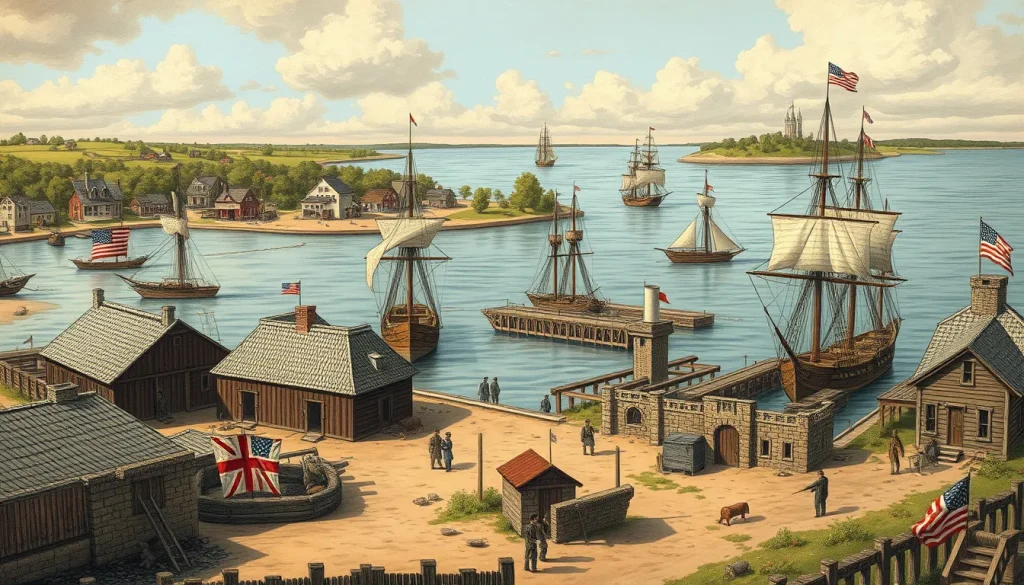
Before the war, the harbor’s founder, Augustus Sacket, had established a trading post in 1801. The location’s natural advantages—deep water, abundant timber, and proximity to the St. Lawrence River—soon attracted military attention. During the embargo years after 1807, the U.S. Navy deployed the brig Oneida to suppress smuggling across the border. When war was declared in June 1812, Sackett’s Harbor rapidly transformed from a small village into a bustling military and naval depot. By 1813, its population had swelled from around one hundred to several thousand, as shipwrights, soldiers, and sailors gathered to support American operations.
What Happened
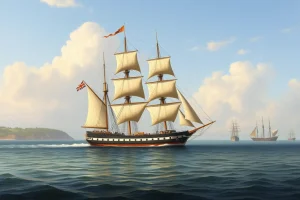
The first British attack on Sackett’s Harbor occurred on 19 July 1812. A squadron of five British ships under the Provincial Marine appeared off the harbor, demanding the surrender of the Oneida and the village. The American brig, commanded by Captain Melancthon Woolsey, together with shore batteries, returned fire. After a two-hour exchange, the British withdrew, suffering at least eight killed, while the Americans sustained no casualties. Although a minor skirmish, the action marked the first hostile encounter on Lake Ontario and demonstrated the harbor’s capacity to repel an amphibious assault.
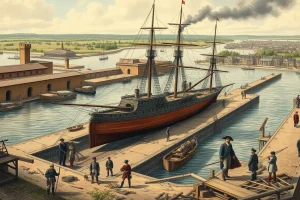
In the months that followed, Commodore Isaac Chauncey established a naval squadron at Sackett’s Harbor and contracted master shipbuilder Henry Eckford to convert merchant vessels and build new warships. The American naval build-up culminated in the joint army–navy attack on York (present-day Toronto) on 27 April 1813. That successful raid, though costly—including the death of Brigadier General Zebulon Pike—heightened British concern over American naval strength.
While the American squadron was supporting operations at the far end of the lake, the British struck at Sackett’s Harbor. On 29 May 1813, a British force under Lieutenant General Sir George Prevost, governor general of Canada, and naval commander Sir James Lucas Yeo landed on Horse Island, a small island just offshore. The troops, numbering around 900, waded across the submerged causeway to the mainland. The American defenders, initially composed of local militia under Brigadier General Jacob Brown, retired hastily, but regulars under Lieutenant Colonel Electus Backus rallied and, supported by artillery, checked the British advance. Confusion among the British, including a premature order to retreat, led to a withdrawal. The battle ended after approximately three hours, with the British suffering heavy casualties—estimates range from 259 to nearly 400 killed and wounded, while the Americans lost about 157, including Backus. During the fighting, a premature order to burn the almost-completed ship General Pike was given, and many naval stores were destroyed to prevent capture, but the vessel itself was saved and later launched.
Why It Matters
The successful defense of Sackett’s Harbor prevented the British from destroying the American naval establishment on Lake Ontario. Had the harbor fallen, the British would have gained unchallenged command of the lake, threatening the entire American position in the north. The harbor’s shipyards continued to produce warships, including the frigate Superior launched in 1814, which helped secure American naval superiority for the remainder of the war.
Moreover, the battle of 29 May 1813 proved to be a turning point in the career of Jacob Brown, whose leadership earned him promotion and later command of the U.S. Army on the Niagara frontier. For the British and Canadians, the failure to capture the harbor was a significant missed opportunity, and the battle remains a notable example of a well-executed defensive action.
Historically, the site underscores the complexities of the war, including the participation of Indigenous forces on both sides and the multinational character of the conflict. Today, the battlefield is preserved as a New York State Historic Site, and in 2013, a monument was dedicated to the British, Canadian, and American soldiers, reflecting the shared heritage of the war.
Historical Map Context
Sackett’s Harbor lies at the eastern end of Lake Ontario, on the south shore of Black River Bay. The harbor is nearly enclosed, with a narrow peninsula named Navy Point forming its northern shore. Horse Island, located to the west, is a low-lying islet separated from the mainland by a shallow strait that could be waded at times, making it an important landing point during the 1813 attack. The harbor’s proximity to Kingston, Ontario—only about forty miles across the lake—made it a base for American raids against British supply lines and a target for British counterattacks.
Modern Location
Today, Sackets Harbor is a small village in Jefferson County, New York, approximately ten miles west-southwest of Watertown. The Sackets Harbor Battlefield State Historic Site preserves much of the 1813 battleground, including Horse Island, which was transferred to New York State in 2019. The site includes restored navy-yard buildings, an 1850 commandant’s house, and interpretive trails.
Events at the Site
Besides the two battles, the harbor functioned as the principal base for American naval operations on Lake Ontario. Expeditions against York and Fort George departed from here in 1813. The shipyard built numerous vessels, including the General Pike, the Superior, and two ships-of-the-line that were laid down but never completed after the war. In the decades following 1815, the naval station remained in military use until it was turned over to the State of New York in 1955.
Associated People
Key figures associated with Sackett’s Harbor include founder Augustus Sacket, Commodore Isaac Chauncey, shipbuilder Henry Eckford, and Brigadier General Jacob Brown, who commanded the defenders in 1813. Lieutenant Colonel Electus Backus, who fell in the battle, is buried in the Madison Barracks cemetery. On the British side, Sir George Prevost and Sir James Yeo led the attack. The harbor also hosted numerous unnamed soldiers, sailors, and civilians whose labor sustained the war effort.
Surviving Monuments and Site
The Sackets Harbor Battlefield State Historic Site, administered by the New York State Office of Parks, Recreation and Historic Preservation, encompasses 71 acres of battleground, including Horse Island. A granite monument erected in 1913 for the centennial of the battle stands as the centerpiece. In 2013, a joint American–British–Canadian monument was dedicated to the Crown forces who fought at the site, and in 2013 Queen Elizabeth II recognized its international significance. The restored navy yard, museum, and commandant’s house offer visitors a glimpse into the site’s military past.
Primary Sources
Among the most vivid contemporary accounts is the letter of Balthaser Kramer, a volunteer militia soldier, written shortly after the 29 May 1813 battle. Kramer described the American retreat and the fighting spirit of the troops. Official reports from General Jacob Brown and British commanders provide tactical details, though they naturally reflect each side’s perspective. Midshipman and naval officers’ journals also illuminate the shipbuilding and the naval arms race. These sources must be read critically, as they are shaped by the authors’ positions and the needs of wartime propaganda.
Further Reading
- Mahan, Alfred Thayer. Sea Power in Its Relation to the War of 1812. Boston: Little, Brown, 1905.
- Kingsford, William. The History of Canada. Vol. 8. Toronto: Rowsell & Hutchison, 1895.
- Malcomson, Robert. Lords of the Lake: The Naval War on Lake Ontario 1812–1814. Toronto: Robin Brass Studio, 1998.
- Sackets Harbor Battlefield State Historic Site. Official website and interpretive materials.
References
- New York State Parks & Historic Sites. “Sackets Harbor Battlefield State Historic Site.” Accessed 2025. https://parks.ny.gov/visit/historic-sites/sackets-harbor-battlefield-state-historic-site.
- Martin, Tyrone G. “Lake Ontario’s Little-Known Gem.” Naval History Magazine 21, no. 1 (February 2007). https://www.usni.org/magazines/naval-history-magazine/2007/february/lake-ontarios-little-known-gem.
- Barone, Constance. “Controlling the Waterways at Sackets Harbor.” Hallowed Ground Magazine, American Battlefield Trust, June 11, 2019. https://www.battlefields.org/learn/articles/controlling-waterways-sackets-harbor.
- Bandy Heritage Center. “Sacket’s Harbor during the War of 1812.” PDF. Accessed 2025. https://www.bandyheritagecenter.org/Content/Uploads/bandy/files/1812/Sacket’s%20Harbor%20in%20the%20War%20of%201812.pdf.
- 1911 Encyclopædia Britannica. “Sackett’s Harbor.” Wikisource. Accessed 2025. https://en.wikisource.org/wiki/1911_Encyclopædia_Britannica/Sackett%27s_Harbor.
FAQ
What was the significance of the Battle of Sackets Harbor in 1813?
The 29 May 1813 battle was a successful American defense of their primary naval base on Lake Ontario. The British failed to destroy the shipyard and warships under construction, which allowed the United States to maintain naval parity on the lake and eventually achieve superiority.
Who were the key figures at Sackett's Harbor?
Commodore Isaac Chauncey directed naval operations, shipbuilder Henry Eckford oversaw construction, and Brigadier General Jacob Brown commanded the defenders during the 1813 attack. On the British side, Lieut. Gen. Sir George Prevost and Commodore Sir James Yeo led the assault.
How is Sackets Harbor remembered today?
The site is preserved as the Sackets Harbor Battlefield State Historic Site, with 71 acres including Horse Island. A centennial monument from 1913 and a joint American-British-Canadian monument from 2013 commemorate the battles.


Leave a Reply