

Short Answer
The St. Lawrence Campaign of 1813 was a failed American offensive during the War of 1812, aimed at capturing Montreal by advancing along the St. Lawrence River and the Chateauguay River. Launched in the autumn of 1813, it was the largest American military undertaking of the conflict, involving two separate forces totaling over 11,000 men. The campaign ended in defeat at the Battles of Chateauguay and Crysler’s Farm, securing the St. Lawrence corridor for the British and ending any realistic American hope of conquering Canada.
Historical Context
Montreal held the logistical key to Upper Canada. Sitting at the junction of the St. Lawrence and Ottawa Rivers, it was the gateway to the supply line that sustained every British post west of Quebec. If Montreal fell, Upper Canada would be cut off and likely forced to surrender. American strategy in 1813 therefore concentrated on seizing that city to end the war quickly.
After a disappointing 1812 campaign, the Madison administration appointed John Armstrong as Secretary of War, who devised an ambitious plan. Major General James Wilkinson would lead a force of about 8,000 men down the St. Lawrence from Sackets Harbor, while Major General Wade Hampton advanced north from Lake Champlain with 4,000 to rendezvous before Montreal. The plan, however, was undermined from the start by a bitter personal quarrel between Wilkinson and Hampton, who refused to cooperate effectively.
What Happened
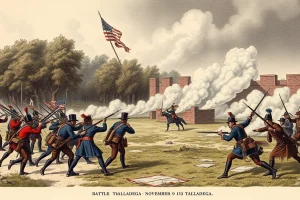
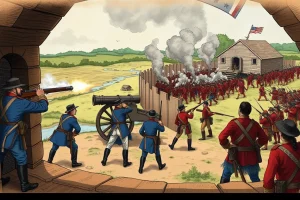
The campaign unfolded in two separate operations. Hampton moved first, advancing up the Chateauguay River toward Montreal. On 26 October 1813, his 3,000-plus troops encountered a small British and Canadian force of approximately 339 men under Lieutenant Colonel Charles de Salaberry. De Salaberry had prepared a defensive position with abattis, concealed firing lanes, and a deception scheme using buglers to suggest a much larger presence. After an intense skirmish, Hampton, convinced he faced overwhelming numbers, withdrew, ending his part of the campaign.
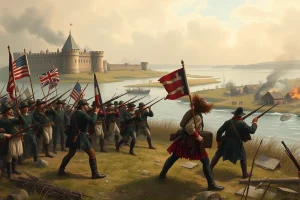
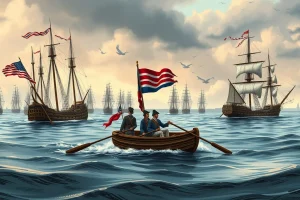
Wilkinson’s flotilla of 300 boats and 8,000 troops descended the St. Lawrence from Sackets Harbor on 17 October, but was shadowed by a British force under Lieutenant Colonel Joseph Morrison. Near the farm of John Crysler on 11 November, Morrison’s approximately 900 regulars and Canadian troops turned to confront the American rear guard of about 4,000 men under Brigadier General John Parker Boyd. The American attacks were uncoordinated and defeated by disciplined British volley fire and bayonet charges. After two hours, Boyd retreated. When Wilkinson learned of both Hampton’s withdrawal and his own rear guard’s defeat, he aborted the campaign and led his army into winter quarters at French Mills, New York.
Why It Matters
The St. Lawrence Campaign of 1813 was the most serious American attempt to conquer Canada. Its complete failure secured the St. Lawrence corridor, ensuring that Upper Canada remained connected to British supply lines and ultimately forcing the United States to abandon large-scale offensives in the Canadian theater. The battles of Chateauguay and Crysler’s Farm became celebrated moments in Canadian military history, especially in Quebec, where de Salaberry emerged as a national hero. Historians see the campaign as a decisive strategic turning point, confirming that the United States could not seize Canada by invasion and shaping the war’s eventual outcome.
Prelude
After early American defeats in 1812, President James Madison and Secretary of War John Armstrong sought a decisive blow for 1813. They identified Montreal as the key to severing the supply lines to Upper Canada. The plan called for two converging forces: Wilkinson from Sackets Harbor down the St. Lawrence, and Hampton from the Lake Champlain valley. Logistical preparation was extensive, but the operation was handicapped by the inability of the two generals to cooperate, as well as by poor weather, disease, and inadequate transportation.
Forces and Commanders
American: Major General James Wilkinson commanded the main force of about 8,000 men in a flotilla of 300 boats. Brigadier General John Parker Boyd led the rear division that fought at Crysler’s Farm. Major General Wade Hampton commanded the 4,000-man Lake Champlain column. Wilkinson was ill and accused of poor judgment; Hampton was a wealthy planter with political connections.
British and Canadian: At Chateauguay, Lieutenant Colonel Charles de Salaberry led about 339 Canadian Voltigeurs, Select Embodied Militia, and Abenaki warriors. At Crysler’s Farm, Lieutenant Colonel Joseph Morrison commanded roughly 900 regulars of the 49th and 89th Regiments, Canadian Fencibles, and militia, supported by gunboats and artillery.
Battlefield and Map Context
The Chateauguay battlefield was a densely forested river valley southwest of Montreal. De Salaberry occupied a series of abattis and concealed positions along the river, using the terrain to mask his small numbers and to channel the American advance. Crysler’s Farm was an open stretch of farmland on the north bank of the St. Lawrence, near present-day Morrisburg, Ontario. The ground offered clear fields of fire for British regulars and allowed gunboat support from the river.
Battle Chronology
26 October 1813: Hampton’s forces attack de Salaberry’s position at Chateauguay. American flanking attempt fails; Hampton withdraws.
6–10 November: Wilkinson’s flotilla runs the St. Lawrence rapids, with skirmishing along the banks.
11 November 1813: Boyd’s rear division engages Morrison’s force at Crysler’s Farm. After two hours, Boyd retreats. Wilkinson learns of Hampton’s defeat and calls off the campaign.
Casualties and Losses
At Chateauguay, British and Canadian losses were 5 killed, 16 wounded, and 4 missing; American losses were 23 killed, 33 wounded, and 29 missing. At Crysler’s Farm, British and Canadian losses were 22 killed, 148 wounded, and 9 missing; American losses were 102 killed, 237 wounded, and approximately 100 captured. Total American casualties in the campaign exceeded 500, while the defenders lost fewer than 200.
Result
The campaign was a decisive British and Canadian victory. Montreal remained in British hands, the St. Lawrence supply line was never seriously threatened again, and the American invasion of Canada was effectively ended for the remainder of the war.
Strategic Consequences
The failure at Chateauguay and Crysler’s Farm secured Upper Canada from the east. It also contributed to the American shift to a defensive posture in 1814, culminating in invasions from the Niagara frontier and elsewhere that also failed. The campaign solidified British control of the St. Lawrence and made the conquest of Canada an increasingly impossible goal for the United States.
Primary Accounts
Official reports from the generals provide contemporary accounts: Hampton’s report to the Secretary of War describes his defeat; de Salaberry’s dispatch to Prevost details the defense of Chateauguay; Wilkinson’s letters and court-martial records offer a detailed narrative of the campaign; Morrison’s after-action report covers Crysler’s Farm. Soldiers’ diaries and letters, such as those of American regulars, describe the hardships. Most of these documents are held at Library and Archives Canada and the U.S. National Archives.
Battlefield Today
The Chateauguay battlefield is now the Chateauguay National Historic Site of Canada, located near the town of Ormstown, Quebec. Crysler’s Farm battlefield is commemorated at Upper Canada Village near Morrisburg, Ontario, where a monument marks the engagement. Both sites offer interpretive trails and plaques that help visitors understand the terrain and the course of the fighting.
Primary Sources
The most important primary sources are the after-action reports of the commanders. Wade Hampton’s report to Secretary Armstrong, dated 29 October 1813, details the Chateauguay fight. Charles de Salaberry’s report to Lieutenant General Prevost, also of late October, claims victory and emphasizes his defensive preparations. Joseph Morrison’s report on Crysler’s Farm, dated 16 November 1813, describes the discipline and effectiveness of his troops. James Wilkinson’s official report and his later court-martial testimony provide the American perspective. These documents are essential for reconstructing the events but must be used with caution, as each general sought to cast himself in the best light.
Further Reading
- Barbuto, Richard V. The Canadian Theater 1813. Washington, D.C.: Center of Military History, U.S. Army, 2013.
- Berton, Pierre. The Invasion of Canada 1812–1813. Toronto: McClelland & Stewart, 1980.
- Hickey, Donald R. The War of 1812: A Forgotten Conflict. Urbana: University of Illinois Press, 1989.
- Lambert, Andrew. The Challenge: America, Britain and the War of 1812. London: Faber & Faber, 2012.
- Latimer, Jon. 1812: War with America. Cambridge, MA: Belknap Press, 2007.
References
- “The St. Lawrence & Montreal Campaign – War of 1812.” thewarof1812.org. https://thewarof1812.org/campaigns/the-st-lawrence-montreal-campaign/
- “War of 1812 – The Campaigns of 1813.” WarHistory.org. https://warhistory.org/article/war-of-1812-the-campaigns-of-1813
- “Battle of Crysler’s Farm – War of 1812.” thewarof1812.org. https://thewarof1812.org/battles/battle-of-cryslers-farm/
- “The Canadian Theater, 1813.” U.S. Army Center of Military History, govinfo.gov. https://www.govinfo.gov/content/pkg/GOVPUB-D114-PURL-gpo41603/pdf/GOVPUB-D114-PURL-gpo41603.pdf
- “Battle of Chateauguay – War of 1812.” thewarof1812.org. https://thewarof1812.org/battles/battle-of-chateauguay/
FAQ
What was the St. Lawrence Campaign of 1813?
It was a two-pronged American offensive aimed at capturing Montreal by advancing down the St. Lawrence River from Lake Ontario and up from Lake Champlain, intended to sever the British supply line to Upper Canada.
Why did the campaign fail for the Americans?
Failures included poor coordination between Generals Wilkinson and Hampton, strong defensive positions prepared by de Salaberry and Morrison, and disciplined British regulars. Hampton withdrew after Chateauguay, and Wilkinson's rear guard was defeated at Crysler's Farm.
What were the consequences of the campaign?
The campaign's failure secured the St. Lawrence corridor for Britain, ended American plans to conquer Canada, and became a celebrated victory for French-Canadian and British forces, shaping later Canadian national identity.
Leave a Reply