
Short Answer
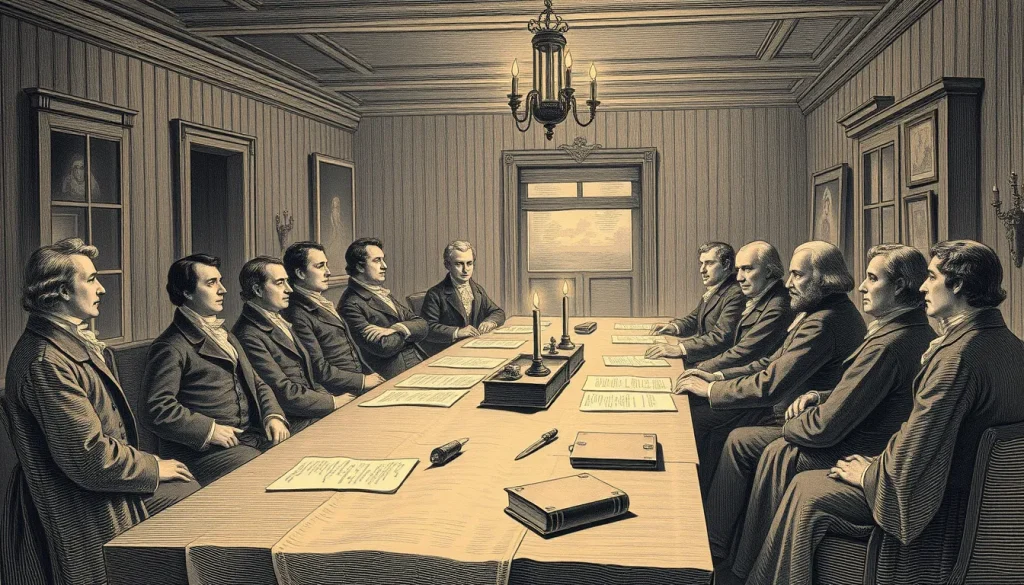
The Hartford Convention was a series of secret meetings held from December 15, 1814, to January 5, 1815, in Hartford, Connecticut, where twenty-six delegates from New England Federalist strongholds gathered to discuss grievances against the U.S. government’s conduct of the War of 1812 and the growing power of the Democratic-Republican Party. The convention produced a report that condemned federal policies and proposed constitutional amendments but stopped short of secession. Its timing, coinciding with the peace treaty and Andrew Jackson’s victory at New Orleans, severely discredited the Federalist Party and accelerated its decline.
Historical Context
The roots of the Hartford Convention lay in long-standing sectional tensions. New England’s economy depended heavily on maritime trade, and Thomas Jefferson’s embargo policies—starting with the Embargo Act of 1807—had devastated the region’s shipping industry. The subsequent Non-Intercourse Act and Macon’s Bill No. 2 continued to restrict commerce, further alienating New England merchants. When President James Madison declared war on Britain in 1812, New England Federalists, who dominated the region politically, opposed the war as ruinous to their interests and as an overreach of federal power.
By 1814, the war had gone badly for the United States. The British blockade choked off trade, and the federal government faced bankruptcy. New England governors refused to commit state militias to the national effort, and Massachusetts, Connecticut, and Rhode Island openly opposed the war. In September 1814, Madison proposed a conscription bill, which Federalists feared would lead to military despotism. These conditions prompted state legislatures to call for a convention to coordinate resistance and consider constitutional remedies.
What Happened
The convention assembled in Hartford on December 15, 1814, with twenty-six delegates representing Massachusetts, Connecticut, Rhode Island, and two counties from New Hampshire and one from Vermont. The meetings were held in secret, and no official record of the debates was kept. The delegates were divided between moderate and radical factions. Radicals, including Timothy Pickering and Gouverneur Morris, advocated secession or a separate New England confederacy. Moderates, led by Harrison Gray Otis, favored a more conciliatory approach.
The moderates prevailed. On January 4, 1815, the convention issued its report, titled the Report of the Hartford Convention. The report declared that “acts of Congress in violation of the Constitution are absolutely void” and asserted the right of states to interpose their authority against unconstitutional federal laws. It also listed grievances regarding the embargo, the war, and the admission of new states. Most significantly, the report recommended a series of constitutional amendments designed to rebalance power toward New England:
- Limiting any trade embargo to sixty days.
- Requiring a two-thirds congressional majority for declarations of war, admission of new states, and laws restricting commerce.
- Abolishing the three-fifths clause that counted enslaved individuals for representation and taxation.
- Prohibiting the election of two consecutive presidents from the same state.
- Limiting presidents to a single term.
The report stopped short of secession, explicitly rejecting disunion during wartime and citing George Washington’s Farewell Address. The delegates dispatched the report to Washington, but it arrived after the news of the Treaty of Ghent (signed December 24, 1814) and Andrew Jackson’s overwhelming victory at the Battle of New Orleans (January 8, 1815). The timing made the Federalists appear unpatriotic and treacherous.
Why It Matters
The immediate effect of the Hartford Convention was to discredit the Federalist Party. The secrecy of the proceedings fueled rumors of treason, and the subsequent peace and military triumph transformed public sentiment into a wave of nationalism. The Federalists were branded as a disloyal faction, and their influence collapsed. By 1816, the party had all but disappeared as a national force, ushering in the “Era of Good Feelings” under President James Monroe.
Historians interpret the convention as a crucial moment in the early republic’s struggle over federal authority. It demonstrated the depth of sectional discontent and the willingness of states to challenge federal power. While the convention stopped short of nullification or secession, its language of state interposition foreshadowed the constitutional theories that would later fuel the Nullification Crisis and ultimately the Civil War. The convention also illustrates the decline of the Federalist Party, which had never recovered from its opposition to the war.
Definition
The Hartford Convention was a political gathering of New England Federalists who met in Hartford, Connecticut, from December 15, 1814, to January 5, 1815, to protest the Madison administration’s conduct of the War of 1812 and to propose constitutional reforms. It was the culmination of Federalist opposition to the war and to the policies of the Democratic-Republican majority.
Background
New England’s Federalist leaders had long opposed Jefferson’s embargoes and the war with Britain. They believed that the federal government, controlled by southern and western interests, was undermining New England’s commercial prosperity and its influence in national politics. The Louisiana Purchase of 1803 and the Twelfth Amendment (1804) were seen as threats to Federalist power. By 1814, the war’s economic toll—blockade, loss of trade, and bank failures—combined with Madison’s conscription proposal to trigger the demand for a convention.
How It Worked
The convention operated as a deliberative body of elected delegates from state legislatures. It met in secret, with no official journal kept of the debates. After three weeks of discussion, the delegates adopted a report that combined a statement of grievances with a list of proposed constitutional amendments. The report was then submitted to Congress and the state legislatures on January 5, 1815. The convention’s success lay in its ability to channel radical secessionist sentiment into a moderate call for reform, thereby maintaining a semblance of unity among the New England states.
Competing Viewpoints
Historians debate the extent to which secession was seriously considered. Some emphasize the presence of radical delegates like Timothy Pickering and the circulation of secessionist plans in newspapers. Others point to the convention’s final report, which explicitly rejected secession as unjustified except in extreme necessity, and note that moderates controlled the proceedings. The lack of records makes definitive conclusions impossible. The convention can be seen either as a legitimate exercise in states’ rights protest or as a dangerous flirtation with disunion, depending on the perspective.
Role in the War of 1812
The Hartford Convention was a direct consequence of the war. It embodied New England’s refusal to support the conflict and its leaders’ efforts to resist federal authority. The convention’s proposed amendments—requiring two-thirds majorities for war and trade restrictions, and limiting presidential terms—were aimed at preventing future wars like the War of 1812 that were perceived to harm New England disproportionately. The convention also influenced the war’s outcome indirectly by undermining public support and contributing to the federal government’s financial difficulties. Its report arrived in Washington just as the war was ending, making the Federalists appear out of step with the nation’s mood.
Consequences and Historical Interpretation
The immediate consequence was the political ruin of the Federalist Party. The party’s opposition to the war, combined with the timing of the convention’s report, transformed it into a symbol of disloyalty. The Federalists lost credibility and never again fielded a competitive national campaign. Historians agree that the convention contributed to the party’s demise, though they debate whether that outcome was inevitable. More broadly, the convention is seen as a precursor to later states’ rights arguments, demonstrating the persistence of sectional conflict in the early republic.
Primary Sources
The most important primary source is the Report of the Hartford Convention, issued on January 4, 1815. It contains the delegates’ grievances and proposed amendments. A later publication, the Secret Journal of the Hartford Convention (1823), provided a partial record of the proceedings, though it was compiled after the fact. Contemporary letters, such as those from John Adams and William H. Crawford, reveal concerns about treason. Newspaper editorials from 1814-1815 show the intense partisanship around the convention. Each source carries bias: the report was a carefully worded political document, while private letters often voiced extreme views not reflected in the official record.
Further Reading
- Donald R. Hickey, The War of 1812: A Forgotten Conflict (University of Illinois Press, 1989).
- Richard Buel Jr., America on the Brink: How the Political Struggle Over the War of 1812 Almost Destroyed the Young Republic (Palgrave Macmillan, 2005).
- D. W. Meinig, The Shaping of America: A Geographical Perspective on 500 Years of History, Vol. 2 (Yale University Press, 1993) for sectional context.
- Teaching American History, “The Hartford Convention: Secession or Reform?” and “Resolutions Adopted by the Hartford Convention.”
- American Battlefield Trust, “The Hartford Convention.”
References
- American Battlefield Trust, “The Hartford Convention,” last modified May 23, 2024, https://www.battlefields.org/learn/articles/hartford-convention.
- Wikipedia, “Hartford Convention,” accessed 2025, https://en.wikipedia.org/wiki/Hartford_Convention.
- Teaching American History, “The Hartford Convention: Secession or Reform?” by Ray Tyler, February 9, 2021, https://teachingamericanhistory.org/the-hartford-convention-secession-or-reform/.
- Teaching American History, “Resolutions Adopted by the Hartford Convention,” edited by John Dinan, https://teachingamericanhistory.org/document/resolutions-adopted-by-the-hartford-convention/.
- Bill of Rights Institute, “The Hartford Convention,” by Jeremy D. Bailey, https://billofrightsinstitute.org/essays/the-hartford-convention/.
FAQ
Was secession proposed at the Hartford Convention?
Some radical delegates discussed secession, but the convention's final report explicitly rejected disunion as unjustifiable during wartime and instead proposed constitutional amendments.
What were the Hartford Convention's proposed amendments?
The amendments included limiting embargoes to 60 days, requiring a two-thirds congressional majority for war decisions and trade restrictions, abolishing the three-fifths clause, and limiting presidents to one term and prohibiting successive presidents from the same state.
Why did the Hartford Convention fail to achieve its goals?
The report arrived in Washington just after the signing of the Treaty of Ghent and the Battle of New Orleans, which made the Federalists appear unpatriotic and irrelevant, and the proposals were never seriously considered by Congress.


Leave a Reply