
Short Answer
Fort Stephenson, a modest American stockade on the west bank of the Sandusky River in present-day Fremont, Ohio, served as a critical supply depot and staging area during the War of 1812. Its most notable moment came on August 1–2, 1813, when Major George Croghan and a garrison of about 160 U.S. regulars successfully defended the fort against a larger British and Indigenous force led by Major General Henry Procter. The American victory at Fort Stephenson restored confidence in the Northwest theater and cemented Croghan’s reputation as a national hero.
Historical Context
Following the American declaration of war in June 1812, the conflict along the Great Lakes and the Northwest Territory centered on control of key waterways and supply routes. After the fall of Detroit in August 1812, Major General William Henry Harrison took command of the Army of the Northwest and embarked on a campaign to retake the post. To support his advance, Harrison ordered the construction of forts, including Fort Meigs on the Maumee River and Fort Stephenson on the Sandusky River, to protect supply lines and provide staging areas for offensives.
The British, under Major General Henry Procter, sought to maintain pressure on American positions and to encourage their Indigenous allies. In May 1813, Procter besieged Fort Meigs but failed to capture it. By late July, after a failed ruse against Fort Meigs, Procter shifted his attention eastward to Fort Stephenson, hoping to overrun a seemingly isolated outpost and advance into Ohio.
What Happened
Fort Stephenson was originally constructed in 1812 as Fort Sandusky but was burned by Britain’s Indian allies after the fall of Detroit. Rebuilt in March 1813 under supervision of Captain Eleazar Wood, it was renamed in honor of Lieutenant Colonel Miles Stephenson. The fort enclosed about an acre of ground, with a ten-foot palisade atop an earth embankment and two blockhouses. Major George Croghan assumed command in July 1813 with a garrison of seven officers and 160 men, mostly from the 17th U.S. Infantry.
On July 29, 1813, Harrison, believing the fort indefensible against heavy artillery, ordered Croghan to abandon and destroy the fort. Croghan refused, responding famously: “We have determined to maintain this place, and by heavens we can.” He was briefly relieved of command but reinstated after explaining his position. Procter’s force arrived at the mouth of the Sandusky River on July 31, joined by Robert Dickson and Matthew Elliott with a few hundred Indigenous warriors. On August 1, the British demanded surrender; Croghan refused. British artillery, including gunboats and howitzers, bombarded the fort through the night and into the next morning, but the earthen ramparts absorbed the fire.
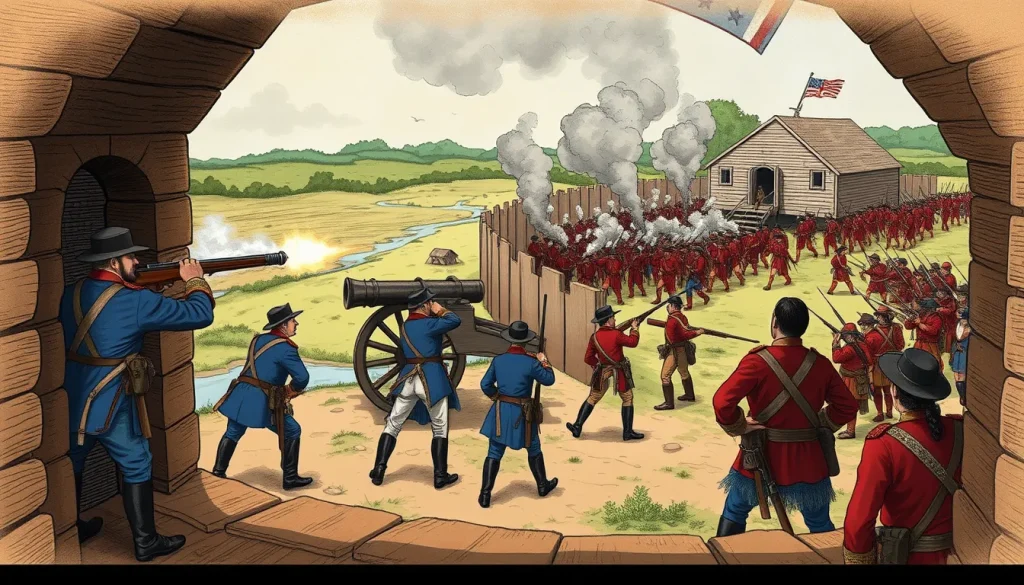
On the afternoon of August 2, Procter launched an assault on the northwest angle of the fort. The British column, mainly from the 41st Regiment, advanced into the ditch at the base of the palisade. Croghan had concealed his single six-pounder cannon, “Old Betsy,” behind a masked embrasure. When the attackers were packed in the ditch, the cannon fired grape shot at point-blank range, inflicting devastating casualties. The attack broke, and the British retreated. On August 3, Procter withdrew to Amherstburg, ending the siege.
Why It Matters
The American victory at Fort Stephenson came at a critical moment when U.S. fortunes in the Northwest were at a low ebb. The defense demonstrated that even small, well-led garrisons could repel larger forces, provided they used terrain and artillery effectively. Croghan’s defiance of orders—though insubordinate—was vindicated by the outcome. The victory boosted American morale and disheartened the British and their Indigenous allies. Procter’s failure further eroded his standing and contributed to his later defeat at the Battle of the Thames in October 1813.
Fort Stephenson also served as a staging area for Harrison’s successful campaign to retake Detroit and advance into Upper Canada. After the war, the fort was abandoned, and the site was gradually absorbed by the village of Lower Sandusky (later Fremont). Today, the site is marked by monuments, a memorial, and the preserved cannon “Old Betsy,” a testament to the battle’s enduring place in American memory.
Prelude
Procter’s decision to attack Fort Stephenson followed his failure at Fort Meigs. His Indigenous allies, including Tecumseh, had urged a renewed attack on Fort Meigs, but Procter turned east after a ruse failed. He sailed down Lake Erie into Sandusky Bay, while his Indigenous contingent marched overland. The British force, numbering about 500 regulars and a few hundred Indigenous warriors, approached Fort Stephenson on August 1.
Forces and Commanders
British and Allied: Major General Henry Procter commanded a force of about 500 regulars (primarily the 41st Regiment), Canadian militia, and Indigenous warriors led by Robert Dickson and Matthew Elliott. Estimates of the Indigenous contingent vary from a few hundred to over 700, but modern historians generally place it at a few hundred.
American: Major George Croghan commanded seven officers and about 160 men, mostly from the 17th U.S. Infantry, supported by a single six-pounder cannon nicknamed “Old Betsy.” A small number of Kentucky militia also served in the garrison.
Battlefield and Map Context
The fort stood on the west bank of the Sandusky River, approximately 10 miles upstream from Sandusky Bay, on elevated ground overlooking a bend in the river. The terrain included a ravine to the south and a flat plain to the north, which influenced the British approach. The fort encompassed about one acre, surrounded by a ten-foot palisade and an earth embankment, with two blockhouses at opposite corners. A six-foot-deep ditch had been dug around the fort, providing additional defensive depth.
Battle Chronology
August 1: Procter’s forces arrived and demanded surrender. Croghan refused. British artillery began bombarding the fort from gunboats and field pieces. The bombardment continued into the night but caused little damage.
August 2: The British increased fire, focusing on the northwest angle. Late afternoon, Procter launched an infantry assault. The 41st Regiment advanced toward a masked embrasure concealing “Old Betsy.” As the attackers entered the ditch, the cannon fired grape shot, causing heavy casualties. The British retreated in disorder.
August 3: Procter withdrew, ending the siege.
Casualties and Losses
British casualties are generally given as 26 killed, 41 wounded, and 29 missing (some accounts vary). American losses were one killed and seven wounded. The disparity in casualties underscores the one-sided nature of the assault, which resulted from the effective use of grape shot at close range.
Result
Fort Stephenson remained in American hands. The British failed to capture the post and withdrew to Upper Canada. Croghan’s successful defense was a clear American tactical victory.
Strategic Consequences
Procter’s withdrawal ended the immediate threat to Ohio and the Sandusky River supply line. The victory allowed Harrison to continue preparations for his fall offensive, which culminated in the recapture of Detroit and the victory at the Battle of the Thames. The defeat also damaged Procter’s reputation and strained his relationship with Tecumseh and other Indigenous leaders, contributing to the eventual British defeat in the Northwest.
Primary Accounts
Contemporary reports include Croghan’s official report to Harrison, in which he described the action and the role of “Old Betsy.” Procter’s report, while acknowledging the failure, claimed his Indigenous allies were fewer than expected. Other accounts appear in the letters and memoirs of participants, such as the British officer Lieutenant John Richardson, who served in the 41st Foot. These sources provide varying perspectives on the battle’s details and the conduct of the opposing commanders.
Battlefield Today
The site of Fort Stephenson is now in downtown Fremont, Ohio. The Birchard Public Library stands on part of the original fort grounds. The Soldiers’ Monument, unveiled in 1885, commemorates the battle and later wars. The cannon “Old Betsy” is displayed near the library’s north entrance. A granite boulder with a bronze tablet, placed in 1903, marks the fort’s location. Annual observances of “Croghan Day” continue to honor the defense.
Primary Sources
Key primary sources include George Croghan’s official report to William Henry Harrison, dated August 3, 1813, detailing the defense. Henry Procter’s report to his superiors provides the British view. The memoir of Lieutenant John Richardson, who participated in the assault, offers a participant’s perspective. The published collections of Harrison’s papers and the letters of soldiers in the garrison also illuminate the event.
Further Reading
- Hickey, Donald R. The War of 1812: A Forgotten Conflict. University of Illinois Press, 1989.
- Antal, Sandy. A Wampum Denied: Procter’s War of 1812. Carleton University Press, 1997.
- Latimer, Jon. 1812: War with America. Harvard University Press, 2007.
- Sugden, John. Tecumseh: A Life. Henry Holt, 1998.
- Haynes, Emory J. History of Sandusky County, Ohio. 1902. (Reprint with battle details.)
References
- “Battle of Fort Stephenson.” Wikipedia, https://en.wikipedia.org/wiki/Battle_of_Fort_Stephenson.
- “Fort Stephenson.” Wikipedia, https://en.wikipedia.org/wiki/Fort_Stephenson.
- Howe, Henry. “Fort Stephenson or Sandusky.” In Historical Collections of Ohio, 1904. Accessed via USGenWeb, https://archives.ohgenweb.org/files/sandusky/history/part2.txt.
- “Battle of Fort Stephenson – War of 1812.” The War of 1812.org, https://thewarof1812.org/battles/battle-of-fort-stephenson/.
- Schulman, Marc. “Fort Stephenson Defended.” HistoryCentral, https://www.historycentral.com/1812/Stephenson.html.
FAQ
Why did Major Croghan disobey General Harrison's order to abandon Fort Stephenson?
Croghan believed that a retreat would be risky because Indigenous forces were in the area, and he considered the fort defensible despite the threat of artillery. His famous reply, "We have determined to maintain this place, and by heavens we can," reflected his confidence. After explaining his reasoning, Harrison allowed him to stay.
What was the strategic significance of the Battle of Fort Stephenson?
The American victory prevented a British and Indigenous force from advancing into Ohio and destroying a key supply depot. It boosted American morale, restored confidence in the Northwest theater, and enabled Harrison to prepare for his successful autumn campaign, which culminated in the Battle of the Thames.
What happened to Fort Stephenson after the war?
After the War of 1812, the U.S. Army abandoned the fort. In 1818, the blockhouses were sold and dismantled, and the logs of the palisade were taken by settlers. The site later became part of the town of Lower Sandusky (now Fremont, Ohio), and today it is commemorated by monuments, the Birchard Library, and the preserved cannon 'Old Betsy.'

Leave a Reply