

Short Answer
The Battle of Talladega was fought on November 9, 1813, near present-day Talladega, Alabama, during the Creek War, an armed conflict that became part of the broader War of 1812. United States forces under Major General Andrew Jackson defeated Red Stick Creek warriors who had besieged the allied Creek occupants of Fort Leslie. The engagement killed roughly 300 Red Sticks, lifted the siege, and strengthened the alliance between the United States and the friendly Creek towns.
Historical Context
The Creek War (1813–1814) arose from internal tensions within the Creek Nation, exacerbated by economic hardship, land pressure, and the influence of Shawnee leader Tecumseh, who advocated resistance to American expansion. The Red Sticks, the militant faction, launched attacks on white settlements and Creek towns perceived as too accommodating to the United States. The massacre of about 250 defenders and civilians at Fort Mims on August 30, 1813, by Red Sticks triggered American retaliation. Tennessee, Georgia, and Mississippi Territory mobilized militia forces. Major General Andrew Jackson, commanding Tennessee militia, established Fort Strother on the Coosa River as a forward base for operations against Red Stick towns.
What Happened
After defeating a Red Stick force at the Battle of Tallushatchee on November 3, 1813, Jackson received a desperate appeal from friendly Creeks and a few white families trapped in Fort Leslie, a small stockade built around a trading post in the town of Talladega. Red Stick warriors under William Weatherford surrounded the fort. A Creek man, wrapped in a hog skin, slipped through the besieging lines to inform Jackson. Leaving a small guard at Fort Strother, Jackson led about 2,000 men—some 1,200 infantry and 800 cavalry—on an overnight march. On November 9, Jackson’s force encircled the Red Stick camp. In the ensuing battle, the Americans inflicted heavy casualties, though a gap in the lines allowed roughly 700 Red Sticks to escape. The siege was broken, and Fort Leslie’s occupants were relieved. Red Stick losses were around 300 killed and 110 wounded; American losses were 15 killed and 85 wounded.
Why It Matters
The Battle of Talladega was a significant early victory for Andrew Jackson, burnishing his reputation as a determined commander. It also secured the loyalties of the Lower Creek towns, which provided valuable intelligence and logistical support to American forces. The combined American victories at Tallushatchee and Talladega killed or wounded over a thousand Red Stick warriors, severely depleting their ranks. This attrition weakened the Red Sticks and set the stage for their decisive defeat at the Battle of Horseshoe Bend in March 1814. The battle also demonstrated the interconnectedness of frontier conflicts, British influence, and the War of 1812.
Prelude
Following the destruction of Tallushatchee, the Red Sticks turned against Creek towns that had sided with the United States. The pro-American inhabitants of Talladega, numbering about 154 warriors and noncombatants, took refuge in Fort Leslie. Red Stick forces invested the fort, cutting off any communication. The siege lasted for several days, with food and water running low. The successful escape of a Creek man using a hog skin disguise brought word to Jackson at Fort Strother, prompting his relief expedition.
Forces and Commanders
The American force comprised about 2,000 men—approximately 1,200 infantry and 800 cavalry from the Tennessee militia. Major General Andrew Jackson commanded the entire force, with Brigadier General John Coffee leading the cavalry. The Red Stick force numbered around 700 warriors, reportedly under the overall leadership of William Weatherford, although command may have been shared among several war chiefs. The allied Creeks inside the fort were not actively engaged in the fighting.
Battlefield and Map Context
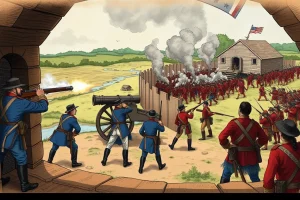
The battle took place near the present-day city of Talladega, Talladega County, Alabama, which was then part of the Mississippi Territory. Fort Leslie was a modest stockade surrounding the trading post of a man named Leslie. The terrain consisted of open woods and fields, with the fort situated on slightly elevated ground. The area is approximately 30 miles southeast of Fort Strother, near the Ten Islands on the Coosa River. The battlefield site is now within the modern city, and a historic marker commemorates the engagement.
Battle Chronology
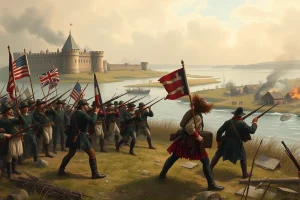
Jackson’s force departed Fort Strother on November 8, marching through the night. They arrived at Talladega on the morning of November 9. Jackson ordered an encirclement, placing cavalry on the flanks and infantry in the center. The Red Sticks, alerted to the American presence, launched a vigorous attack. A portion of the militia line broke, creating a gap through which many Red Sticks escaped. The fighting lasted perhaps fifteen minutes, with the Americans driving the remaining Red Sticks from the field. The siege was thus lifted, and the friendly Creeks were liberated.
Casualties and Losses
Contemporary reports, including Andrew Jackson’s own dispatch to Governor Willie Blount, indicate Red Stick losses of about 300 killed and 110 wounded. American casualties were 15 killed and 85 wounded. Some sources give slightly different figures, but these numbers are widely accepted. The number of Red Sticks who escaped is estimated at around 700.
Result
The battle was an American victory. The immediate objective—relieving the besieged Creeks at Fort Leslie—was accomplished. Jackson’s force retired to Fort Strother, having suffered relatively few casualties. The Red Sticks were compelled to retreat, though their main body survived intact.
Strategic Consequences
The victory at Talladega, following closely on the heels of the Tallushatchee triumph, eliminated about a thousand Red Stick warriors over six days. This attrition reduced the Red Sticks’ offensive capacity and morale. It also confirmed the value of alliances with pro-American Creek towns, which provided scouts and supplies. The battle contributed to the eventual American victory at Horseshoe Bend, which effectively crushed the Red Stick resistance. For Jackson, the victory elevated his national prominence and helped secure his military reputation.
Primary Accounts
Andrew Jackson’s letter to Tennessee Governor Willie Blount, written a few days after the battle, provides the most detailed contemporary description of the action and casualties. Captain Isaac Baker, who later passed the battlefield in 1814, recorded seeing skeletons still on the field. Davy Crockett, a Tennessee militiaman in the campaign, wrote about the encounter in his memoir, though his account is less precise. Albert James Pickett’s History of Alabama (1851) offers a narrative that includes the hog-skin escape episode, which is widely retold but may be partly legendary.
Battlefield Today
The battlefield site is now largely absorbed by the city of Talladega. A historic marker, placed in the early twentieth century, commemorates the battle. In 1930, the U.S. Congress authorized a small commemorative marker, but no federal park was established. The exact location of Fort Leslie is not precisely known, though the marker indicates an approximate site. The city of Talladega and the Talladega County Historical Society maintain local records and historical interest.
Primary Sources
Key primary sources include Andrew Jackson’s official report to Governor Willie Blount (November 1813, available in the Tennessee State Library and Archives and published in collections of Jackson’s papers). The journal of Captain Isaac L. Baker, published in the Southwestern Historical Quarterly (1927), offers a later firsthand observation of the battlefield. Albert James Pickett’s History of Alabama (1851) contains a detailed narrative based on interviews and earlier documents. Another important source is Benson Lossing’s Pictorial Field-Book of the War of 1812 (1868), which includes a description and map.
Further Reading
- Halbert, H. S., and T. H. Ball. The Creek War of 1813 and 1814. 1895. Reprint, Tuscaloosa: University of Alabama Press, 1969.
- Griffith, Benjamin W., Jr. McIntosh and Weatherford: Creek Indian Leaders. Tuscaloosa: University of Alabama Press, 1988.
- Borneman, Walter R. 1812: The War That Forged a Nation. New York: Harper Perennial, 2004.
- Lossing, Benson J. The Pictorial Field-Book of the War of 1812. New York: Harper & Brothers, 1868.
References
- Lewis, Herbert J. “Battle of Talladega.” Encyclopedia of Alabama, July 14, 2010, last updated July 16, 2024. https://encyclopediaofalabama.org/article/battle-of-talladega/.
- “Battle of Talladega.” Wikipedia, The Free Encyclopedia. Accessed 2025. https://en.wikipedia.org/wiki/Battle_of_Talladega.
- United States Congress. “Commemoration of the Battle at Talladega, Alabama.” S. 2596, 71st Cong., 2nd sess., 1930. National Park Service Historical Files. https://npshistory.com/publications/proposed-parks/al-talladega-nhp.pdf.
- “Battle of Talladega.” mywarof1812.com. Accessed 2025. https://www.mywarof1812.com/battles/141109.html.
- Pickett, Albert James. History of Alabama. Chapter 39. 1851. http://files.usgwarchives.net/al/statewide/history/books/pickett/chaptr39.txt.
FAQ
What was the Battle of Talladega?
The Battle of Talladega (November 9, 1813) was a clash during the Creek War where Andrew Jackson's Tennessee militia defeated Red Stick Creek warriors who were besieging Fort Leslie, a stockade sheltering pro-American Creeks.
Who commanded the American forces at Talladega?
Major General Andrew Jackson commanded the American forces, with Brigadier General John Coffee leading the cavalry.
What were the casualties at the Battle of Talladega?
Red Stick casualties were about 300 killed and 110 wounded. American losses were 15 killed and 85 wounded.

Leave a Reply