Short Answer
Jean Lafitte, a privateer and smuggler who led the Baratarian community on Louisiana’s Gulf Coast, played a significant role in the American victory at the Battle of New Orleans on January 8, 1815. His participation in the War of 1812 campaign helped secure the defense of New Orleans against a major British invasion force. The battle, fought after the Treaty of Ghent was signed but before news reached the region, cemented Lafitte’s reputation as both a patriot and an outlaw.
Historical Context
By 1814, the War of 1812 had reached a critical point for the United States. The British blockade stretched from the Atlantic to the Gulf of Mexico, choking American trade. New Orleans, a vital port at the mouth of the Mississippi River, was a strategic prize; its capture would sever the western states from the Atlantic. British planners sought to seize the city and control the river basin.
Meanwhile, the Louisiana economy suffered from embargoes and blockades, but a thriving smuggling network emerged in the swampy bayous south of New Orleans. Jean Lafitte and his brother Pierre operated from Grand Terre Island in Barataria Bay, smuggling goods and enslaved people into the region. Their operations were tolerated by many local merchants and planters despite being illegal. The group, known as Baratarians, were effectively privateers holding commissions from Cartagena (modern Colombia) to prey on Spanish commerce, but American law considered them pirates.
What Happened
In September 1814, British officers from HMS Sophie contacted Lafitte at Grand Terre. They offered him £30,000, a captaincy in the Royal Navy, and land grants if he would assist in the planned invasion of Louisiana. Lafitte asked for time to consider, then secretly sent a letter to Governor William C. C. Claiborne of Louisiana, offering his services to the American side. He requested a full pardon for his men in exchange for their aid.
The American authorities were skeptical, and in November 1814 a U.S. naval force attacked and destroyed the Baratarian base, capturing many of Lafitte’s men and goods. However, Andrew Jackson, commander of the U.S. forces in the Gulf, recognized that Lafitte and his gunners could provide much-needed artillery expertise and local intelligence. After negotiations, Jackson accepted Lafitte’s offer. Lafitte and several of his lieutenants were integrated into the American defenses, with about fifty Baratarians serving as artillerists in the earthworks at Chalmette Plantation.
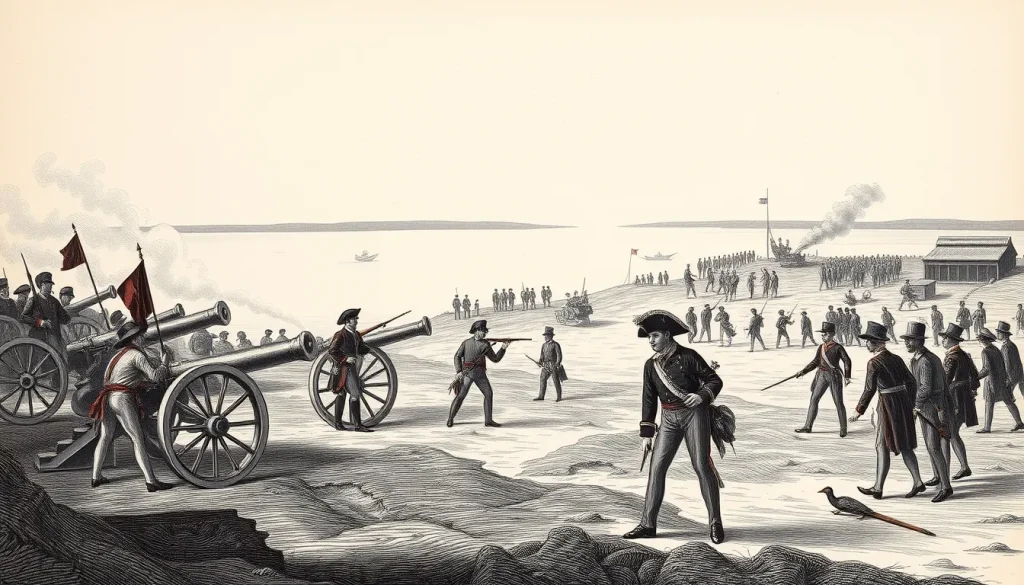
On January 8, 1815, British forces under Major General Edward Pakenham launched a frontal assault on Jackson’s line. The American batteries, manned in part by Baratarian gunners, poured fire into the advancing redcoats, causing devastating casualties. The British attack failed, and they withdrew. News of the Treaty of Ghent, signed December 24, 1814, later reached the region, confirming that the battle was fought after the war had technically ended, but it was a decisive American victory that protected New Orleans.
Why It Matters
The Battle of New Orleans was one of the most lopsided victories of the War of 1812, and Lafitte’s contribution was central to the American defense. His decision to reject the British offer and support the United States helped supply crucial artillery support and knowledge of the terrain. President James Madison issued a pardon to Lafitte and his Baratarians in February 1815, acknowledging their service.
The battle and Lafitte’s role have been mythologized in American memory. Lafitte is often portrayed as a romantic hero who chose patriotism over profit, though historians note that his motivations were complex and practical. The battle’s symbolic importance as a national triumph helped restore American confidence after the burning of Washington, and it elevated Andrew Jackson to national prominence.
Early Life
Jean Lafitte’s early life is obscure. He was likely born in the early 1780s in either France or the French colony of Saint-Domingue (now Haiti). His father may have been a leatherworker, and Jean reportedly had at least two brothers, Pierre and Alexandre. By 1807, Jean and Pierre arrived in Louisiana, and by 1810 they were leading a smuggling operation based in Barataria Bay. Lafitte himself was described as tall, dark-haired, and charismatic, with a reputation for intelligence and daring.
Role Before the War
Before the War of 1812, Lafitte and his brother established themselves as privateers and smugglers. They held commissions from Cartagena to attack Spanish shipping, but they smuggled captured goods and enslaved people into Louisiana, evading customs. Their base at Grand Terre became a hub for trade, attracting merchants and planters. The Lafitte brothers built warehouses and conducted auctions, while also maintaining a blacksmith shop in New Orleans as a front. Their operations were illegal under American law, but they enjoyed local tolerance due to the scarcity imposed by the embargo and blockade.
Role During the War
During the War of 1812, Lafitte’s role shifted from smuggler to potential collaborator with either side. When the British offered him incentives to join their campaign, he used the opportunity to negotiate a pardon for his men from the Americans. Despite the American attack on Barataria in November 1814, Lafitte continued to seek an accommodation with Jackson. After meeting with Jackson, Lafitte and his men were allowed to serve as volunteers, manning key artillery positions. They played a critical part in the defense, firing on the British columns from positions along the Rodriguez Canal.
Major Actions
Lafitte’s most significant military contribution was his supervision of artillery batteries during the Battle of New Orleans. His men were experienced gunners, and they helped direct effective cannon fire that broke the British assault. Additionally, Lafitte’s knowledge of the local waterways and bayous was valuable for planning troop movements and supply routes. Some accounts also credit Lafitte with supplying ammunition and providing intelligence about British intentions.
Contemporary Accounts
Contemporary records include letters between Lafitte, Governor Claiborne, and British officers. In his September 1814 letter to Claiborne, Lafitte offered his services, emphasizing his loyalty to the United States and his willingness to help defend New Orleans. British Captain Nicholas Lockyer later reported the negotiations at Grand Terre. Andrew Jackson, who initially called Lafitte a “hellish banditti,” later acknowledged the importance of the Baratarians’ artillery. In February 1815, Jackson wrote favorably of their conduct, and President Madison issued a pardon.
Later Life
After the war and his pardon, Lafitte returned to his privateer ways, moving to Galveston Island in Spanish Texas around 1816. He established a settlement and continued raiding Spanish shipping, but his operations eventually drew American scrutiny. In 1820, the U.S. Navy forced him to leave Galveston. Lafitte’s final whereabouts remain unknown; he likely died at sea or in the Caribbean, possibly in the 1820s.
Historical Legacy
Lafitte’s legacy is a blend of fact and legend. He is celebrated as a hero in Louisiana for his role in the Battle of New Orleans, but historians debate the extent of his military contribution versus that of the regular troops. Some emphasize his criminal past, while others view him as a pragmatist who chose the side that offered a better future. The Jean Lafitte National Historical Park and Preserve in Louisiana preserves the sites associated with his life, including the Chalmette Battlefield and the Barataria Preserve, ensuring his story remains accessible to the public.
Primary Sources
Key primary sources include the correspondence between Jean Lafitte and Governor William C. C. Claiborne in September 1814, printed in various collections. British Captain Nicholas Lockyer’s official report of the meeting at Grand Terre provides a British perspective. Andrew Jackson’s dispatches after the battle, including his mention of the Baratarians, are preserved in the National Archives. Edward Alexander Parsons published a study with transcriptions of several letters in the American Antiquarian Society’s proceedings (1940). These documents reveal both Lafitte’s negotiations and the attitudes of the officials.
Further Reading
- Groom, Winston. Patriotic Fire: Andrew Jackson and Jean Laffite at the Battle of New Orleans. Knopf, 2006.
- Parks, William. Jean Laffite and the Louisiana Pirates. Louisiana State University Press, 1994.
- National Park Service. “Jean Lafitte.” National Park Service.
- American Battlefield Trust. “Jean Lafitte.” American Battlefield Trust.
- Parsons, Edward Alexander. “Jean Lafitte in the War of 1812.” Proceedings of the American Antiquarian Society 50, no. 2 (1940): 205–224.
References
- National Park Service, “Jean Lafitte,” National Park Service, accessed 2024, https://www.nps.gov/people/jeanlafitte.htm.
- American Battlefield Trust, “Jean Lafitte,” American Battlefield Trust, accessed 2024, https://www.battlefields.org/learn/biographies/jean-lafitte.
- Winston Groom, “Saving New Orleans,” Smithsonian Magazine, August 2006.
- Edward Alexander Parsons, “Jean Lafitte in the War of 1812,” Proceedings of the American Antiquarian Society 50, no. 2 (1940): 205–224.
FAQ
Why did Jean Lafitte side with the Americans in the Battle of New Orleans?
Lafitte sided with the Americans after the British offered him a bribe; he instead sought a pardon from the U.S. government for his smuggling activities. He likely judged that an American victory would secure his legal status and allow him to continue operations, whereas the British offer was uncertain.
Was Jean Lafitte actually a pirate?
Lafitte and his men operated as privateers holding commissions from Cartagena to attack Spanish shipping, but they also smuggled goods into Louisiana, which American law treated as piracy. The label 'pirate' is debated; contemporaries used it pejoratively, but they considered themselves privateers.
What happened to Lafitte after the War of 1812?
Following his pardon, Lafitte returned to privateering, establishing a base at Galveston Island in Spanish Texas. He was forced out by the U.S. Navy in 1820, and his subsequent fate is unknown, with no reliable record of his death.
Leave a Reply