Short Answer
The naval war on the Great Lakes was a central theater of the War of 1812, fought between the United States and Great Britain from 1812 to 1814. Because the Great Lakes provided the most practical transportation routes across the thinly settled frontier, control of these waters was essential for supplying armies, launching invasions, and defending Upper Canada. The struggle saw the rise of freshwater fleets, culminating in the American victory on Lake Erie in 1813 and the subsequent demilitarization of the lakes after the war.
Historical Context
The Great Lakes—Ontario, Erie, Huron, Michigan, and Superior—formed a natural highway linking the Atlantic via the St. Lawrence River to the continental interior. For the British, the lakes were vital to the Canadian fur trade and to the defense of the provinces of Upper and Lower Canada. For Americans, they offered a route for invasion northward and a barrier to British counterattack. The region was home to numerous Indigenous peoples, many of whom allied with the British, hoping to resist American expansion. At the start of the war, the British maintained a small naval force known as the Provincial Marine, while the United States had no armed vessels on the lakes. The immense distances and poor overland roads made waterborne transport decisive, so both sides rushed to build warships from the abundant timber of the region.
What Happened
Hostilities opened with British successes. In July 1812, a British and Indigenous force captured Fort Michilimackinac, securing the strategic straits between Lake Huron and Lake Michigan. In August, Major General Isaac Brock captured Detroit, giving the British control of the upper lakes and a secure supply line down the Detroit River. American naval efforts centered on Lake Ontario, where Commodore Isaac Chauncey built a base at Sackets Harbor, and on Lake Erie, where shipyards at Black Rock and Presque Isle (present-day Erie, Pennsylvania) prepared vessels.
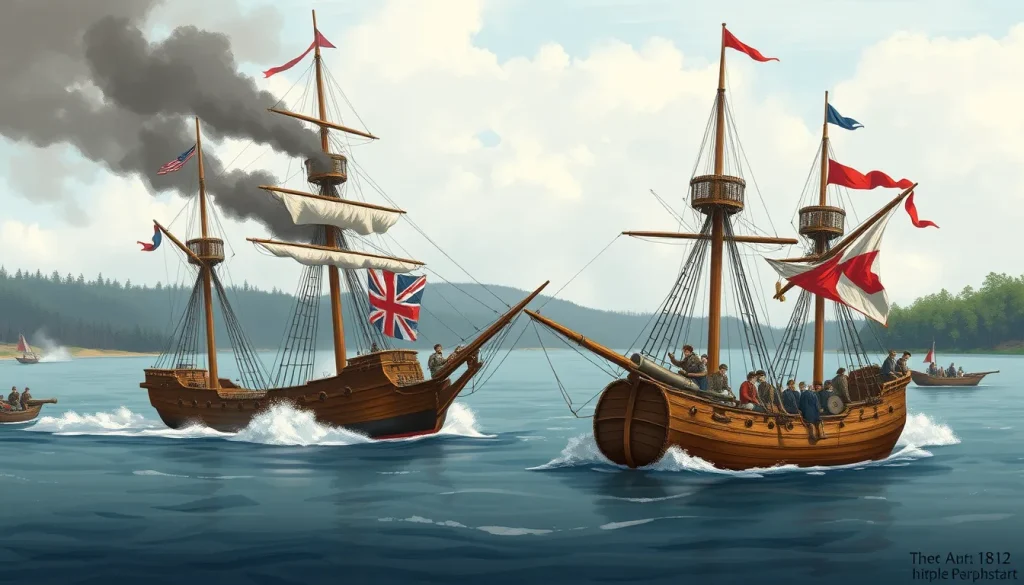
The 1813 campaigning season brought decisive action. In April, an American force under Chauncey and General Henry Dearborn captured and burned York (Toronto), temporarily disrupting British supply lines. In May, American forces crossed the Niagara River and captured Fort George, while a British attack on Sackets Harbor was repelled. The key battle came on September 10, 1813, when Master Commandant Oliver Hazard Perry’s squadron defeated a British fleet under Commander Robert Heriot Barclay at the Battle of Lake Erie, near Put-in-Bay. Perry’s victory secured American control of the lake, forced the British to abandon Detroit and Fort Amherstburg, and enabled General William Henry Harrison to win the Battle of the Thames, where Tecumseh was killed. On Lake Ontario, Chauncey and British Commodore Sir James Lucas Yeo engaged in a series of inconclusive actions, each building larger ships in a feverish arms race. The British launched the 112-gun ship of the line HMS St. Lawrence in September 1814, effectively ending American challenges on that lake.
On Lake Huron, American forces under Commodore Arthur Sinclair attempted to recapture Michilimackinac and destroyed the British schooner Nancy. The British captured the American vessels Tigress and Scorpion in September 1814, but these were isolated actions. By late 1814, neither side held clear supremacy across all the lakes, but the American victory on Lake Erie had a lasting strategic impact.
Why It Matters
Control of the Great Lakes determined the ability to move troops and supplies, and thus directly influenced the success of military campaigns on the northwest frontier. The American victory at Lake Erie secured the Old Northwest, ended British and Indigenous dominance in that region, and helped shape the final peace negotiations. The naval arms race on Lake Ontario, though indecisive, demonstrated the enormous cost and effort both nations were willing to expend. After the war, the Rush-Bagot Treaty of 1818 limited armed vessels on the lakes, and subsequent agreements fully demilitarized the region, allowing it to become a peaceful border. The naval war on the Great Lakes also showcased the importance of freshwater naval power and left a lasting legacy in the national histories of the United States, Britain, and Canada.
Definition
The naval war on the Great Lakes refers to the series of military engagements, shipbuilding programs, and strategic maneuvers conducted by American and British forces on Lakes Ontario, Erie, Huron, and Michigan during the War of 1812. It involved both naval squadrons and combined army-navy operations, and it was driven by the need to control the primary transportation corridors of the region.
Background
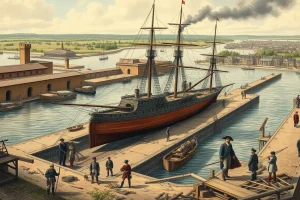
Before 1812, the British Provincial Marine, a small force of armed vessels, was the only naval presence on the Great Lakes. The United States had no significant naval forces there. The outbreak of war prompted both sides to rapidly construct warships using local timber. The Americans established naval yards at Sackets Harbor, New York, on Lake Ontario, and at Presque Isle, Pennsylvania, on Lake Erie. The British relied on existing yards at Kingston and Amherstburg, and later expanded. The strategic importance lay in the lakes as supply routes: an army could not operate far from water, so whoever controlled the lakes could control the movement of troops and supplies.
How It Worked
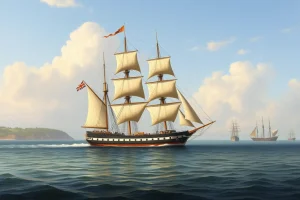
The naval war on the lakes was characterized by small squadrons of sloops, brigs, and schooners, often armed with carronades and long guns. Commanders on both sides faced challenges of logistics, weather, and the constant need to build and repair ships. The Americans under Chauncey prioritized a strong force on Lake Ontario, while Perry’s squadron on Lake Erie was assembled with great speed. Tactics often involved close-quarter battles and amphibious landings. The Royal Navy assumed command from the Provincial Marine in 1813, bringing experienced officers and sailors, but the Americans had superior shipwrights and, at Lake Erie, better gunnery and morale. The arms race on Lake Ontario escalated until the British launched the St. Lawrence, the largest warship ever built on freshwater at that time, which forced the Americans to abandon attempts to gain superiority there.
Competing Viewpoints
American and British leaders held different views on the value and strategy of the lakes. American strategists saw Lake Ontario as the key to invading Upper Canada and securing the northern frontier. They believed that naval control was essential for land operations. British strategists, led by Sir George Prevost and Commodore Yeo, saw the lakes as a defensive barrier protecting Canada. They aimed to maintain control of at least one of the lakes to prevent an American invasion. There was also debate within each side about resource allocation: the Americans had to balance naval forces on the ocean with those on the lakes, and the British, after Napoleon’s defeat in 1814, could send reinforcements but also faced logistical limits. Indigenous allies, particularly Tecumseh’s confederacy, saw the war as an opportunity to resist American expansion, and their collaboration with the British was vital, especially on the upper lakes.
Role in the War of 1812
The naval war on the Great Lakes was crucial to the overall conflict. The American victory at Lake Erie in 1813 directly led to the recovery of Detroit, the Battle of the Thames, and the death of Tecumseh, which broke the Indigenous confederacy. This secured the American northwest frontier and allowed American forces to concentrate on other fronts. The struggle on Lake Ontario, while indecisive, occupied significant resources and prevented a decisive American invasion of Canada. In 1814, the British attempt to launch an invasion from Canada was hindered by the American naval presence, and the eventual failure to gain control of the lakes contributed to the strategic standoff that led to the Treaty of Ghent. The lakes also served as staging areas for amphibious operations, such as the capture of York, which had symbolic and material consequences.
Consequences and Historical Interpretation
The immediate consequence was a change in territorial control and military posture. After the war, the Rush-Bagot Treaty of 1818 limited each side to one armed vessel each on Lake Ontario and Lake Champlain, and the lakes gradually became a demilitarized border. Historians have interpreted the naval war as a demonstration of the importance of naval power in a North American context. The American victory at Lake Erie is often celebrated as a decisive moment, while the arms race on Lake Ontario is seen as a warning about the costs of military competition. The role of Indigenous peoples, who fought for their own survival, is increasingly recognized in modern scholarship. The long-term interpretation sees the demilitarization as a foundation for peaceful relations between the United States and British North America, later Canada.
Primary Sources
Primary sources include official reports, letters, and ship logs. Oliver Hazard Perry’s dispatch to Secretary of the Navy William Jones after the Battle of Lake Erie, written on September 10, 1813, provides a detailed account of the action and is preserved in the National Archives. Commodore Isaac Chauncey’s extensive correspondence with the Navy Department details the shipbuilding and operations on Lake Ontario. British sources include the reports of Commodore Yeo and the logs of HMS St. Lawrence. The Naval War of 1812: A Documentary History, edited by William S. Dudley and Michael J. Crawford, compiles many of these documents and is available from the Naval Historical Center. Another useful source is the memoir of Surgeon’s Mate Usher Parsons, who served with Perry and left a vivid narrative. Each source must be evaluated for its author’s perspective and purpose, but together they reveal the challenges and achievements of the naval war on the Great Lakes.
Further Reading
- Roosevelt, Theodore. The Naval War of 1812. New York: G.P. Putnam’s Sons, 1882.
- Dudley, William S., and Michael J. Crawford, eds. The Naval War of 1812: A Documentary History. 3 vols. Washington, DC: Naval Historical Center, 1985–2002.
- Gough, Barry M. “War on the Lakes in the War of 1812.” The Canadian Encyclopedia, 2011.
- American Battlefield Trust. “The Great Lakes in the War of 1812.”
- Malcomson, Robert. Lords of the Lake: The Naval War on Lake Ontario, 1812–1814. Toronto: Robin Brass Studio, 1998.
References
- Gough, Barry M. “War on the Lakes in the War of 1812.” The Canadian Encyclopedia, 2011. https://thecanadianencyclopedia.ca/en/article/war-on-the-lakes-in-the-war-of-1812.
- American Battlefield Trust. “The Great Lakes in the War of 1812.” https://www.battlefields.org/learn/articles/great-lakes-war-1812.
- Dudley, William S., and Michael J. Crawford, eds. The Naval War of 1812: A Documentary History. Vol. 2 (1813). Washington, DC: Naval Historical Center, 1992.
- Crawford, Michael J., ed. The Naval War of 1812: A Documentary History. Vol. 3 (1814–1815). Washington, DC: Naval Historical Center, 2002.
- Roosevelt, Theodore. The Naval War of 1812. New York: G.P. Putnam’s Sons, 1882.
FAQ
Why were the Great Lakes strategically important in the War of 1812?
The Great Lakes provided the most efficient transportation routes for moving troops and supplies through the frontier. Controlling them allowed a nation to invade and defend territory, making them essential to military operations in the northwest.
What was the largest warship on the Great Lakes during the war?
The HMS St. Lawrence, a 112-gun ship of the line launched by the British on Lake Ontario in September 1814, was the largest. It effectively ended the American challenge on that lake.
How did the naval war on the Great Lakes affect the outcome of the War of 1812?
The American victory at Lake Erie in 1813 secured the Old Northwest and enabled the recapture of Detroit and the Battle of the Thames. This helped maintain American morale and contributed to a stalemate that led to the Treaty of Ghent. The eventual demilitarization of the lakes via the Rush-Bagot Treaty promoted long-term peace.


Leave a Reply