
Short Answer
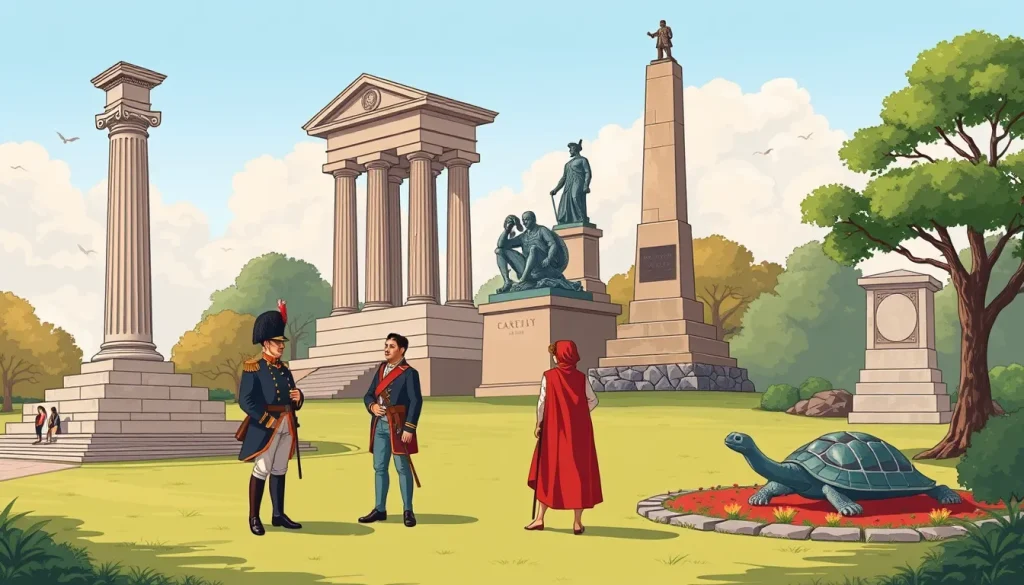
War of 1812 monuments and memorials are physical structures erected to commemorate the people, battles, and events of the conflict that raged between the United States, Great Britain, and their allies from 1812 to 1815. Spanning the United States and Canada, these memorials range from towering columns and bronze statues to intimate plaques and landscape gardens. They are culturally significant because they reveal how different nations and Indigenous communities have remembered a war that shaped borders, identities, and collective memories.
Historical Context
The War of 1812 was fought along the North American frontier, involving American, British, Canadian, and Indigenous forces. It ended without clear victory, but participants on all sides claimed moral or territorial gains. In the decades that followed, nationalist narratives emerged: Americans celebrated the defense of national sovereignty, Canadians viewed the war as a successful defense against invasion that helped forge a distinct identity, and Indigenous peoples recalled their vital role as allies and the subsequent loss of homelands. These narratives drove the creation of monuments, beginning in the 1820s and continuing into the modern era, often timed to anniversaries such as the centennial and bicentennial.
What Happened
Memorialization began soon after the war. The first major monument was erected to honor Major-General Sir Isaac Brock, killed at the Battle of Queenston Heights on October 13, 1812. The Parliament of Upper Canada voted funds in 1814, and a first column was constructed by 1827; after being damaged by a bomb in 1840, a second, taller monument was completed in 1859. In the United States, the Battle of Lake Erie inspired Perry’s Victory and International Peace Memorial, a 352-foot Doric column built between 1912 and 1915 on South Bass Island, Ohio, containing the remains of American and British officers. In Canada, the government unveiled the War of 1812 Monument, Triumph Through Diversity, on Parliament Hill in Ottawa, in 2014, recognizing the participation of diverse groups. The Landscape of Nations Memorial, dedicated in 2015 at Queenston Heights Park, specifically honors Haudenosaunee and Indigenous allies, marking a shift toward acknowledging Indigenous contributions. Other memorials include battlefield markers, cemeteries, and plaques at Forts, such as Fort McHenry and Châteauguay.
Why It Matters
These monuments are more than stone and bronze; they are cultural artifacts that shape public memory. They can unify nations or perpetuate controversies, as seen in debates over which figures and events deserve honor. For Canadians, memorials like Brock’s Monument became symbols of resistance and national formation. For Americans, Perry’s Victory celebrated a decisive naval triumph and later an international peace. Indigenous memorials, such as the Landscape of Nations, address historical erasure and affirm the centrality of First Nations to the conflict’s outcome. Monument placement, design, and inscriptions reveal how each generation interpreted the war, making them primary sources for historians studying collective memory.
Definition
War of 1812 monuments and memorials are enduring physical structures—statues, columns, obelisks, plaques, and built landscapes—that serve to commemorate the conflict, its participants, or its significance. They may be state-sponsored, community-funded, or individual tributes, and they exist in various forms, from grand national monuments to local battlefield markers.
Background
The practice of erecting monuments to the War of 1812 began with the death of military leaders like Brock and the growing national consciousness in the post-war era. In the United Kingdom, the conflict was a footnote to the Napoleonic Wars, but in North America it became central to national stories. Early monuments were often constructed through public subscription and legislative grants, reflecting strong local sentiment. The centennial (1911-1915) saw a wave of commemoration, including Perry’s Victory, while the bicentennial (2012-2015) prompted new monuments, particularly highlighting diversity and Indigenous participation.
How It Worked
Monument creation involved a complex process: selecting a site, often a battlefield or place of death; raising funds from governments, veterans, or the public; and commissioning designers and sculptors. Inscriptions were carefully worded to convey specific messages. For example, Brock’s Monument was designed as a Tuscan column by engineer Francis Hall, and later the Neoclassical design by William Thomas emphasized strength and mourning. Perry’s Victory was designed as a Doric column, symbolizing military order, and later renamed to emphasize peace. The War of 1812 Monument in Ottawa used granite and bronze figures to depict combatants in a circle, intended to show unity. Recent monuments integrate landscape elements, like the Turtle and Tree of Peace at the Landscape of Nations, which draw from Haudenosaunee cosmology.
Competing Viewpoints
Different national and cultural groups have held competing views on who and what to commemorate. Canadians often emphasized loyalty to the Crown and the defense of the homeland, celebrating British and local militia heroes; Americans highlighted naval victories and national sovereignty; Indigenous peoples remember the war as an alliance but also as a turning point after which their lands were increasingly lost. In contemporary times, debates have surfaced over the appropriate representation of Indigenous fighters—as noble allies or as victims—and over the inclusion of women and civilians. The War of 1812 Monument in Ottawa was specifically designed to depict diversity, yet some critics argue it still centers a military narrative, while the Landscape of Nations Memorial seeks to correct that by foregrounding Indigenous perspectives and a peace ceremony of 1815.
Role in the War of 1812
The war itself played a direct role in creating the events and heroes later honored by monuments. Battles such as Queenston Heights, Lake Erie, and Châteauguay became iconic because they were fought to protect territorial claims or national honor. Without these engagements, there would be no monuments. The war also produced enduring figures like Brock, Lieutenant Colonel Macdonell, Perry, and Tecumseh, whose actions were later immortalized. Monuments thus function as historical markers that anchor the war’s narrative to physical places, influencing how subsequent generations understand the conflict’s causes and results.
Consequences and Historical Interpretation
The construction and interpretation of War of 1812 monuments have had lasting consequences for historical memory and public education. They contribute to national identity, as seen in Canada’s 200th anniversary celebrations, which emphasized unity and diversity. They also provide tangible sites for pilgrimage and reflection. Historians now interpret these monuments not merely as tributes but as evidence of shifting attitudes: early monuments glorified military leaders, while later ones acknowledge social complexity. The bicentennial prompted critical reassessments, with some urging recognition of the war’s impact on Indigenous communities. Contemporary scholarship emphasizes that memorials are not neutral objects but cultural statements that reveal the values and conflicts of their eras.
Primary Sources
Primary sources for the study of War of 1812 monuments include the design plans, fundraising records, and contemporary newspaper reports of monument dedications. For Brock’s Monument, the journals of the monument committee and the correspondence of the architect William Thomas are invaluable. For Perry’s Victory, the National Park Service archives hold construction records and historical photographs. The Veterans Affairs Canada website provides official descriptions and inscriptions of the War of 1812 Monument and Brock’s Monument. The Landscape of Nations Memorial has published materials and a dedicated website. These sources help scholars analyze the intentions, funding, and public reception of the monuments, but they must be read critically since they often reflect official narratives.
Further Reading
- James H. Marsh and Elaine Young, “Brock’s Monument, Queenston Heights,” The Canadian Encyclopedia, 2011 (revised 2016).
- National Park Service, “Perry’s Victory and International Peace Memorial,” U.S. Department of the Interior, n.d.
- Veterans Affairs Canada, “War of 1812 Monument, Triumph Through Diversity,” and “Brock’s Monument.”
- Niagara Parks, “Landscape of Nations Memorial,” n.d.
- Donald R. Hickey, The War of 1812: A Forgotten Conflict, University of Illinois Press, 1989, for general context.
- Alan Taylor, The Civil War of 1812: American Citizens, British Subjects, Irish Rebels, & Indian Warriors, Alfred A. Knopf, 2010, for social and cultural interpretations.
References
- Veterans Affairs Canada. “War of 1812 Monument, Triumph Through Diversity.” Accessed May 24, 2025. https://www.veterans.gc.ca/en/remembrance/memorials/canada/war-1812-monument-triumph-through-diversity
- Veterans Affairs Canada. “Brock’s Monument.” Accessed May 24, 2025. https://www.veterans.gc.ca/en/remembrance/memorials/national-inventory-canadian-memorials/details/5513
- Niagara Parks. “Landscape of Nations Memorial.” Accessed May 24, 2025. https://www.niagaraparks.com/visit/heritage/landscape-of-nations-memorial/
- National Park Service. “Perry’s Victory and International Peace Memorial.” Accessed May 24, 2025. https://nps.gov/places/perry-s-victory.htm
- Marsh, James H., and Elaine Young. “Brock’s Monument, Queenston Heights.” The Canadian Encyclopedia. Last edited January 14, 2016. https://thecanadianencyclopedia.ca/en/article/brocks-monument-queenston-heights
FAQ
What is the most well-known War of 1812 monument in Canada?
Brock's Monument, located in Queenston Heights, Ontario, is the most famous Canadian monument. It honors Major-General Sir Isaac Brock, who died at the Battle of Queenston Heights in 1812. The current 56-meter Neoclassical column, completed in 1859, is a federal heritage site.
Why was Perry's Victory Memorial built as an international peace memorial?
Perry's Victory and International Peace Memorial was constructed between 1912 and 1915 to honor those who fought in the Battle of Lake Erie and to commemorate the lasting peace among the United States, Britain, and Canada. It is the only international peace memorial in the U.S. National Park System.
How does the Landscape of Nations Memorial address Indigenous involvement in the War of 1812?
The Landscape of Nations Memorial, dedicated in 2015, explicitly recognizes the contributions of the Haudenosaunee Confederacy and Indigenous allies. It includes symbols from Haudenosaunee culture, such as the Turtle and the Tree of Peace, and commemorates the 1815 peace ceremony that restored harmony among First Nations who had faced each other during the war.



Leave a Reply