Short Answer
The American invasion of Canada in 1812 was a series of military operations launched by the United States against British North America, specifically Upper and Lower Canada, during the first year of the War of 1812. Believing that Canada would fall quickly, the Madison administration planned a three-pronged attack, but the invasions ended in disastrous defeats for the Americans, including the surrender of Detroit and the repulse at Queenston Heights. The campaign solidified British control over Canada and forced the United States to rethink its strategy for the remainder of the war.
Historical Context
The War of 1812 had its origins in the broader Napoleonic conflict between Great Britain and France. Britain’s blockade of Europe and its practice of impressing American sailors into the Royal Navy created intense American resentment. Additionally, many westerners blamed British support for Indigenous resistance against American expansion. When diplomatic efforts failed, President James Madison called for war in June 1812. Many Americans, including prominent war hawks like Henry Clay, believed that conquering Canada would be a simple matter. Thomas Jefferson famously wrote that the acquisition of Quebec would be a “mere matter of marching.” Canada was defended by only a small British regular force, supported by Canadian militia and Indigenous allies, and American planners assumed that the population would welcome liberation from British rule.
What Happened
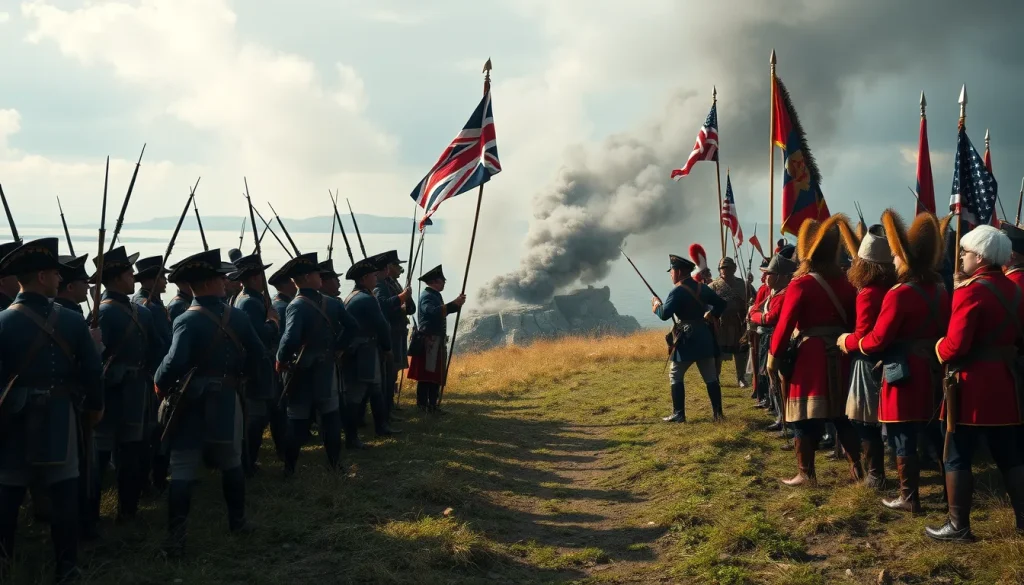
The American invasion plan involved three main thrusts. The most western attack was led by Brigadier General William Hull, who crossed the Detroit River into Upper Canada on July 12, 1812, and issued a proclamation promising liberation. However, after learning of the fall of Fort Michilimackinac to the British and facing supply threats from Tecumseh’s warriors, Hull withdrew to Fort Detroit. British major general Isaac Brock and Tecumseh forced Hull to surrender the fort and his entire army on August 16, 1812, without a major battle. In the east, Major General Stephen Van Rensselaer’s militia forces attacked Queenston Heights on October 13, 1812. Although American troops briefly captured the heights, they were defeated when New York militia refused to cross the Niagara River, and British reinforcements counterattacked. The third thrust, led by Major General Henry Dearborn, advanced from Plattsburgh, New York, toward Montreal in November 1812, but his militia also refused to fight outside U.S. territory, and the expedition collapsed without entering Canada.
Why It Matters
The failure of the 1812 invasion had immediate and long-lasting consequences. It shattered American confidence and exposed the unpreparedness of the U.S. Army and militia. The surrender of Detroit was a national humiliation, and the British maintained control of Canada for the rest of the war. For Canadians, the successful repulse of American invasions fostered a sense of identity and loyalty to the Crown, often credited to the efforts of local militia and British regulars. For Indigenous peoples, the alliance with Britain raised hopes of halting American expansion, but these hopes were later dashed after the war. The campaign set the stage for more serious American efforts in 1813 and 1814, but the British retained the strategic initiative in Canada.
Prelude
In the months before the declaration of war, American leaders debated strategy. Secretary of War William Eustis and other officials believed that Canada, with its population of about 500,000, could be easily conquered by the United States, which had roughly 7.7 million people. The U.S. Army, however, numbered only about 12,000 men, many of them raw recruits and inefficient officers. The regular army was supplemented by state militias, which often refused to serve beyond the borders of their states. The British, although outnumbered, were better organized and had the support of Canadian militia and Indigenous allies, including Tecumseh’s confederacy. The British also controlled the Great Lakes, giving them superior mobility for defense.
Forces and Commanders
American forces were organized into three commands. In the west, Brigadier General William Hull commanded about 2,000 men, mostly Ohio militia and regulars. In the Niagara region, Major General Stephen Van Rensselaer, a political appointee, led a mixed force of regulars and militia. In the north, Major General Henry Dearborn commanded a large force near Lake Champlain, intended to strike Montreal. British forces in Upper Canada were commanded by Major General Isaac Brock, who had only about 1,600 regulars, supplemented by local militia and Indigenous warriors led by Tecumseh. Brock’s leadership and aggressive tactics were pivotal in defending Canada.
Battlefield and Map Context
The invasion took place across the frontier separating the United States from British North America. The western campaign centered on the Detroit River, where Fort Detroit faced Fort Malden (Amherstburg) in Canada. The Niagara campaign focused on the Niagara River, with Fort Niagara on the American side and Fort George and Fort Erie on the Canadian side. The northern campaign aimed at Montreal through the Lake Champlain corridor, with Plattsburgh, New York, as the staging point. These waterways and portages were crucial for moving troops and supplies.
Battle Chronology
- July 12, 1812: Hull’s forces cross the Detroit River and occupy Sandwich (now Windsor), Ontario.
- July 17: British and Indigenous forces capture Fort Michilimackinac, a key American outpost.
- August 15: After learning of British reinforcements and fearing a massacre by Tecumseh’s warriors, Hull orders the evacuation of Sandwich.
- August 16: Brock and Tecumseh arrive at Amherstburg; Brock sends a bluffing message demanding surrender; Hull, fearing atrocities, surrenders Fort Detroit and his entire army.
- October 13: Van Rensselaer’s invasion at Queenston Heights; initial American success, but militia refusal leads to defeat; Brock is killed during the battle.
- November 20-29: Dearborn’s advance toward Montreal stalls; militia refuse to cross the border; the campaign collapses.
Casualties and Losses
At Detroit, the Americans lost about 2,500 men captured, along with 35 cannons and military stores. The British suffered no combat casualties. At Queenston Heights, American losses were around 300 killed and wounded, and nearly 1,000 captured. British and Canadian losses were about 100 killed and wounded. At the northern front, there were no major engagements, but the expedition’s failure brought no casualties. Overall, the 1812 invasion resulted in over 3,000 American prisoners and a significant blow to morale.
Result
The American invasion of Canada in 1812 ended in total failure. All three invasion attempts were repulsed or collapsed due to lack of leadership, militia unwillingness, and British and Indigenous resilience. The United States not only failed to capture any territory but also lost Fort Detroit and Fort Michilimackinac, giving the British control of the Northwest. The British retained all of Canada, and the threat of invasion was, at least temporarily, removed.
Strategic Consequences
The strategic consequences were profound. The Americans were forced to rebuild their army and leadership. The surrender at Detroit and the militia failures at Queenston led to a change in command, with more capable officers like William Henry Harrison taking over the Northwest. The British, emboldened by their success, expanded offensive operations, including the capture of Fort Harrison and raids into American territory. For Canada, the defense of 1812 became a founding myth, emphasizing the contribution of Canadian militia and Indigenous allies. However, the war also intensified the loss of Indigenous lands and power after the conflict.
Primary Accounts
Several contemporary documents illuminate the campaign. Hull’s July 12, 1812, proclamation to Canadians promised liberation and protection, revealing American expectations. Brock’s letters and orders, particularly his correspondence with Hull demanding surrender, demonstrate his calculated use of intimidation. The American militia’s refusal to cross the border is documented in court-martial records and diaries. Indigenous perspectives, though less well recorded, are present in British officers’ reports of Tecumseh’s strategies. These sources must be read with awareness of their national biases.
Battlefield Today
Many sites associated with the 1812 invasion are preserved. Fort Detroit, now in Detroit, Michigan, is not fully intact, but Fort Malden in Amherstburg, Ontario, is a National Historic Site. Queenston Heights, in Ontario, features a monument commemorating General Brock’s death and is managed by Parks Canada. The Niagara Parkway includes plaques and markers. Plattsburgh, New York, hosts a War of 1812 museum. These sites allow visitors to explore the geography of the campaign.
Primary Sources
Key primary sources include William Hull’s proclamation issued on July 12, 1812, and his subsequent court-martial proceedings. Isaac Brock’s dispatches to Governor General George Prevost chronicle British strategy and his victory at Detroit. The diary of Captain John Le Couteur, a British officer at Quebec, provides insight into the campaign. On the American side, the Memoirs of William Hull, published in 1824, defend his actions. These documents are available through archives such as the National Archives of Canada and the Library of Congress.
Further Reading
- Berton, Pierre. The Invasion of Canada, 1812-1813 (McClelland and Stewart, 1980).
- Hickey, Donald R. The War of 1812: A Forgotten Conflict (University of Illinois Press, 1989).
- Grodzinski, John R. Defender of Canada: Sir George Prevost and the War of 1812 (University of Oklahoma Press, 2013).
- Rauch, Steven J. The Campaign of 1812 (U.S. Army Center of Military History, 2013).
References
- Heidler, Jeanne T. “War of 1812 – US-Britain, Causes, Outcome.” Britannica, 2 Aug. 2026, www.britannica.com/event/War-of-1812/War.
- Rauch, Steven J. The Campaign of 1812. U.S. Army Center of Military History, 2013, history.army.mil/Portals/143/Images/Publications/Publication%20By%20Title%20Images/C%20Pdf/CMH_Pub_74-2.pdf.
- “Chapter 6: The War of 1812.” American Military History, U.S. Army Center of Military History, history.army.mil/books/AMH/AMH-06.htm.
- Marsh, James H., Pierre Berton, and Tabitha de Bruin. “War of 1812.” The Canadian Encyclopedia, 16 July 2026, thecanadianencyclopedia.ca/en/article/war-of-1812.
- Greenspan, Jesse. “How U.S. Forces Failed to Conquer Canada in War of 1812.” HISTORY, 12 July 2012, www.history.com/articles/how-u-s-forces-failed-to-conquer-canada-200-years-ago.
FAQ
Why did the United States invade Canada in 1812?
The U.S. sought to pressure Britain by seizing Canada, which was lightly defended and seen as an easy conquest. American leaders also aimed to remove British influence over Indigenous peoples and satisfy expansionist desires.
What were the main reasons for the failure of the invasion?
Major factors included American military unpreparedness, incompetent or hesitant commanders, the refusal of state militias to cross the border, and the effective defense led by Isaac Brock and Tecumseh, combined with British control of the Great Lakes.
What was the significance of the surrender of Detroit?
The surrender of Fort Detroit and its entire army on August 16, 1812, was a devastating American defeat that gave the British control of the Michigan Territory and demoralized the U.S., while boosting Canadian confidence.



Leave a Reply