
Short Answer
The race to build warships on the Great Lakes during the War of 1812 was an intense naval construction competition between the United States and Great Britain for control of Lake Ontario and Lake Erie. Stretching from late 1812 to 1815, both sides poured enormous resources into building increasingly powerful vessels at remote shipyards, culminating in ships like HMS St. Lawrence and the unfinished American ship-of-the-line New Orleans. This contest decisively shaped the war’s northern theater, influencing military strategy and leading directly to the postwar Rush-Bagot Agreement that limited naval armaments on the lakes.
Historical Context
The Great Lakes and the St. Lawrence River formed the principal invasion corridor between British Canada and the United States. Control of these waterways was essential for moving troops, supplies, and artillery through a largely roadless wilderness. At the outbreak of the War of 1812, both belligerents maintained only a handful of small armed vessels on the lakes, mostly converted merchant schooners. As the war progressed, each side recognized that naval supremacy would decide the fate of Upper Canada and the American frontier. American strategy aimed at conquering Canada, while the British sought to defend their colonies and cut American supply lines. The race began almost immediately after the declaration of war, as both nations scrambled to assemble fleets capable of controlling these vital waters.
What Happened
The American naval effort centered at Sackets Harbor on Lake Ontario and at Presque Isle (present-day Erie, Pennsylvania) on Lake Erie. Commodore Isaac Chauncey arrived at Sackets Harbor in October 1812 and found a handful of small vessels. He initiated an aggressive building program, with shipwrights like Henry Eckford and the Brown brothers (Noah and Adam) overseeing rapid construction. On Lake Erie, Daniel Dobbins and later Noah Brown built Perry’s fleet at Presque Isle in 1813, assembling a squadron that defeated the British at the Battle of Lake Erie in September 1813.
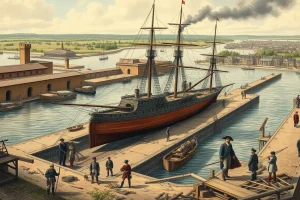
On Lake Ontario, the race escalated dramatically. The British built at Kingston under Sir James Lucas Yeo, who took command in May 1813. The two fleets skirmished indecisively in 1813, including the “Burlington Races” on September 28, but neither commander risked a fleet action. By 1814, both sides launched larger vessels: the Americans commissioned USS Superior (62 guns) and USS Mohawk (42 guns), while the British built HMS St. Lawrence, a 112-gun ship-of-the-line launched at Kingston in September 1814—the largest warship ever built on the Great Lakes. The American response, two massive 120-gun ships-of-the-line (New Orleans and Chippewa) under construction at Sackets Harbor, were never completed. The war ended before any decisive engagement occurred on Lake Ontario.
Why It Matters
The warship race had immediate and lasting consequences. It consumed vast amounts of timber, labor, and money on both sides, but also prevented a decisive naval battle that might have altered the outcome of the war. The American victories on Lake Erie in 1813 and at Plattsburgh on Lake Champlain in 1814 were enabled by successful shipbuilding efforts, while the standoff on Lake Ontario allowed the British to maintain a foothold in Upper Canada. In the long term, the race convinced both governments of the need for mutual naval disarmament on the Great Lakes, leading to the Rush-Bagot Agreement of 1817, which remains in effect (with modifications) today. Historians debate whether the enormous expenditure was strategically necessary or a wasteful arms race, but they agree it was one of the most extraordinary naval construction efforts of the conflict.
Definition
The Great Lakes warship race refers to the rapid and escalating construction of warships by the United States and Great Britain on Lakes Ontario, Erie, and Champlain during the War of 1812. It involved building vessels from scratch at frontier shipyards, often using green timber, in response to the other side’s latest ship. The race was characterized by a cycle of over-matching and counter-building, leading to progressively larger and more powerful warships.
Background
At the start of the war, both nations had only a few small armed vessels on the lakes. The United States was initially caught unprepared, while the British had a slight advantage through the Provincial Marine and the support of the Royal Navy. However, the strategic importance of the lakes was paramount: whoever controlled Lake Ontario controlled the route to the Niagara frontier and the supply line to Upper Canada. Similarly, Lake Erie was the gateway to the Old Northwest. Both sides quickly realized that building warships locally was faster and more practical than transporting ships from the coast overland.
How It Worked
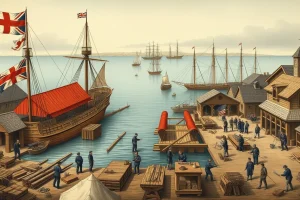
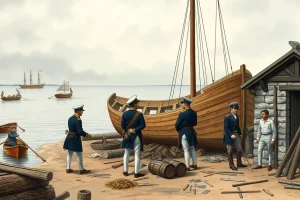
Shipbuilding on the Great Lakes was a race against time and weather. Timber was cut from surrounding forests and hauled to shipyards at Sackets Harbor, Kingston, Presque Isle, and other locations. Shipwrights—many with no formal naval training—employed innovative methods to build hulls quickly. For example, Noah Brown completed Perry’s brigs at Presque Isle in just a few months in 1813. Crews worked through winters, often in snow and freezing conditions, to launch ships by spring. Guns, sails, and rigging had to be transported overland from the coast, and skilled labor was scarce. The result was a series of hastily built but often seaworthy warships, ranging from small schooners to first-rate ships-of-the-line.
Competing Viewpoints
American and British commanders held different perspectives on how to conduct the naval war. Commodore Isaac Chauncey and Sir James Lucas Yeo were both cautious, preferring to preserve their fleets rather than risk a decisive engagement. Chauncey argued that naval superiority was essential for supporting military operations and that building a superior fleet was the surest way to achieve it. Yeo, for his part, saw defensive building as necessary to protect Kingston and the St. Lawrence supply line. Later historians have criticized both for excessive timidity, pointing to the aggressive actions of Oliver Hazard Perry on Lake Erie as proof that decisive battle was possible. However, the stakes were high: loss of a fleet could mean loss of the entire theater. The race itself reflected the conviction among officials on both sides that controlling the lakes was worth the enormous cost.
Role in the War of 1812
The warship race directly influenced military operations. American naval victories on Lake Erie and Lake Champlain in 1813 and 1814 secured those lakes and enabled offensive operations. On Lake Ontario, the stalemate prevented either side from mounting a decisive invasion of the other’s territory. The British use of HMS St. Lawrence in 1814 effectively gave them control of the lake, but the ship was never engaged in a major battle. The race also drove the strategic decisions of commanders like General George Prevost and Secretary of War John Armstrong, who deferred operations until naval superiority was achieved. In this way, the race shaped the pace and course of the war in the north.
Consequences and Historical Interpretation
The immediate consequence of the race was a strategic stalemate on the Great Lakes, with no decisive engagement on Lake Ontario. The enormous ships built—especially HMS St. Lawrence and the American ships-of-the-line—represented the extraordinary efforts of both nations. After the war, the cost and risk of the race contributed to the Rush-Bagot Agreement, which limited naval forces on the lakes to small patrol vessels. Historians have interpreted the race as a classic example of an arms race driven by mutual distrust and strategic necessity. Some argue it drained resources that could have been used elsewhere, while others contend it preserved the balance of power and prevented a disastrous defeat. The unfinished American ships were eventually dismantled, and HMS St. Lawrence rotted at its moorings, symbolizing the fleeting nature of wartime efforts.
Primary Sources
Key primary sources include the official correspondence of Commodore Isaac Chauncey, such as his letter to Secretary of the Navy Benjamin Crowninshield on March 26, 1815, which discusses the completion of the large ships and is held in the Isaac Chauncey Papers at the University of Michigan’s Clements Library. Daniel Dobbins’s letters and papers, preserved by the Buffalo Historical Society, provide detailed accounts of the building of Perry’s fleet at Presque Isle. British sources include the orders and reports of Commodore Sir James Lucas Yeo and the Admiralty records. Contemporary maps, such as Patrick May’s 1815 “A Map of Sacketts Harbour with Explanatory Notes,” and newspaper accounts also offer insights. These sources, however, often reflect the biases and perspectives of the officers involved, particularly their desire to justify their own decisions.
Further Reading
- Hickey, Donald R. The War of 1812: A Forgotten Conflict. University of Illinois Press, 1989.
- Lambert, Andrew. The Challenge: Britain Against America in the Naval War of 1812. Faber and Faber, 2012.
- Latimer, Jon. 1812: War with America. Harvard University Press, 2007.
- Stagg, J.C.A. The War of 1812: Conflict for a Continent. Cambridge University Press, 2012.
- Berton, Pierre. The Invasion of Canada. McClelland and Stewart, 1980.
References
- Clements Library, University of Michigan. “Case 9: Ontario and Champlain.” War of 1812 Bicentennial Exhibition. Accessed 2023. https://clements.umich.edu/exhibit/the-war-of-1812/case-9/
- Gluntz, Marvin H. “Naval Construction on the Great Lakes.” Proceedings 83/2 (February 1957). U.S. Naval Institute. https://www.usni.org/magazines/proceedings/1957/february/naval-construction-great-lakes
- Prom, William J. “The Brothers Brown.” Naval History Magazine 36, no. 1 (February 2022). U.S. Naval Institute. https://www.usni.org/magazines/naval-history-magazine/2022/february/brothers-brown
- Palmer, Richard. “The Great Warship That Waited and Waited.” Thousand Islands Life Magazine, November 13, 2015. https://tilife.org/BackIssues/Archive/tabid/393/articleType/ArticleView/articleId/1840/The-Great-Warship-That-Waited-and-Waited.html
- “The Lake Ontario Arms Race – War of 1812.” The War of 1812 Website. https://thewarof1812.org/battles/the-lake-ontario-arms-race/
FAQ
Which side won the warship race on the Great Lakes?
No clear winner emerged. On Lake Ontario, the British gained temporary superiority with HMS St. Lawrence, but the war ended before any decisive naval engagement. On Lake Erie, the Americans won the decisive Battle of Lake Erie. The race ultimately ended in a strategic stalemate and was followed by disarmament.
What was the largest warship built on the Great Lakes?
HMS St. Lawrence, launched at Kingston in September 1814, was a 112-gun ship-of-the-line and was the largest warship ever built on the Great Lakes. It was even larger than Nelson's HMS Victory.
Why did neither side risk a fleet battle on Lake Ontario?
Both commanders, Isaac Chauncey and James Lucas Yeo, were cautious because the loss of their fleet would be catastrophic for their side's strategic position. Control of Lake Ontario was vital for supply and invasion, so they avoided risking the entire fleet in a single engagement, leading to a building race instead.


Leave a Reply