
Short Answer
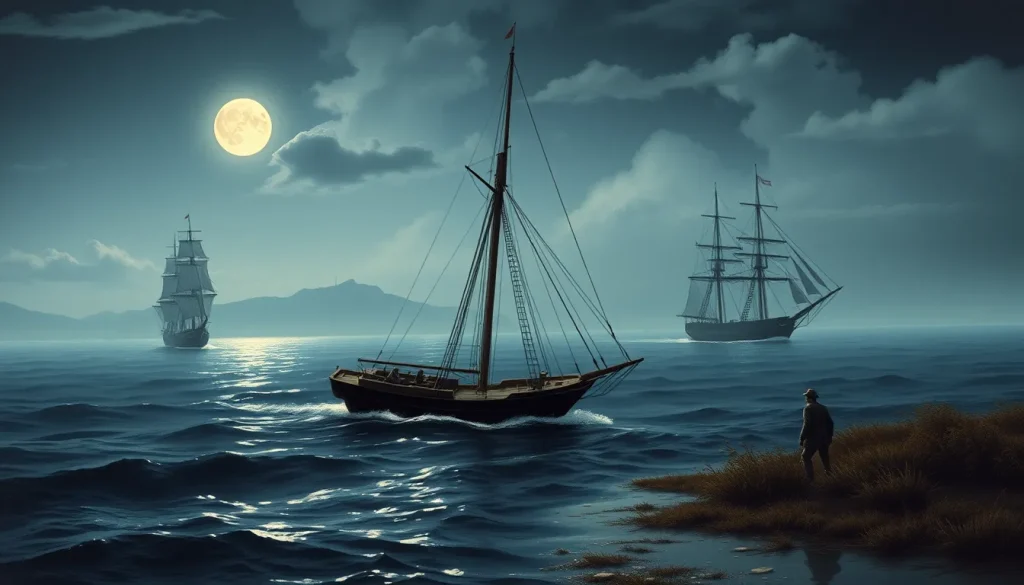
American privateers evaded the British blockade of the United States during the War of 1812 chiefly by running a loose cordon rather than fighting it. They relied on fast, shallow-draft vessels, local pilots, night and foul-weather departures, less-watched inlets, and dispersal into distant cruising grounds. This mattered because privateering allowed the United States to harass British commerce despite the Royal Navy’s overwhelming superiority, though it never broke the blockade itself.
Historical Context
The United States declared war on Britain on June 18, 1812. The Royal Navy was the world’s strongest naval force, with global commitments against Napoleonic France, while the U.S. Navy was small. Congress authorized privateering on June 26, 1812, and President James Madison signed the measure the following day. Under this system, private shipowners received letters of marque and reprisal, which authorized them to capture British merchant vessels and warships as prizes. Prize courts then determined whether a capture was lawful.
Britain’s blockade was not a single wall. It began as a series of cruising squadrons off major American ports, particularly in the Chesapeake and Delaware, and expanded in stages during 1813 and 1814. The blockade aimed to strangle American trade, protect British merchant shipping, and support British land operations. The American coastline, with its many bays, rivers, inlets, and shoals, made complete closure difficult. British warships also had to contend with weather, limited numbers, and distant stations.
What Happened
Within weeks of the declaration of war, privateers sailed from Baltimore, Salem, New York, Charleston, and other ports. The Baltimore schooner Rossie, commanded by Joshua Barney, received a letter of marque dated July 12, 1812, and sailed from Baltimore Harbor. During a roughly 90-day cruise, Rossie captured, sank, or burned 18 British vessels valued at about $1.5 million. Baltimore shipyards, especially those associated with Thomas Kemp, produced fast schooners such as Rossie, Comet, and Chasseur.
Between 1812 and 1815, Congress issued about 1,100 letters of marque. American privateers captured at least 1,200 British merchant vessels, compared with roughly 250 taken by the U.S. Navy. They operated in the West Indies, the Gulf of St. Lawrence, the English Channel, and the Irish Sea. British convoys, escorts, and tightened blockade measures reduced their success later in the war, but privateers continued to sail from smaller ports and less-watched anchorages. African Americans made up an estimated 20 percent of privateer crews, a higher proportion than in the U.S. Navy.
Why It Matters
Privateering imposed real costs on British merchant shipping, raised insurance rates, and forced merchants to demand convoy protection. It also provided the United States with revenue, supplies, and morale during a war marked by military setbacks. Yet it did not lift the blockade, prevent British land operations, or change the overall strategic balance. Historians disagree about its importance. Some treat privateers as an effective private navy that damaged Britain more than the small U.S. Navy could; others argue that privateering diverted sailors and capital from the navy and could not compensate for the blockade’s economic pressure.
For British and Canadian maritime communities, privateers represented legalized plunder and a threat to trade. Prize cases in Halifax and other courts became part of the wartime experience. In the longer term, privateering declined as navies professionalized, and the 1856 Paris Declaration abolished it among major powers, though the United States did not initially agree. Historical memory has often romanticized privateers, but their evasion of the blockade rested on practical advantages in speed, geography, and timing rather than on defeating the Royal Navy.
Definition
Evading the British blockade meant getting past or around Royal Navy squadrons that patrolled off American ports, then avoiding capture while cruising against British commerce. It was not a single tactic or a formal naval operation. It included escaping from blockaded harbors, using coastal geography, and choosing routes and timing that minimized contact with British warships. It is related to, but distinct from, blockade running by merchant vessels carrying cargo.
Background
The British blockade developed gradually. In late 1812, Britain declared blockades of the Chesapeake and Delaware; later measures extended restrictions to more ports. The Royal Navy assigned frigates, sloops, and smaller vessels to blockade stations, but it could not station a ship in every channel. Privateering law gave American owners an incentive to take risks: crews and owners shared prize money, while the government collected taxes on prizes. This made privateering an entrepreneurial form of warfare.
How It Worked
Privateers combined several methods to evade the blockade and survive at sea:
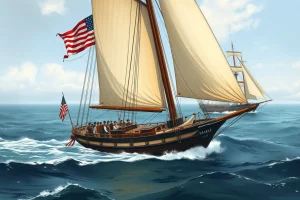
- Vessel design and speed. Baltimore clippers and other fast schooners had sharp hulls, raked masts, and fore-and-aft rigs. They could sail close to the wind and often outrun larger, heavier Royal Navy ships.
- Shallow draft and coastal geography. Privateers could use shoals, rivers, and inlets where blockading frigates dared not follow. Local pilots knew tides, channels, and hidden anchorages.
- Night and weather. Dark nights, fog, rain, and gales gave cover. Blockaders often had to move offshore in heavy weather, opening opportunities to slip out or in.
- Deception. Privateers sometimes flew false or neutral colors, disguised themselves as merchantmen, or altered their appearance. Under the laws of war, false colors were a ruse, but a vessel had to show its true colors before firing.
- Dispersal and avoidance. Once at sea, privateers avoided Royal Navy warships and scattered to distant cruising grounds. They sought merchant prizes rather than battle with blockade squadrons.
- Remote anchorages and neutral ports. Privateers used out-of-the-way coves for water and repairs. Some sought neutral ports for refuge or prize sales, though British pressure and local regulations limited this option.
Competing Viewpoints
American newspapers and privateer owners portrayed the trade as patriotic and legitimate. British officials and merchants often described privateers as pirates or licensed plunderers, especially when crews treated captured ships harshly. Modern historians debate the extent of privateering’s effectiveness. One view stresses that privateers captured far more merchant ships than the U.S. Navy and forced Britain to divert warships to convoy duty. Another view argues that the captures were a nuisance rather than a decisive blow, that privateering drained manpower and capital, and that the British blockade still crippled American commerce. The debate also turns on evidence: American accounts sometimes exaggerated captures, while British records such as Lloyd’s List and prize court files undercount or record only adjudicated cases.
Role in the War of 1812
Privateers served as an auxiliary maritime force throughout the war. Baltimore was the leading center, with more than 120 letters of marque issued to vessels there. Other important ports included Salem, New York, Charleston, and Philadelphia. Notable privateers included Rossie, Chasseur under Thomas Boyle, Comet, and Prince de Neufchatel. Their captures disrupted British trade routes and created diplomatic and legal complications. British convoys and naval patrols became more effective over time, and the tightening blockade made returns to American ports difficult. The Treaty of Ghent, signed in December 1814, ended the war and privateering operations.
Consequences and Historical Interpretation
In the short term, privateering hurt British merchants, raised insurance costs, and gave Americans a sense of success despite defeats on land. Prize money and captured goods helped sustain the war effort. In the long term, privateering’s decline reflected changing international law and the growing dominance of professional navies. Historians generally agree that privateers did not break the British blockade, but they disagree on how much they shortened the war or altered British policy. The evasion of the blockade demonstrated the limits of age-of-sail blockades and the importance of speed, local knowledge, and dispersion in asymmetric naval warfare.
Primary Sources
Key contemporary sources include letters of marque and reprisal issued by the U.S. Department of State, now held in National Archives and Records Administration records; captains’ logs, journals, and correspondence; prize court records in the United States and Halifax; British Admiralty correspondence held by The National Archives (UK); the shipping newspaper Lloyd’s List; and American newspapers such as Niles’ Weekly Register. These sources must be read critically. Official records are selective, newspapers were partisan, Lloyd’s List did not capture every loss, and prize court files survive mainly for successful captures. Paraphrase should be distinguished from direct quotation, and quotations should be used only when a reliable transcription is available.
Further Reading
- American Battlefield Trust, ‘David and Goliath: Privateers vs. the Mighty British Navy.’
- Green, Anthony. ‘The Private Navy of the United States: The Effects of Privateers on the War of 1812.’ MA thesis, James Madison University, 2019.
- Garitee, Jerome R. The Republic’s Private Navy: The American Privateering Business as Practiced by Baltimore During the War of 1812. Wesleyan University Press, 1977.
- Hickey, Donald R. The War of 1812: A Forgotten Conflict. University of Illinois Press, 1989.
- Kert, Faye M. Prize and Prejudice: Privateering and Naval Prize in Atlantic Canada in the War of 1812. International Maritime Economic History Association, 1997.
- Dudley, William S., ed. The Naval War of 1812: A Documentary History. Naval Historical Center, 1985–2002.
References
- American Battlefield Trust, ‘David and Goliath: Privateers vs. the Mighty British Navy,’ https://www.battlefields.org/learn/articles/head-tilting-history/david-and-goliath-privateers-vs-mighty-british-navy.
- Green, Anthony. ‘The Private Navy of the United States: The Effects of Privateers on the War of 1812.’ MA thesis, James Madison University, 2019. https://commons.lib.jmu.edu/master201019/619.
- Garitee, Jerome R. The Republic’s Private Navy: The American Privateering Business as Practiced by Baltimore During the War of 1812. Middletown, CT: Wesleyan University Press, 1977.
- Hickey, Donald R. The War of 1812: A Forgotten Conflict. Urbana: University of Illinois Press, 1989.
- Kert, Faye M. Prize and Prejudice: Privateering and Naval Prize in Atlantic Canada in the War of 1812. St. John’s, Nfld: International Maritime Economic History Association, 1997.
- Dudley, William S., ed. The Naval War of 1812: A Documentary History. Washington, DC: Naval Historical Center, 1985–2002.
FAQ
How did American privateers get past the British blockade?
They exploited gaps in the Royal Navy's cordon, using fast and shallow-draft vessels, local pilots, night and bad weather, less-watched inlets, deceptive flags, and dispersal into distant cruising grounds. They avoided fighting blockade squadrons whenever possible.
Were American privateers legal?
They were legal under the laws of war if they held a valid letter of marque and followed prize law. British officials often called them pirates, but commissioned privateers were generally treated as lawful combatants, though treatment and neutral rights remained contested.
Did privateers break the British blockade?
No. They evaded it often enough to damage British commerce and capture more than 1,200 merchant vessels, but the blockade tightened over time and continued to restrict American trade. Privateering supplemented the U.S. Navy rather than lifting the blockade.

Leave a Reply