
Short Answer
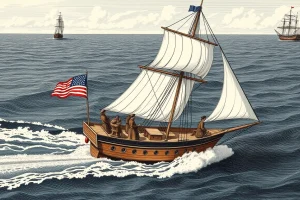
The General Armstrong was an American privateer brig built in New York in 1812 and active in the Atlantic during the War of 1812. Under captains such as Samuel Chester Reid, she captured numerous British merchant ships and fought two notable naval engagements, including a final, celebrated defense against a British squadron in the neutral harbor of Fayal in the Azores in September 1814. Her crew’s resistance delayed the British squadron and became a symbol of American privateering valor, though the ship was ultimately scuttled to avoid capture.
Historical Context
The War of 1812 pitted the United States against Great Britain. With the struggling U.S. Navy heavily outnumbered, the American war effort relied significantly on privateers—privately owned armed vessels commissioned to attack enemy merchant shipping. These ships were issued letters of marque and were expected to operate within the laws of war, targeting trade rather than warships. Privateering offered American shipowners profitable opportunities while disrupting British commerce, which was vital to the British economy. By 1814, American privateers had infested the Atlantic and even approached the British coasts, raising insurance rates and forcing the Royal Navy to divert warships to protect convoys. In this context, the General Armstrong was built to take advantage of the wartime trade.
What Happened
The General Armstrong was constructed at New York by Adam and Noah Brown at the East River yard near Houston Street, and launched in 1812. She was named for Revolutionary War brigadier general John Armstrong, Sr. The ship mounted a powerful main battery, including a long 42-pounder “Long Tom” on a pivot, supported by eight long 9-pounder guns, and carried a crew of about ninety men.
Her first cruise under Captain Tim Barnard in late 1812 produced several captures. On 11 November she took the British ship Queen, a wealthy prize valued at £90,000, though the prize was later wrecked off Nantucket. Two days later she captured the Lucy & Alida, and on 19 November the Sir Sidney Smith. Under Captain Guy Richards Champlin in 1813, the General Armstrong fought a severe action with the British sloop HMS Coquette in the Suriname River in March 1813, sustaining heavy damage and casualties but successfully escaping. Captain Champlin’s log recorded that six men were killed and sixteen wounded during that engagement.
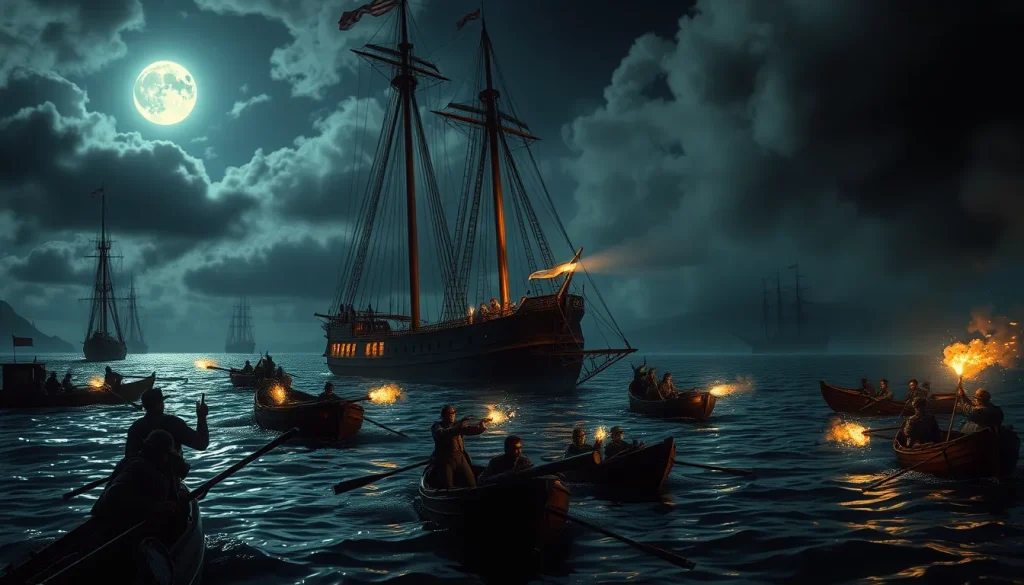
After Captain Samuel Chester Reid took command in 1814, the privateer continued raiding. In January she captured the sloop Resolution and the brig Phoebe. In April she encountered the 18-gun British letter of marque Fanny off the coast of Ireland and took her after an hour-long close-range battle. The Fanny was later recaptured by the British third-rate Sceptre. By late September 1814, the General Armstrong sailed into Fayal in the Azores to take on water, a neutral Portuguese port. On 26 September a British squadron under Captain Robert Lloyd entered the harbor: the 74-gun Plantagenet, the 38-gun frigate Rota, and the 18-gun brig Carnation. Despite the Portuguese neutrality, Lloyd ordered a boat attack on the American privateer. Reid prepared his ship, and the first assault of four boats was repelled with heavy British casualties. A second attack that night involved around twelve boats and about 400 sailors and marines. The American crew, using the pivot gun, small arms, and cutlasses, beat back the boarders. However, with the powerful British squadron blocking escape, Reid ordered the crew to abandon and scuttle the General Armstrong on the morning of 27 September. The Americans went ashore, where Portuguese authorities refused British demands to turn them over. British losses were 36 killed and 93 wounded; American losses were two killed and seven wounded.
Why It Matters
The General Armstrong‘s defense at Fayal became an iconic example of American privateer courage. American writers, painters, and poets celebrated the action, portraying Reid and his men as heroes who stood against overwhelming force. Some contemporaries, including Theodore Roosevelt, promoted the claim that the battle delayed the British squadron’s passage to Jamaica and ultimately to New Orleans, thus helping to save Louisiana from invasion. However, this interpretation is debated; many historians argue that the delay was too short to have affected the outcome of the New Orleans campaign. The engagement also highlighted the tensions between neutral ports and British naval practice. For the Americans, the General Armstrong symbolized the contribution of privateers to the war effort, while the British considered such ships as pirates and legitimate targets regardless of territorial waters. The aftermath of the battle also reinforced Portuguese neutrality and the rights of neutral nations. In broader context, the ship’s career demonstrates the significant role of privateering in American strategy, the dangers of commerce raiding, and the brutality of small-boat naval warfare.
Type and Construction
The General Armstrong was a two-masted brig, likely with a square rig on both masts. She was built in 1812 in New York City by the prominent shipbuilders Adam and Noah Brown, whose yard was located on the East River at the foot of Houston Street. The vessel measured 246 tons burthen and was designed for speed, as was typical of American privateers of the era. Her hull was lightly built and sharp-lined to maximize speed, allowing her to outrun many Royal Navy warships. The ship was adorned with a figurehead depicting Hercules, in reference to the strength of the vessel’s namesake.
Nation
The General Armstrong was an American privateer, sailing under a letter of marque and reprisal issued by the United States. Her homeport was New York City. Privateers were an important component of the U.S. naval effort in the War of 1812, with hundreds of privately armed vessels raiding British commerce.
Armament
According to the most reliable records, the General Armstrong carried eight long 9-pounder guns and one long 42-pounder cannon mounted on a pivot, often referred to as a “Long Tom.” This heavy gun could fire a 42-pound shot and was effective at long range. The lighter 9-pounders were used for broadside fire. Later accounts vary, but this armament matches the ship’s specifications as listed in contemporary sources and secondary histories.
Crew
The ship’s complement numbered about 90 officers and men. This was a typical size for an American privateer of this class. The crew was made up of experienced sailors, often recruited from merchant vessels and the whaling trade. In addition to seamen, the crew included the captain, lieutenants, a sailing master, and often a contingent of marines or armed sailors for boarding actions. The crew was paid from the profits of captured prizes, providing strong incentive for aggressive action.
Commander
The General Armstrong had three captains during her career: Tim Barnard (1812), Guy Richards Champlin (1813–July 1814), and Samuel Chester Reid (July 1814 to September 1814). Both Champlin and Reid were experienced privateers. Champlin was praised for his leadership in the Suriname River action, and Reid became a national hero for his defense at Fayal. Reid later served in the U.S. Navy and is also known for promoting the design of the American flag with 13 stars and stripes, which was adopted in 1818.
Engagements
The General Armstrong participated in several significant actions:
- Capture of the Queen (11 November 1812): The privateer captured the British ship Queen after a fight that killed the enemy captain and nine crewmen. The prize was valued at £90,000 but was wrecked while being brought to the United States.
- Battle of Suriname River (11 March 1813): The General Armstrong encountered the British sloop Coquette and fought a severe close-range action. The American ship was heavily damaged and suffered 6 killed and 16 wounded, but escaped capture.
- Capture of Fanny (19 April 1814): Off Ireland, the privateer fought the British letter of marque Fanny for about an hour at pistol-shot range, forcing the British to strike. The Fanny was later recaptured.
- Battle of Fayal (26–27 September 1814): In the neutral harbor of Fayal, the privateer repelled two British boat attacks from a squadron consisting of a 74-gun ship, a frigate, and a brig. After scuttling the ship, the crew escaped.
Fate
On the morning of 27 September 1814, after repelling the British attacks, Captain Reid determined that the ship could not escape the overwhelming force of the British squadron. He ordered the crew to abandon the General Armstrong and set her on fire. The burning hulk drifted into the harbor and sank, leaving only the hull visible at low tide for some years. The crew made it ashore and received protection from the Portuguese authorities, and eventually returned to the United States.
Primary Sources
Key primary sources include:
- The logbook of Captain Guy Richards Champlin, which records the Suriname River battle and other events. This document is likely held in a private collection or a maritime archive.
- Captain Samuel Reid’s official report of the Battle of Fayal, written shortly after the event. This report was published in American newspapers and is the basis for many later accounts.
- The letter from a British eyewitness on shore at Fayal, quoted in later histories, which describes the aftermath of the battle and British demands.
- British official reports from Captain Robert Lloyd, filed with the Admiralty, which present the British perspective on the engagement.
Further Reading
- Roosevelt, Theodore. The Naval War of 1812 (1882). Contains a detailed account of the General Armstrong‘s defense.
- de Kay, James Tertius. The Battle of Fayal: The Privateer General Armstrong and the British at the Azores (2001). A modern scholarly study.
- Benjamin Armstrong, “A Daring Defense in the Azores,” Naval History magazine, April 2014.
- Rowen, Bob. “American Privateers in the War of 1812,” New York Military Affairs Symposium, 2001.
References
- “General Armstrong.” Wikipedia, accessed 2025. https://en.wikipedia.org/wiki/General_Armstrong
- Benjamin Armstrong, “A Daring Defense in the Azores,” Naval History 28, no. 2 (April 2014). https://www.usni.org/magazines/naval-history-magazine/2014/march/daring-defense-azores
- Bob Rowen, “American Privateers in the War of 1812,” NYMAS, 2001–2006. https://nymas.org/warof1812paper/paperrevised2006.html
- “General Armstrong: the Captain, the Ship, the Battle,” paper on Academia.edu, accessed 2025. https://www.academia.edu/19507033/General_Armstrong_the_Captain_the_Ship_the_Battle
FAQ
What was the General Armstrong?
The General Armstrong was an American privateer brig built in New York in 1812, active in the Atlantic during the War of 1812.
How did the General Armstrong fight at Fayal?
On September 26-27, 1814, the privateer was attacked by British boats from a squadron. Her crew repelled the attacks, and the ship was scuttled to avoid capture.
Did the General Armstrong help save New Orleans?
Some accounts, notably by Theodore Roosevelt, claimed that the delay caused by the battle helped save New Orleans, but this is debated and most historians consider it a minor factor.
Leave a Reply