
Short Answer
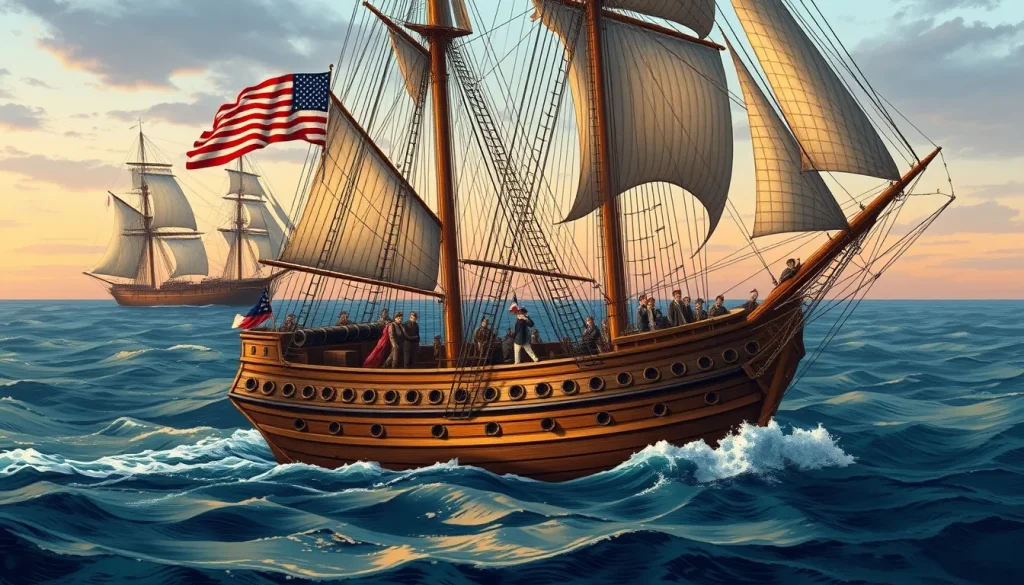
During the War of 1812 (1812–1815), privately owned armed vessels commissioned by their governments—privateers—played a significant role in the conflict’s naval dimensions. Operating from American, British, and Canadian ports, these ships attacked enemy merchant shipping, capturing at least 1,200 vessels and disrupting transatlantic trade. Their actions inflated British insurance rates, diverted Royal Navy resources, and shaped economic pressure on both belligerents.
Historical Context
In 1812 the Royal Navy was the world’s dominant naval force, while the United States Navy had only about fifteen seaworthy warships. Facing this imbalance, the United States turned to privateering—a traditional strategy for weaker maritime powers—to attack British commerce. Privateering had a long legal history, governed by letters of marque and prize courts, and had been used extensively during the American Revolution. Britain and its North American colonies also commissioned privateers to prey on American shipping, especially from Nova Scotia and New Brunswick. The war unfolded amid the Napoleonic Wars, during which Britain relied heavily on merchant shipping for supplies and trade, making its commerce a vulnerable target.
What Happened
On June 26, 1812, Congress passed a bill authorizing privateers, signed by President James Madison the next day. Within weeks, American privateers began streaming from Atlantic ports, with the first commission issued to Joshua Barney’s Rossie on July 12, 1812. Over the war, Congress issued roughly 1,100 letters of marque. American privateers, often fast Baltimore clippers, captured many British merchant ships, burning some, ransoming others, and bringing many into port for condemnation. In the first six months alone, they took about 450 British vessels. By 1814, insurance rates on shipping between England and Ireland soared to 13%, three times higher than during the war with all Europe.
British and Canadian privateers, based largely in Halifax, were also active. The schooner Liverpool Packet captured some 50 prizes, while the Sir John Sherbrooke took 18. These privateers harassed American coastal trade and supplied intelligence to the Royal Navy. Although British and Canadian privateering was on a smaller scale than American, it contributed to the overall disruption of enemy commerce. The last major action of the privateer war occurred in early 1815, before the Treaty of Ghent ended hostilities.
Why It Matters
Privateering had several significant effects on the War of 1812. It inflicted substantial economic damage on British merchant shipping, raised insurance costs, and forced the Royal Navy to allocate warships to escort convoys, thereby reducing its ability to enforce a tighter blockade. Privateer prizes also brought millions of dollars into the American economy, helping to sustain the war effort and boosting public morale. Scholars debate the strategic weight of these effects: some argue that privateering was critical, while others emphasize the navy’s role and the blockade’s impact. The legacy includes the eventual decline of privateering, formalized by the 1856 Declaration of Paris, which abolished it among signatories.
Definition
Privateers were privately owned merchant ships that, in wartime, were armed and commissioned by their government to attack enemy commerce. The commission—a letter of marque and reprisal—made captures lawful prizes rather than piracy. Privateers usually targeted merchant vessels and sought to avoid combat with warships, focusing on economic damage through capture, ransom, or destruction of enemy trade.
Background
Privateering had existed for centuries, with roots in medieval maritime law. In the 18th and early 19th centuries, it was a common tool of maritime powers, especially those with limited navies. During the American Revolution, American privateers had been highly successful, capturing hundreds of British prizes. The practice was governed by international law, requiring a valid commission and adjudication of captures by prize courts. The Napoleonic Wars had already seen extensive privateering by French and other forces, when the United States entered the conflict in 1812.
How It Worked
Privateering was an entrepreneurial venture. Groups of merchants and shipowners pooled capital to outfit a vessel, often a fast schooner or sloop, and stocked it with sailors who received no regular wages but shared in the proceeds of captured prizes. A letter of marque, issued by the government, authorized the ship to take enemy vessels. Upon capturing a ship, the privateer sent a prize crew to escort it to a friendly port, where a prize court determined whether the capture was legal. If condemned, the ship and cargo were auctioned, with proceeds distributed among investors, crew, and the state. Privateers typically carried large crews to overwhelm merchant ships and provide prize crews.
Competing Viewpoints
Historians have disagreed over the significance of privateering in the War of 1812. Some, like Frederick C. Leiner, argue that privateers were “critical” to the American war effort, capturing five times as many British ships as the U.S. Navy and imposing serious economic strain. Others, particularly in recent general histories, have downplayed their role, focusing on naval battles, the blockade, and the northern frontier campaigns. Some scholars note that the British blockade of American ports eventually throttled American trade, undermining privateering’s impact in the later war years. The debate reflects broader questions about the relative importance of economic versus military pressure, and about which theaters were decisive.
Role in the War of 1812
Privateers served as a force multiplier for the United States, which had only a handful of navy warships. They disrupted British commerce in the Atlantic, the Irish Sea, and the West Indies, capturing supplies, military stores, and consumer goods. They also forced the Royal Navy to convoy merchant fleets, lessening its ability to enforce a closer blockade. American privateers were especially active in the early months of the war, when the navy was still organizing. British and Canadian privateers, though fewer, similarly attacked American coastal shipping and helped to close American ports, while providing reconnaissance for the Royal Navy.
Consequences and Historical Interpretation
The cumulative effect of privateering was to raise the cost of war for Britain and to provide tangible victories for the American public. The financial losses from privateering, along with the navy’s frigate successes, contributed to British willingness to negotiate peace, though the Treaty of Ghent returned to the status quo ante bellum. After the war, privateering declined in importance as international law moved toward prohibiting it; the Declaration of Paris of 1856, to which the United States did not accede, nonetheless marked its end among the great powers. Modern historians see privateering as a significant, though not decisive, factor in the war’s outcome—a testament to how economic warfare could shape a conflict fought primarily near the coast.
Primary Sources
Relevant primary sources include the Privateering Act of June 26, 1812, and the letters of marque issued by the United States and by colonial governors in British North America. Prize court records, such as those of the U.S. District Courts and the Vice-Admiralty Court in Halifax, document the legal condemnation of captured vessels. Contemporary accounts, like Thomas Jefferson’s letter of August 4, 1812, predicted that American privateers would “eat out the vitals” of British commerce. These sources provide direct evidence of privateering activities, but must be read with caution: prize court records often favor the captor, and privateer logs were subject to self-promotion.
Further Reading
- Maclay, Edgar Stanton. A History of American Privateers. 1899.
- Kert, Faye M. “True, Publick and Notorious: The Privateering War of 1812.” London Journal of Canadian Studies 28 (2013).
- Leiner, Frederick C. “Yes, Privateers Mattered.” Naval History Magazine 28, no. 2 (2014).
- Gilje, Paul. “Cruising for Dollars: Privateers in the World of 1812.” National Park Service, 2017.
References
- The Privateering Act, June 26, 1812, United States Statutes at Large.
- Leiner, Frederick C. “Yes, Privateers Mattered.” Naval History Magazine 28, no. 2 (2014). https://www.usni.org/magazines/naval-history-magazine/2014/march/yes-privateers-mattered.
- Gilje, Paul. “Cruising for Dollars: Privateers in the World of 1812.” National Park Service. https://www.nps.gov/articles/cruising-for-dollars.htm.
- Kert, Faye M. “’True, Publick and Notorious’: The Privateering War of 1812.” London Journal of Canadian Studies 28 (2013). doi:10.14324/111.444.ljcs.2013v28.005.
- American Battlefield Trust. “David and Goliath: Privateers vs. the Mighty British Navy.” https://www.battlefields.org/learn/articles/head-tilting-history/david-and-goliath-privateers-vs-mighty-british-navy.
- Marsh, James H. “Privateering During the War of 1812.” The Canadian Encyclopedia, 2011. https://thecanadianencyclopedia.ca/index.php/en/article/privateering-during-the-war-of-1812.
FAQ
How many prizes did American privateers capture?
American privateers took at least 1,200 British merchant vessels during the War of 1812, with some estimates reaching 2,000. In contrast, the U.S. Navy captured about 250 ships.
Why did privateering matter to the British economy?
Privateering raised insurance premiums on British shipping, forced the Royal Navy to organize convoys, and disrupted trade routes, causing financial strain and diverting naval resources from blockade duties.
Did privateering continue after the War of 1812?
Privateering declined after the war, and the 1856 Declaration of Paris, which banned it among European powers, marked its end as a common practice, though the United States never formally acceded.

Leave a Reply