
Short Answer
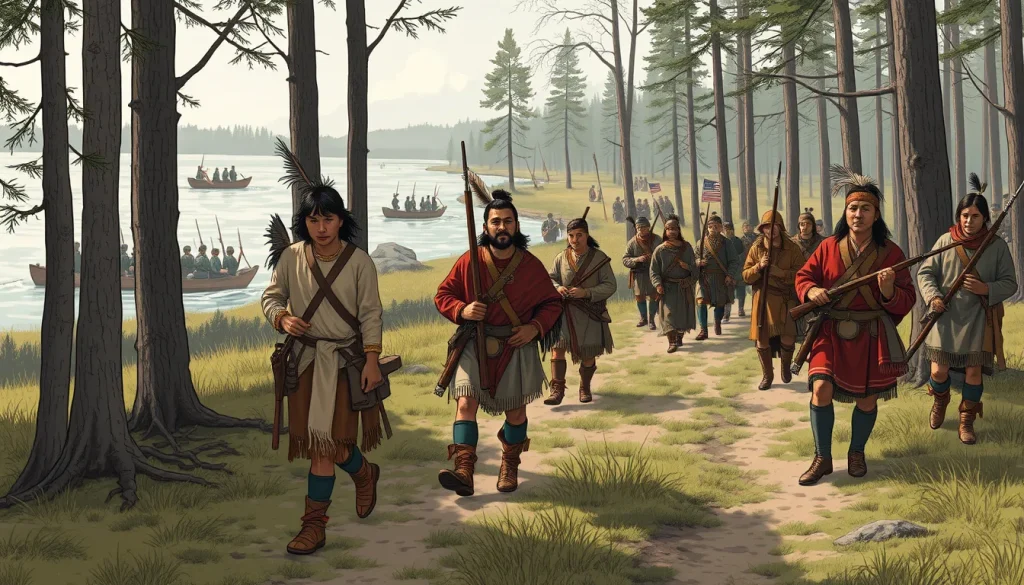
The Ojibwe, more broadly part of the Anishinaabe world that also included Mississauga and Chippewa communities, played a limited but conspicuous role in the defense of York (modern Toronto) during the Battle of York on April 27, 1813. A contingent of allied Indigenous warriors assembled at York in early 1813 and, when the American fleet arrived, moved out as light troops to meet the landing force west of the town. They were among the first Crown forces to engage the Americans, fighting alongside British regulars and Upper Canadian militia under Major General Roger Hale Sheaffe. Although York fell, their service became a focal point for later commemoration and for historical debate over Indigenous motives, agency, and the meaning of alliance in the War of 1812.
Historical Context
York was the capital of Upper Canada and a principal British supply point on the north shore of Lake Ontario. During the War of 1812 the lake was both a frontier and a corridor: British reinforcements and supplies moved from Quebec toward Niagara and the western posts, while the United States sought to sever that line. In 1812 British and Indigenous forces under Major General Isaac Brock and the Shawnee leader Tecumseh had won early victories, but by 1813 the United States had built up a naval squadron at Sackets Harbor under Commodore Isaac Chauncey. American planners initially considered Kingston but chose to attack York, a less heavily defended town, in the spring of 1813.
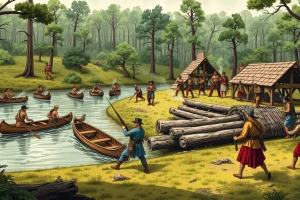
British authorities in Upper Canada depended on Indigenous allies for scouting, skirmishing, and knowledge of the wooded terrain. On the north shore of Lake Ontario, Mississauga and Chippewa (Ojibwe) communities had their own reasons to oppose American expansion. The Mississaugas called Americans Keche Mookomon, or Big Knives, a term recorded by Kahkewaquonaby (Peter Jones) in his 1861 History of the Ojebway Indians; Jones wrote that they associated the Americans with earlier violence against Indigenous people. At York, Major James Givins, the British Army’s liaison to the war chiefs, was fluent in Anishinaabemowin and was known to some as Ma’iigan, the Wolf. Warriors and their families camped near his property and on the Military Reserve, an area around what is now Queen Street West and the Centre for Addiction and Mental Health in Toronto. In January 1813 the York resident Thomas Ridout wrote that five Indigenous nations had come down to the war and were encamped “on the skirts of the woods on the back of the Town,” keeping the town alive with war dances. His letter shows that York’s defenders expected Indigenous warriors to be an important part of the coming campaign.
What Happened
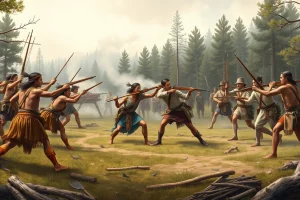
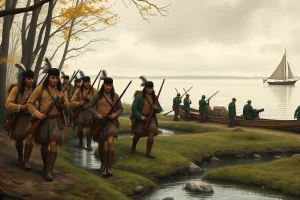
On the evening of April 26, 1813, the American squadron was sighted off the bluffs east of York. Early on April 27 it became clear that the Americans would land troops a few kilometres west of Fort York. The Indigenous contingent, described by the Friends of Fort York as the fastest part of the Crown force, set out through the forest with Major Givins and the war chiefs. Their exact numbers are uncertain: estimates range from about 40 to 100 warriors within a Crown force of just over 1,000, while other summaries give 40 to 50 Indigenous fighters. They were not a formally enrolled British unit with nominal rolls. Warriors made their own decisions about fighting, influenced by war chiefs, and Givins acted as a liaison rather than as a conventional commander.
The warriors met the American landing force, or its vanguard, in the woods and open ground west of the town. Contemporary and later accounts place them in the opening skirmishing, before or alongside the main British line. American regulars, including a strong vanguard unit, pushed inland. Sheaffe’s outnumbered regulars and militia fought, but the American force was larger and supported by naval vessels. As the British position collapsed, Sheaffe ordered his surviving regulars to withdraw toward Kingston, leaving militia and civilians to their fate. The Americans captured Fort York, the town, and the dockyard. During the fighting or withdrawal, the fort’s magazine exploded, killing Brigadier General Zebulon Pike and a number of American soldiers. The Americans occupied York, burned several public buildings, and withdrew weeks later.
Ojibwe and other Anishinaabe casualties at York are not precisely known. The names of most warriors were not recorded by British authorities. Among those identified in later accounts are Nawahjegezhegwabe, or Sloping Sky, later baptized Joseph Sawyer and eventually Head Chief of the Mississaugas; Chief Yellowhead and his son William of Lake Simcoe; James Ajetance, later a Mississauga chief; and Lawrence Herkimer, the son of a Loyalist fur trader and a Mississauga woman. A bronze memorial at the Fort York Visitor Centre, placed by the Mississaugas of the Credit, Beausoleil First Nation, the Chippewas of Georgina Island, and the Chippewas of Rama, commemorates the warriors “who went first to defend York on April 27, 1813.”
Why It Matters
The Ojibwe role at York did not save the capital. York fell, and the battle is generally remembered as an American victory with limited strategic consequences, since Kingston remained the more important British naval base. Yet the Indigenous contingent mattered in several ways. It was part of the opening defense, it demonstrated that Indigenous allies were integrated into the Crown’s local defense, and it contributed to a broader pattern of Indigenous participation in the War of 1812. For the Ojibwe and their Mississauga and Chippewa relatives, the war was not simply a British cause. It was tied to protecting their own lands, rights, and autonomy against American expansion. Chief M. Bryan Laforme of the Mississaugas of the Credit later stated that “We fought for our lands and rights in the War of 1812,” adding that in doing so they helped save Upper Canada.
Historians interpret the episode in different ways. Some emphasize Indigenous loyalty to the British Crown and the military value of warriors as skirmishers. Others stress Indigenous agency: warriors fought for their own nations, not as auxiliaries, and their decisions were shaped by war chiefs, kinship, and local interests. A third line of interpretation notes that the British alliance ultimately failed to protect Indigenous sovereignty, as postwar treaties and settlement pressures continued to reduce Indigenous lands. At York specifically, the small number of warriors and the rapid British defeat limit how much tactical weight their role can bear. Their significance lies more in what their service reveals about alliance, memory, and the incomplete documentary record than in any claim that they alone decided the battle.
Definition
In the context of the War of 1812, the “role of the Ojibwe in the defense of York” refers to the participation of Ojibwe, Chippewa, Mississauga, and other Anishinaabe warriors in the Crown’s defense of York on April 27, 1813. It does not refer to a single unified Ojibwe national army. Instead, it describes a contingent of allied warriors from communities around Lake Ontario, Lake Simcoe, and nearby areas who assembled at York and fought under their own leaders with British liaison support.
Background
The background is the wider Indigenous-British alliance in Upper Canada. After 1812, British commanders sought Indigenous support to offset their small regular forces. At York, Givins maintained relationships with Anishinaabe communities, and warriors camped near the town in early 1813. The American decision to attack York rather than Kingston brought the war directly to that allied encampment. The warriors’ presence was therefore not accidental; it was the product of diplomacy, kinship, and military expectation.
How It Worked
Anishinaabe warriors functioned as light infantry and skirmishers. They knew the forest and moved faster than regular troops. They were not subject to British drill or unit rolls in the same way as regulars and militia. War chiefs provided leadership, and individual warriors weighed risks and rewards. When the Americans landed west of Fort York, the warriors went out first with Givins and the chiefs. They engaged the American advance in the wooded and open ground, buying time and creating confusion before the main British line fought. After the British defeat, they withdrew or dispersed; the sources do not provide a detailed account of their retreat.
Competing Viewpoints
One interpretation casts the warriors as loyal allies who helped defend Upper Canada and were among the first to fight. A second interpretation insists that they were independent actors pursuing Indigenous interests, not British pawns. A third argues that their role has sometimes been inflated in commemoration because the documentary record is thin and the battle was lost. These views are not mutually exclusive. The warriors could be both allied with Britain and motivated by their own goals, and their tactical contribution could be real but limited by numbers and circumstances.
Role in the War of 1812
Their role at York was part of the larger Indigenous war effort that included Tecumseh’s confederacy in the west and Six Nations and other allied warriors along the Niagara and Lake Ontario frontiers. Indigenous support allowed British forces to contest American expansion, but it also exposed Indigenous communities to retaliation and postwar dispossession. At York, the warriors helped make the defense an Indigenous as well as a British and Canadian story, even though the town fell.
Consequences and Historical Interpretation
The immediate consequence was defeat and occupation for York. The longer consequence was memory: for much of the nineteenth and twentieth centuries, the Ojibwe and other Indigenous participants were omitted from popular accounts of the battle. Since the late twentieth century, First Nations and historians have worked to recover their presence. The Fort York memorial and the Friends of Fort York article are examples of that recovery. Scholarly interpretation now emphasizes Indigenous agency, the limits of British records, and the need to read oral history alongside written sources. The exact number of warriors, their casualties, and the details of their fighting remain uncertain, and responsible accounts state that uncertainty rather than inventing detail.
Primary Sources
The most useful contemporary written source for the Indigenous presence at York is a January 1813 letter by Thomas Ridout, a York militiaman. Ridout described five Indigenous nations encamped behind the town and their war dances. The letter is valuable because it shows that the warriors were already at York before the battle, but it is written from a British settler perspective and uses dismissive language about “savage yells,” so it must be read critically. It survives through quotation in the Friends of Fort York article.
British military correspondence from Major General Roger Hale Sheaffe and Governor General Sir George Prevost discusses the defense and withdrawal from York, but it is official British documentation and generally does not name individual Indigenous warriors. American reports, including accounts of the landing and of Brigadier General Zebulon Pike’s death, describe the battle from the attacking side and are similarly limited for Indigenous history.
Kahkewaquonaby (Peter Jones), History of the Ojebway Indians (1861), records Mississauga views of Americans as Keche Mookomon, or Big Knives, and reflects Indigenous memory from a later Christian and Anishinaabe perspective. It is not a battle narrative. A rare oral history of the battle was recited by John York, whose grandfather was present, and recorded on the Rama reserve for an Ontario Ministry of Education archaeological series in 1916. It varies from the documentary record and should be used with caution, but it is an important Indigenous account. The 1817 “Plan of York, U.C.” by Lt. E. A. Smith, held in Library and Archives Canada, helps locate the camp and Givins property near the modern Queen Street West corridor.
Further Reading
- Friends of Fort York, “The Anishinaabe warriors at York: first to engage,” by Bob Kennedy, May 21, 2022.
- Robert Malcomson, Capital in Flames: The American Attack on York, 1813 (2008).
- Carl Benn, The War of 1812 (2002).
- Robert S. Allen, His Majesty’s Indian Allies: British Indian Policy in the Defence of Canada, 1774–1815 (1992).
- Peter S. Schmalz, The Ojibwa of Southern Ontario (1991).
- Fort York National Historic Site, Toronto, including the visitor centre memorial to the Anishinaabe warriors.
References
- Bob Kennedy, “The Anishinaabe warriors at York: first to engage,” Friends of Fort York, May 21, 2022, https://friendsoffortyork.ca/newsletter/the-anishinaabe-warriors-at-york-first-to-engage/.
- “Battle of York,” Wikipedia, https://en.wikipedia.org/wiki/Battle_of_York.
- Thomas Ridout to his niece, January 1813, quoted in Kennedy, “The Anishinaabe warriors at York.”
- Kahkewaquonaby (Peter Jones), History of the Ojebway Indians (London: A. W. Bennett, 1861), as quoted in Kennedy.
- Robert Malcomson, Capital in Flames: The American Attack on York, 1813 (Annapolis: Naval Institute Press, 2008).
FAQ
Did the Ojibwe fight at the Battle of York?
Yes. Ojibwe, Chippewa, Mississauga, and other Anishinaabe warriors were part of the Crown force at York on April 27, 1813. Estimates vary from about 40 to 100 warriors.
Were the Ojibwe under British command at York?
They fought alongside British forces, but not as ordinary British soldiers. War chiefs led them, and Major James Givins served as liaison. Warriors made individual decisions about fighting.
How many Ojibwe warriors were at York?
Estimates range from about 40 to 100, though some summaries give 40 to 50. The exact number is unknown because British authorities did not keep nominal rolls for Indigenous allies.
What happened to York after the battle?
The Americans captured York, occupied it for several days, burned public buildings including the parliament, and withdrew. The British withdrew to Kingston. The Ojibwe role is commemorated at Fort York.
Leave a Reply