
Short Answer
Prophetstown, also called Prophet’s Town, was a multi-tribal Indigenous settlement founded in 1808 on the Wabash River in what is now Indiana. Led by the Shawnee religious leader Tenskwatawa, or the Prophet, and closely associated with his brother Tecumseh, it became the political and spiritual center of a nativist revitalization movement and an emerging Indigenous confederacy. U.S. forces under William Henry Harrison destroyed the town in November 1811 after the Battle of Tippecanoe, an event that weakened but did not end the confederacy and helped set the stage for Indigenous-British alliances in the War of 1812. This article treats Prophetstown as the Wabash River settlement associated with Tenskwatawa and Tecumseh, not as a later or unrelated place of the same name.
Historical Context
Prophetstown emerged from the decades of warfare, treaty-making, and settler expansion that followed the American Revolution. The 1795 Treaty of Greenville ended the Northwest Indian War and confirmed U.S. possession of much of present-day Ohio, while opening parts of the Indiana and Illinois country to American settlement. After Indiana Territory was organized in 1800, William Henry Harrison, as territorial governor and superintendent of Indian affairs, pursued a series of land-cession treaties with Indigenous nations. These agreements were often contested by leaders and communities who argued that no single group could sell lands held in common.
The Wabash-Maumee valley was a diverse Indigenous homeland. Miami, Wea, Kickapoo, Potawatomi, Delaware, Shawnee, Ottawa, Ojibwe, Wyandot, and other peoples lived in villages tied by kinship, trade, and diplomacy. French traders and mixed-heritage communities also remained important in the region. American expansion disrupted these relationships, especially as treaties transferred hunting grounds and village sites. Alcohol, debt, and the fur trade added to social strain.
Religious renewal was one response. Tenskwatawa, a Shawnee man who had survived illness and personal crisis, began preaching around 1805 that Indigenous peoples should reject alcohol, European-American goods, and land cessions, and return to older ways. His teachings drew on earlier nativist traditions but gave them new urgency. Tecumseh, his brother, became a leading diplomat and war captain who sought to build a confederacy strong enough to stop further American encroachment. British officials at Fort Malden in Upper Canada were aware of the movement and offered trade and encouragement, though the extent of British influence before 1811 is debated.
What Happened
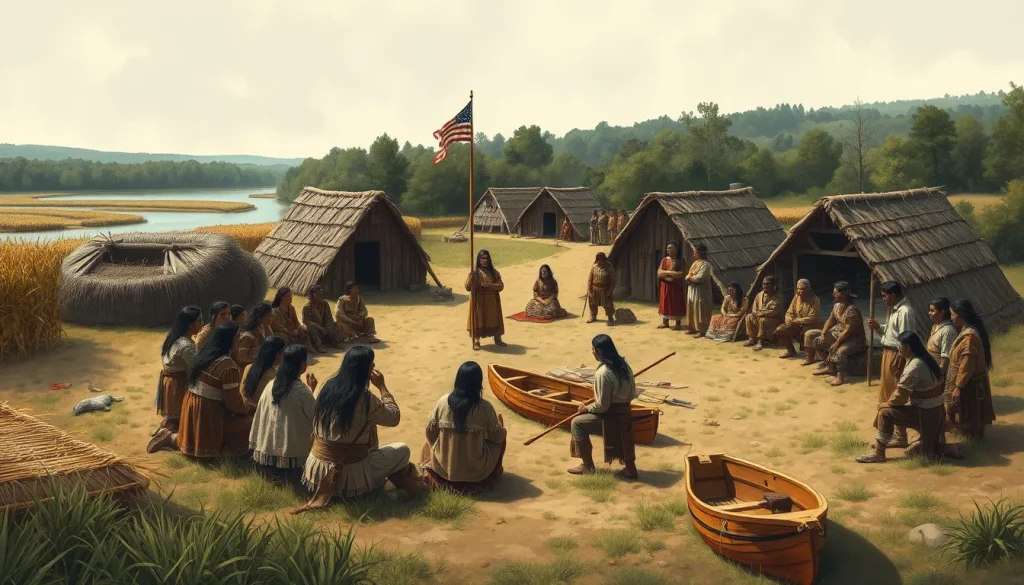
In June 1808 Tenskwatawa and Tecumseh moved with followers from Greenville, Ohio, to a site on the right bank of the Wabash River, about ten miles above the future city of Lafayette, Indiana. The location was chosen for practical and strategic reasons: it lay near an old French and Indigenous trading post, had access to cornfields, and sat along water routes that connected to Vincennes, the Great Lakes, and British posts in Canada. The settlement became known as Prophetstown.
Prophetstown grew into a multi-tribal community. Shawnee, Potawatomi, Kickapoo, Ottawa, Ojibwe, Winnebago, Wyandot, and other people came to hear Tenskwatawa and to join the movement. Estimates of population vary, but American officials considered it a substantial and alarming center. Tenskwatawa exercised spiritual authority, while Tecumseh traveled widely to recruit allies and to argue that Indigenous lands were held in common and could not be sold piecemeal.
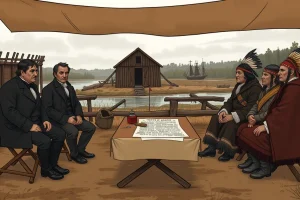
Tensions rose after the 1809 Treaty of Fort Wayne, in which Harrison secured cessions from several Indigenous leaders. Tecumseh and Tenskwatawa rejected the treaty and demanded that it be rescinded. In August 1810 Tecumseh met Harrison at Vincennes in a tense council. Accounts of the meeting differ, but Harrison treated Tecumseh’s opposition as a direct challenge to American authority.
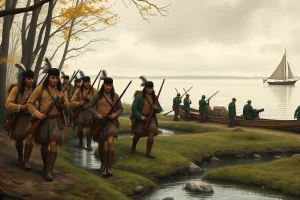
In 1811 Harrison marched up the Wabash with a force of regulars, militia, and volunteers. He built Fort Harrison near present-day Terre Haute before continuing toward Prophetstown. Tecumseh was away recruiting in the South, leaving Tenskwatawa in charge. On November 6, 1811, Harrison’s army camped near Tippecanoe Creek, close to Prophetstown. After a council in which Tenskwatawa reportedly promised supernatural protection, his warriors attacked the American camp before dawn on November 7.
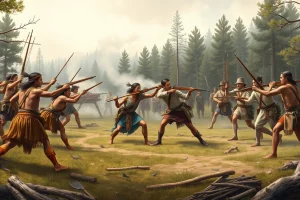
The Battle of Tippecanoe was a fierce, close-range fight. Harrison’s men held their lines, and the Indigenous force eventually withdrew. American casualties were roughly sixty killed and about one hundred twenty wounded. Indigenous losses are not reliably documented and estimates vary widely. On November 8 Harrison’s troops entered and burned Prophetstown, destroying food stores and buildings. The town was abandoned. Tenskwatawa’s prestige suffered severely, and Tecumseh returned to find the settlement ruined.
The confederacy was not dissolved. Tecumseh continued to seek alliances, and when the United States declared war on Britain in June 1812, many Indigenous nations in the Northwest sided with Britain. Tecumseh and Tenskwatawa went to Canada. Tecumseh fought at Detroit and other engagements before being killed at the Battle of the Thames in October 1813. Tenskwatawa lived in Canada and later returned to the United States; he was removed with Shawnee communities to Kansas, where he died in 1836. Prophetstown was never rebuilt as the movement’s capital.
Why It Matters
Prophetstown mattered immediately because it represented the most serious Indigenous challenge to U.S. land policy in the Old Northwest before the War of 1812. Harrison’s destruction of the town was intended to break the confederacy and secure the Wabash valley. Instead, the fighting deepened Indigenous-British cooperation and helped turn the Northwest into a major theater of the war. The fall of Prophetstown also damaged Tenskwatawa’s authority while elevating Tecumseh’s reputation as a military and political leader.
In the longer term, Prophetstown became a symbol of Indigenous resistance to dispossession. The confederacy it anchored did not prevent American expansion, but it shaped the course of the War of 1812 in the Northwest and remained a reference point for later Indigenous political efforts. The destruction of the town also contributed to the broader removal of Shawnee and other nations from their homelands in the decades that followed.
Historians disagree about how to interpret Prophetstown. R. David Edmunds and Gregory Evans Dowd place it within a tradition of nativist religious and political resistance. John Sugden emphasizes Tecumseh’s diplomatic and military leadership. Adam Jortner argues that the movement was a holy war with deep religious meaning. Patrick Bottiger challenges the image of a unified, militant town, stressing factionalism among Miami, Wea, French, and American communities; he argues that Harrison and Miami leader Little Turtle used claims about Prophetstown’s militancy for their own political purposes. These interpretations differ because the sources are fragmented, heavily mediated by American and British officials, and often hostile to the town.
Historical Map Context
Prophetstown lay in the Wabash River valley near the mouth of the Tippecanoe River, in a region that Indigenous nations used for hunting, agriculture, and travel. The Wabash connected the village to Vincennes downstream and, through portages, to the Great Lakes and the Maumee valley. This location made Prophetstown a meeting place for peoples from across the Midwest and made it strategically threatening to American officials. Maps from the early nineteenth century show the village near the old trading route and the later battlefield, though exact boundaries of the settlement are not precisely known.
Modern Location
The site of Prophetstown is generally identified near present-day Battle Ground, Tippecanoe County, Indiana, about ten miles north of Lafayette. The battlefield itself is preserved at Tippecanoe Battlefield Park. The village area lies nearby in the Wabash valley. Prophetstown State Park, established in the early twenty-first century, interprets the broader landscape of the Wabash and Tippecanoe confluence, though it is not a reconstruction of the original town.
Events at the Site
Prophetstown was founded in 1808 and became a center of religious teaching, diplomacy, and recruitment. Councils at the town addressed land cessions, unity, and relations with Britain and the United States. In 1811 it was the base for Indigenous warriors who fought Harrison’s army at Tippecanoe. After the battle, American troops burned the town and destroyed its stores. The site was then abandoned as a political and spiritual capital, though the surrounding region remained contested during the War of 1812.
Associated People
Tenskwatawa, the Shawnee Prophet, was the town’s spiritual founder and leader. Tecumseh was its leading diplomat and military organizer. Other Indigenous leaders and communities, including Miami, Wea, Kickapoo, Potawatomi, Delaware, Ottawa, Ojibwe, Wyandot, and Winnebago people, were connected to the town. William Henry Harrison led the American forces that destroyed it. Miami leaders such as Little Turtle and Pacanne figured in the political struggles around the town, as did French traders, interpreters, and British agents at Fort Malden.
Surviving Monuments and Site
No standing buildings from Prophetstown remain. The principal public commemoration is Tippecanoe Battlefield Park, which includes an obelisk monument, a museum, and interpretive trails. Prophetstown State Park preserves parts of the nearby prairie and river landscape and offers educational exhibits. Archaeological and historical research continues, but the exact layout of the town is not fully known. The site is best understood as a landscape of memory as well as a physical location.
Primary Sources
Contemporary evidence for Prophetstown comes from several kinds of records. William Henry Harrison’s official reports and letters, including his November 1811 report on Tippecanoe, describe the campaign from the American military perspective. The Treaty of Fort Wayne of 1809 survives in published treaty collections and reveals the land-cession claims that Tenskwatawa and Tecumseh rejected. The Vincennes Western Sun, edited by Elihu Stout, printed local news and alarmist accounts of Prophetstown; it reflects settler anxieties and political conflicts. British Indian Department correspondence, including letters associated with officials such as Matthew Elliott, shows British interest in the Wabash region and Indigenous-British connections. Tenskwatawa’s teachings and speeches survive only through the records of interpreters, agents, and later recollections, which filter and often distort his words. Later reminiscences by American soldiers and settlers add detail but are shaped by memory and partisan feeling. These sources must be read together because each has significant limitations.
Further Reading
- R. David Edmunds, The Shawnee Prophet (University of Nebraska Press, 1983).
- John Sugden, Tecumseh: A Life (Henry Holt, 1998).
- Gregory Evans Dowd, A Spirited Resistance: The North American Indian Struggle for Unity, 1745-1815 (Johns Hopkins University Press, 1992).
- Adam Jortner, The Gods of Prophetstown: The Battle of Tippecanoe and the Holy War for the American Frontier (Oxford University Press, 2011).
- Patrick Bottiger, The Borderland of Fear: Vincennes, Prophetstown, and the Invasion of the Miami Homeland (University of Nebraska Press, 2016).
- Elmore Barce, Tecumseh’s Confederacy: The Prophet’s Town, Indiana Magazine of History (1912).
- Tippecanoe Battlefield Park and Prophetstown State Park, Indiana State Museum and Historic Sites.
References
- Jortner, Adam. The Gods of Prophetstown: The Battle of Tippecanoe and the Holy War for the American Frontier. Oxford University Press, 2011. https://iportal.usask.ca/record/41309
- Bottiger, Patrick. The Borderland of Fear: Vincennes, Prophetstown, and the Invasion of the Miami Homeland. University of Nebraska Press, 2016. https://digitalcommons.unl.edu/cgi/viewcontent.cgi?article=1340&context=unpresssamples
- Ironstrack, George. Review of The Borderland of Fear. The Annals of Iowa 76, no. 4 (2017): 435-437. https://ir.uiowa.edu/annals-of-iowa/vol76/iss4/5
- Bottiger, Patrick. Two Towns, Multiple Places: Race and Identity on the Early Republic’s Frontier. Dissertation, University of Oklahoma, 2009. https://hdl.handle.net/11244/318692
- Barce, Elmore. Tecumseh’s Confederacy: The Prophet’s Town. Indiana Magazine of History. https://scholarworks.iu.edu/journals/index.php/imh/article/download/6021/5763/
FAQ
What was Prophetstown?
Prophetstown was a multi-tribal Indigenous settlement founded in 1808 by Tenskwatawa on the Wabash River. It served as a spiritual and political center for resistance to U.S. land cessions until U.S. forces destroyed it in November 1811.
Why did the Battle of Tippecanoe happen?
Tensions grew after the 1809 Treaty of Fort Wayne, which Tecumseh and Tenskwatawa opposed. In 1811 William Henry Harrison marched toward Prophetstown; Tenskwatawa's warriors attacked his camp near Tippecanoe Creek on November 7, and Harrison's troops burned the town the next day.
How was Prophetstown connected to the War of 1812?
Its destruction weakened the Indigenous confederacy but intensified Indigenous-British cooperation. Tecumseh and many northwestern nations allied with Britain after the United States declared war in June 1812, making the Northwest a key theater.
Leave a Reply