Short Answer
Tenskwatawa (born Lalawethika, about January 1775 in the Ohio Country; died November 1836 near present-day Kansas City, Kansas), the Shawnee religious leader known as the Prophet, was the younger brother of the war leader Tecumseh. When Tecumseh was killed at the Battle of the Thames on 5 October 1813 in Upper Canada, the pan-Indigenous confederacy the brothers had built collapsed, but Tenskwatawa survived the battle by more than two decades. This article treats the Shawnee Prophet specifically rather than other Indigenous or Euro-American figures who have been called “the Prophet.” His later career — exile in British territory, a return to the United States, and involvement in the Shawnee removal — is a case study in what happened to Indigenous leaders whose military and diplomatic leverage disappeared after 1813.
Historical Context
By the early nineteenth century, Indigenous nations of the Ohio Valley and the Old Northwest had lost most of their land base through the Treaty of Greenville (1795) and subsequent cessions, while alcohol, epidemic disease, and the collapse of the fur trade undermined older economic and social patterns. A long tradition of prophetic resistance — associated with Neolin in the 1760s and Pontiac’s war — held that Native peoples should reject European goods and Christianity and unite across tribal lines. Tenskwatawa’s movement of 1805 onward revived that message.
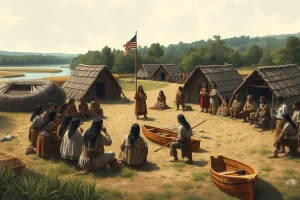
From the village of Prophetstown, established in 1808 at the confluence of the Wabash and Tippecanoe rivers in what is now Indiana, Tenskwatawa supplied the spiritual authority and Tecumseh the political and military leadership for a confederacy that sought to halt American expansion. On 7 November 1811, while Tecumseh was recruiting in the South, Tenskwatawa authorized an attack on the encampment of William Henry Harrison’s force near Prophetstown. The two-hour Battle of Tippecanoe ended with the Indigenous warriors withdrawing, the village burned, and Tenskwatawa’s standing badly damaged.
When the United States declared war on Britain in June 1812, Tecumseh’s confederacy allied with British forces on the Detroit frontier. Tenskwatawa accompanied the campaign as a religious figure rather than a war leader. The American naval victory on Lake Erie in September 1813 cut British supply lines, and the retreat that followed ended at Moraviantown on the Thames River, where Tecumseh was killed. For Tenskwatawa, that defeat marked the beginning of a very different phase of life.

What Happened
Most accounts place Tenskwatawa with the British and Indigenous force at Moraviantown on 5 October 1813; he survived the battle and withdrew eastward with Major-General Henry Procter’s retreating column. His personal role in the fighting is not clearly documented.
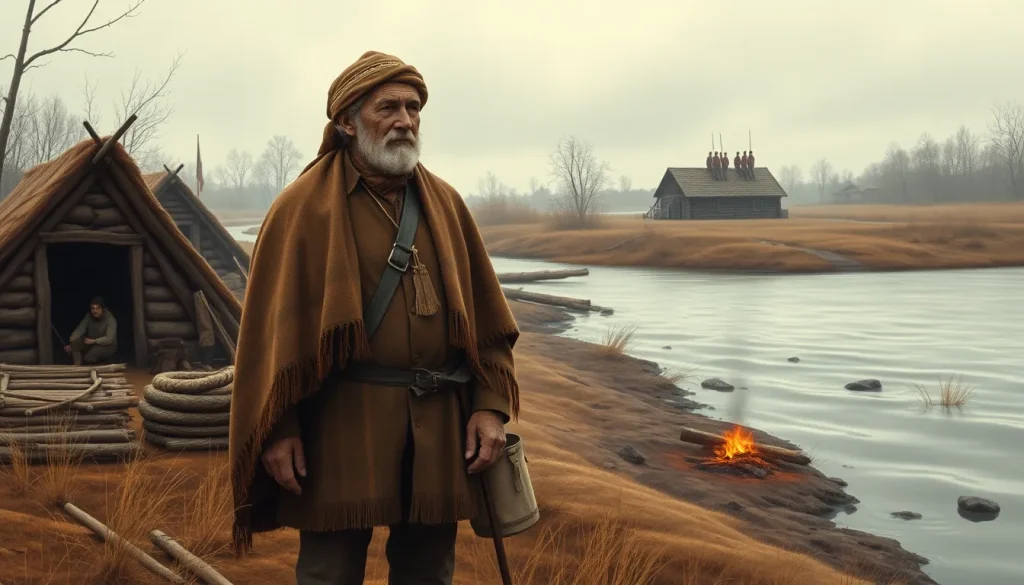
Rather than return to American-controlled territory, Tenskwatawa remained in Upper Canada, joining the refugee population of Shawnee, Delaware, Wyandot, Potawatomi, and other peoples who had moved north during the war. Sources differ on exactly where he lived during these years — various accounts associate him with the western districts of Upper Canada near the Detroit frontier and the Thames River — and the documentary record for 1813 to the early 1820s is thin. The Treaty of Ghent of 24 December 1814 contained a clause promising the restoration of Indigenous nations to their pre-war status, but the United States did not implement it, and Britain largely abandoned its Native allies in the peace. Tenskwatawa consequently had no diplomatic route home on favourable terms.
He remained in British territory for roughly a decade. Estimates of his return date vary: some accounts have him returning to the United States in 1824, and others in 1825 or shortly after. Once back, he worked with American officials as an intermediary to persuade Shawnee bands to accept removal west of the Mississippi River, a role that has struck historians as a striking reversal for a man who had once preached total rejection of American culture. Under treaties negotiated in the 1820s, Shawnee groups ceded lands in Ohio and Missouri in exchange for a reservation in what is now Kansas. Tenskwatawa reached that reservation, in the Argentine district of present-day Kansas City, Kansas, toward the end of the 1820s. He died there in November 1836 and was buried near White Feather Spring.
Why It Matters
For British, Canadian, and American officials, Tenskwatawa’s post-1813 career was a minor administrative matter: a refugee religious leader who had to be fed, then a useful intermediary in treaty negotiations. For the Indigenous nations of the Old Northwest, it marked the end of a coordinated military option east of the Mississippi and the beginning of the removal era. Tecumseh’s death and the Prophet’s decline removed the two figures most closely identified with armed resistance; what followed was two decades of treaty cessions and forced migration.
Historians disagree about how much authority Tenskwatawa retained after 1813. One strand of interpretation, reflected in the Wikipedia and Canadian Encyclopedia accounts, describes him as losing influence, becoming an outcast, and fading into obscurity in exile. Another strand, reflected in the National Park Service’s biography, holds that he continued to preach and retained a substantial following even after his brother’s death. The disagreement partly reflects a shortage of evidence: British Indian Department records document rations and presents but seldom record what the Prophet preached in Canada. A further interpretive debate concerns his later cooperation with American removal policy — whether it reflected genuine conviction that relocation was the only remaining option, an attempt to preserve a leadership role among the Shawnee, or simple expediency. Contemporaries and later historians have also blamed him for the defeat at Tippecanoe, a judgement that shapes his popular reputation more than his Canadian exile does.
Early Life
Tenskwatawa was born in early 1775, probably at Old Piqua in the Ohio Country, to Puckeshinwa, a Shawnee war leader of the Kispokotha division, and Methoataske, a woman of Creek descent. His father was killed at the Battle of Point Pleasant in October 1774, before his birth, and his mother left the family around 1779. He was raised by an elder sister, Tecumpease, and an elder brother, Chiksika. He lost the sight of his right eye in a hunting accident, was overshadowed by his brothers Chiksika and Tecumseh, and by his twenties had a reputation for heavy drinking. He was present at the Battle of Fallen Timbers in 1794 and probably at the Treaty of Greenville in 1795, but he did not distinguish himself as a warrior. In 1805, after a trance-like illness, he claimed a vision from the Master of Life and took the name Tenskwatawa, “the Open Door.”
Role Before the War
From 1805 Tenskwatawa preached a nativist program: abstention from alcohol, rejection of Christianity and American goods, restoration of communal life and traditional ritual, and unity among Native nations. His prediction of a solar eclipse in June 1806, made after William Henry Harrison challenged him to prove his powers, greatly increased his following. He settled first near Greenville in western Ohio and then, in 1808, at Prophetstown in Indiana Territory. He also presided over witchcraft accusations among the Delaware and Wyandot in 1806, which ended with the execution of several accused people. Prophetstown attracted followers from many nations, and by 1811 tensions with American settlers and officials had made conflict likely.
Role During the War
Tenskwatawa provided the spiritual foundation of the confederacy; Tecumseh supplied its diplomacy and military leadership. The Prophet’s decision to allow an attack at Tippecanoe on 7 November 1811 came while Tecumseh was absent, and the defeat cost the movement both its headquarters and much of its credibility. During the War of 1812 he accompanied his brother on the Detroit frontier and, according to the Canadian Encyclopedia, was present at the American surrender of Detroit on 16 August 1812. He was not a battlefield commander; his standing rested on prophecy, ritual, and counsel. When the British position on the Detroit frontier collapsed after the Battle of the Thames on 5 October 1813, he left the field with the retreating British column and did not return to the United States for about ten years.
Major Actions
Tenskwatawa’s principal actions after his brother’s death were, in sequence: escaping the Thames battlefield with Procter’s retreat; remaining in Upper Canada as a refugee leader rather than submitting to American authority; living for roughly a decade in British territory, where his activities left only fragmentary traces; returning to the United States in the mid-1820s; serving American officials as an intermediary in negotiations for Shawnee removal; and settling on the Kansas reservation, where he lived quietly until his death. No single act in these years restored his earlier influence. He did not lead another confederacy, and no comparable following gathered around him again.
Contemporary Accounts
Documentation for Tenskwatawa after October 1813 is far thinner than for his years at Prophetstown, and it falls into three groups.
British Indian Department records. Officials at posts such as Amherstburg, Fort George, and York corresponded about rations, presents, and payments to Indigenous refugees and their leaders in Upper Canada. These records, held chiefly at Library and Archives Canada, document the presence of Shawnee and other refugee communities but rarely describe Tenskwatawa’s own movements or words in detail.
United States official correspondence. War Department and Office of Indian Affairs letters from the 1820s and 1830s record the use of Indigenous intermediaries in removal negotiations and the movements of Shawnee leaders between Ohio, Missouri, and Washington. These documents are administrative rather than descriptive, and they present him through the eyes of officials who wanted a result, not a biography.
Earlier testimony about the Prophet, carried forward in later publications. The most frequently quoted contemporary statement is William Henry Harrison’s 1806 challenge to the Delawares, preserved in printed editions of his correspondence and quoted in the Dictionary of Canadian Biography: Harrison instructed them to ask Tenskwatawa “to cause the sun to stand still – the moon to alter its course.” The eclipse of 16 June 1806 was taken by followers as proof of his power and by American officials as fraud or coincidence. A portrait long attributed to the artist Charles Bird King, reproduced by the National Portrait Gallery and the National Park Service and dated to roughly the 1820s, is the best-known visual record of his later years, but it is a studio likeness rather than a documentary image and should be treated with caution as evidence of his appearance.
Later Life
On the Shawnee reservation in what is now Kansas, Tenskwatawa lived as an elderly religious figure with a small circle of followers rather than as a political leader. He arrived toward the end of the 1820s, after the main Shawnee removal to the region had begun, and he died in November 1836. Details of his final years — his preaching, the size and nature of his following, and his relations with the Shawnee bands already settled there — are sparsely documented. He was buried near White Feather Spring, a site in what is now Kansas City, Kansas.
Historical Legacy
Tenskwatawa is remembered primarily for the years before 1813: as the Prophet who built a religious revival into a political movement and whose authority collapsed at Tippecanoe. His post-Tecumseh career has usually been treated as an epilogue, and the contrast between the two phases — from the spiritual centre of a pan-Indigenous confederacy to an obscure old man on a removal-era reservation — is itself part of his historical significance. Modern scholarship, notably R. David Edmunds’s study of the Shawnee Prophet, treats him as a serious religious thinker whose message addressed genuine social crisis rather than a fraud or a British tool, while acknowledging his responsibility for the Tippecanoe decision and the practical failure of his program. His burial place near White Feather Spring is marked and is sometimes noted by local historical organizations in Kansas. He appears only marginally in American memory of the War of 1812, generally as a foil to Tecumseh.
Primary Sources
The relevant contemporary materials are scattered and mostly institutional rather than personal. The British Indian Department’s correspondence and accounts for Upper Canada, 1813–1820, held at Library and Archives Canada, document the support given to Indigenous refugees among whom Tenskwatawa lived, though they name individuals inconsistently. United States War Department and Office of Indian Affairs records from the 1820s and 1830s, largely in the National Archives, document his role in removal negotiations as officials understood it. Printed editions of William Henry Harrison’s correspondence preserve his 1806 challenge to Tenskwatawa, which is often quoted as evidence of how American officials sought to discredit him. Later nineteenth-century recollections by participants in the Tippecanoe campaign and by settlers on the Detroit frontier contain accounts of the Prophet, but they were written decades after the events and are shaped by hindsight and by hostility toward him; they should be used as interpretation rather than as direct testimony. Tenskwatawa left no known personal papers, and no verified written text of his preaching survives; his teachings reach us through paraphrases by officials, missionaries, and later writers.
Further Reading
- R. David Edmunds, The Shawnee Prophet (University of Nebraska Press, 1983) — the standard scholarly biography.
- R. David Edmunds, Tecumseh and the Quest for Indian Leadership (1984).
- John Sugden, Tecumseh: A Life (1997).
- Colin G. Calloway, The Shawnees and the War for America (2007).
- Dictionary of Canadian Biography, entry on Tenskwatawa (biographi.ca).
- Library and Archives Canada, British Indian Department records (RG 10).
- National Park Service biography of Tenskwatawa (nps.gov).
- Kansas Historical Society resources on the Shawnee reservation and White Feather Spring.
References
- Wikipedia, “Tenskwatawa,” https://en.wikipedia.org/wiki/Tenskwatawa (accessed 2024).
- National Park Service, “Tenskwatawa,” https://nps.gov/people/tenskwatawa.htm (last updated 20 November 2024).
- D. S. Davis, “Tenskwatawa (The Prophet),” The Canadian Encyclopedia, https://thecanadianencyclopedia.ca/en/article/tenskwatawa-the-prophet.
- Dictionary of Canadian Biography, “Tenskwatawa,” https://www.biographi.ca/en/bio/tenskwatawa_7E.html.
- EBSCO Research Starters, “Founding of Prophetstown,” https://www.ebsco.com/research-starters/history/founding-prophetstown.
FAQ
Did Tenskwatawa fight at the Battle of the Thames?
Most accounts place him with the British and Indigenous force at Moraviantown on 5 October 1813, and he survived by retreating eastward with Major-General Procter's column. His personal role in the fighting is not clearly documented, and he was never a battlefield commander; his authority rested on religious leadership and counsel.
Where did Tenskwatawa live after Tecumseh's death?
He remained in British territory in Upper Canada for roughly a decade, associated in various accounts with the western districts near the Detroit frontier and the Thames River. Sources differ on his specific locations, and British Indian Department records for the period rarely describe his movements in detail.
When did Tenskwatawa return to the United States?
Estimates vary. Some accounts place his return in 1824, and others in 1825 or shortly after. He subsequently worked with American officials to encourage Shawnee bands to accept removal west of the Mississippi and reached the Shawnee reservation in present-day Kansas toward the end of the 1820s.
How and when did Tenskwatawa die?
He died in November 1836 on the Shawnee reservation near what is now Kansas City, Kansas, and was buried near White Feather Spring. Contemporary records do not provide a detailed account of his final illness or death.
Leave a Reply