
Short Answer
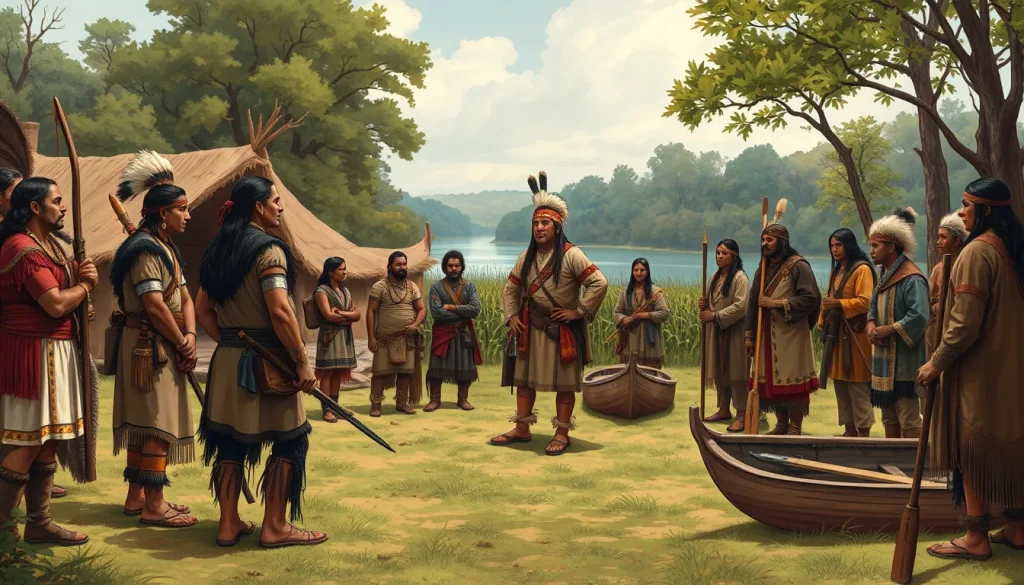
The Pan-Indigenous Confederacy, commonly called Tecumseh’s Confederacy, was a broad but loose alliance of Indigenous nations in the Great Lakes and Ohio Valley region during the early nineteenth century. It formed around the religious teachings of Tenskwatawa, the Shawnee Prophet, and the diplomacy and military leadership of his brother Tecumseh, especially between about 1805 and 1813. From its headquarters at Prophetstown on the Wabash River, near present-day Battle Ground, Indiana, it resisted United States land cessions and allied with Britain during the War of 1812. Its collapse after Tecumseh’s death at the Battle of the Thames in 1813 marked a turning point in Indigenous resistance and American expansion in the Old Northwest.
Historical Context
After the Treaty of Greenville in 1795 ended the Northwest Indian War, the United States claimed much of present-day Ohio and parts of Indiana and Illinois. Many Indigenous nations did not accept the cession as final, and the treaty’s terms accelerated displacement. Shawnee, Lenape (Delaware), Miami, Wea, Kickapoo, Potawatomi, Wyandot, Odawa, Ojibwe, Ho-Chunk (Winnebago), Sauk, Meskwaki, and other peoples lived in overlapping villages and hunting grounds. Leadership was often organized at the village level rather than by a single tribal government, and civil chiefs negotiated treaties while war chiefs led in conflict. This made broad unity difficult but not impossible.
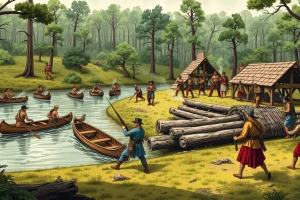
The religious revival that became the confederacy’s spiritual core emerged after the death of Lenape chief Buckongahelas in 1805 and a subsequent witch hunt. Tenskwatawa, a Shawnee man previously known as Lalawethika, gained influence as a prophet. He drew on earlier Indigenous religious traditions associated with Neolin and other teachers, preaching that Native peoples should reject alcohol, European-style clothing, and dependence on American goods, and should cease selling land. His message appealed to many who had lost homelands and to those who opposed accommodationist chiefs. In 1808, Tenskwatawa and Tecumseh moved followers to Prophetstown on the Wabash River, a location accessible to British posts in Upper Canada and to multiple Indigenous communities.
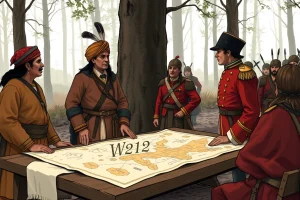
American expansion intensified. The 1809 Treaty of Fort Wayne, negotiated with several chiefs, ceded additional lands in Indiana. Tecumseh and Tenskwatawa rejected it, arguing that land was held communally and that no single nation or chief could sell it without general consent. British authorities at Malden and elsewhere in Upper Canada watched the movement with interest, seeing it as a potential counterweight to the United States. Pan-Indigenous resistance had precedents in Pontiac’s uprising of 1763 and the Northwestern Confederacy of the 1780s and 1790s, but Tecumseh’s effort was broader in geographic reach and diplomatic ambition.
What Happened
Tecumseh became the confederacy’s principal diplomat and war leader around 1808. He traveled widely, meeting with nations across the Old Northwest and making an 1811 journey to the South to seek support from Creek, Cherokee, Choctaw, and Chickasaw communities. Those southern efforts produced limited results, but they show that the confederacy was not confined to a single region. While Tecumseh was away, Governor William Henry Harrison of Indiana Territory marched a U.S. force toward Prophetstown. On November 7, 1811, Harrison’s army fought Tenskwatawa’s warriors at the Battle of Tippecanoe. The U.S. force held the field, though losses on both sides were significant. Harrison’s troops then destroyed Prophetstown and its stores. The battle became a public relations disaster for Tenskwatawa, who had assured followers of supernatural protection, and it weakened the confederacy’s standing among some nations.
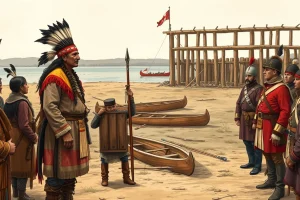
Tecumseh returned to find Prophetstown in ruins. Rather than abandon resistance, he deepened the alliance with Britain as the United States declared war in June 1812. In August 1812, Tecumseh and British Major General Isaac Brock captured Detroit, a victory that boosted the confederacy’s prestige and provided weapons and supplies. In 1813, confederacy warriors fought alongside British and Canadian forces at the sieges of Fort Meigs and the Battle of Fort Stephenson in Ohio. The alliance was uneasy: British commanders pursued their own imperial priorities, while Tecumseh sought security, land, and recognition for Indigenous nations.
On October 5, 1813, at the Battle of the Thames near Moraviantown in Upper Canada, U.S. forces under William Henry Harrison defeated the British and their Indigenous allies. Tecumseh was killed. His death shattered the confederacy’s political center. Tenskwatawa survived and later lived in Canada and the United States before being removed with Shawnee people to Kansas, where he died in 1836. Without Tecumseh’s diplomatic authority, the broad alliance dissolved, and the United States moved to consolidate control over the Old Northwest.
Why It Matters
The confederacy mattered immediately because it made Indigenous nations central to the War of 1812 in the Great Lakes theater. British successes at Detroit and on the Detroit frontier depended heavily on Indigenous warriors. For the United States, the defeat of the confederacy helped secure the Northwest and opened the way for further settlement. For Indigenous nations, the outcome was catastrophic. The Treaty of Ghent in 1814 promised restoration of Indigenous possessions and rights as they had existed in 1811, but the United States did not honor that promise. In the following decades, many nations were forced to cede more land and remove west of the Mississippi.
Historians interpret the confederacy in different ways. Some emphasize it as a military and diplomatic alliance against American expansion. Others treat it primarily as a religious revitalization movement, with Tenskwatawa as its founder and Tecumseh as its political and military organizer. Recent scholarship, notably Peter Cozzens’s Tecumseh and the Prophet, argues that Tenskwatawa was an equal partner, not a failed prophet overshadowed by his brother. Another debate concerns how unified the confederacy really was: it included diverse nations with separate interests, and some leaders chose accommodation with the United States. The term ‘confederacy’ can imply more centralized authority than existed, but it remains the common name for a broad Indigenous coalition that briefly posed a serious challenge to American expansion.
Definition
In this context, a pan-Indigenous confederacy means a coalition of separate Indigenous nations and villages formed for common political, diplomatic, and military purposes. Tecumseh’s Confederacy was not a state with fixed borders, a single army, or a permanent bureaucracy. It was a network of alliances, kinship ties, and shared grievances, anchored at Prophetstown and inspired by Tenskwatawa’s teachings. Its members included Shawnee, Lenape, Wyandot, Miami, Potawatomi, Kickapoo, Wea, Piankeshaw, Sauk, Meskwaki, Ho-Chunk, Odawa, Ojibwe, Mingo, and Seneca participants, though no nation was unified in support and some actively opposed it.
Background
The confederacy grew from the pressures of American settlement after the American Revolution and the Treaty of Greenville. U.S. officials treated treaties as transfers of sovereignty and land, while many Indigenous peoples understood them as limited agreements that did not extinguish communal rights. Earlier pan-Indigenous movements, including Pontiac’s alliance in 1763 and the Northwestern Confederacy that fought the United States in the 1790s, offered models of intertribal cooperation. The religious revival led by Tenskwatawa after 1805 gave the new movement a moral and cultural program. The 1809 Treaty of Fort Wayne provided the immediate political spark by alienating land that Tecumseh and Tenskwatawa considered off-limits.
How It Worked
The confederacy operated through village-level leadership, councils, and personal networks rather than formal institutions. Tecumseh traveled as an emissary, seeking commitments from chiefs and warriors and using kinship and reputation to hold the coalition together. Prophetstown served as a gathering place, refuge, and symbol. Warriors joined campaigns as contingents from their own communities, often under their own leaders. British Indian Department agents supplied arms, ammunition, and provisions, but Indigenous goals were not identical to British ones. The doctrine that land belonged to all Indigenous peoples collectively gave the confederacy a legal and moral argument against unilateral cessions.
Competing Viewpoints
Historians disagree about the confederacy’s character and effectiveness. One view stresses Tecumseh as the indispensable leader and the alliance as a military response to American expansion. Another stresses Tenskwatawa’s religious vision as the original unifying force, with Tecumseh later translating it into diplomacy. Some scholars see the movement as a genuine pan-Indian breakthrough; others note that tribal and village loyalties remained strong and that support for accommodation with the United States continued. British officials valued the alliance for manpower but often pursued their own strategic interests. American officials tended to portray the confederacy as a British plot, which downplayed Indigenous agency. These competing perspectives reflect different sources: British and American records, Indigenous oral traditions, and later ethnohistorical scholarship.
Role in the War of 1812
Tecumseh’s Confederacy entered the War of 1812 as Britain’s most important Indigenous ally in the Old Northwest. In August 1812, Tecumseh and Brock captured Detroit, a victory that forced a U.S. surrender and secured the western British frontier. In 1813, confederacy warriors participated in the sieges of Fort Meigs and the attack on Fort Stephenson, though these campaigns failed to break American resistance. The death of Tecumseh at the Battle of the Thames in October 1813 removed the coalition’s leading diplomat and commander. After that, Britain and the United States negotiated the war’s end largely without Indigenous representation, and the confederacy ceased to function as a broad fighting alliance.
Consequences and Historical Interpretation
The immediate consequence was U.S. consolidation of the Old Northwest and the loss of Indigenous bargaining power. The Treaty of Ghent’s promise to restore Indigenous rights proved ineffective, and American treaty commissioners pressed new land cessions. Longer-term consequences included the removal policies of the 1830s and the hardening of U.S. sovereignty over the region. For Indigenous nations, the confederacy became a memory of resistance and a precedent for later pan-Indigenous activism. Historians continue to debate whether it should be understood primarily as a religious movement, a military alliance, or an early expression of Indigenous nationalism. Its significance lies in its scale, its brief success, and its role in one of the most consequential wars in North American history.
Primary Sources
Primary sources for Tecumseh’s Confederacy are uneven. U.S. officials produced extensive correspondence, including letters and reports from William Henry Harrison and other territorial officials. These documents reveal American fears and policy but often treat Indigenous motives as threats or British manipulation. British Indian Department records and military correspondence from Upper Canada document the alliance, supplies, and campaigns, though they focus on British strategic needs. Treaties such as the Treaty of Greenville (1795) and the Treaty of Fort Wayne (1809) are essential for understanding the land disputes that drove the confederacy.
Indigenous voices survive mainly through speeches recorded by interpreters, agents, and journalists, and through oral traditions preserved by descendant communities. Tenskwatawa’s teachings were reported by contemporaries, but the surviving accounts are mediated and sometimes hostile. The Shawnee Prophet’s own words are difficult to recover directly; scholars rely on multiple, overlapping records. For the War of 1812 campaigns, British and American after-action reports, orderly books, and newspaper accounts provide details about Detroit, Fort Meigs, Fort Stephenson, and the Thames, but casualty figures and descriptions vary. The Draper Manuscripts at the Wisconsin Historical Society and the Logan Esarey edition of Harrison’s papers are standard starting points for research.
Further Reading
- Peter Cozzens, Tecumseh and the Prophet: The Shawnee Brothers Who Defied a Nation (2020).
- John Sugden, Tecumseh: A Life (1997) and Tecumseh’s Last Stand (1985).
- R. David Edmunds, The Shawnee Prophet (1983) and Tecumseh and the Quest for Indian Leadership (1984).
- Gregory Evans Dowd, A Spirited Resistance: The North American Indian Struggle for Unity, 1745–1815 (1992).
- Richard White, The Middle Ground: Indians, Empires, and Republics in the Great Lakes Region, 1650–1815 (1991).
- Todd Leahy, Pontiac and Tecumseh: An Evaluation of Early Pan-Indian Confederacies (2000).
- Indiana Historical Bureau and the National Park Service, resources on the Tippecanoe Battlefield and Prophetstown.
References
- Peter Cozzens, Tecumseh and the Prophet: The Shawnee Brothers Who Defied a Nation (New York: Alfred A. Knopf, 2020).
- Todd Leahy, Pontiac and Tecumseh: An Evaluation of Early Pan-Indian Confederacies (dissertation, 2000), https://doi.org/10.58809/beoe1778.
- Elmore Barce, ‘Tecumseh’s Confederacy,’ Indiana Magazine of History, https://scholarworks.iu.edu/journals/index.php/imh/article/download/6021/5763/.
- Joseph Bryan Icenhower, Tecumseh and the Indian Confederation, 1811–1813: The Indian Nations East of the Mississippi Are Defeated (New York: F. Watts, 1975), https://archive.org/details/tecumsehindianc00icen.
- Wikipedia contributors, ‘Tecumseh’s confederacy,’ Wikipedia, https://en.wikipedia.org/wiki/Tecumseh%27s_confederacy.
- Logan Esarey, ed., Messages and Letters of William Henry Harrison (Indianapolis: Indiana Historical Commission, 1922).
- John Sugden, Tecumseh: A Life (New York: Henry Holt, 1997).
- R. David Edmunds, The Shawnee Prophet (Lincoln: University of Nebraska Press, 1983).
FAQ
What was Tecumseh's Confederacy?
It was a broad but loose alliance of Indigenous nations in the Great Lakes and Ohio Valley, organized around Tenskwatawa's religious revival and Tecumseh's diplomacy to resist U.S. land cessions and expansion. It allied with Britain during the War of 1812.
How did Tenskwatawa contribute to the confederacy?
Tenskwatawa, the Prophet, provided the religious and cultural doctrine that drew diverse followers to Prophetstown and rejected alcohol, European goods, and further land cessions. Recent scholarship treats him as a co-architect, not merely Tecumseh's subordinate.
Why did the confederacy ally with Britain?
Britain was at war with the United States and maintained posts and Indian Department agents in Upper Canada. The alliance offered arms, supplies, and a strategic partner against American expansion, though British and Indigenous goals were not identical.
Leave a Reply