
Short Answer
Oneida warriors were men of the Oneida (Onyota’a:ka) nation, one of the Six Nations of the Haudenosaunee (Iroquois) Confederacy, who served alongside the United States during the War of 1812 (1812–1815). Their best-documented action was the ambush at Big Sandy Creek on the Lake Ontario shore on 30 May 1814, in which roughly 130 Oneida fighters helped capture a British naval and military detachment. Service as scouts, guides, boatmen, and light infantry, together with diplomatic correspondence addressed to President James Madison, makes the Oneida one of the most thoroughly recorded cases of Indigenous military support for the United States during the war.
Historical Context
The Haudenosaunee Confederacy was a league of nations — Mohawk, Oneida, Onondaga, Cayuga, and Seneca, joined by the Tuscarora in the early eighteenth century — bound by the Great Law of Peace and by alliances maintained through wampum belts and the diplomatic covenant chain. During the American Revolution the Confederacy divided. The Oneida and most Tuscarora supported the American colonists; the Mohawk, Seneca, Cayuga, and Onondaga generally supported Britain. Oneida warriors fought at Oriskany in 1777 against Mohawk and Seneca forces, and the Oneida settlement of Oriska was burned in retaliation. The war left the Confederacy fractured and its communities exposed.
After 1783 the Oneida in central New York faced sustained pressure on their lands from New York State and from settlers. The federal Treaty of Canandaigua (1794), negotiated by Timothy Pickering with the Six Nations, confirmed reserved lands and pledged United States protection — an alliance that Oneida leaders described in the language of the covenant chain. Haudenosaunee who had sided with Britain instead received land along the Grand River in Upper Canada and remained tied to the Crown.
When the United States declared war on Great Britain on 18 June 1812 over maritime grievances linked to the Napoleonic Wars — impressment, blockade, and trade restrictions — fighting spread quickly to the Great Lakes. Control of Lake Ontario and of the supply route from Albany through Oswego to the naval base at Sackets Harbor became strategically critical. The United States needed local guides, scouts, and manpower; the Oneida, whose villages lay close to that corridor, had reasons to defend their remaining territory and to sustain an alliance they believed had guaranteed it.
What Happened
Oneida backing for the United States was visible from the outset. Oneida leaders in New York affirmed their alliance, and Oneida men served as scouts, messengers, boatmen, and warriors attached to American forces on the northern frontier. Records also indicate that Oneida women served: an Oneida woman named Dolly Schenandoah, aged 29, is documented as enlisting for three months’ service in June 1813 in a regiment of Indian volunteers, according to the National Museum of the American Indian’s American Indian Magazine.
On 11 September 1813 the chiefs of the Oneida Indian Nation sent a letter to President James Madison reaffirming their support for the United States, according to the Oneida Indian Nation’s published history. The letter is frequently cited in Oneida accounts of the war; its text is not reproduced here.
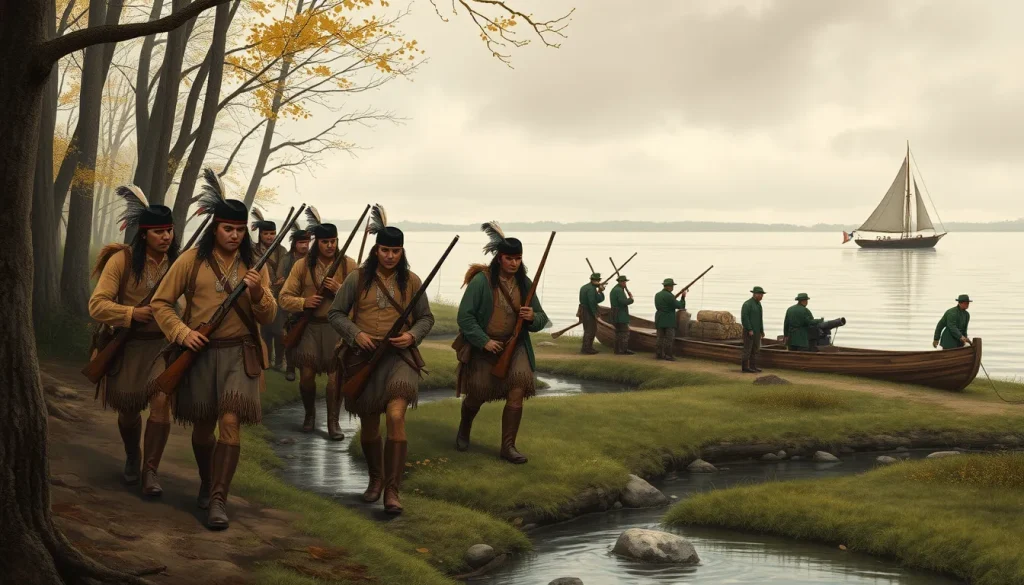
In the spring of 1814 a British squadron on Lake Ontario, cooperating with troops under Lieutenant-General Gordon Drummond, raided the American depot at Oswego on 5–6 May and seized large quantities of stores. The Americans evacuated the remaining cannon, cordage, and naval supplies and moved them by bateaux along the shoreline toward Sackets Harbor, where frigates were under construction. Captain Melancthon T. Woolsey, United States Navy, commanded a convoy of nineteen bateaux carrying thirty-four cannon and other supplies; about 130 Oneida warriors moved overland as escort, together with American riflemen under Major Daniel Appling.
Woolsey’s boats left Oswego after nightfall and rendezvoused with the Oneida escort; published accounts differ on whether the meeting point was at the mouth of the Big Salmon River or nearer Sandy Creek. On 30 May 1814 a British flotilla of armed boats under Captain Stephen Popham, Royal Navy, pursued the convoy into Big Sandy Creek, roughly two miles upstream from Lake Ontario. There American riflemen and Oneida warriors ambushed the British as they came up the narrow stream. The engagement lasted about fifteen minutes. Popham’s force was broken and nearly the entire detachment — sailors, marines, and soldiers — was captured, including Popham. Reported British losses differ among accounts; a frequently cited figure is 17 killed and 47 wounded. American and Oneida casualties were light, and Oneida warriors pursued British fugitives into the woods.
The captured guns and stores were carried on to Sackets Harbor, where they were used in the naval construction program. Oneida service continued along the Lake Ontario frontier through 1814. Oneida participation in the Niagara campaigns is far less well documented than their role on the lake corridor, and Oneida contingents should not be confused with the Seneca, Cayuga, and Onondaga warriors from the Buffalo Creek Reservation who fought at Chippawa in July 1814.
Why It Matters
The immediate military effect of the Sandy Creek action was substantial. The convoy’s guns and naval stores reached Sackets Harbor, and the loss of Popham’s detachment removed a British striking force from Lake Ontario for a period. American officers and later naval historians treated the affair as one of the more complete United States successes of the 1814 lake campaign.
For the Oneida, the war’s aftermath was sobering. The Treaty of Ghent (24 December 1814) contained a provision, Article IX, by which Britain and the United States pledged to restore to the Indigenous nations the possessions and rights they had held in 1811; the United States did not implement it. Pressure on Oneida land in New York continued, and in the 1820s and 1830s many Oneida removed to Wisconsin, while others remained in New York and a separate community at Grand River in Ontario followed a different political path. Historians such as Laurence M. Hauptman have argued that Oneida wartime service did little to slow dispossession.
Historical memory remains contested. The Oneida Indian Nation and the Oneida Nation of Wisconsin point to the war record as evidence of a long "First Allies" relationship with the United States, while scholars caution that this framing took shape partly in the nineteenth and twentieth centuries and served later political purposes. Historians of the Haudenosaunee, notably Carl Benn, emphasize the tragedy of a confederacy divided against itself, with Oneida, Tuscarora, and some Seneca, Cayuga, and Onondaga fighting for the United States while Mohawk and other Grand River warriors fought for Britain.
What "Oneida Warriors" Means in This Context
Here the term refers to Oneida men who took up arms or performed military labor for the United States between 1812 and 1815, together with Oneida women documented in military service. It covers two overlapping groups: warriors who served under their own leaders and were attached to American commands as allies, and individuals who enlisted in American formations, including the regiments of Indian volunteers mentioned in the enlistment record of Dolly Schenandoah. United States records often labeled both simply as Indians, blurring the distinction. The scope is the New York Oneida and the Lake Ontario frontier, not the communities that later formed in Wisconsin and Ontario.
Background: Treaty Obligations and a Divided Confederacy
Oneida decisions in 1812 rested on treaty relationships rather than a single wartime calculation. The 1794 Treaty of Canandaigua and the wampum belts associated with the covenant chain framed the United States as a protector and the Oneida as allies. Many Oneida also remembered the Revolution, when their support for the Americans had been followed by land losses rather than security. Haudenosaunee at Grand River held a parallel obligation to the Crown. Both chains of alliance were taken seriously, which is why the same confederacy produced warriors on both sides.
How Oneida Service Worked
Oneida participation was organized largely through Oneida communities and leaders. Warriors operated as scouts, guides, and flankers, using knowledge of shoreline, creeks, and forest that American officers lacked. On the Oswego–Sackets Harbor corridor they escorted bateaux and stores. Some served for short terms under American enlistment; others served as volunteers whose terms and pay are poorly documented. Coordination with American officers such as Woolsey and Appling appears to have been effective at Sandy Creek, where the Oneida screened the convoy and then pursued the British after the ambush. Evidence for individual participants is fragmentary: American and British reports typically identify only officers and rarely name Indigenous fighters.
Competing Viewpoints
Oneida leaders described their position as the fulfillment of an alliance and a means of protecting land and people. United States officials valued Oneida service but often treated Native allies as auxiliaries rather than as treaty partners, and some American officers distrusted Indigenous fighters generally. British officials regarded the Oneida as rebels against the Crown and relied instead on Grand River warriors. Historians disagree about how decisive the Oneida were at Sandy Creek: some credit the ambush to Appling’s riflemen and Woolsey’s planning, while others argue that the Oneida escort made the convoy’s survival possible and that their pursuit turned a repulse into a capture. The larger dispute concerns whether the Oneida were allies with enforceable claims or auxiliaries whose contributions could be acknowledged without being repaid.
Role in the War of 1812
Oneida contributions fall into four categories: intelligence and scouting along the lake shore and inland routes; logistics, including escorting bateaux and stores between Oswego and Sackets Harbor; combat, most clearly in the ambush and pursuit at Big Sandy Creek on 30 May 1814; and diplomacy, expressed in the 1813 letter from Oneida chiefs to President Madison and in the maintenance of the American alliance in Oneida councils. Documented Oneida service concentrates on the Lake Ontario frontier; evidence for large Oneida contingents in the Niagara or St. Lawrence campaigns is thin, and broader claims should be treated with caution unless tied to a specific source.
Consequences and Historical Interpretation
In the short term, Oneida service helped keep the Sackets Harbor supply line open and contributed to a notable American success on Lake Ontario. In the longer term, the war did not produce the protection the Oneida sought. Article IX of the Treaty of Ghent was not enforced, New York State continued to acquire Oneida land, and removal to Wisconsin followed treaties in the 1820s and 1830s. Later generations of Oneida, in New York, Wisconsin, and Ontario, have used the war record to assert a continuing national identity and a historic claim on United States friendship. Historians generally treat the Oneida case as illustrating both the military value of Indigenous alliances and the limits of what those alliances secured for Indigenous nations.
Primary Sources
The most important contemporary materials for this subject are the operational correspondence of the United States Navy and Army on Lake Ontario, British naval dispatches, and Oneida diplomatic records.
- Melancthon T. Woolsey’s reports to the Navy Department (May–June 1814). Woolsey commanded the bateau convoy and described the movement of the guns and the ambush at Big Sandy Creek. His reports are printed in William S. Dudley, ed., The Naval War of 1812: A Documentary History, vol. 3. They are detailed on ships and cargo but say little about individual Oneida participants.
- Captain Stephen Popham’s and Commodore James Lucas Yeo’s dispatches (1814). British accounts of the failed boat expedition, printed in William Wood, ed., Select British Documents of the Canadian War of 1812. They describe the action as a costly surprise and are shaped by the need to explain a defeat.
- Letter of the Oneida chiefs to President James Madison, 11 September 1813. Cited in Oneida Indian Nation historical accounts as a statement of continued support for the United States. This article does not quote it; readers seeking the text should consult the James Madison Papers at the Library of Congress and Oneida Nation archives.
- Treaty of Canandaigua, 11 November 1794. The treaty text, held by the National Archives, sets out the reserved lands and mutual obligations that Oneida leaders invoked during the war.
- The Washington Covenant Belt and related wampum. Material records of the alliance rather than written documents, and central to how Oneida leaders understood their obligations.
All of these sources are limited. Military reports were written by officers who rarely named Indigenous participants and who had incentives to emphasize their own decisions. Oneida testimony survives largely through oral tradition, community histories, and nineteenth-century petitions, all of which were shaped by later land disputes. No single document gives a full account of Oneida service in the war.
Further Reading
- Carl Benn, The Iroquois in the War of 1812 (University of Toronto Press, 1998).
- Robert S. Allen, His Majesty’s Indian Allies: British Indian Policy in the Defence of Canada, 1774–1815 (Dundurn Press, 1992).
- Laurence M. Hauptman, Conspiracy of Interests: Iroquois Dispossession and the Rise of New York State (Syracuse University Press, 1999).
- Alan Taylor, The Divided Ground (Knopf, 2006).
- William S. Dudley, ed., The Naval War of 1812: A Documentary History, vol. 3 (Naval Historical Center, 2002).
- Fort Ontario State Historic Site, Oswego, New York; Shako:wi Cultural Center, Oneida Indian Nation, Oneida, New York.
References
- Oneida Indian Nation. "First Allies: 19th Century." https://www.oneidaindiannation.com/first-allies-19th-century
- Hill, Rick. "Choosing Sides: Divided Loyalties in the War of 1812." American Indian Magazine (National Museum of the American Indian) 13, no. 4 (Winter 2012). https://www.americanindianmagazine.org/story/choosing-sides-divided-loyalties-war-1812
- Benn, Carl. The Iroquois in the War of 1812. Toronto: University of Toronto Press, 1998.
- Hauptman, Laurence M. Conspiracy of Interests: Iroquois Dispossession and the Rise of New York State. Syracuse, NY: Syracuse University Press, 1999.
- Taylor, Alan. The Divided Ground: Indians, Settlers, and the Northern Borderland of the American Revolution. New York: Knopf, 2006.
- Dudley, William S., ed. The Naval War of 1812: A Documentary History. Vol. 3. Washington, DC: Naval Historical Center, 2002.
- Wood, William, ed. Select British Documents of the Canadian War of 1812. 3 vols. Toronto: Champlain Society, 1920–1928.
- Treaty of Canandaigua, 11 November 1794. United States–Six Nations. National Archives, Washington, DC.
- Allen, Robert S. His Majesty’s Indian Allies: British Indian Policy in the Defence of Canada, 1774–1815. Toronto: Dundurn Press, 1992.
- Stagg, J. C. A. The War of 1812: Conflict for a Continent. Cambridge: Cambridge University Press, 2012.
FAQ
Did the Oneida fight for the United States in the War of 1812?
Yes. Most New York Oneida sustained the alliance they had made with the United States during the American Revolution and served as scouts, guides, boatmen, and warriors. Their best-documented combat role came at Big Sandy Creek on 30 May 1814, where roughly 130 Oneida fighters helped ambush and capture a British naval and military detachment.
Why did the Oneida side with the United States rather than Britain?
Oneida leaders pointed to treaty obligations, especially the 1794 Treaty of Canandaigua, and to the need to protect their remaining lands in central New York. Their position was not simply a wartime choice; it continued a Revolutionary-era alignment. Support was not universal across the Haudenosaunee, and Oneida communities were separated from relatives at Grand River in Upper Canada who fought for Britain.
How many Oneida warriors served in the War of 1812?
No reliable total exists. About 130 Oneida warriors are documented as escorting the bateau convoy involved in the Big Sandy Creek action of May 1814, and smaller numbers appear in other service roles. Records kept by American and British officers rarely named Indigenous participants, so the overall number remains uncertain and should not be stated with false precision.
What did the Oneida gain from their service?
Very little in material terms. Article IX of the Treaty of Ghent, which promised to restore Indigenous nations to their 1811 status, was not implemented by the United States. Pressure on Oneida land in New York continued, and many Oneida removed to Wisconsin in the 1820s and 1830s. Later Oneida generations have cited the wartime record as evidence of a historic alliance rather than as a source of legal protection.

Leave a Reply