
Short Answer
After the War of 1812, Native American nations lost the British military and diplomatic support that had helped sustain their resistance to United States expansion, and the United States converted its wartime advantage into a rapid series of land-cession treaties. Between 1814 and the 1840s, agreements such as the Treaty of Fort Jackson (1814), the Second Treaty of Greenville (1814), and the Treaties of Portage des Sioux (1815) transferred tens of millions of acres in the Great Lakes region, the Ohio Valley, and the Southeast, and set the legal groundwork for the removal of most eastern nations to lands west of the Mississippi River. The outcome is historically significant because it ended the possibility of a renewed intertribal confederacy east of the Mississippi and permanently changed the political geography of North America. This article treats “Native American land after the War of 1812” as the question of how Indigenous territory changed between 1814 and roughly 1840, in both the United States and British North America, for nations that fought in or were affected by the war.
Historical Context
The land question that dominated the postwar decades had been created long before 1812. In the Treaty of Paris of 1783, Britain ceded its claims to territory east of the Mississippi without consulting the Indigenous nations who lived there, and the new United States asserted that it had acquired both sovereignty over that territory and the exclusive right to purchase Native land within it. Between 1790 and 1795 the republic fought a war in the Ohio Country against a Native confederacy that received British encouragement and supplies from posts such as Fort Miami. After the defeats of General Josiah Harmar (1790) and General Arthur St. Clair (1791), General Anthony Wayne’s victory at Fallen Timbers (1794) and the Treaty of Greenville (1795) forced a dozen nations to cede much of present-day Ohio. That sequence — a military defeat followed by a broad cession signed by leaders who did not speak for every landholder — became the template for the years after 1812.
By 1810, two Shawnee brothers, the Prophet Tenskwatawa and Tecumseh, had built a revitalization movement and an intertribal confederacy at Prophetstown on the Wabash River, arguing that no single nation could sell land held in common. William Henry Harrison’s victory at Tippecanoe in November 1811 and the American declaration of war on Britain in June 1812 turned that dispute into a wider conflict. For Britain, Indigenous allies were essential to the defense of Upper Canada: warriors recruited and supplied through the Indian Department, notably from Fort Malden, provided manpower that the small British garrison could not. For Native nations, the alliance with Britain was a means of defending homelands and forcing the United States to accept a permanent boundary, not a war fought on Britain’s behalf. For the United States, removing both the British presence and the Native confederacy became inseparable goals, and western settlers and their representatives in Congress pressed for both.
What Happened
Military events between 1813 and 1815 determined the terms on which land changed hands. On October 5, 1813, Harrison’s army defeated a British force and Tecumseh’s warriors at the Battle of the Thames in Upper Canada. Tecumseh was killed, his confederacy effectively dissolved, and the western nations lost both their most effective leader and their connection to a functioning British alliance on the Detroit frontier. In the South, the Creek War of 1813–1814 ended with Andrew Jackson’s victory at Horseshoe Bend on March 27, 1814.
On August 9, 1814, Jackson imposed the Treaty of Fort Jackson on Creek leaders, taking roughly 23 million acres in what is now Alabama and Georgia. Much of the ceded land belonged not to the Red Stick Creeks who had fought the United States but to Lower Creek and Cherokee communities that had allied with or remained neutral toward the United States; their protests were ignored, and the treaty became one of the largest single land transfers in American history.
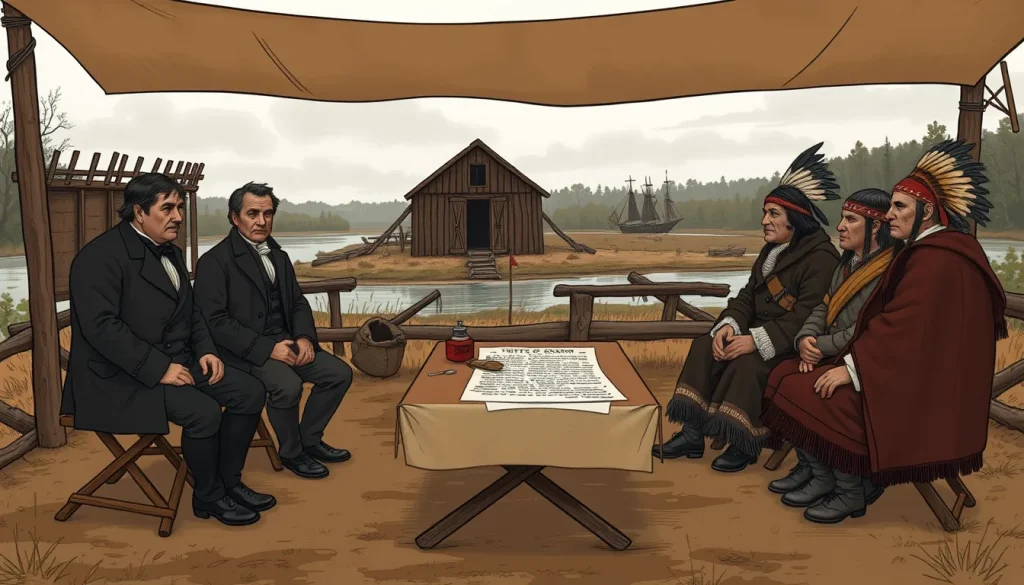
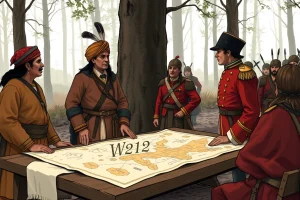
In the northwest, Harrison negotiated the Second Treaty of Greenville on July 22, 1814, with Wyandot, Delaware, Shawnee, Seneca, Miami, Chippewa, Ottawa, and Potawatomi representatives. It confirmed peace, extracted further cessions in what became Indiana and Ohio, and required the signatory nations to abandon relations with the British. The Treaty of Ghent, signed on December 24, 1814, addressed Native interests in Article IX, which bound the United States to end hostilities with the tribes and to “restore to such Tribes or Nations respectively all the possessions, rights, and privileges which they may have enjoyed or been entitled to in one thousand eight hundred and eleven.” British negotiators had earlier sought an autonomous Native territory between the United States and Canada and had argued for uti possidetis, the principle that each side would keep what it held at the peace. After the Duke of Wellington advised that Britain could neither hold nor demand such terms, and after American victories at Plattsburgh and Baltimore weakened the British position, London dropped both demands and left relations with the tribes to the United States.
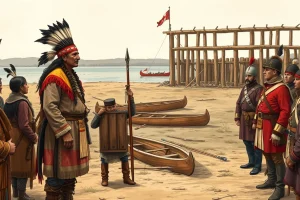
The United States then took the position that Article IX was satisfied because it had signed separate peace treaties with the tribes in 1815, rather than restoring their 1811 lands. In July 1815 William Clark and Auguste Chouteau began a series of treaties at Portage des Sioux, in present-day Missouri, with Sauk, Meskwaki (Fox), Iowa, Sioux, Omaha, Kickapoo, and other nations. The Sauk leader Black Hawk’s band initially refused to attend, and Black Hawk later signed a treaty at St. Louis in 1816 that the Sauk maintained only confirmed a fraudulent cession made in 1804.
Between 1815 and 1830, a steady stream of treaties stripped nations of their remaining eastern lands. In the Old Northwest these included the Treaty of Fort Meigs (1817), the Treaty of St. Mary’s (1818), the Treaty of Saginaw (1819), the Treaty of Chicago (1821), the Treaty of Prairie du Chien (1825), and further Prairie du Chien treaties in 1829 and 1830. In the Southeast they included the Treaty of Fort St. Stephens (1816) with the Choctaw, the Treaty of the Cherokee Agency (1817), the Treaty of Tuscaloosa (1818) with the Chickasaw, the Treaty of Calhoun (1819) with the Cherokee, and the Treaty of Doak’s Stand (1820) with the Choctaw. The Indian Removal Act of 1830 converted this piecemeal process into national policy, and the resulting treaties — Payne’s Landing (1832), Cusseta (1832), Chicago (1833), and New Echota (1835) — led to the removal of the Choctaw, Creek, Chickasaw, Cherokee, and Seminole. The Cherokee removal of 1838 became known as the Trail of Tears.
In British North America the outcome differed in form but not in direction. The Crown’s Indigenous allies, including the Six Nations of the Grand River, the Mississauga, and the Mohawk communities of the Bay of Quinte, received smaller and less secure land bases than many had been led to expect, and the Indian Department was reduced after 1815. Land surrenders and leases to settlers eroded reserve holdings through the nineteenth century, though most of these communities retained small reserves in what became Ontario rather than being removed en masse.
Why It Matters
The immediate consequence was strategic. The defeat of Tecumseh’s confederacy and the British decision to abandon the demand for a Native territory removed the two forces that had most effectively limited American expansion east of the Mississippi. The United States acquired millions of acres by treaty between 1814 and 1820, and the military reputations of Andrew Jackson and William Henry Harrison, both built on campaigns against Native nations, carried them to the presidency. Historian Kathryn Braund has argued that although Jackson and Harrison did not destroy the nations outright, they left them so weakened that renewed intertribal military resistance became nearly impossible. By one accounting cited by the National Park Service, more than 200 treaties were subsequently imposed on tribes, establishing nearly a hundred reservations west of the Mississippi.
The longer-term consequences were demographic and legal. Removal and reservation policy rearranged Native populations, and the treaty process became the foundation of the federal trust relationship that still governs tribal sovereignty claims. The Supreme Court’s Marshall Trilogy of the 1820s and 1830s — Johnson v. McIntosh (1823), Cherokee Nation v. Georgia (1831), and Worcester v. Georgia (1832) — drew directly on the land regime created by these cessions. For many tribal communities, the war and its treaties remain living history: Shawnee, Seneca, Muscogee, and Poarch Band Creek nations, among others, commemorate wartime leaders and the treaties that followed as part of contemporary identity and sovereignty.
Historians disagree about emphasis rather than about the outcome. Some, following Reginald Horsman, treat the war as a decisive turning point that removed the last external obstacle to expansion. Others stress continuity, arguing that demographic and economic pressure would have produced similar cessions regardless of the war’s result. A third line of interpretation, prominent in Native and Indigenous studies scholarship, treats the postwar treaties less as an unintended byproduct of war than as the deliberate execution of a policy of dispossession, carried out through councils that Native nations describe as coerced or fraudulent.
Definition: What Changed, and Where
In this context, “Native American land” means territory over which Indigenous nations exercised recognized rights — whether by treaty, by long occupation, or by hunting and usufruct claims — rather than a single unified landmass. The change after 1812 was not an instantaneous transfer of title. It was a decisive shift in bargaining power: nations that had negotiated from a position of military and diplomatic leverage before the war found themselves, after 1814, negotiating alone with a government that no longer had to consider a British counterweight. The geographic scope of the change covered the Old Northwest (present-day Ohio, Indiana, Illinois, Michigan, and Wisconsin), the Southeast (Georgia, Alabama, Mississippi, Tennessee, and Florida), and the Missouri Valley, with a separate but related process of land loss in Upper Canada.
Background: The Prewar Land Regime
Under the framework established in the 1780s and 1790s, the federal government claimed the exclusive right to acquire Indigenous land. The Nonintercourse Acts, beginning in 1790, prohibited purchases without federal authorization, and the practice of “preemption” gave the United States the first claim to buy land from nations that the government had already agreed to recognize. Treaties were negotiated at councils held at forts or agencies, typically with annuity payments, goods, and debt cancellation offered in exchange for cessions. Because annuities created dependence on federal payments and because debts to traders were often settled out of annuity funds, the system tended to generate further cessions. In British North America, by contrast, the Royal Proclamation of 1763 had asserted Crown authority over transactions with Indigenous nations, and land was transferred through surrenders to the Crown rather than through treaties with the United States.
How It Worked: Treaties, Cessions, and Removal
Postwar land transfers usually followed a recognizable pattern. Federal commissioners or territorial governors summoned leaders to a fort or agency, presented terms already drafted, and secured signatures from those willing to sign. Where a nation’s leadership was divided, the United States negotiated with a faction and treated its agreement as binding on the whole. Intermarriage, trade relationships, interpreters, and mixed-heritage intermediaries shaped which leaders were recognized. Once a cession was signed, the United States surveyed the land, opened it to settlement, and used annuity payments to secure compliance. Where treaties failed or were resisted — as with the Sauk in 1832 and the Seminole in the 1830s — military force followed. Removal, formalized by the 1830 act, was presented as an exchange of eastern homelands for western territory, but the western lands were often already occupied by other nations or were smaller and less suitable than those surrendered.
Competing Viewpoints
American officials of the period generally described the treaties as lawful, voluntary, and beneficial, arguing that they compensated Native nations for land they could not defend and opened it to productive use. Native leaders and communities almost universally rejected that characterization, arguing that land was held collectively, that the signers often lacked authority to sell, and that the alternative to signing was starvation or attack. British officials, once they had abandoned the demand for a Native territory, treated the matter as a domestic American question. Historians today largely agree that coercion, fraud, and unequal bargaining power shaped many of these agreements, but they debate whether the decisive factor was wartime defeat, the loss of the British alliance, or the longer-term demographic and economic pressure of settler expansion.
Role in the War of 1812
The war mattered to land outcomes in three ways. First, it destroyed the military capacity of the strongest intertribal coalition in the eastern interior when Tecumseh was killed at the Thames in October 1813. Second, it demonstrated to British policymakers that Native allies could not be protected in a peace settlement once Britain’s own territorial demands were abandoned at Ghent. Third, it produced the two campaigns — Harrison’s in the northwest and Jackson’s in the South — whose treaties became the legal instruments of the largest cessions. American negotiators at Ghent also pressed to be allowed to treat tribes as conquered enemies rather than as independent parties, a position the final treaty only partly constrained.
Consequences and Historical Interpretation
Between 1814 and 1840, the United States acquired vast tracts through treaty, removed most eastern nations to territory west of the Mississippi, and established the reservation system and federal trust doctrine that continue to define tribal–federal relations. For Native nations, the period produced a shared political vocabulary of treaty rights and sovereignty that later generations used in courts and in Congress. Interpretations differ on whether the outcome was inevitable. Those who emphasize contingency point to the British demand for a Native buffer state that came close to being negotiated, and argue that a different outcome in the war’s final campaigns might have preserved a protected Indigenous territory. Those who emphasize structure argue that the demographic imbalance alone made large-scale dispossession likely, and that the war accelerated rather than caused it.
Primary Sources
Treaty of Ghent, Article IX (December 24, 1814). Drafted by British and American commissioners meeting at Ghent, this article is the only formal wartime commitment by the United States to restore Native possessions. Its limitations are significant: it applied only to tribes “at war” with the United States, was conditional on those tribes ceasing hostilities, and did not recognize sovereignty or define boundaries. The passage quoted above is a direct quotation from the article; the remainder of the section is paraphrase.
Treaty of Fort Jackson (August 9, 1814). Signed by Andrew Jackson and Creek leaders, this document records the largest single cession of the period. Its text is reproduced in Charles J. Kappler’s Indian Affairs: Laws and Treaties. The signers represented only part of the Creek Nation, and Lower Creek and Cherokee communities whose lands were included protested the agreement.
Second Treaty of Greenville (July 22, 1814). Negotiated by William Henry Harrison with northwestern nations, the treaty records both cessions and the requirement that the signatories sever ties with Britain. Some affected nations were not represented, and the negotiations took place under the immediate pressure of ongoing military operations.
Treaties of Portage des Sioux (1815) and related Missouri Valley treaties. The journals and treaty records of William Clark and Auguste Chouteau document the peace-making process with nations west of the Mississippi. They reflect the American preference for negotiating with pliant factions and do not preserve the arguments of those who refused to attend.
Black Hawk, Life of Ma-ka-tai-me-she-kia-kiak, or Black Hawk (1833). Dictated by the Sauk leader and published through Antoine LeClaire and editor J. B. Patterson, this autobiography is one of the few extended Native accounts of the postwar treaties. It was mediated by translation and editing, so its language reflects its intermediaries as well as its subject.
British imperial correspondence, 1814–1815. The letters and memoranda surrounding the Ghent negotiations, including the Duke of Wellington’s assessment and the Cabinet’s decision to drop the Indian territory demand, document how British policy abandoned the allies’ territorial claims. These records are written from an imperial perspective and rarely preserve Native testimony.
Indigenous oral traditions and tribal records. Muscogee accounts of the Treaty of 1814, Seneca commemorations of Red Jacket, and Shawnee traditions about Tecumseh transmit perspectives absent from official documents. Because many were recorded by outsiders well after the events, they require careful handling.
Further Reading
- Donald L. Fixico, “Native Nations contend with the legacy of the War of 1812,” U.S. National Park Service.
- Kathryn Braund, “Losing ground: The wages of war in Indian Country,” U.S. National Park Service.
- Charles J. Kappler, ed., Indian Affairs: Laws and Treaties, Vol. II (Treaties), Government Printing Office, 1904.
- Reginald Horsman, Expansion and American Indian Policy, 1783–1812, Michigan State University Press, 1967.
- Gregory Evans Dowd, A Spirited Resistance: The North American Indian Struggle for Unity, 1745–1815, Johns Hopkins University Press, 1992.
- Alan Taylor, The Civil War of 1812: American Citizens, British Subjects, Irish Rebels, and Indian Allies, Knopf, 2010.
- John Sugden, Tecumseh: A Life, Henry Holt, 1998.
- Anthony F. C. Wallace, The Long, Bitter Trail: Andrew Jackson and the Indians, Hill and Wang, 1993.
- Francis Paul Prucha, The Great Father: The United States Government and the American Indians, University of Nebraska Press, 1984.
- Avalon Project, Yale Law School: Treaty of Ghent text.
- Horseshoe Bend National Military Park and Fort Malden National Historic Site, Parks Canada, for site-based interpretation.
References
- Donald L. Fixico, “Native Nations contend with the legacy of the War of 1812,” U.S. National Park Service, https://www.nps.gov/articles/the-legacy-of-the-war-of-1812-in-tribal-communities.htm
- Kathryn Braund, “Losing ground: The wages of war in Indian Country,” U.S. National Park Service, https://www.nps.gov/articles/losing-ground.htm
- “Treaty of Ghent, December 24, 1814,” Avalon Project, Yale Law School, https://avalon.law.yale.edu/19th_century/ghent.asp
- Charles J. Kappler, ed., Indian Affairs: Laws and Treaties, Vol. II (Treaties), Washington: Government Printing Office, 1904.
- Reginald Horsman, Expansion and American Indian Policy, 1783–1812, East Lansing: Michigan State University Press, 1967.
- Gregory Evans Dowd, A Spirited Resistance: The North American Indian Struggle for Unity, 1745–1815, Baltimore: Johns Hopkins University Press, 1992.
- Alan Taylor, The Civil War of 1812: American Citizens, British Subjects, Irish Rebels, and Indian Allies, New York: Knopf, 2010.
- John Sugden, Tecumseh: A Life, New York: Henry Holt, 1998.
- Anthony F. C. Wallace, The Long, Bitter Trail: Andrew Jackson and the Indians, New York: Hill and Wang, 1993.
- Francis Paul Prucha, The Great Father: The United States Government and the American Indians, Lincoln: University of Nebraska Press, 1984.
- Black Hawk, Life of Ma-ka-tai-me-she-kia-kiak, or Black Hawk, dictated to Antoine LeClaire, edited by J. B. Patterson, 1833.
FAQ
Did Native nations lose land immediately when the War of 1812 ended?
Some losses came during the war, notably the Treaty of Fort Jackson in August 1814 and the Second Treaty of Greenville in July 1814. The Treaty of Ghent promised restoration of 1811 possessions, but the United States considered that promise satisfied by separate peace treaties signed with tribes in 1815, and a long series of cession treaties followed through the 1820s and 1830s.
Why did Britain not protect its Native allies' lands at the peace talks?
British negotiators initially demanded an autonomous Native territory between Canada and the United States and argued for keeping occupied territory. After the Duke of Wellington advised that Britain could not hold or enforce such terms, and after American victories at Plattsburgh and Baltimore, London dropped the demand and left relations with the tribes to the United States.
How much land changed hands, and what happened to the nations that lost it?
The Treaty of Fort Jackson alone took roughly 23 million acres, and subsequent treaties removed most of the remaining Indigenous land base in the Old Northwest and Southeast. Many nations were relocated west of the Mississippi under the Removal Act of 1830, while a minority, including some Seneca, Cherokee, and Seminole communities, remained in the East.

Leave a Reply